

Every year, SaaS startup founders launch thousands of new micro-SaaS projects. They all fade away quietly and unnoticed. The problem here isn’t the code, the technology, or even the competition. The problem begins much earlier, namely, when choosing a niche.
Founders can choose a niche the same way they choose an idea: by eye, by inspiration, or because they think it will be a hit. They look at trends, read social media, study Product Hunt, and think the market will sort it out. But the market doesn’t forgive such mistakes. It simply passes your micro SaaS by.
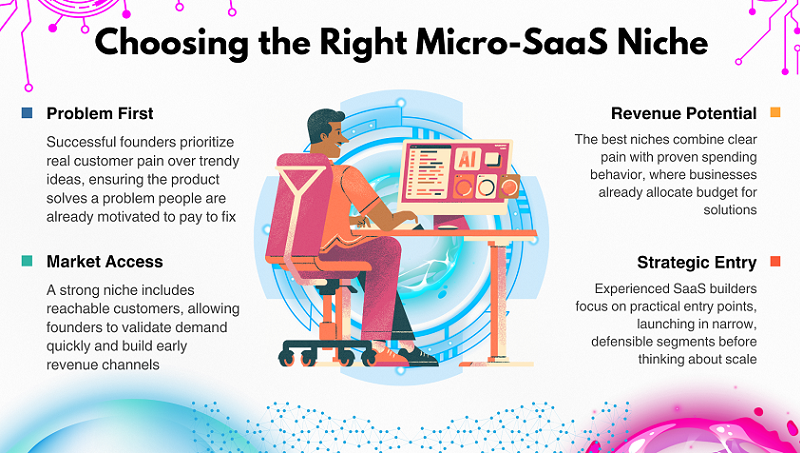
The right niche for a micro-SaaS isn’t one with a lot of users. It’s one with pain, money, and access to people who are already willing to pay. This is where most startups make a big mistake. They look for ideas, not problems. And they build a product without understanding who needs it or why.
Experienced SaaS founders act differently. They start not with features, but with context. Not with scaling, but with survivability. And not with the market, but with the entry point.
In this article, we’ll explore how those who achieve revenue and growth with micro-SaaS actually choose a niche. No theory, no motivational clichés, and no “magic formulas.” Just real patterns, mistakes, and solutions that separate a working SaaS from just another project in the “ideas” folder.
If you want to understand why some micro-SaaS survive while others disappear, you should read this article to the end.
1. Why Most Micro-SaaS Niches Fail Before the Product Is Built
Most micro-SaaS projects fail long before launch. Not because the product is bad, or because the code is weak. But because the founder failed to see that the niche was dead from the start. The main problem is that startups confuse a “good idea” with real demand.
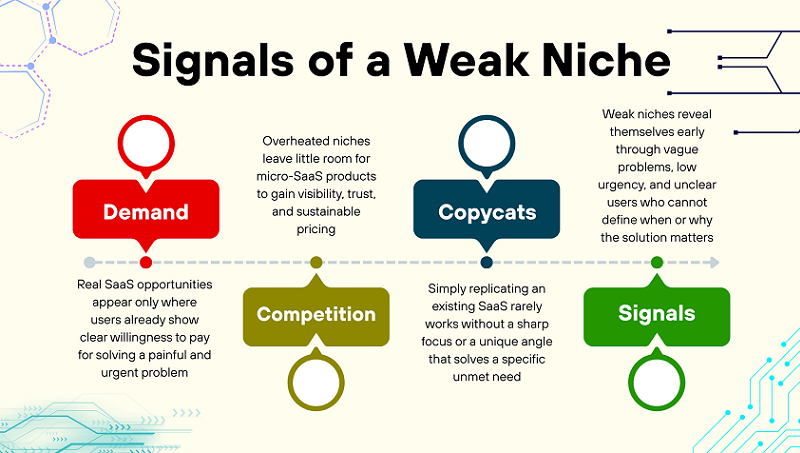
A niche may look attractive: there are competitors, people are discussing the problem, and similar threads are popping up on X.com or Reddit. But attention doesn’t mean money. Most niches generate only interest, not effective demand. This is critical for micro-SaaS, as it lacks a safety margin.
The second common mistake is when a newcomer enters an overheated niche, believing they can make a better SaaS product than others. In reality, crowded niches kill small SaaS projects faster than poor execution. Everything is already pre-determined: traffic, trust, and price expectations. A small product simply has no place to fit.
It’s even more dangerous when newcomers try to copy existing SaaS. They may think it’s logical that if the product is already working, there’s a market. But a micro-SaaS can’t survive on a copycat. Without a radical focus and angle of attack, you become just another invisible tool.
Strong founders learn to read the signals of a weak niche very early on. Low urgency, vaguely defined pain points, a lack of concrete use cases—all of this is visible even before the MVP. Ignoring these signals simply delays failure for months.
This pattern is not unique to micro-SaaS. The same dynamics appear across the broader SaaS ecosystem, including AI products. In fact, many founders repeat the same mistakes — weak demand, unclear positioning, and poor niche selection. A deeper explanation of why most AI SaaS startups fail and what the successful 10% do differently r
eveals the structural patterns behind sustainable SaaS growth.
The Illusion of Demand and the Danger of Overheated Niches
The most common trap is when founders mistake interest for demand. People may like an idea, express their thoughts on how engaging it is, and discuss it in the comments. But that doesn’t mean they’re willing to pay. Interest is worthless, yet payment always represents pain and urgency for them.
Overheated niches reinforce this illusion. When dozens of similar products are out there, it seems like the market is huge. In reality, this means the easy money has already been taken. What’s left are either customers with high expectations or those who pay mere pennies.
In such niches, micro-SaaS faces pressure from all sides. Users compare every detail. Price becomes the primary consideration. Features quickly depreciate. Support eats up time.
Micro-SaaS needs oxygen—a niche where a small product can be visible and useful. In overheated markets, this oxygen simply doesn’t exist.
Interest ≠ Willingness to Pay
The phrase “I’d use it” has no value. Willingness to pay manifests itself differently. People complain that current solutions don’t work as they need them to. They’re already wasting money or time. They’re looking for workarounds.
Real pain is always concrete. It sounds like: “We’re wasting time,” “This is costing us money,” “This is disrupting important processes in our business.” Such formulations can’t be confused with abstract interest.
Founders who know how to distinguish these signals save months of their lives. They build a product around pain, not curiosity. This is where the SaaS economy emerges.
Early Signs of a Weak Niche
A weak niche almost always reveals itself almost immediately. Users can’t clearly describe the problem. Their answers are very vague and lack any sense of urgency. Solutions are put off until later.
Another warning sign is when there’s no specific process or role behind the problem. If it’s unclear who exactly is suffering and when, selling will be extremely difficult.
If you hear a lot of “maybes,” “in theory,” and “someday,” you don’t have a market. It’s an idea without a future.
2. Starting With Pain, Not Market Size
One of the most harmful habits of micro SaaS product founders is to start with market size. TAM, SAM, and SOM look nice in spreadsheets, but they say almost nothing about the reality of micro-SaaS. A large market is no help if there’s no acute pain.
Small but painful problems will almost always win over large and vague ones. People pay not for scale, but for relief. If a problem is unpleasant, recurring, and impacts money or time, they pay for it.
Founders often misinterpret TAM. They look at the numbers and think the market is eager to see their product as quickly as possible. In reality, the market is indifferent. It responds only to pain, not to presentations.
The strongest micro-SaaS are built around problems that are already being paid for. This means the budget exists. They just need to offer a more precise or convenient solution.
The key factor is urgency. If a problem can be postponed, it won’t become a SaaS business. Boredom problems can be interesting, but they don’t convert well into money.
Why a small pain is better than a big market
A small but acute pain drives action. A big market without pain does not. People don’t buy SaaS for potential benefits; they buy to relieve discomfort.
Micro-SaaS doesn’t need a billion users. It needs, even if only in the initial launch phase, a group of people who are experiencing pain right now. This radically simplifies the product, marketing, and sales.
When pain is intense, users themselves help you refine the product. They provide quality feedback and are willing to test.
Misunderstandings of TAM
TAM isn’t a market, it’s an abstraction. Founders often substitute numbers for reality. They think that if the market is big, there’s bound to be a place for them.
But micro-SaaS doesn’t live in TAM, but in specific scenarios. In specific roles. In specific user days.
If you can’t describe when and why someone wants to pay for a subscription to your micro-SaaS, TAM is irrelevant.
Urgency as a Key Factor
Urgency is what turns a problem into a purchase. If a solution can be postponed, it is postponed. Always.
If something interferes with people’s work today, they are willing to pay for it. Not for something that “might be useful in the future.”
Micro-SaaS without urgency is doomed to be a perpetual side project.
3. Choosing a Niche You Can Actually Reach
Even the perfect pain is useless if you can’t reach the user. Distribution and access are more important than niche size. Micro-SaaS products disappear not because the market itself is bad, but because the founder doesn’t know where their customers live.
Each niche has its own acquisition cost. In some, users are accessible through communities, in others, only through expensive outbound marketing. For a small product, this is critical.
The best niches are those with existing ecosystems: platforms, marketplaces, communities, Slack groups, forums. You can integrate into them without huge budgets.
Trust is another factor. In some niches, trust is built quickly, in others, it takes years. Micro-SaaS can’t wait years.
Many markets are simply invisible to early founders. Not because they don’t exist, but because entering them requires context, experience, and reputation.
Why distribution is more important than niche size
A niche without an accessible channel is a trap. Even if the pain is severe, you won’t be able to scale without access.
A founder must understand where they will find the first 5, 10, 50, or 100 users. If there’s no response, the niche is premature.
Cost of Acquisition and Ecosystems
Different niches require different CACs. Some require content and SEO, while others require cold outreach.
Platforms and ecosystems reduce the cost of entry. Shopify, Notion, Slack, and WordPress aren’t just markets; they’re channels.
Micro-SaaS wins where it’s possible to tap into an existing user base.
Where trust is built faster
Trust builds faster in narrow professional niches. Specifics and experience are valued there.</p>
In mass markets, trust is expensive and slow to build. Micro-SaaS almost always loses there.
A good niche isn’t just a pain, it’s also an opportunity to quickly become “one of the guys.”
4. Niches Where Micro-SaaS Has a Real Advantage
When founders begin searching for a micro-SaaS niche, they often think in terms of ideas, features, or technologies. But in practice, a product’s success depends much more on the structure of the market itself. Some niches are inherently ideal for small SaaS teams, while others require resources that only large companies possess.
Micro-SaaS works best where the product solves a narrow, specific workflow. It may be a small part of a larger system, but if this part is used daily, it becomes critical to the user. These are the very tools that often go unnoticed by large players because they are too small for their scale.
Large SaaS companies love to build platforms. They add dozens of features, integrations, and complex systems. Micro-SaaS, on the other hand, excels through focus. It solves a single problem faster, more simply, and more cost-effectively.
Very often, the best SaaS niches are found in so-called “operational” markets—markets where people perform routine work every day. These include accounting, e-commerce operations, marketing processes, content management, reporting, and automation of internal tasks.
These markets may seem boring from the outside. But it’s precisely these “boring” markets that often prove to be the most profitable.
The reason is simple. When a tool saves a person time every day, it quickly becomes part of the workflow. And when a tool becomes part of the workflow, it’s almost impossible to replace.
This is a huge advantage for micro-SaaS. The product shouldn’t be revolutionary. It should be useful.
Another important factor is the possibility of founder-led sales. In a small SaaS business, the founder often communicates directly with the first customers. Therefore, niches where they can directly interact with users are much easier to launch.
If a niche requires a huge support team, complex implementation, or corporate integrations, micro-SaaS quickly begins to feel the pressure. Support
becomes expensive, development slows, and the product loses flexibility.
Therefore, smart founders look for smaller markets. They seek out markets where a small team can be faster, simpler, and more useful than a large player.
It’s precisely these niches that create sustainable SaaS businesses.
Workflow-Based Niches, Not Feature-Based
Most successful micro-SaaS products are built around specific workflows. They don’t try to become a platform. They solve a single problem within a larger system.
For example, Shopify is a huge platform. But around it, there are hundreds of smaller SaaS tools. Each solves a single, narrow problem: analytics, price optimization, review automation, inventory management.
These are workflow-based niches.
In such niches, users aren’t looking for universal solutions, but for tools that do one thing perfectly. The simpler and more accurately a product fits into the user’s workflow, the faster it becomes a familiar tool.
Feature-based markets work differently. There, companies constantly compete with the number of features. Each new product tries to add another feature, another integration, another module.
For micro-SaaS, this is a bad game.
A small team can’t compete on the number of features. But it can win with speed, focus, and simplicity.
Workflow products offer precisely this advantage.
If a product solves a specific step in a workflow, the user doesn’t care if it has fewer features. They care that the task is completed faster.
This is why many successful micro-SaaS products appear very simple. But behind this simplicity lies a deep understanding of the user’s workflow.
Why “boring” markets often prove to be the most profitable
Most founders seek out “interesting” markets. They want to work with new technologies, trends, and fast-growing industries.
But the paradox of SaaS is that the most stable products often emerge in the most boring niches.
Accounting, reporting, document management, process automation—none of these seem very exciting. But these markets share one important factor: constant demand.
When a problem arises every day, a tool that solves it becomes indispensable.
In these niches, users aren’t looking for entertainment. They’re looking for efficiency.
This means a product is evaluated not by its design or number of features, but by how much time it saves.
Another advantage of “boring” markets is lower competition.
Many startups avoid these niches because they don’t seem “innovative.” But for micro-SaaS, innovation is often unnecessary. Simply making an existing process faster, simpler, or cheaper is enough.
Such improvements may seem small, but they have enormous value for the user.
Why Small Teams Can Beat Big SaaS Companies
One of the most interesting features of the SaaS market is that small teams can successfully compete with large companies.
The reason is simple: large companies are slow.
They have complex decision-making processes, long development cycles, and large product teams. This makes them strong at scaling but weak at niche products.
Micro-SaaS operates on a different logic.
A small team can quickly test ideas, release updates quickly, and communicate directly with users.
This provides a huge advantage in niche markets.
When a founder communicates directly with customers, they understand real problems faster. They see which features are truly needed and which are not.
Large SaaS companies rarely have such closeness to their users.
As a result, a small product can be much more precisely tailored to a specific task.
And it is precisely this precision that often becomes a key competitive advantage
5. How to Know If a Niche Will Actually Pay
One of the most dangerous mistakes when choosing a niche is confusing user interest with their willingness to pay. Many ideas receive positive feedback early on, but that doesn’t necessarily mean they’ll become a real business.
In the SaaS world, money is the most honest signal.
Users may say a product is interesting. They may leave comments, like posts, or even sign up for a waitlist. But all these signals remain weak until people are ready to pull out a credit card.
That’s why experienced founders try to understand the economics of a niche before development begins.
The easiest way to do this is to look at existing tools. If there are already products in the niche, then there’s a problem. But it’s important to understand how much people are willing to pay for a solution.
Sometimes a niche can have a huge number of users but very low willingness to pay. This often happens in B2C markets or with products that are perceived as “nice-to-have” rather than essential.
On the other hand, a s
mall audience of professionals can pay much more.
This is why micro-SaaS often targets professional markets: marketers, developers, analysts, and store owners.
In such niches, the tool directly impacts revenue or operational efficiency, making it easier to pay for.
Another important signal is revenue density. Sometimes it’s better to have a thousand customers paying $30 than ten thousand users paying $2.
For a small SaaS team, high revenue density makes the business sustainable.
How to understand whether users are willing to pay
The easiest way to assess willingness to pay is to look at the current tools users are using.
If people are already paying for solutions to a problem, then the market exists. But it’s important to understand not only the payment itself, but also the pricing level.
How much do existing tools cost? What plans do competitors offer? Are there paid features, or is everything free?
These signals help us understand the economics of the niche.
Another useful indicator is user behavior. People often complain about existing products: they may be too expensive, too complex, or poorly adapted to a specific task.
These complaints create an opportunity for micro-SaaS.
If a product can solve the same problem more simply or cheaply, it has a chance to quickly occupy the niche.
But if users are accustomed to free tools, the situation becomes more complicated.
In such markets, convincing people to pay is much more difficult.
Why free users distort validation
Free users create one of the most dangerous signals for SaaS founders.
When a product is offered for free, people are often willing to try it. They may sign up, test the features, and even actively use the service.
But this doesn’t mean they’re willing to pay.
Many products receive thousands of signups but hardly convert users into paying customers.
The reason is simple: when the price is zero, the barrier to entry is also zero.
The user isn’t making an economic decision. They’re simply trying the tool.
Therefore, free activity often looks like success, even though it’s actually irrelevant to the business model.
Experienced SaaS founders understand this and try to test user payment behavior as early as possible.
Even a small price can change the picture dramatically.
Revenue density versus number of users
Many aspiring founders think that SaaS success depends on the number of users.
But for micro-SaaS, revenue density is much more important.
This refers to how much money one customer brings in.
If a product earns $5 per user, it needs thousands of customers to become a sustainable business. But if the average check is $40 or $50, the situation changes.
Even a few hundred customers can generate stable revenue.
This is especially important for small teams.
Fewer users means less support, lower infrastructure costs, and a simpler operating model.
This is why many successful micro-SaaS products focus on professional tools.
Professional users are willing to pay more if a tool saves them time or increases revenue.
6. Validating the Niche Before Writing Code
Once a niche appears promising and users are potentially willing to pay, the next question arises: does the problem actually exist in the way the founder envisions it?
This is where the validation stage begins.
Many founders skip this step. They’re confident in their idea and start writing code. But it’s at this stage that months or even years of wasted time can be avoided.
This is exactly why idea validation should happen before development starts. Many SaaS founders waste months building products for problems that don’t actually exist. If you’re still exploring potential directions, this Day 1 — Where to Find Great SaaS Ideas (and how to vet them) lesson explains practical ways to discover strong SaaS ideas and test them before writing a single line of code.
Niche validation isn’t just talking to users. It’s an attempt to understand people’s actual behavior, their workflows, and their willingness to change current tools.
Very often, a problem exists, but users have already found a way around it.
In this case, a new product may be unnecessary.
Another important aspect is understanding who exactly is buying the solution. In SaaS, the user and the buyer are often different people.
For example, a tool might be used by a marketer, but the decision to purchase is made by an executive.
If the founder doesn’t understand this dynamic, the product may be perfectly designed for the user, but will never be purchased.
Therefore, validation must test several things at once: the problem, the buyer, and the workflow.
When all these elements come together, a real opportunity for a SaaS product emerges.
How to Talk to Users Without Selling Your Product
Conversations with users are one of the most powerful validation tools. But many founders make a common mistake here: they start selling the idea.
When a founder talks about their product, users often respond politely. They say the idea sounds interesting and that they’d like to try such a tool.
But such responses rarely reflect reality.
It’s much more useful to talk about the problem rather than the product.
You need to ask how the user currently solves the problem, what tools they use, and how much time they spend on the process.
These questions help understand the user’s real behavior.
Sometimes the problem turns out to be less significant than it seemed. And sometimes, on the contrary, it turns out to be much deeper.
It’s these kinds of conversations that form the foundation for a strong SaaS product.
What exactly needs to be validated in a niche?
Niche validation consists of several levels.
The first level is the problem itself. Does it really exist? Does it occur regularly? How much does it impact the user experience?
The second level is the buyer.
Who makes the purchasing decision? What factors influence this decision? What does the tool selection process look like?
The third level is the workflow.
Where exactly will the product be used? How will it fit into the user’s current tools? What integrations might be needed?
If even one of these elements is inconsistent, the product may encounter difficulties.
Therefore, strong validation always tests the entire system, not just a single idea.
When to give up a niche
Sometimes the smartest move is to abandon an idea.
It sounds unpleasant, but it’s the ability to stop in time that separates experienced founders from beginners.
During validation, signs may emerge that a niche is weak.
Users don’t experience significant pain. They rarely encounter the problem. Or they already have simple solutions.
In such cases, continuing development becomes risky.
But many founders ignore these signs. They’ve already invested time and energy into the idea, so they continue working on the product.
This is called the “invested effort trap.”
Experienced SaaS founders see things differently.
If a niche doesn’t show strong signals, it’s better to abandon it early on.
Wasting a few weeks is much better than wasting a year of development.
Final Thoughts — The Right Micro-SaaS Niche Is a Strategic Decision, Not a Guess
Choosing a niche for micro-SaaS isn’t a matter of inspiration or a random idea. It’s a strategic decision that determines the fate of the product long before the first line of code is written.
Most founders start with an idea. They try to come up with something clever, interesting, or technologically advanced. But in reality, sustainable SaaS products don’t start with ideas—they start with problems.
The right niche is where there’s a real pain point, a consistent workflow, and people already looking for solutions. Without these three elements, even the most beautiful product will struggle to attract users.
Micro-SaaS is especially sensitive to niche selection. A small team doesn’t have the resources to compete in broad markets or wage protracted marketing campaigns. Therefore, success comes not from scale, but from precision.
The more precisely you select a user segment, the easier it is to build a product that truly meets their needs.
Strong SaaS founders don’t think about market size, but rather about the structure of the problem. They look for recurring tasks that arise in users’ workflows over and over again.
When a product becomes part of daily workflows, it transforms from a “cool tool” into essential infrastructure.
Another important factor is access to the audience. The niche must be not only profitable but also achievable. If the founder can’t find users, talk to them, and understand their workflows, the product will be built blindly.
That’s why choosing a niche isn’t a guess, but a consistent process of analysis.
It involves studying user pain points, understanding their current solutions, assessing their willingness to pay, and validating real workflows.
When all these elements come together, the foundation for a true SaaS business emerges.
At this point, the product ceases to be an experiment and begins to evolve into a system.
And it is precisely these systems that eventually become sustainable micro-SaaS companies.