

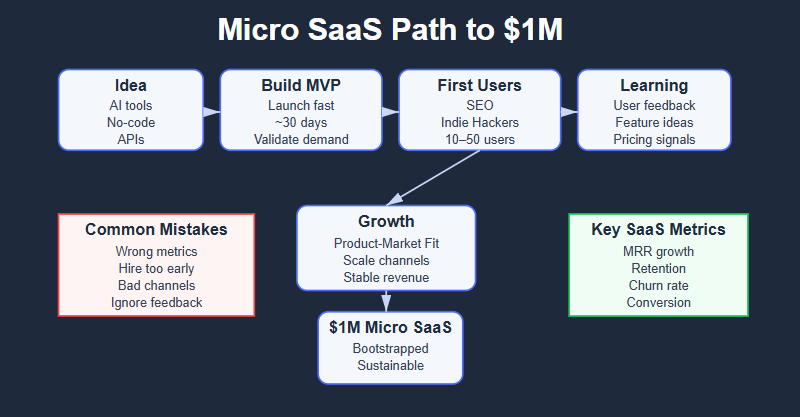
If you want to launch a micro SaaS today, it’s much more accessible than it was a few years ago. Thanks to no-code tools, AI, and ready-made APIs, many founders can create a SaaS product in just a few weeks. If you’ve already started building your micro SaaS startup, your goal is likely to quickly build a working MVP, test demand, and launch the product in about 30 days.
This approach allows you to avoid spending months on development and immediately understand whether the product is in demand. After launch, the most interesting stage usually begins. The first users come through early adopter communities, SEO, or platforms like Indie Hackers and Reddit. If the product truly solves a problem, you’ll be able to acquire your first 10-50 paying users and begin to see real signals of product-market fit. Even a small influx of paying users provides important data: what works, what features are needed, and what people are willing to pay for.
However, the path from first users to a $1M micro SaaS business is rarely straightforward. Many founders make the same mistakes: focusing on the wrong metrics, building a team too early, or choosing the wrong SaaS growth channels. These mistakes can slow product growth or even completely halt the project’s development. That’s why it’s important to understand the typical pitfalls SaaS founders face early on.
In this article, we’ll explore five common startup mistakes most often made by micro SaaS founders. Understanding these mistakes will help you move more quickly from idea to stable revenue and avoid wasting time and resources. If your goal is to build a sustainable bootstrapped SaaS and eventually reach $1M in revenue, this analysis will help you move more deliberately and confidently.
1. Focusing on Profit Too Early Instead of Customer Value in a Micro SaaS Launch
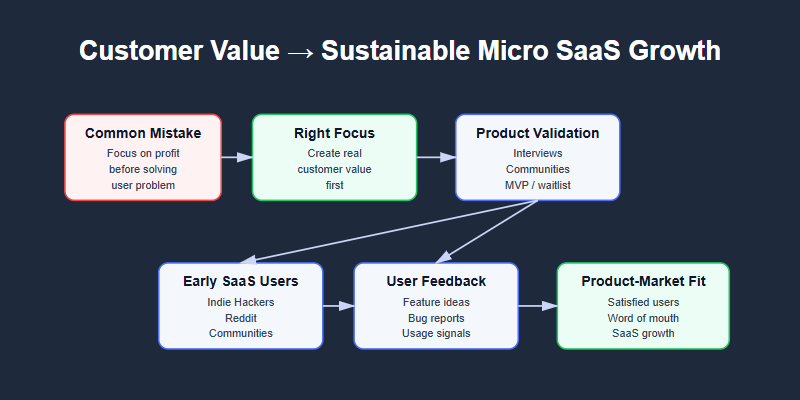
One of the most common mistakes in micro SaaS launches is focusing too early on profit. If you’re a newbie among bootstrapped SaaS founders, you may start thinking about revenue before the product actually solves a problem for users. As a result, the founder immediately tries to optimize the pricing strategy, even though the product itself hasn’t yet undergone full SaaS product validation.
In the early stages, profit is far more important than the value the user receives. If your product doesn’t address a specific pain point, no SaaS growth strategy will ensure long-term growth — understanding why 90% of AI SaaS startups fail can help you avoid these common pitfalls. This is why many successful products focus on customer experience first and then scale monetization.
This is especially important when trying to attract early SaaS users. Early users come not because of marketing, but because of the product’s true usefulness. They test the product, find bugs, and help determine the true product-market fit.
It’s also worth remembering that at the beginning of a SaaS journey, marketing channels don’t yet play a decisive role. Even if you drive a lot of traffic through SEO or community building, users won’t stick around if the product doesn’t solve a problem. Therefore, the right focus for any bootstrapped SaaS founder is to first create value for users and then optimize revenue.
This approach allows you to turn a small micro SaaS launch into a sustainable product that gradually grows and scales.
Why Customer Satisfaction Drives Long-Term SaaS Revenue and Sustainable SaaS Growth Strategy
The long-term growth of any SaaS product is directly dependent on user satisfaction. When a founder focuses on customer satisfaction, they lay the foundation for stable SaaS revenue growth. Users who receive real value stay with the product longer and increase customer lifetime value (LTV).
This is especially important for bootstrapped SaaS founders, as they typically don’t have a large marketing budget. In such circumstances, a positive user experience and recommendations become the main growth driver. Satisfied customers often bring in new early SaaS users through word of mouth.
When a product truly solves a user’s problem, any SaaS marketing channels become more effective. Therefore, focusing on customer value becomes a key part of a sustainable SaaS growth strategy.
Building a Micro SaaS Product That Solves a Real Problem Through Proper SaaS Product Validation
One common mistake is creating a product around an idea rather than a user problem. A successful micro SaaS product almost always starts with a specific pain point for its audience. This is why early SaaS product validation is so important.
You can validate your idea through user interviews, analysis of discussions in niche communities, or surveys. Try to think like a bootstrapped SaaS founder who finds ideas in discussions on Indie Hackers or Reddit. These platforms often reveal real problems that users want to solve.
Also effective is launching a simple MVP for a micro SaaS launch or a landing page describing the solution. If people start signing up for the waitlist, it’s a signal that the product has potential.
How Early User Feedback from Early SaaS Users Improves Product-Market Fit
Feedback from early users is one of the most valuable resources in the early stages. Early SaaS users help us understand which features are truly important for the product. Their comments and behavior provide real signals about the direction of development.
As you’ve already noticed, bootstrapped SaaS founders actively collect feedback through communities, forums, and private messages. Platforms like Indie Hackers, Slack communities, and Twitter help quickly obtain user feedback for SaaS product validation.
This approach accelerates product-market fit because the product develops based on real user needs. This results in a more effective SaaS growth strategy, based on data rather than assumptions.
2. Trying to Build a Team Before Validating Your Micro SaaS Idea
One common mistake in the early stages of a micro SaaS launch is trying to build a team right away. Some startup newbies think that developers, designers, and marketers are essential for launching a product. However, in reality, most successful bootstrapped SaaS founders who start a micro SaaS business without a team begin their journey alone.
In the early stages, the primary goal isn’t scaling the team, but rather validating the SaaS product before hiring developers or building a startup team. Until you’re convinced that the product truly needs the market, any investment in employees may be premature — following a structured guide on how to find great SaaS ideas and vet them can make this process much more reliable.
Furthermore, working alone allows for faster decision-making and experimentation. When a founder leads development themselves, they can quickly change the product’s direction based on early user feedback from indie hacker communities and SaaS founder forums.
Only after a stable stream of early SaaS users and the first paying customers emerges should it make sense to consider expanding the team. At this stage, it becomes clear what skills are needed for the product’s continued growth.
Therefore, for certain bootstrapped SaaS founders building profitable micro SaaS products, starting solo isn’t a limitation, but an advantage.
Why Many Micro SaaS Founders Start as Solo Builders
The smartest decision for successful bootstrapped SaaS founders was to begin working on their SaaS product without a team. This approach allows them to focus on the main task—validating their idea and launching a minimum viable product for a micro SaaS launch.
Working alone, the founder makes decisions faster and can quickly test different hypotheses. This is especially important during SaaS product validation with early SaaS user communities.
Furthermore, starting alone reduces financial risks. If the idea fails the market test, the founder only loses their time, not the entire team’s resources.
The Advantages of Bootstrapping a SaaS Startup Alone
Launching a bootstrapped SaaS startup without outside funding or a large development team has several important advantages. First of all, the founder has complete control over the product and development strategy.
This allows for faster product adaptation based on early user feedback and product-market fit signals from SaaS communities. Without a complex team structure, changes are implemented much more quickly.
Also, starting alone forces the founder to focus on the most important things: SaaS product validation, finding early SaaS users, and building a sustainable SaaS growth strategy. This focus often helps achieve initial results faster.
When It Actually Makes Sense to Hire Your First Team Member
Despite the advantages of starting solo, there comes a point when the product begins to grow. This typically occurs after the micro SaaS product begins generating recurring revenue and attracting consistent early SaaS users.
At this stage, the founder may face time and resource constraints. For example, product development, user support, and working with SaaS marketing channels for early-stage SaaS growth begin to require more effort.
This is when it makes sense to hire your first employee. This is best done after product-market fit has been confirmed and the micro SaaS business model with paying users has been validated.
3. Launching Too Fast Without Proper Product Validation
Speed is often considered an advantage in the world of micro SaaS launches and rapid startup experimentation. As a founder, you may want to release your product and start attracting users as quickly as possible. However, launching too quickly without validating your idea can result in a product that isn’t ready for real-world use.
A common problem is the lack of proper SaaS product validation before launching to real paying customers. If the founder hasn’t verified that the product solves a specific problem, even active promotion through SaaS marketing channels for early-stage startups won’t lead to sustainable growth.
Furthermore, launching too early often means the product is riddled with bugs. This can ruin the first impression of early SaaS users testing new micro SaaS tools and products. And in the early stages, it’s the early users who shape a product’s reputation.
It’s important to understand the difference between quickly launching a minimum viable product for micro SaaS launches and market testing and prematurely releasing a product that isn’t yet ready for use. In the first case, the founder is consciously testing the hypothesis, while in the second, they’re simply rushing to market.
For many bootstrapped SaaS founders building profitable micro SaaS businesses, the best approach is to first gather user feedback and then actively scale the product. This process helps gradually improve the service and develop a sustainable SaaS growth strategy based on real user behavior and feedback.
The Difference Between a Fast MVP Launch and a Premature Product Release
A fast launch of a minimum viable product for a micro SaaS launch and early market validation is common practice in the startup world. The main goal of an MVP is to test the idea and understand whether the product solves a real user problem.
However, a premature release differs in that the product is launched without proper SaaS product validation with real target users before launch. In this case, users encounter numerous problems and quickly lose interest.
The difference lies in the approach: an MVP is created for learning and testing, whereas a premature launch occurs without a clear understanding of product-market fit signals from early SaaS user communities.
Using Free Beta Access to Collect Early User Feedback
One of the most effective ways to improve a product is to offer free beta access to early SaaS users testing new micro SaaS tools. Free access helps attract early adopters who are willing to test the service and share their feedback.
These users often come from startup communities where early adopters discover new SaaS products. They actively report problems, suggest feature ideas, and help understand how the product is used in practice.
For bootstrapped SaaS founders, validating their micro SaaS ideas before monetization is especially valuable. Beta testing can significantly improve the product even before monetization begins.
Fixing Bugs and Improving Your SaaS Product Before Charging Users
Before introducing payment, it’s important to ensure the product is working smoothly. Fixing bugs and improving the interface helps create a better user experience for early adopters testing micro SaaS products.
If users encounter problems immediately after signing up, they rarely return. This can negatively impact early retention metrics for new SaaS startups launching MVP products.
Therefore, bootstrapped SaaS founders focus on improving product quality before launching paid SaaS plans. Once the service becomes stable and useful, users are much more likely to upgrade to the paid model.
4. Relying on Only One Distribution Channel for Growth
There’s a mistake SaaS founders make when launching their first micro SaaS product: relying solely on a single user acquisition channel. For example, some founders rely entirely on SEO, hoping that an organic search traffic strategy for early-stage SaaS startups will quickly generate customers. Others, on the contrary, rely solely on the community or social media.
However, in the early stages of product development, it’s important to test different SaaS marketing channels to find early users for a new micro SaaS product. This helps you understand where exactly your audience is and which traffic sources produce the best results. Different channels can attract different types of users, and this is especially important during the micro SaaS launch and early user acquisition experiments.
Furthermore, a single channel can be unstable. For example, search engine algorithms can change, and social media activity can decline. Therefore, successful bootstrapped SaaS founders use a combination of multiple traffic sources to build sustainable user acquisition strategies.
Another advantage of a multi-channel strategy is the ability to receive feedback more quickly. When users come from different sources, it becomes easier to understand which audience segments are most interested in the product. This helps improve your SaaS growth strategy based on real user behavior and traffic source data.
Therefore, for sustainable growth, it’s important not to limit yourself to a single channel. It’s much more effective to gradually test different user acquisition methods and build a diversified SaaS marketing channel strategy for long-term product growth.
Why Micro SaaS Marketing Requires Multiple Traffic Channels
Marketing for micro SaaS startups trying to find their first paying customers online rarely works effectively through a single traffic source. Early on, it’s important for founders to understand which user acquisition channels are truly bringing in interested users for bootstrapped SaaS founders with limited marketing budgets.
Using multiple channels allows for faster testing of hypotheses and finding the most effective ways to attract customers. For example, a combined content marketing strategy for micro SaaS founders building niche products and community activity can yield faster results.
Furthermore, a multi-channel strategy reduces risk. If one traffic source stops working, other SaaS marketing channels generating early users for new software products continue to attract users.
Using Communities Like Indie Hackers and Reddit to Find Early Users
Startup communities are often one of the first places to find early adopters interested in testing new micro SaaS tools and software products. Platforms like Indie Hackers or Reddit startup communities, where SaaS founders share product launches and feedback, allow for direct interaction with the audience.
First and foremost, SaaS founders promote micro SaaS launches in online startup communities and attract early users through these platforms. People in these communities are actively interested in new tools and are willing to test products early on.
Furthermore, discussions in such communities help obtain valuable early user feedback for SaaS product validation and feature improvements. This makes communities an important part of the early growth strategy.
Combining SEO, Communities, and Direct Outreach for SaaS Growth
One of the most effective approaches is combining multiple user acquisition channels. For example, bootstrapped SaaS founders combine an SEO content strategy with community-driven product promotion to generate a steady stream of early users.
SEO helps attract organic traffic from people searching for solutions to specific niche problems online. At the same time, communities and social media allow you to quickly find early SaaS users interested in discovering new productivity tools.
A direct outreach strategy for SaaS founders connecting with potential early adopters can also be useful. This combined approach helps build a sustainable SaaS growth strategy using multiple marketing channels for user acquisition.
5. Selling Features Instead of Communicating Real User Benefits
Another common mistake among bootstrapped SaaS founders launching their first micro SaaS product is trying to sell technical features instead of the product’s true value. Founders often describe in detail the technologies used within the service, the APIs connected, and the algorithms running within the system. However, most users aren’t interested in the technical details of how a micro SaaS product is technically built behind the scenes.
Potential customers are much more concerned with the outcome. They want to understand how a micro SaaS tool helps them solve a specific business problem faster and easier. If the user doesn’t see clear benefit, even the most advanced functionality won’t seem valuable.
Therefore, effective SaaS marketing is built around a clear value proposition explaining how the product improves productivity or saves time. Users should immediately understand what problem the product solves and why they should start using it.
This is especially important during a micro SaaS launch, when early users evaluate whether the tool is worth trying. At this point, the founder needs to explain not the features, but the results: time savings, task automation, or cost reduction.
Remember that every feature should be translated into user benefit. This approach significantly improves conversion and makes a SaaS growth strategy focused on communicating real customer value much more effective.
Why Users Care About Outcomes, Not Product Features
When users search for a new tool, they rarely think about features. They are much more likely to look for software tools that help solve repetitive tasks and automate daily business workflows. This is why describing the outcome works better than listing product features.
For bootstrapped SaaS founders promoting micro SaaS tools to busy professionals and entrepreneurs, it’s important to immediately demonstrate the end benefit. Users should quickly understand how the product will improve their work or save time.
If communication is built around clear outcomes, such as saving hours of manual work or simplifying complex tasks, users are more likely to decide to try the service. This approach significantly increases marketing effectiveness.
Turning Technical SaaS Features Into Clear Customer Benefits
Technical features alone rarely sell a product. For example, API integration or complex algorithms may sound impressive, but it’s more important for users to understand how those technical SaaS features translate into real, everyday productivity benefits.
Therefore, SaaS founders explain complex product functionality in simple, user-focused language and try to translate each feature into a concrete benefit. For example, process automation can be described as automatically completing repetitive tasks that would normally take hours of manual work.
When features are transformed into clear benefits, users more easily see the product’s value. This helps improve conversion rates for micro SaaS landing pages targeting specific niche audiences.
Showing How Your Micro SaaS Saves Time, Money, or Effort
The most powerful argument in marketing is a concrete benefit. Users quickly respond to micro SaaS tools that help save time, reduce operational costs, or eliminate repetitive manual tasks.
Therefore, startup founders demonstrate real use cases for their niche SaaS products by showing practical use cases. For example, how a product automates time-consuming workflows for freelancers, founders, or small online businesses.
When users see real-world examples of how a micro SaaS tool improves efficiency and reduces workload, the product’s value becomes clear. This significantly simplifies new user acquisition and strengthens a long-term SaaS growth strategy based on clear product value.
FAQ Section
What is the golden ratio for SaaS?
The “golden ratio” in SaaS typically refers to a metric that measures a company’s growth performance. It most often refers to the balance between customer acquisition costs and revenue growth. If a company spends too much on marketing and sales, growth can be unsustainable. This is why many founders analyze how to calculate the SaaS golden ratio for sustainable revenue growth and efficient customer acquisition. This approach helps understand how effectively a business converts investments into revenue growth.
Is 1% equity in a startup good?
A 1% stake in a startup can be very valuable or practically worthless, depending on the company’s future growth. If a startup becomes successful and scales, even a small stake can generate significant profits. However, in the early stages, it’s important to understand a person’s role in the project and their contribution to product development. Many founders discuss such issues when developing an equity distribution strategy for early-stage startup teams and bootstrapped SaaS founders. Therefore, the value of a stake should always be assessed in the context of the company’s potential.
What are some common mistakes startups make?
Startups often make similar mistakes early on. These include failing to truly validate their idea, choosing the wrong user acquisition channels, and focusing too early on scaling. Some founders also try to build a product without understanding the audience’s needs. Therefore, it’s crucial to study the most common mistakes first-time founders make when launching a micro SaaS startup. Understanding these mistakes can significantly increase the chances of a successful launch.
What kills most startups?
Most startups fail not because of technology, but because of a lack of demand. If the product doesn’t solve a real user problem, even a strong team and good funding won’t help. Other reasons include an inappropriate growth strategy, a lack of resources, and product issues. Research often shows that the key factors in startup failure are lack of product-market fit and poor customer validation. This is why validating the idea and working with users is critical.
How many startups fail in 5 years?
Statistics show that a significant portion of startups fail in the first few years of operation. According to various estimates, approximately half of new companies fail within five years. The main reasons are lack of demand, financial problems, and an inappropriate development strategy. Therefore, as a founder, it’s important to first study startup failure rate statistics and the reasons why most early-stage startups fail within five years. This data helps you better understand the risks and build a more sustainable growth strategy.
Final Thoughts
Building a micro SaaS may seem like a relatively simple process, especially today with the availability of AI tools, no-code solutions, and ready-made APIs. However, even with this accessibility, many projects face the same challenges. Founders think about scaling too early, build a team without validating their idea, or focus on technical features instead of user value. As a result, the product can enter the market without a clear understanding of audience needs.
The key lesson for any founder is that a successful SaaS starts not with the technology, but with the user’s problem. The sooner you identify a real pain point for the audience and validate demand, the higher the chance of building a sustainable product. Therefore, the most important step remains testing the idea, communicating with early users, and gradually improving the product based on feedback.
It’s also important to remember that growth in a SaaS project rarely happens overnight. Most successful products start with a small audience and gradually attract their first paying users. It is these early users who help determine the direction the product should take.
If you can avoid the common mistakes described in this article, your path to a stable SaaS business will become much more predictable. Gradual development, working with feedback, and focusing on the product’s true value create the foundation for long-term growth. Over time, this approach can transform a small micro SaaS project into a sustainable and profitable business.