

You’re a young and ambitious startup and you’ve decided to launch your own micro SaaS. Within the first month, you’ve already attracted your first users, who are actually using the product and paying for it. This isn’t just luck—it’s a sign that you’ve tapped into a real pain point for your audience. Now comes the fun part: growth, which can either be systemized or lost due to poor decisions. It’s at this stage that tips to scale a SaaS business becomes especially relevant, because simple growth doesn’t mean the business is ready for scaling.
Here’s what a real growth trajectory might look like:
Month 1 — 50 users
Month 2 — 120 users
Month 3 — 280 users
Month 4 — 600 users
Month 5 — 1,000 users
Month 6 — 1,400 users
Month 7 — 1,700 users
Month 8 — 2,000+ users
With each passing month, it becomes clear that growth isn’t random. Repeatable channels, clear user behavior patterns, and the first stable sources of revenue emerge. By the time you reach 1,500–2,000 users, the product is already capable of generating around $150,000–$200,000 MRR. But this result isn’t the result of large investments or a team of dozens of people.
Midway through this journey, many people begin actively searching for real tips to scale a SaaS business because they encounter their first limitations. Growth slows, conversions begin to decline, and acquiring new users becomes more expensive. This is the moment when it becomes clear: chaotic actions no longer work.
It’s important to understand that such growth is never perfectly smooth. Within each stage, there are dips, failed hypotheses, and mistakes. Some channels stop working, users churn, and new features don’t produce the expected effect. But it’s precisely by analyzing these moments that you can build a system.
Over time, growth ceases to be a set of random actions. It becomes a controlled process, where every decision is based on data and audience insight. As a result, the product begins to grow not faster, but smarter.
This article will show you how to transition from such chaotic growth to systemic scaling. You’ll see which mistakes most often hinder SaaS products. And most importantly, you’ll understand which actions truly lead to stable growth and allow you to outpace competitors.
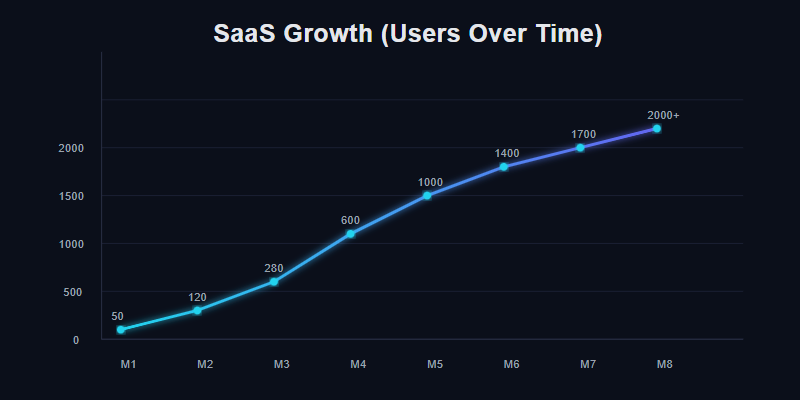
This trajectory highlights how SaaS products grow from initial traction to sustainable scale by identifying patterns, optimizing retention, and refining acquisition strategies
1. Why Most SaaS Products Fail to Scale Despite Early Growth
The early growth of a SaaS product often creates the illusion that everything is working perfectly. Users arrive, the first revenue comes in, and it seems like scaling is just the next step. But it’s at this stage that mistakes are made that later hinder development. Without understanding the reasons for growth, it’s impossible to replicate it at the next level.
One of the key problems is attempting to scale a product that hasn’t yet been fully validated. Without a clear product-market fit, any effort only exacerbates weaknesses. This is clearly seen in scenarios about how to scale a SaaS product without clear product-market fit validation, where growth quickly gives way to stagnation.
Another mistake is trying to sell to everyone. This approach produces quick results at the start, but doesn’t build a sustainable customer base. As a result, the product doesn’t gain a foothold in any one segment, and conversions begin to decline.
It’s important to understand the difference between growth and scaling. Growth can be “pushed” through effort—more advertising, more outreach, more activity. Scaling requires precision and repeatability. Without this, each new user becomes increasingly expensive.
SaaS products often become overly complex too early. New features are added, the team expands, and dozens of channels are tested. As a result, focus is lost and costs increase.
Product economics also plays a key role. Without understanding LTV, CAC, and unit metrics, it’s impossible to make strategic decisions. This is especially critical in building scalable SaaS businesses with sustainable unit economics and predictable revenue growth, where every mistake directly impacts profit.
User behavior analysis is also undervalued. Without it, it’s impossible to understand which actions lead to retention and which lead to churn. This deprives the product of the opportunity to improve based on real data.
Another common problem is reliance on a single acquisition channel. While it’s working, everything seems under control. But as soon as its effectiveness declines, growth stalls. Audience segmentation is often ignored. All users are treated as a single entity, which reduces the effectiveness of marketing and the product. As a result, opportunities for targeted growth are lost.
It’s also important to consider the timing of your launch. Even a good product may not scale if the timing isn’t right. This impacts growth rate and competition.
Mistakes at this stage are rarely immediately apparent. They accumulate gradually and only become apparent when growth begins to slow. At that point, correcting them becomes more difficult.
Therefore, it’s important to build processes in advance. Analytics, segmentation, and metric monitoring should be part of the strategy from the very beginning. This reduces risks and makes growth more manageable.
Focusing on one specific audience yields much more than trying to reach everyone. It allows for a deeper understanding of needs and the creation of a more valuable product.
Ultimately, it becomes clear: early growth is just the beginning. True scaling requires discipline and precision. This is what distinguishes successful SaaS products from those that remain at the level of their initial successes.
The key factor is not speed, but the ability to repeat results. This is what turns growth into a sustainable system.
The Hidden Cost of Scaling Too Early Without Product-Market Fit
Early scaling often seems like a logical step after initial success, but this is where the fundamental mistake lies. When a product hasn’t yet established itself in the market, growth begins to amplify weaknesses rather than strengths. Users come but don’t stay, leading to unstable momentum. Ultimately, the illusion of progress is created, concealing high churn. This scenario aptly describes premature SaaS scaling without product-market fit validation.
At this stage, money begins to be spent faster than real value is created. Acquiring new users becomes expensive, and retention becomes weak. This destroys the product’s economics before it has a chance to take shape. Even a good product can “break” under the pressure of too-rapid growth.
Teams often begin adding new features in an attempt to compensate for low engagement. But this only complicates the product and dilutes its core value. Instead of focus, development becomes chaotic.
Here, the key isn’t speed, but the moment when scaling is truly justified. First, you need to achieve stable retention and clear value. Only then will growth begin to pay off.
Why Broad Targeting Kills Focus and Slows Down SaaS Expansion
Trying to sell a product to everyone seems like a quick way to increase your user base. In practice, this leads to blurred positioning and weak conversions. Different audience segments have different expectations, and the product can’t meet all needs equally well. As a result, clarity in communication and value is lost.
This approach turns into the classic scattergun SaaS marketing approach of targeting an overly broad audience without clear segmentation. Users come but don’t understand why they need the product. This reduces engagement and increases churn.
Without focus, it becomes difficult to build marketing and product. Each new hypothesis requires more resources but yields fewer results. The team begins to spread itself thin, instead of strengthening what’s already working.
Strong growth begins with a clear understanding of your audience. When a product solves a specific problem for a specific segment, conversions increase naturally. This creates the foundation for scaling, as explained in 90% of AI SaaS Startups Fail, but the 10% Follow This Formula.
This approach is the foundation of Tips to Scale a SaaS Business, where narrow specialization yields more than trying to cover the entire market.
The Difference Between Growth Momentum and True Scalability in SaaS
Growth and scaling are often perceived as the same thing, but there is a fundamental difference. Growth can occur through effort—more advertising, more sales, more activity. Scaling requires consistency and repeatability of results. Without this, each new stage becomes more difficult and expensive.
When growth is not supported by a system, it quickly loses momentum. Channels stop working, acquisition costs rise, and revenue fails to keep up with expenses. This is a sign that the model is not ready for scalability. This scenario is described by the difference between SaaS growth and scalable revenue systems with repeatable acquisition channels.
True scaling begins when processes are repeatable. You understand which actions lead to results and can repeat them. This reduces risks and makes growth more predictable. It also gives you control over the economy. You know how much it costs to acquire a customer and how much they bring in. This allows you to make more accurate decisions.
And here the key is shifting from efforts to systems. This is what transforms growth into a sustainable model capable of scaling without losing efficiency.
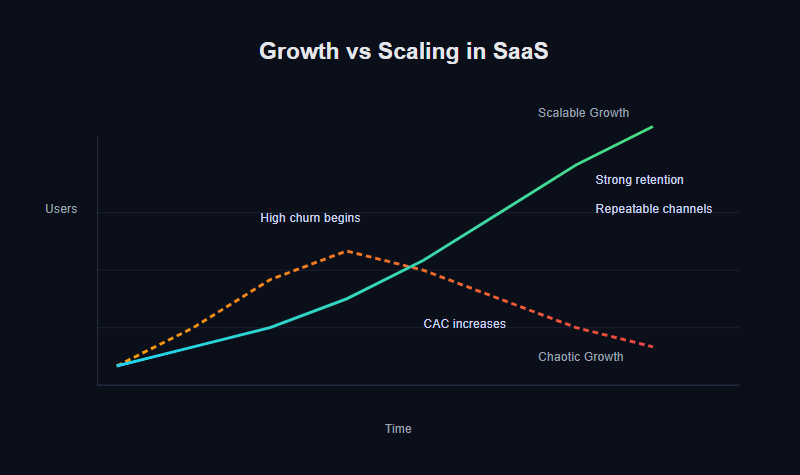
This trajectory highlights how SaaS products grow from initial traction to sustainable scale by identifying patterns, optimizing retention, and refining acquisition strategies
2. Building a Lean SaaS Growth Engine Without Big Teams or Capital
Scaling SaaS doesn’t require large teams or initial investment. Much more important is a clear structure of operations and a focus on key metrics. When a product solves a specific problem, growth becomes more manageable. With this approach, each new user strengthens the system rather than creating a burden.
The Lean model is built around efficiency, not scale. Minimal resources are directed where they yield the greatest results. This allows for faster testing of hypotheses and elimination of unnecessary components. As a result, the product develops without overloading processes.
Cost control is especially important. When the team is small, every decision impacts the overall result. This fosters discipline and helps avoid chaotic actions. This approach is often described as “how to build a lean SaaS growth engine without external funding or large team resources.”
Speed of implementing changes is also important. Without a complex structure, you can adapt to the market more quickly. This gives you an advantage over larger competitors.
Growth in such conditions is built on repeatable actions. If one channel is working, it is strengthened rather than replaced by a new one. This creates a stable foundation for scaling.
The connection between the product and the user is further strengthened. There are no unnecessary layers that distort feedback. This accelerates product improvement.
The economy becomes transparent. Revenue and expenses are easily tracked, simplifying decision-making. This approach is often used in bootstrapped SaaS scaling strategies with minimal resources and maximum capital efficiency.
The result is a system where growth does not require constant increases in costs. This is the foundation of lean SaaS.
How Solo Founders Can Scale Micro SaaS Products Efficiently
One person is quite capable of building a scalable SaaS product. Everything depends on the right selection of tasks and priorities. Focus shifts to key features that deliver value to the user. This prevents spreading yourself too thin and allows for faster results.
Work is built around automation. Repetitive processes are simplified or eliminated entirely. This frees up time for product development. This approach is typical for solo founders of micro SaaS scaling with lean execution and automation systems.
It’s also important to choose simple and straightforward solutions. The fewer complexities in a product, the easier it is to maintain. This reduces the workload and accelerates growth.
One key factor is speed. Decisions are made quickly, without lengthy approvals. This provides flexibility and the opportunity to test more hypotheses.
As a result, the product develops without unnecessary bureaucracy. This provides a significant advantage in the early stages.
Creating a Self-Sustaining Revenue Model That Funds Its Own Growth
A self-funding model allows for growth without external investment. Revenue from the product is reinvested in its development. This makes the business more sustainable.
This approach requires control over metrics. It’s important to understand which actions generate revenue and which don’t. This helps allocate resources more effectively.
The primary focus is on user retention. The longer a customer stays, the more revenue they generate. This reduces dependence on constantly acquiring new users.
It’s also important to develop a clear pricing model. Users must see value and be willing to pay for it. This enhances monetization.
This strategy is often described as a self-funded SaaS growth model driven by recurring revenue and reinvestment strategy. It allows for gradual but steady growth.
Ultimately, the business begins to finance itself. This gives greater freedom in decision-making.
From 50 to 2,000 Users: A Simple SaaS Growth Curve Breakdown
SaaS growth rarely occurs in leaps and bounds. It typically involves gradual user base buildup. It all starts with the first dozen customers who actively use the product. This is the perfect moment for testing your first SaaS ideas and validating which problems truly resonate with your audience.
Growth then accelerates through repeatable channels. Stable traffic sources emerge. This allows the user base to grow without significant investment.
At the 500-1,000 user stage, retention plays a significant role. If the product fails to retain customers, growth slows. This is a critical point for most SaaS.
After 1,000 users, economies of scale emerge. New users arrive faster through recommendations and recognition. This accelerates growth dynamics.
This scenario is often described through SaaS user growth stages from early traction to scalable recurring revenue milestones. It demonstrates the importance of monitoring each stage.
As a result, the journey from 50 to 2,000 users becomes a manageable process rather than a random one.
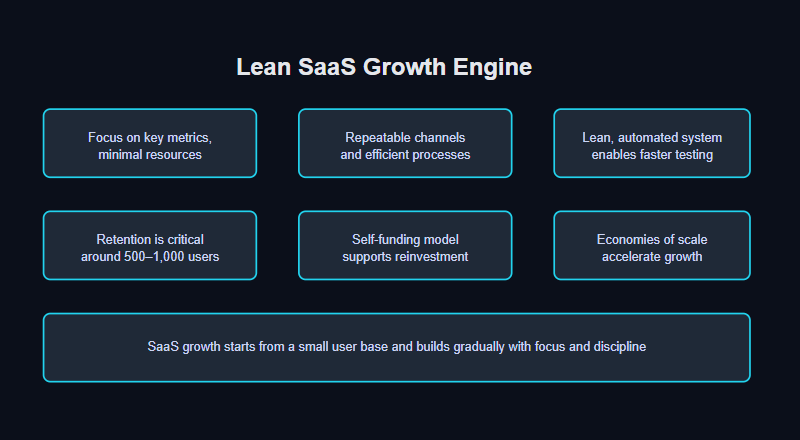
This diagram illustrates how a lean SaaS growth engine builds sustainable momentum, emphasizing retention, repeatable channels, and disciplined reinvestment for scalable success
3. Market Focus and Segmentation as the Core of Scalable SaaS Growth
SaaS product growth directly depends on how accurately you define your market and audience. Without a clear focus, the product begins to lose clarity, and its value becomes blurred for the user. As a result, marketing fails to hit its target, and conversions gradually decline.
Segmentation allows you to bring order to this chaos and build a more precise growth strategy. When you understand who exactly the product is being created for, it becomes easier to communicate its value. Messages become concrete, not abstract, and this immediately impacts results.
This allows you to target not just anyone, but those who truly need the product. These are the users who generate the highest engagement and long-term revenue. This creates a stable foundation on which to build scalability.
This logic is clearly demonstrated in “How to Identify Ideal Customer Segments for SaaS Growth and Improve Conversion Rates Effectively.”
Additionally, the SaaS market segmentation strategy for scalable growth and predictable revenue expansion enhances the results.
Focus and segmentation transform chaotic growth into a manageable system.
Why Selling to Everyone Leads to Plateaued Growth
Trying to sell a product to everyone at the start can generate a rapid influx of users. However, over time, it becomes apparent that these customers convert poorly and quickly churn. This is because the product cannot equally effectively address the needs of different segments.
Without clear positioning, users don’t understand the problem the product solves. This reduces trust and makes the purchase decision less clear. As a result, even with increased traffic, revenue doesn’t increase proportionally.
Customers who aren’t initially suited to the product emerge, increasing churn. The team spends resources supporting the wrong audience instead of developing strong segments.
This scenario is often described as broad SaaS targeting without a clear niche, leading to low conversion and poor retention rates. As a result, growth hits a ceiling that’s difficult to break without a change in strategy.
Using Customer Segmentation to Unlock Predictable Revenue Streams
Segmentation allows you to see which user groups bring the most value to your product. This allows you to focus on those who are truly willing to pay and stay long-term. A one-size-fits-all approach replaces targeted work with specific segments.
Each segment receives its own message, offers, and user journey. This makes communication more relevant and increases conversion at all stages. Users begin to understand the product’s value and make decisions more quickly.
Product development is also simplified, as clear guidelines emerge. Features are created for specific tasks, not just “just in case.”
This approach is well-suited for customer segmentation in SaaS to improve retention and increase the lifetime value of users.
As a result, revenue becomes more stable and predictable.
Finding the Right Market Timing and Entry Strategy for Faster Adoption
Even a strong product can fail if the market launch timing is incorrect. Users may simply not be ready for a new solution, even if it’s objectively better. Therefore, it’s important to consider not only the product itself but also the context in which it’s being launched.
Demand signals can be seen in audience behavior, trends, and industry changes. When a problem becomes widespread, the solution begins to spread significantly faster. This creates the effect of accelerated growth without additional pressure on marketing.
Positioning also plays a key role in launch timing. How you communicate the value of your product influences the speed of user adoption.
When you choose timing and strategy correctly, your product grows significantly faster and more sustainably.
4. Strategic Execution: Building a Defensible SaaS Business That Scales
Strong SaaS growth is impossible without a well-thought-out execution strategy. The idea and product kick-start the business, but it’s execution that determines whether the business can sustain itself. Without well-established processes, even a good product begins to lose ground as it grows.
Scaling requires not only user acquisition but also control over the business. Without an understanding of key metrics, growth can appear positive but be unprofitable internally. This is especially noticeable when expenses grow faster than revenue.
Stable SaaS companies are built on systemic solutions, not on one-off successes. Each stage of growth must be supported by clear logic and repeatable actions. This is what allows you not only to grow, but to establish yourself in the market.
The result is a business that is difficult to copy and easy to scale.
Understanding Unit Economics Before Scaling Revenue Operations
Before scaling, it’s important to clearly understand the product’s unit economics. Without this, growth can lead to increased losses instead of profits. Metrics like LTV and CAC show how effectively the model is working.
If the cost of acquisition is too high, scaling will only exacerbate the problem. Even with user growth, the business may remain in the red. Therefore, it’s important to see the true picture of revenue and expenses.
When unit economics are transparent, decisions are made more accurately and quickly. It becomes clear which channels are working and which need to be shut down.
This is what allows you to build growth that generates revenue, not just user numbers.
Following Customer Workflows Instead of Chasing Brand Names
Focusing on high-profile customers often distracts a product from its true value. Brands can attract attention, but they don’t always generate sustainable growth. It’s far more important to understand how a product is used in real-world scenarios.
When a product is integrated into a user’s daily processes, it becomes indispensable. This increases retention and reduces the likelihood of churn. Growth begins to come from value, not marketing.
Working with real-world use cases helps improve the product faster. Each improvement is based on concrete user experiences.
This creates a more solid foundation for scaling than chasing brand names.
Creating a Competitive Moat in B2B SaaS Through Product and Positioning
Competition in SaaS intensifies as the market grows. Products with similar features appear quickly, making it difficult to stand out. In this environment, those who build a defense around their product win.
Moat is formed not only through technology but also through positioning. A clear understanding of your niche makes your product more recognizable. Users begin to associate the solution with a specific task.
Integration and the ecosystem surrounding the product further enhance defense. The more deeply a product is integrated into the customer’s processes, the more difficult it is to replace.
As a result, businesses gain a long-term advantage and resilience to competition.
FAQ Section
What does it mean to scale a SaaS business?
Scaling a SaaS business is the process of increasing revenue without a proportional increase in costs. This is typically achieved through automation, marketing optimization, and product improvement. The main goal is to grow the user base and revenue while maintaining efficiency.
When should a SaaS startup start scaling?
Scaling should begin when the product has reached product-market fit and there is a stable flow of customers. It’s important that metrics (LTV, CAC, retention) are predictable. Without this, growth can lead to losses.
Can a micro SaaS really scale to high revenue?
Yes, micro SaaS can generate significant profits with the right niche and strategy. Narrow specialization often provides a competitive advantage. The key is to focus on value for a specific audience.
What are the biggest mistakes when scaling SaaS?
One of the biggest mistakes is premature scaling without a sustainable business model. Many teams often ignore unit economics and overestimate demand. Inappropriate hiring and a lack of a clear growth strategy can also slow down development.
How do you compete with bigger SaaS companies?
Small SaaS companies can benefit from flexibility and narrow specialization. Quickly adapting to customer needs is their key advantage. Building a strong brand and developing high-quality user support are also important.
Final Thoughts
Scaling a SaaS business is a complex but highly promising stage of company development. It’s crucial not just to grow, but to do so systematically and in a controlled manner. Successful companies always rely on data and metrics, not intuition. A deep understanding of their audience allows them to identify new growth points and strengthen their product. Flexibility and speed of decision-making become key competitive advantages.
To stay ahead of the competition, it’s essential to constantly test hypotheses and implement improvements. Even small changes to the product or marketing can yield significant results. Investing in process automation and scalable infrastructure is also crucial. This allows for growth without dramatically increasing costs and maintaining profitability.
Building a strong brand that inspires trust among customers is also crucial. A high-quality customer experience directly impacts retention and referrals. In the long run, companies that balance growth and sustainability win. Ultimately, SaaS success depends on the ability to adapt to market changes and exceed user expectations.