
why-most-ai-products-fail

Why Most AI Products Fail Before Reaching Real Users

Today, creating an AI product is technically easier than ever. Models are readily available, no-code tools lower the barrier to entry, and examples of successful launches are constantly appearing in the news feed. But the paradox is that most AI products never reach real users. They don’t fail because of bad code or a weak model—they fail much earlier.

Most often, the problem lies in the founder’s mindset and how they understand the word “product.” Many launch a demo, wrap it in a beautiful interface, and call it a service. The first tests go well, friends say “wow,” but then something goes wrong. Users don’t return, the scenarios break, and any improvements turn into chaotic prompt edits. It feels like “the AI is acting weird,” when in fact, it’s the system itself that’s acting weird.

In this article, we’ll explore why AI products don’t reach the point of real use, where exactly they break down, and what mistakes are repeated over and over again. Without technical jargon, we’ll use product logic.

This article isn’t about models or tools. It’s about why good ideas don’t become products, and how to distinguish a temporary demo from a trustworthy system.

If you’re building an AI service, micro-SaaS, or a no-code product, you’ll almost certainly recognize yourself here. And that’s good: it means the problem can still be fixed.
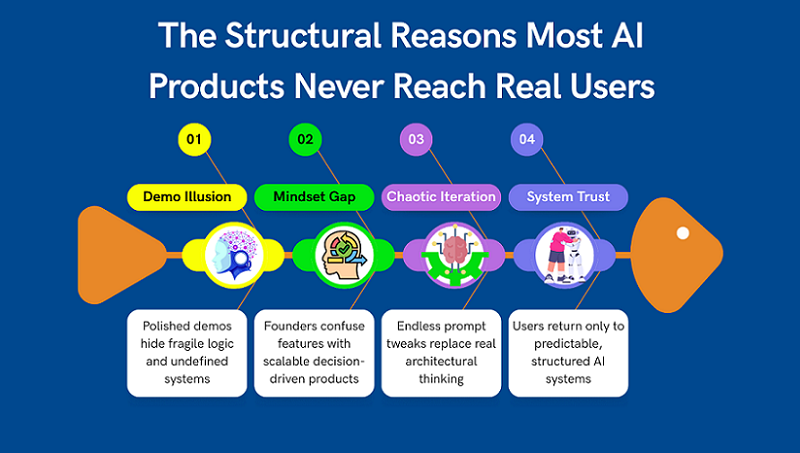
1. Mistaking a Demo for a Product

Most AI projects fail not at the scaling stage, but much earlier—when a demo is mistaken for a product. A demo demonstrates what the model can do, but the product is responsible for delivering consistent user experiences. These are fundamentally different things, yet they are often confused.

In a demo, everything works under ideal conditions: one scenario, one type of request, minimal context. In reality, users act chaotically, ask questions incorrectly, and expect predictable results.

When there’s no system in place, any deviation from the “ideal case” begins to break the product. And instead of scaling, the founder begins endlessly fixing prompts.

The problem is compounded by the fact that a demo is easy to sell to oneself. It looks smart, provides attractive answers, and creates the illusion of readiness. But it’s precisely this illusion that most often kills a product.

In this section, we’ll explore the line between a demo and a product and why it’s so important to recognize it as early as possible.

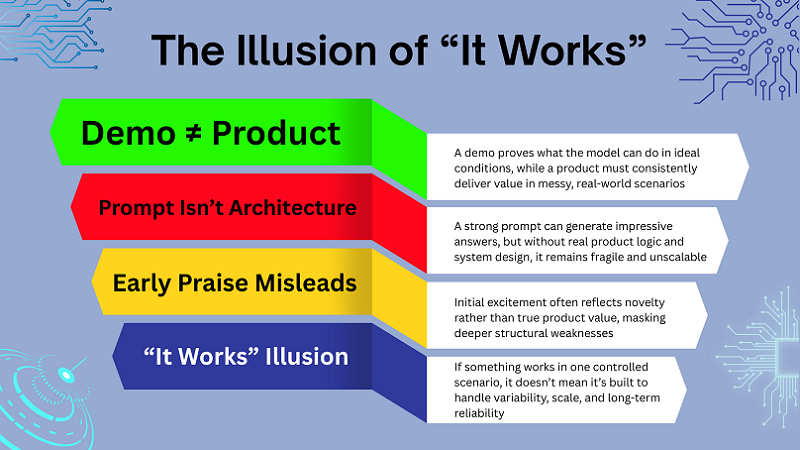
A Prompt Is Not a Product

One of the most common mistakes is thinking that a good prompt is already a product. Yes, a well-thought-out prompt can provide impressive answers, especially at the start. But at its core, it’s just an instruction for a model, not product logic.

A prompt doesn’t make decisions, doesn’t manage context, and doesn’t understand the user’s goal. It simply reacts to input. As soon as the scenario becomes more complex, the prompt begins to crumble.

A real product knows what it does, why it does it, and what state the user is in. If everything rests on one big prompt, the system becomes fragile and unpredictable. This is why products built solely on prompts don’t scale well and require constant manual intervention. This isn’t architecture—it’s a temporary construct.

Why Early Praise Is Misleading

Almost every AI founder has encountered this: early users say the product is “really cool.” It’s nice, but dangerous. Early feedback often evaluates the quality of responses rather than the product’s value.

People are impressed that the AI understands anything at all and responds coherently. But that doesn’t mean they’re ready to use the product regularly or pay for it.

This kind of feedback rarely reveals where the system breaks down in real-world use. It doesn’t identify problems with logic, context, or repeatability.

As a result, the founder begins to optimize what they already like and ignores structural weaknesses. These only surface later, when fixing them becomes expensive.

When “It Works” Actually Means “It Breaks Later”

In AI products, the phrase “everything works for me” almost always means “it works in one scenario.” This is the most dangerous point, as it creates a false sense of readiness.

As soon as new user types, different goals, or non-standard requests appear, the system begins to behave unpredictably. Responses contradict each other, logic is lost, and trust declines.

The problem isn’t with the model or the API. The problem is that the product wasn’t designed to handle variability.

Scaling in this case doesn’t break the product—it simply reveals the errors inherent in the very beginning. And that’s why it’s so important to distinguish between “it works now” and “it could work stably.”
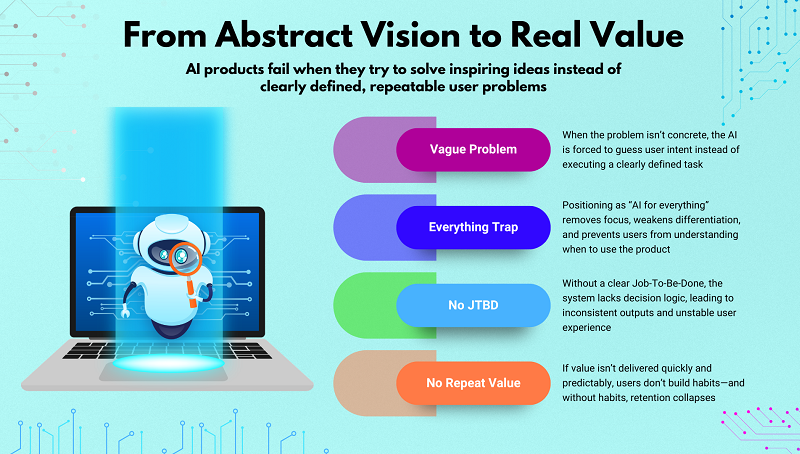
2. Solving Abstract Ideas Instead of Concrete Problems

One of the key reasons AI products fail to reach real users is the attempt to solve an abstract idea instead of a concrete task. Founders often start with an inspiring description but not a clear problem statement. Under these conditions, the AI is forced to “guess” what is expected of it rather than perform a specific task.

At the start, this may seem normal, especially if the initial model responses are impressive. But as usage increases, inconsistencies, contradictions, and instability begin to emerge. The user perceives this as a “raw” product, even if they can’t explain why.

Abstract formulations don’t provide the system with a basis for decision-making. As a result, the product doesn’t scale and doesn’t become part of the user’s daily workflow. This is where many AI projects lose their chance to move from experimentation to production.

“AI That Helps With Everything” Trap

The promise of “AI that helps with everything” almost always works against the product. The user doesn’t understand the specific scenario in which the service will be useful. Without a clear focus, the product doesn’t set expectations and doesn’t reinforce behavior.

Such solutions often turn into a one-size-fits-all chat that “can do everything” but doesn’t solve anything well enough.

The user tries it a couple of times and never returns because they don’t see any specific value.

Broad positioning also complicates product development: each new improvement pulls it in a different direction. As a result, the team loses focus, and the system loses stability.

No Clear Job-To-Be-Done

When it’s unclear what work AI performs for the user, the product begins to break down internally. The system doesn’t understand which decisions are a priority and which are secondary. This leads to inconsistent results and unstable behavior.

A clear Job-To-Be-Done defines the framework for logic, context, and UX. Without it, each request becomes a separate experiment. The user is forced to constantly clarify, correct, and monitor the result.

Under such conditions, AI doesn’t reduce the workload; on the contrary, it creates additional work. This quickly destroys trust in the product.

Why Users Don’t Return

Users only return to products where value is felt quickly and repeatably. If the result is different every time, trust doesn’t develop. Even good responses don’t compensate for the lack of consistency.

An abstract task doesn’t allow for a predictable experience. Users can’t integrate the product into their workflow. As a result, the service remains “interesting,” but not essential. When value isn’t cemented into habit, the product loses users even before it reaches the growth stage. The problem here isn’t marketing, but the initial problem.

If you’re at the very beginning and still defining what problem your AI product should solve, start here:
Day 1 — Where to Find Great SaaS Ideas (and How to Vet Them) It walks through how to identify concrete, monetizable problems instead of abstract ideas — and how to validate them before building anything.
3. Building Screens Before Systems

The second common mistake is starting with the interface, not the system. Many AI products look beautiful, but lack clear logic underneath. This is especially common in no-code environments, where screens are assembled faster than product decisions are made.

Focusing on the UI creates the illusion of progress. The product seems almost ready because it has buttons, forms, and scenarios. But beneath the surface, a lack of structure lurks.

When the user begins using the product in real-world conditions, the system can’t handle the load. Errors appear suddenly and are difficult to fix without reworking the entire logic. As a result, a beautiful interface becomes a mask for a fragile product.

UI-First Thinking in No-Code Tools

No-code tools simplify interface creation, but they increase the focus on screens. Founders begin to think in terms of “page,” “form,” and “button” rather than “decision” and “logic.”

This leads to the product being designed as a set of screens rather than as a decision-making system. In this approach, AI is simply inserted into the UI, without understanding its role.

As a result, the system becomes dependent on the interface, not vice versa. Any change to the flow requires manual edits and complicates product development.

When UX Hides Broken Logic

Good design can temporarily hide problems in logic. The user feels the product is “beautiful,” but over time, they begin to notice strange behavior. Responses contradict each other, the system forgets the context, and decisions appear random.

In the early stages, this is often attributed to “AI quirks.” But the real problem is the lack of a clear structure. UX can’t compensate for a weak system.

When logic breaks down, no interface can save the user’s trust. They simply stop using the product.

Why Systems Scale, Screens Don’t

Interfaces don’t scale on their own. Only the logic behind them scales. If the system understands what to do and why, the interface can be changed painlessly.

When logic is hardwired into screens, every change becomes a risk. The product becomes fragile and poorly adapts to growth.

This is why sustainable AI products are built as systems, with the interface merely as a way to interact with them. This is the fundamental difference between a demo and a real product.

If you’re trying to understand what it actually means to build AI as a system — not just a set of prompts behind a UI — this is explored in depth in How to Build Scalable AI Products Without Code (Using ChatGPT as the Core Layer).

It breaks down how to structure decision logic, context layers, and product architecture so the system stays stable even as usage grows.

4. Ignoring Context as a Core Product Layer

One of the most underestimated reasons for the failure of AI products is ignoring context as a fully-fledged product layer. Many founders consider context to be secondary: “we’ll add memory later,” “this can be solved with a prompt.” In practice, it is context that determines whether a product feels intelligent or useless.

When AI starts from scratch every time, the product loses consistency, predictability, and trust. The user is forced to repeat the same things, clarify goals, and correct answers. This may be unnoticeable in early demos, but in real use, the problem immediately becomes apparent.

Context is not a technical detail, but product logic: what the system knows about the user, the process, and the current state of the task. Without it, AI remains a response generator, not part of the service. This is precisely why products without context rarely reach regular use. They may impress, but they don’t retain users.

Treating Every Request as Isolated

When each request is treated as a separate event, the AI loses the sense of continuity. The product doesn’t “understand” what came before and doesn’t know where to lead the user next. As a result, responses may be formally correct, but contextually useless.

The user feels like they’re interacting not with the system, but with disjointed responses. This undermines the sense of intelligence and reduces the product’s value after just a few sessions. This approach may work in tests, but quickly breaks down in a real-world scenario.

Isolated requests are a quick path to frustration because the product doesn’t evolve with the user. It simply reacts, but doesn’t support it.

What Users Expect the Product to Remember

Users don’t think in terms of “memory” or “state.” They simply expect the product to remember their goal, previous steps, and constraints. This is a basic expectation shaped by other digital services.

When AI forgets what the user has already explained or selected, a sense of chaos ensues. People have to waste time repeating themselves instead of moving forward. In SaaS products, this is perceived as poor UX, not an “AI feature.”

Context allows a product to be consistent, not just clever in its own words. This is why memory is not a feature, but a foundation.

Context Loss as a Trust Killer

Trust in an AI product is built on the feeling that the system understands the user. When context is lost, this trust vanishes instantly. Even one glitch can call the entire product into question.

The user begins to double-check answers, doubt recommendations, and spend more time than it saves. At this point, the product ceases to be a helper.

The most dangerous thing is that such glitches are perceived not as bugs, but as the product’s “stupidity.” And regaining trust after this is extremely difficult.

5. Confusing Generation With Real Value

Many AI products get stuck at the content generation level, mistaking it for the ultimate value. Texts, lists, and answers look impressive, but they don’t necessarily solve the user’s problem. This is the key mistake that prevents products from moving from interest to utility.

The user isn’t interested in the generation itself, but in the result: the decision, the choice, the next step. When a product simply “writes,” it shifts the bulk of the work onto humans. As a result, AI increases the volume of information without reducing the workload.

Real value arises when a product takes on some of the thinking. Without this, AI remains a tool, not a service. This is why generation without logic rarely leads to user retention.

Content ≠ Outcome

A well-written text doesn’t equal a solved problem. The user may receive the perfect answer but still be confused about what to do next. This creates the illusion of help without any real results.

AI founders often confuse the quality of generation with the value of a product. But in real life, it’s not the text that’s valued, but the action or decision it leads to.

If a product doesn’t lead the user to a result, it remains informational noise, albeit a beautiful one.

No Decision-Making Inside the Product

When AI doesn’t make decisions, it doesn’t take responsibility. It merely suggests options, leaving the entire cognitive load to the user. This approach quickly becomes tiring.

Product value emerges when the system itself selects, filters, and recommends. This isn’t about control, but about assistance.

Without integrated decision-making, AI remains an assistant, not a service. And assistants rarely become products worth paying for.

Why Users Feel Overloaded Instead of Helped

Paradoxically, many AI products actually make users more tired. Instead of saving time, they add new layers of choice and analysis.

When a product presents too many options without clear logic, it shifts the thinking onto humans. The user feels like they’re working in the system’s stead.

True help is simplification. If AI doesn’t do this, the product loses its meaning, even if it generates excellent solutions.

6. Avoiding Real Users for Too Long

One of the most common, yet rarely acknowledged, reasons for AI product failure is avoiding real users. Many teams spend years tinkering with a product, believing it’s not ready for release. As a result, the product exists only in the founder’s mind and in closed demos.

The problem is that without contact with reality, an AI system doesn’t receive the feedback it needs to grow. Errors go unnoticed, hypotheses go untested, and confidence in the product is built on assumptions.

This is especially dangerous for AI products, where system behavior only manifests itself in a variety of real-world scenarios. The longer the product is isolated from users, the more painful the launch moment is. And the higher the chance that users simply won’t see the value.

The “Not Ready Yet” Syndrome

The “not ready yet” syndrome seems rational, but in practice, it’s destructive. The founder convinces themselves that the logic, interface, or AI responses need some more refinement. In reality, this is often a fear of receiving negative feedback.

AI products don’t become “ready” in a vacuum. They only become sustainable through use. Every delayed release is a lost opportunity to uncover real problems.

As a result, the product either never launches or launches too late, when energy and focus have already been lost.

Building in Isolation

When a product is created without users, it develops in a closed system. All decisions are made based on assumptions, not behavior. This is especially dangerous for AI services, where the nuances of use are everything.

A founder may be confident that the product is logical and useful, but users think differently. Without real use cases, the system is optimized for an imaginary user.

As a result, upon first contact with the market, it turns out that the product solves the wrong problem or does so in an inconvenient way.

Why No-Code Doesn’t Remove This Fear

No-code lowers the technical barrier, but it doesn’t remove the psychological one. The ability to quickly build a product doesn’t mean you’re ready to share it with the world.

Many founders continue to endlessly “improve” the product, even when technical limitations are removed. The fear of evaluation remains the same.

Therefore, no-code is a tool for acceleration, but not a substitute for determination. Real progress begins only with the first users, not with the next update.

7. Scaling Before the Product Is Ready

Attempts to scale an AI product before it’s stable almost always end in failure. Growth amplifies everything: both strengths and weaknesses. If the system is unstable, scaling only accelerates decay.

Many founders begin thinking about metrics, automation, and growth without ensuring the product behaves predictably. As a result, problems that could have been fixed early on turn into systemic failures.

AI products are especially sensitive to this because their behavior depends on context, logic, and decisions. If these layers aren’t in place, growth becomes dangerous.

Premature Automation

Automating weak logic doesn’t make a product stronger—it makes problems happen faster. AI starts making mistakes more frequently, but on a larger scale.

Founders often automate processes that haven’t yet proven their resilience. As a result, the product loses flexibility and becomes more difficult to fix.

The right approach is to first ensure that the logic works in manual or semi-automated mode and only then scale.

Metrics Without Product Stability

Metrics can create the illusion of control. Increased traffic, requests, or sessions don’t mean the product is working properly.

If system behavior is unstable, the numbers only hide the real problems. Users may come, but they won’t stay.

Without robust product logic, analytics becomes noise, not a decision-making tool.

When Growth Exposes Structural Flaws

Growth doesn’t break a product—it reveals what’s already broken. Errors in logic, context, or decision-making become apparent precisely when the load increases.

What worked for ten users can completely fall apart for a hundred. And that’s okay—if you’re prepared.

The problem arises when growth starts too early, and the team doesn’t understand what exactly needs to be fixed.

Final Thoughts — AI Products Fail Because of Thinking, Not Technology

Most AI products fail to reach real users not because of models, APIs, or a lack of code. They fail much earlier — at the thinking level.

Founders confuse demos with products, generation with value, and interfaces with systems. They avoid users, fear the release, and try to scale before the product is sustainable.

AI products require a different approach: systemic, consistent, and solution-oriented, not answer-oriented.

The context, logic, and responsibility of the system are more important than any prompts or UI effects.

A real product begins when AI takes over some of the thinking, not just writing text.

This is what distinguishes a service that is used from a tool that is quickly forgotten.

Understanding these mistakes is the first step to creating a sustainable AI product.

The solutions to these mistakes are discussed in detail in the pillar article on scalable, no-code AI products.
designing-and-building-ai-products

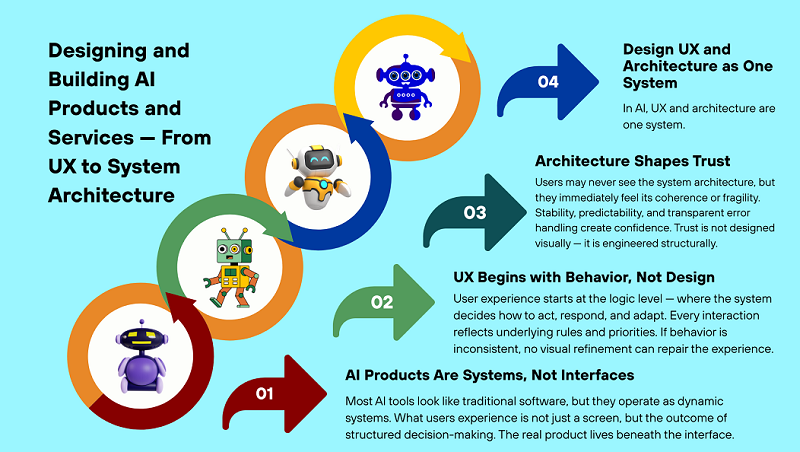
Designing and Building AI Products and Services — From UX to System Architecture

Designing and Building AI Products and Services is not about adding a model to a clean interface. It’s about creating systems that behave predictably, make decisions consistently, and deliver value beyond a single response. Many AI products look polished on the surface — they generate text, answer questions, or analyze data — but they fail to give users the feeling of interacting with a coherent system. The reason is simple: they’re designed as interfaces, not as behaviors.

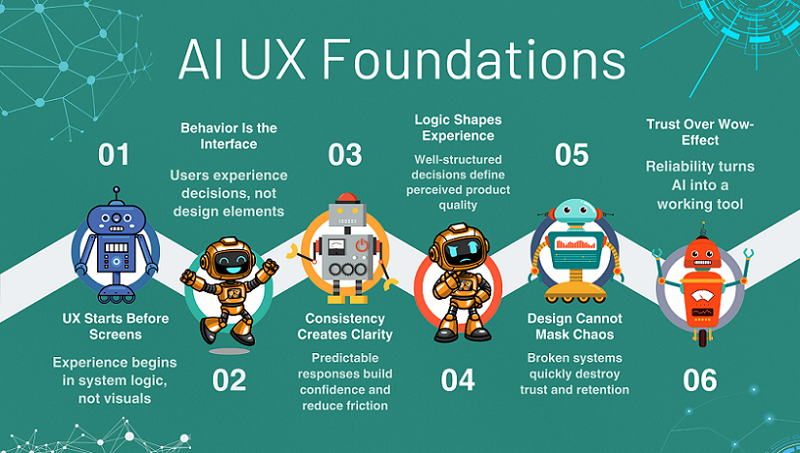
In AI products, UX begins long before the first screen or button. It’s shaped by how the system makes decisions, how it handles errors, and how it behaves in unusual scenarios. Users may never see the architecture, but they always feel its presence. This is why beautiful screens rarely save a product built on unstable logic.

In this article, we’ll explore how Designing and Building AI Products and Services requires treating UX and system architecture as a unified discipline — not at the code level, but at the level of structure, decision flows, and product behavior.

This perspective is especially critical in no-code and low-code environments, where architectural weaknesses surface quickly. We’ll examine where UX truly begins, why design alone can’t fix a broken system, and how to build AI experiences that inspire long-term trust.

1. Designing and Building AI Products and Services: Why UX Starts Before the Interface

In AI products, the user experience doesn’t begin with a login screen or dashboard. Designing and Building AI Products and Services always starts with how the system thinks, reasons, and acts before the interface ever exists. It begins with how the system thinks and acts. The user may not understand how the AI works internally, but they immediately sense chaos or structure. If the system’s behavior is unpredictable, no design will save the situation.

UX in AI is primarily about consistency, logic, and explainability. That’s why the interface is only the final layer, not the starting point. Trying to “finish the UX” after the logic has already been broken is a mistake.

In this section, we’ll explore why UX in AI is product architecture, not visual style. And why UX development should begin long before prototypes and mockups.

UX in AI Products Is System Behavior, Not Visual Design

In classic products, UX is often associated with visuals, but this thinking doesn’t apply to AI systems. Users interact not with screens, but with the system’s behavior. They experience UX in how the AI responds to input, how it interprets context, and what decisions it makes. If a system responds one way today and another tomorrow without explanation, the UX is considered poor. Even with perfect design. Good UX in AI is predictability without a sense of rigidity. It’s when the user understands what to expect from the product. Therefore, UX in AI is the result of well-designed logic, not a well-designed UI. Design merely visualizes an already-adopted system decision. If decisions are chaotic, the UX will be the same.

Why Good UX Can’t Fix a Broken AI System

A beautiful interface is often used as a mask for weak logic. This may work for the first few users, but only briefly. When the AI starts making mistakes, getting confused, or giving inconsistent answers, the UX collapses instantly. The user loses trust in the product, even if they like the design. This is because UX can’t compensate for the lack of a decision-making system. If the product doesn’t understand the user’s goal, the interface won’t save it. In AI products, UX is a consequence of the architecture, not the other way around. This is why many projects look “good” but fail to retain users. This is one of the key reasons why AI products fail to reach real users and die early on.

Designing UX for Trust, Not Wow-Effect

In AI products, the main currency isn’t the wow factor, but trust. Users may be surprised once, but they’ll only use what they trust. Wow-effect responses often look impressive, but they’re unstable. And instability ruins UX faster than anything else. Good UX in AI is when the system explains its behavior through actions, not lengthy prompts. Users should feel like the product understands their task. UX should reduce cognitive load, not add to it. This is achieved not by animations, but by the structure of solutions. When users see logic, even errors are more easily accepted. This is how UX transforms from a show into a working tool.

2. From User Actions to Product Logic

In AI products, there’s always a layer of interpretation between a user’s action and the result. This layer is often underestimated, even though Designing and Building AI Products and Services depends on how well intent is separated from interface actions.

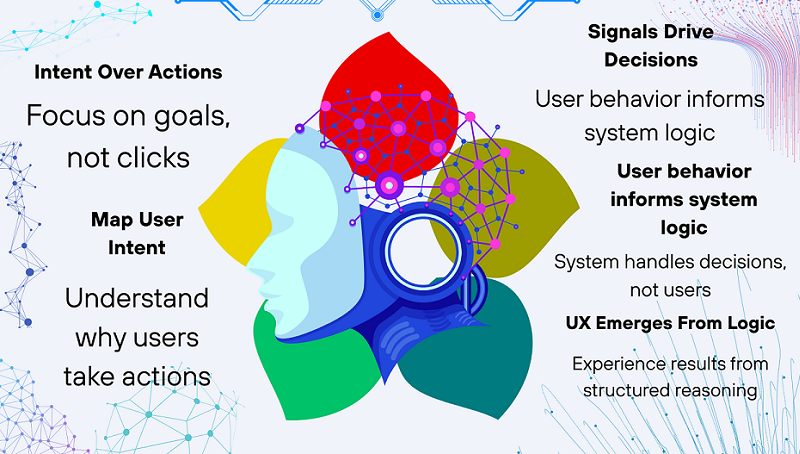
The user clicks a button, enters text, or loads data, but the product doesn’t care about that. It’s important to understand why they’re doing it. This is where most products start to break down, because they continue to think in terms of screens and scenarios. This is acceptable in classic UX, but not in AI. An AI product must work with intent, not clicks. When logic is built around actions, the system becomes fragile and doesn’t scale well. When logic is built around meaning, the product begins to behave like a system.

This section shows how to move from superficial UX thinking to product logic. Without delving into architecture, but with a clear understanding of the system’s responsibilities. This is the foundation for predictable AI behavior. And this is where UX becomes a product.

Mapping User Intent When Designing AI Products and Services

In traditional products, user flows describe the user’s journey through screens. In AI products, this approach quickly becomes unworkable. Users can reach the same goal in different ways, and the system must understand this. Therefore, instead of click flows, it’s important to model intent. Intent is not an action, but the goal behind it. When a product understands intent, it can adapt behavior without changing the interface. This makes the system flexible and resilient. In this approach, UX becomes a consequence of logic, not its source. The user feels that the product “understands” them, even if they act unconventionally. It is intent-based thinking that allows AI products to appear smarter than they actually are. And this is a direct bridge to systems thinking.

Translating UX Signals Into System Decisions

Every user action is a signal, not a command. Entering text, repeating a request, or correcting a result carries context. The task of an AI system is to correctly interpret this context. The mistake many products make is that they react to the interface rather than the meaning of what’s happening. AI shouldn’t “see a button”; it should understand the situation. When UX signals are transformed into system decisions, the product becomes alive. It begins to adjust behavior, not simply follow instructions. This reduces errors and repeated requests. The user experiences it as a smooth and logical experience. This approach prepares the product for growth without complicating the UX. And this is where architectural thinking begins, without technical overload.

Where UX Ends and System Responsibility Begins

One of the most common mistakes is shifting logic to the user. When a product requires “formulating a request correctly,” the UX is already broken. The interface should collect signals, not make decisions. Decisions are the responsibility of the system. When the boundary is blurred, the product becomes tedious and unpredictable. The user begins to adapt to the AI, not the other way around. A good AI product internalizes complexity and externalizes simplicity. UX ends where decision making begins. Everything related to interpretation, context, and action selection must be internal to the system. This is directly related to the idea that a product is a chain of decisions, not a set of functions. And this is what distinguishes a product from a tool.

3. From UX Thinking to AI Product Logic

In AI products, the user journey can’t be viewed as a series of clicks. Designing and Building AI Products and Services requires shifting from interface-driven flows to intent-driven logic. Actions are simply external signals, always based on intent. When a product responds solely to the interface, it quickly hits the limit of its logic. This is why many AI services appear smart in demos but break down in real-world use.

For a product to be robust, it must understand what the user is trying to solve, not just what they clicked. This is where UX begins to seamlessly transition into product logic. This is the point where design ceases to be visual and becomes semantic. An AI product begins to behave like a system, not a form with buttons. This approach simplifies product development without rewriting the entire UX. And this is where the foundation for codeless architectural thinking is laid.

Intent-Based Design in AI Products and Services

Traditional user flows describe the user’s journey through screens. In AI products, this approach quickly breaks down because users act nonlinearly. The same intent can be expressed in different ways. If the system doesn’t understand this, the product begins to feel “dumb.” An intent-based approach shifts the focus from the path to the goal. AI begins to address the user’s task, not their behavior in the interface. This makes the product more flexible and resilient to non-standard scenarios. The user feels understood by the system, even if their request is not perfectly formulated. This approach directly leads to systems thinking.

Translating UX Signals Into System Decisions

Every user action is a signal, not an instruction. Repeating a request, correcting a result, or pausing between actions carries meaning. The task of an AI product is to transform these signals into decisions. When a system responds only to UI events, it loses context. In strong products, AI responds to the situation, not the button. This reduces errors and increases the product’s perceived intelligence. The user doesn’t have to think about logic—they simply see that the product is behaving appropriately. This approach prepares the product for growth without complicating the interface.

Where UX Ends and System Responsibility Begins

One of the key mistakes is forcing the user to compensate for a weak system. When UX requires “asking the right question,” this is a signal of a problem. The interface should collect input, not make decisions. All complex interpretations should occur within the system. If the boundary is blurred, the product becomes tedious. The user begins to adapt to the AI, not the other way around. A good AI product hides complexity rather than exposes it. This is where the idea that a product is a chain of decisions, not a set of screens, comes into play.

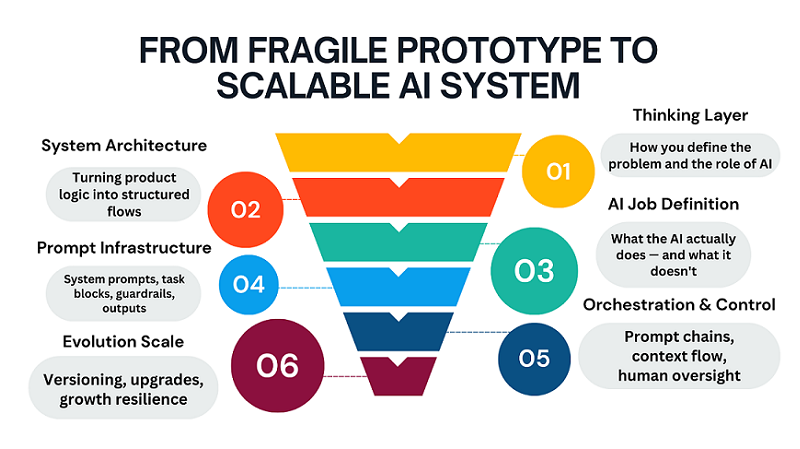
4. Designing and Building AI Product Architecture Without Code

AI product architecture is often perceived as something technical and intimidating. In reality, Designing and Building AI Products and Services in a no-code context is primarily about logic, decisions, and structure — not technology. In fact, in a no-code context, architecture is about logic, not technology. It’s a way to organize thinking about the product.

A good architecture answers the question “what’s going on underneath the hood,” even without code. It defines how the product makes decisions and responds to the user. Without architecture, an AI product turns into a set of disconnected prompts. With architecture, it becomes a system that can evolve. It’s important to understand this before choosing tools. Then, no-code becomes an accelerator, not a constraint. This block helps alleviate the fear of the word “architecture” and prepares for a deeper dive into the pillars.

What “Architecture” Means in No-Code AI Products

In no-code AI products, architecture isn’t diagrams and servers. It’s a decision-making structure. Architecture is responsible for when, why, and how the system acts. It resides in logic, not in tools. Even the simplest AI product already has an architecture—the only question is whether it’s conscious or not. When the architecture is well-thought-out, the product is easier to improve. Without it, any change breaks its behavior. This approach allows for systemic thinking without technical overload.

Input, Context, Processing, Output as a Core Model

Any AI product can be broken down into four parts: input, context, processing, and output. Input isn’t just text, but everything the system receives. Context is what helps interpret this input. Processing is the decision-making logic within the product. Output isn’t text, but a useful result for the user. This model is simple yet universal. It’s suitable for any no-code AI product. Understanding this framework immediately simplifies thinking about the product.

Why Tools Don’t Define Architecture

Choosing a platform is the most overrated step in no-code AI. Tools don’t define the architecture, they merely implement it. Without clear logic, even the best service won’t save the product. Architecture lives in solutions, not in settings. When the logic is clear, tools are easy to change. When there’s no logic, changing platforms is useless. This section helps the reader avoid getting stuck in comparing services and focus on what truly impacts the quality of the product. This approach is what distinguishes a product founder from a “tool hoarder.”

5. Designing Context as a Core Layer of AI Products and Service

In most AI products, context is perceived as an auxiliary detail rather than a separate product layer. Because of this, the system appears intelligent only within the context of a single request. As soon as the user steps outside the context, the logic falls apart.

Context is what connects past actions, the current goal, and the expected outcome. Without it, AI responds formally rather than meaningfully. This is why UX can be cluttered, but the experience can be frustrating. When context is designed correctly, the product begins to behave consistently. The user feels that the system is “in the know,” rather than starting over every time. This layer is rarely visible, but it directly impacts trust. Context is not memory for memory’s sake, but a decision-making tool. And in mature AI products, it becomes a fully-fledged part of the architecture.

Context Is the Missing Layer Between UX and AI

Context is the bridge between what the user does and how the system responds. UX collects signals, AI processes data, but without context, a gap arises. As a result, the product behaves inconsistently. The user expects logic, but receives random responses. Context allows AI to understand the situation, not just a single request. This is where UX thinking and systems logic merge. This approach fits well with step-by-step product development, where meaning emerges first, and automation follows. Without this layer, even the most careful no-code product quickly hits a ceiling.

What the System Must Remember to Feel Intelligent

For a product to feel intelligent, it must remember the right things, not just everything. First and foremost, the user’s goal. Then, the constraints within which this goal must be achieved. The current state is also important: what has already been done and what is expected next. All this creates a sense of continuity. The user doesn’t have to verbalize it, but they immediately feel the difference. When the system “remembers” the context, interaction becomes smooth. AI ceases to be seen as a tool and begins to be perceived as a service. This directly increases trust and reduces frustration.

How Poor Context Design Breaks UX

The most common mistake is treating every request as the first. This leads to contradictory responses. The user is forced to repeat the same thing in different words. The product’s logic falls apart, even if the model is strong. On the surface, this looks like “stupid AI.” In reality, the problem isn’t with intelligence, but with structure. Poor context breaks UX faster than a bad interface. Users leave not because of the design, but because of the feeling of chaos. And this is fixed not by prompts, but by architectural solutions.

6. Decision-Making as the Core of AI Services

The true value of an AI service is not in text generation, but in decision making. This is a central principle when Designing and Building AI Products and Services that aim to behave like real services rather than smart tools. When a product decides for the user, it saves time and reduces workload. If AI only generates options, the user is left alone with the problem. That’s why decision-making is only the basic level.

Decisions shape the product logic. They determine what to show, what to hide, and how to respond to errors. Both the UX and the architecture depend on decisions. When decisions are unclear, the product appears chaotic. When they are clear, the system scales without complicating the interface. This is the core of AI services.

AI as a Decision Engine, Not a Generator

Generation is a means, not an end. The user cares about the result, not the answer itself. When AI makes decisions, it relieves the user of some responsibility. This creates the feeling of a service, not a tool. Decisions can be simple, but they must be consistent. They shape the product’s behavior. This approach directly supports scalability. The less the user thinks about “how,” the higher the product’s value. And the closer the AI service is to a real product.

What Decisions Should Be Automated First

Not all decisions should be immediately delegated to AI. Repetitive and predictable choices are automated first—those where error isn’t critical, but the time savings are significant. Complex and risky decisions are best left under user control. This approach reduces stress and builds trust. The product doesn’t try to be smarter than necessary. It helps where it’s truly useful. This is a product strategy, not a technical limitation. And it’s precisely this that protects the system from overload.

How Decisions Shape Both UX and Architecture

Every decision made by AI impacts two layers at once. UX – through what the user sees and feels. Architecture – through processing logic and context. If decisions are well-thought-out, the interface becomes simpler. If not, UX begins to compensate for a weak system. Architecture always follows decision logic, not the other way around. Therefore, design without understanding decisions is doomed. In strong AI products, decisions are defined first, and screens are created second. This is what distinguishes a service from a set of features.

7. Connecting UX, Architecture, and Scale

At this stage, it’s important to bring everything we’ve discussed so far together into a single picture. UX, architecture, and scale are not different stages of a product’s lifespan, but interconnected layers of a single system. In AI products, they are especially closely intertwined because the system’s behavior is directly experienced by the user.

Problems arise when these layers develop out of sync: UX is improved without changing the logic; architecture is complicated without considering the user experience. While this may be subtle at first, as users grow, such gaps quickly devolve into systemic chaos.

A well-designed AI product considers scale at the design level, not at the infrastructure level. It’s not about load or servers, but whether the product’s logic can withstand changing scenarios, behaviors, and user expectations. In this section, we’ll explore why the UX + architecture pairing is key to sustainability, how to design a system with room for change, and when it’s time to stop “designing” and start testing the product with real people.

Why Products Break When UX and Architecture Drift Apart

One of the most common reasons for AI product failure is when the UX takes on a life of its own, while the system does its own. The interface is improved, simplified, and new scenarios are added, but the underlying logic remains the same.

As a result, the user perceives the product as having become “smarter,” but the system is unprepared to support this behavior. The AI begins to respond inconsistently, becomes confused, and loses context.

Such problems are rarely noticeable in the early stages because users are few and scenarios are predictable. But as the product grows, any discrepancy between the UX promise and the system’s reality becomes critical.

The product becomes unreliable, and the team begins patching holes instead of developing. This is why UX and architecture should be designed as a unified whole, not as independent layers.

Designing for Change Without Rebuilding Everything

Change is an inevitable part of any AI product’s life. Users evolve, scenarios become more complex, and quality requirements increase. The problem isn’t the changes themselves, but how the system prepares for them.

If the architecture is tied to specific screens, prompts, or tools, any change turns into a rewrite of the entire product. This is expensive, slow, and demotivating.

A flexible system is designed around decisions, context, and logic, not implementation. Then you can change the UX, add new scenarios, or improve AI behavior without breaking the foundation.

This approach allows the product to evolve gradually, rather than through painful “relaunches.” It’s a direct bridge to scalability.

When to Stop Designing and Start Testing with Users

There comes a point when further design stops being useful. The logic is established, the system is clear, the UX is well thought out — and then comes the realm of hypotheses.

Many founders get stuck here, endlessly refining the design instead of testing it with real users. But AI products cannot be perfected in theory.

Only real-world use reveals where the system behaves unexpectedly, which decisions are unnecessary, and which are missing. This is where weaknesses in context, logic, and UX are identified.

But testing is not only about interface or behavior — it’s about validating the core idea behind the product. If the initial problem is weak, no amount of architectural clarity will save it.

If you’re still shaping your product direction, start with the fundamentals. Our free lesson — Day 1 — Where to Find Great SaaS Ideas (and How to Vet Them) — walks through how to systematically discover SaaS opportunities, evaluate real demand, and avoid building technically impressive systems that nobody actually needs.

Early testing doesn’t mean scaling. It’s a way to ensure that the system can, in principle, withstand life beyond your imagination. And it’s this step that separates a product from a concept.

Final Thoughts

AI products don’t break suddenly. They break gradually — due to decisions made too early or too superficially. In most cases, the failure has little to do with models or tools, and everything to do with how Designing and Building AI Products and Services was approached from the start.

UX without logic creates the illusion of convenience. Architecture without user insight creates the illusion of reliability. AI without solutions creates the illusion of intelligence. And all these illusions work only until the first serious use.

Good AI products feel simple on the outside and thoughtful on the inside. The user doesn’t see the architecture, but they feel it through stability, predictability, and trust. This is true UX in AI services.

It’s important to understand: no-code doesn’t free you from thinking. It only removes technical noise, leaving you alone with the product logic. And this is where many projects stumble.

If you’ve read this far, it means you’re already thinking about the product more deeply than most. The next step is to understand how all of this can be turned into a scalable system that can grow without constant rework.

If you want to go deeper into how to turn this architectural thinking into a practical, scalable no-code system, explore our complete guide on how to build scalable AI products without code. There we break down the exact structural principles, system layers, and product decisions that allow AI services to grow without collapsing under complexity.

how-to-build-an-ai-product-step-by-step

How to Build an AI Product Step by Step — From Idea to First Users (No Code)

How to Build an AI Product is one of the most important questions in today’s rapidly evolving digital economy. The product market is changing faster than ever before, and traditional development approaches are no longer the only path to success.

Launching a valuable digital product no longer requires deep programming expertise, a full development team, or months of complex coding. Today, competitive advantage belongs to those who clearly understand the problem, move quickly, and know how to turn artificial intelligence into a practical, working solution.

This shift is especially visible in the AI-powered micro-SaaS space. A new generation of product creators is emerging — experts, marketers, analysts, and founders without technical backgrounds — who are building scalable AI products without writing code. The market increasingly rewards systems thinking, speed of execution, and clarity of vision over “deep” engineering complexity.

At the same time, most people still fear, “Without code, I can’t create a real AI product.” Or, at the other extreme, when an AI product is understood as a simple chat with a few tips, it’s a simple process. As a result, dozens of projects are emerging that look like tools but never become products.

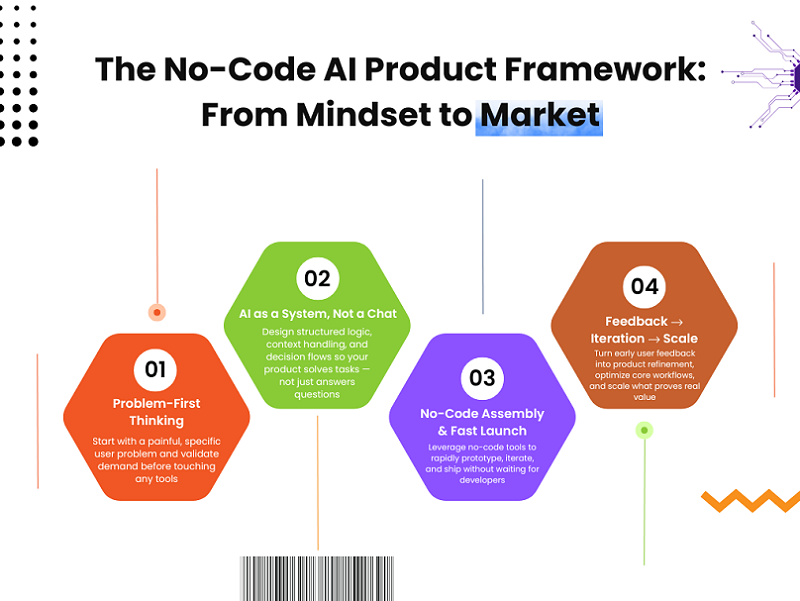
In this article, we’ll walk you through the step-by-step process of creating a fully-fledged AI product without code, not just an interface on top of a model. You’ll understand the logical building blocks of such a product, how it makes decisions, how it works with context, and why this makes it scalable. We’ll speak in simple language, without technical noise, but with a depth often lacking in guides.

This article is about the mindset of a product founder in the AI era.

If you want to create micro-SaaS products that actually find users, rather than die at the idea stage, you’ve come to the right place.

1. What Do We Call an AI product (and where everyone gets confused)

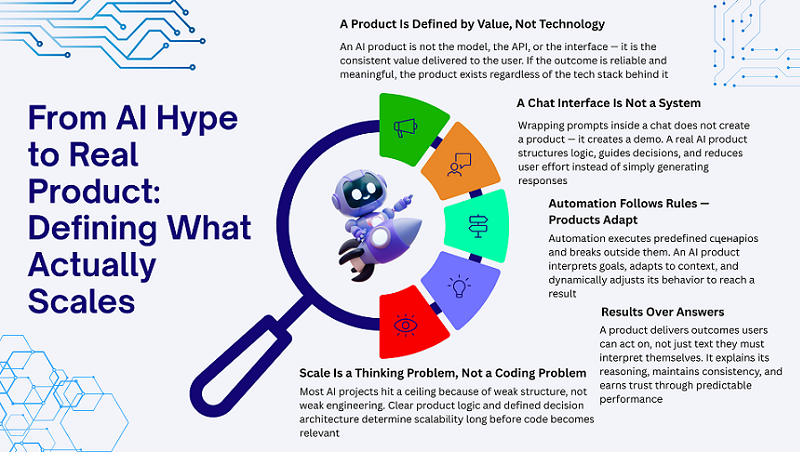
The term “AI product” is overused these days. Some use it to describe a chat with prompts, others to describe API-based automation, and still others to describe any interface with a “Generate” button. This creates the illusion that many are already building a product, when in fact, they only have a tool or a wrapper around a model.

In this section, it’s important to clarify the concepts, because without it, everything will be built on a shaky foundation. An AI product isn’t about the technology, the model, or the service you use. It’s about the value the system consistently delivers to the user.

If you don’t separate these things from the very beginning, the product is almost guaranteed to hit a ceiling with the first few users. Therefore, let’s first understand what makes a product a product, not just a set of features. Only then does it make sense to talk about steps, scaling, and growth.

An AI product ≠ a Chat with Prompts

Most so-called AI products are actually just a regular chat with a pre-written prompt. The user enters something, the model responds, and that’s it. This may look impressive at first, especially if the answers are good.

The problem is that this approach doesn’t create a system. It doesn’t make decisions, doesn’t consider context, and doesn’t guide the user to a result. It’s simply an interface on top of the model.

An AI product begins when the system takes over some of the thinking, rather than simply generating text. If you remove the user from the process of making every step, that’s when the product emerges. Everything else is just a demo.

How a Product Differs from Automation

Automation solves a specific problem according to a predetermined scenario. If the conditions are met, it works; if not, it breaks. An AI product takes a different approach: it adapts to the situation rather than simply following instructions.

The product considers the user’s goal, their context, and possible scenarios. It doesn’t simply “do an action,” but helps them make a decision or reach a result.

This is where the line between automation and a product is drawn. If a system can’t choose and adapt, it’s a set of scripts, even if it’s powered by AI. And such projects almost always come down to scale.

How to Know You’re Creating a Product

There’s a simple way to check this without using complicated terms. First, the product can explain why it performs a particular step. Second, it delivers a result, not just an answer. And third, it works consistently and reliably for different users, not just for the “ideal scenario.”

If a system requires manual edits, clarifications, and monitoring every time, it’s not a product. A true AI product reduces the user’s cognitive load, rather than shifting it onto them.

If you see that the user trusts the system and follows its logic, that’s a good sign. This means you’re no longer creating a tool, but a product.

Why code isn’t even important here

A common mistake is to think that scale and quality are limited by code. In practice, it’s the opposite. Most AI products fail not because of technical limitations, but because of a lack of structure and logic.

You can write perfect code, but if the product doesn’t understand what it does and why, it won’t scale. Conversely, a well-designed system can evolve for a long time without any programming at all.

Code is just a way of implementing it. Growth is limited by thinking: how you define the problem, solutions, and product behavior. That’s where you need to start.

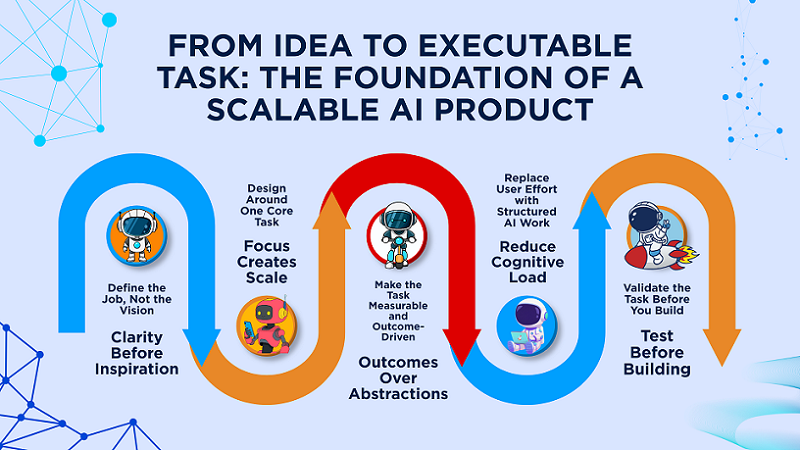
2. Clearly Define the Task, Not the Idea

Almost all AI product problems begin with the phrase “I have an idea.” The idea sounds inspiring, but it’s too vague to build a system on. AI doesn’t handle abstractions well, but it’s great at concrete work.

Therefore, the first and most important step is to stop thinking in terms of ideas and start thinking in terms of tasks. Not “what we want to do,” but what job the product performs for the user.

If this step is skipped or done pro forma, everything will fall apart: the UX, the logic, and scaling. But if the task is clearly defined, half the product is already built. In this section, we’ll look at how to do this as simply as possible.

This is exactly where most AI products quietly fail — long before prompts, tools, or automation even matter.

Founders often jump straight into defining tasks without validating whether the underlying idea is worth turning into a system at all. As a result, the task may be well-defined technically, but irrelevant from a market perspective.

A scalable AI product always starts one level earlier: with a strong, narrow SaaS idea grounded in a real problem. If the problem is weak, no amount of task clarity will save the product later. You’ll end up optimizing logic for something users don’t truly need.

Before defining what the AI should do, it’s essential to understand *which problems are actually worth solving* and how to quickly filter out ideas that sound good but fail in reality.

If you want a practical, no-fluff breakdown of how to find strong SaaS ideas and validate them before building anything, this free lesson walks through the exact process: Day 1 — Where to Find Great SaaS Ideas (and how to vet them)

This step ensures that every task you define later is anchored in real demand, not assumptions.

Not “what to do,” but “what job does AI perform”

The phrase “AI helps write texts” means nothing. But “AI turns a rough brief into a finished draft for a specific purpose” is a task. The AI Job To Be Done approach helps eliminate unnecessary distractions and focus on results.

It’s not the technologies used that matter, but what work the user no longer wants to do themselves. If AI takes over this work, the product will be in demand.

A clearly defined task immediately suggests the logic, context, and solutions the system needs. Everything else is built around this.

One Task is Better than Ten Features

Many people believe that more features = more value. In AI products, this is almost always a mistake. Each new feature increases system complexity and reduces stability.

One well-solved task scales much better than ten superficial ones. Users value predictability and a clear outcome, not a set of features.

Focus simplifies not only the product but also marketing, onboarding, and growth. This is why most successful micro-SaaS start with a single task.

Examples of Good and Bad AI Tasks

A bad task is: “AI helps entrepreneurs.” A good one is: “AI analyzes incoming leads and suggests the next step.” In the first case, it’s unclear what the product does; in the second, everything is clear.

A good task is always measurable, limited, and tied to a specific outcome. A bad one is abstract and requires constant clarification from the user.

If the task is difficult to explain in a single sentence without “and,” “or,” and “plus,” it’s likely poorly formulated.

How to Test a Task Before Building a Product

There’s a simple sanity check. Imagine an AI performing a task perfectly. Is the user willing to pay for it or use the product regularly? If not, the task is weak.

The second test is whether the process can be described in words, without an interface or code. If the logic falls apart at this stage, the product will also fall apart later.

This type of check saves months of work and helps immediately weed out ideas that sound good but don’t work in practice.

3. Break the Product Into a System, Not Screens

Most no-code AI products start from screens: dashboard, chat window, settings, buttons. This feels logical, especially for founders with a design background. But screens are just the surface — they hide how the product actually works.

When you think in screens, you optimize UI, not decisions. And AI products fail not because of bad UI, but because of broken logic underneath.

A scalable AI product should be designed as a system first, and only then wrapped into interfaces.

System thinking forces you to define inputs, transformations, and outputs explicitly.

This makes the product easier to debug, extend, and automate later. More importantly, it prevents the “it works in demo but breaks in ” problem.

In this section, we’ll reframe how to think about AI products before touching any no-code tools.

Why Screens Kill Product Thinking

Screens push you to focus on how things look, not how decisions are made. Most no-code projects fail because founders design flows instead of logic. A beautiful interface can hide a fundamentally weak system underneath.

When something breaks, you don’t know where or why. AI products especially suffer from this, because errors are often invisible at first. System-first thinking forces clarity before complexity appears.

What “a System” Means in an AI Product

A system is a sequence of steps that turns raw input into user value. It doesn’t require architectural diagrams or technical jargon.

At its core, it answers four questions: what comes in, what happens inside, and what comes out. AI is just one component inside this flow, not the whole product.

When you define the system clearly, tools become replaceable. That’s how no-code products avoid being fragile.

Input: What the AI Actually Receives

Most founders think the input is “the prompt”. That’s only the visible layer. In reality, input includes user intent, prior actions, constraints, and product state.

If you don’t define this explicitly, the AI is forced to guess. Guessing works with early users, but fails at scale. Clear inputs reduce hallucinations and increase consistency. Good AI products don’t rely on luck — they rely on structure.

Output: What Counts as a Result

The output of an AI product is not text. It’s value. Sometimes that value is a decision, sometimes a summary, sometimes a next action.

If you measure success by “good answers”, you’ll miss the real problem. Users care about outcomes, not eloquence.

A strong system defines what success looks like before generating anything. That’s how AI becomes useful, not just impressive.

A strong system defines what success looks like before generating anything.

That’s how AI becomes useful, not just impressive.

4. Design Context, Not Prompts

Most beginners obsess over prompts. They tweak wording, add instructions, and hope for better results.

This works temporarily, but it doesn’t scale. Prompts are fragile because they lack memory, structure, and awareness of the product state.

Context is what makes AI behave consistently across sessions and users.

It defines why the request exists, not just what is being asked.

When context is designed properly, prompts become short and stable.

This is one of the biggest mindset shifts in building no-code AI products.
Why AI Breaks Without Context

Without context, AI treats every request as isolated. This leads to contradictions, repeated questions, and shallow outputs.

The problem often isn’t visible with the first users. It appears only when usage patterns diversify. At that point, prompt tweaks stop working. Context is what prevents the system from falling apart under real usage.

Core Types of Context in AI Products

There are four main types of context: history, goal, constraints, and state. History explains what already happened. Goals define what the user is trying to achieve. Constraints limit what is allowed. State reflects where the process currently stands. Together, they give AI situational awareness.

How to Store and Update Context Without Code

Context management is about logic, not tools. You decide what must persist and what can expire.

Some context lives across sessions, some only within a single flow. The key is to update context after meaningful actions, not every message.

This keeps the system lightweight and predictable. No-code tools can store data, but you design the rules.

The “Every Request From Scratch” Anti-Pattern

Treating each request as new is the fastest way to kill product intelligence. It forces the AI to re-learn the same things repeatedly. This increases costs and decreases quality. More importantly, it breaks the user’s mental model. Users expect the product to “remember”. Persistent context is what makes AI feel like a system, not a toy.

5. Turning an AI Idea Into a Working Product System

At this stage, it’s crucial to make a key shift in thinking: stop perceiving an AI product as a set of screens or functions and start seeing it as a system. This is where most no-code projects either start to grow or get stuck forever.

The problem isn’t the tools or the lack of code, but rather the product’s lack of understanding of how it should work in different situations. A system is what connects inputs, context, logic, and output into a coherent whole. Without this, the product only works in demo mode.

In this section, we won’t delve into architecture. The goal here is simpler: to demonstrate how to think systemically, even when building a product without code. This is the foundation without which scalability and stability are impossible.

Product ≠ Screens: Why Interfaces Don’t Define AI Products

Most no-code products start with screens: chat, dashboard, settings, buttons. This creates a sense of progress, but in reality, it distracts from the essence. The interface is a shell, not a product. When thinking gets stuck on the UI, the decisions within the system remain unformulated.

This is where the first mistakes appear: the product “looks” finished, but behaves unpredictably. The system begins to break down under non-standard requests. Ultimately, the design becomes a crutch that hides a lack of logic. Therefore, in AI products, the system is always more important than the interface—the interface can be replaced, but the system cannot.

Context Over Prompts: What Makes AI Behave Predictably

Many people think that the quality of an AI product depends on a perfect prompt. This may work at the start, but not at scale. A prompt is just one signal, not the whole picture.

Context is an understanding of why the user is making a request, what state they’re in, and what’s happened before. Without this, the AI starts from scratch every time. The product loses consistency, and the user loses trust. It’s the context that makes AI behavior stable and predictable, and this is immediately noticeable, even if a human can’t explain why.

Decisions, Not Generation: Where Real Product Value Lives

Text generation alone doesn’t create a product. It can be useful, but value only emerges when the system starts making decisions. An AI product’s value isn’t in the way it answers beautifully, but in the way it guides the user to a result.

Real products decide what to do next, which option is better, where the user is making mistakes. If AI simply generates, it’s a tool. If it chooses, guides, and limits, it’s a product.

This is where the line between a tool and a system is drawn. We explore this distinction in depth in How to Build Scalable AI Products Without Code (Using ChatGPT as the Core Layer) — where we break down the architectural principles behind decision-driven AI systems. Here we’ll only hint at it: scalable AI products are built around decisions, not text.

6. From Prototype to First Users (Without Breaking the System)

The transition from prototype to first users is the most fragile stage in the life of an AI product. This is where most projects fail, even if the idea itself is strong. The problem is rarely related to the model, tools, or lack of code. More often than not, the system is simply not prepared for real-world human behavior.

At the prototype stage, everything seems logical and manageable, but first users wreak havoc. They use the product differently than expected, ask the “wrong” questions, and break the flowcharts. The goal of this stage is not growth, but testing the viability of the system. You need to reach users without the product falling apart under the first pressure. That’s what this section is about: how to carefully transition into reality without destroying logic and trust.

Why Most AI Products Never Reach Real Users

Most AI products get stuck before their first users, and the reason is almost never technical. People endlessly refine, rewrite, and improve something that no one uses yet. This is often driven by fear: the fear that the product is “not good enough.”

No-code isn’t a solution here, because it speeds up the build process but doesn’t eliminate uncertainty. Ultimately, the product exists only in the creator’s mind. The longer the release is delayed, the harder it becomes to take the first step. And without real users, the system remains a hypothesis.

What “Minimum Viable” Means for AI Products

For AI products, an MVP isn’t a “bare bones” or “unfinished” product. It’s a system that reliably does one thing. The user doesn’t care how many features it contains, as long as the outcome is predictable.

At launch, the core should work: input → logic → output. Everything else can be deliberately simplified or eliminated. The most dangerous thing is to launch a product that behaves inconsistently. This is what destroys trust the fastest. A good MVP in AI has fewer features, but more confidence in the system’s behavior.

Getting First Users Without Marketing or Budget

First users aren’t about growth or scale. They’re a learning tool. Their purpose is to show where the system breaks down in real life. Therefore, advertising is unnecessary and even harmful.

The right first users are people you can communicate with directly. Manual onboarding at this stage isn’t a crutch, but a strategy. It allows you to see the product through the user’s eyes.

When an AI product is truly useful, it automatically suggests what needs to be fixed next. And this knowledge is more important than any metrics at the start.

Conclusion

AI products don’t die due to lack of code or poor tooling. They die due to a lack of structure and clear thinking. A prototype is just the beginning, and real users quickly reveal where the system was weak.

In the early stages, you shouldn’t think about scaling, automation, and growth. You need to think about product behavior and trust. If the system can handle the first few users, it will handle more.

We explore everything related to upgrades, scale, and long-term sustainability of an AI product in our pillar article. This is where the next level of product founder thinking begins.

build-scalable-ai-products-without-code

How to Build Scalable AI Products Without Code (Using ChatGPT as the Core Layer)

Over the past two years, thousands of people have attempted to create no-code AI products. Most were able to build a prototype, implement a model, and even get their first users. But almost all of them hit the same ceiling: the product stopped scaling; it wasn’t the code that started breaking, but the logic.
The problem is that no-code and AI are often perceived as a “shortcut” instead of a systematic approach. People think that if you replace code with tools, then the programming mindset is no longer necessary. In practice, the opposite is true: the absence of code requires an even more rigorous architecture at the thinking level.

ChatGPT is often misused in this process. It’s perceived as a smart chat, a text generator, or a task-oriented assistant. In this format, it will never become the foundation of a scalable product—at most, a convenient feature.

This article isn’t about tools or yet another stack. It’s about how to think about an AI product, where ChatGPT acts not as a service, but as a system layer through which logic, decisions, and the user experience flow.

If you want to build a no-code AI product that can handle user growth, scenario complexity, and real-world workloads, this is the level to start at.

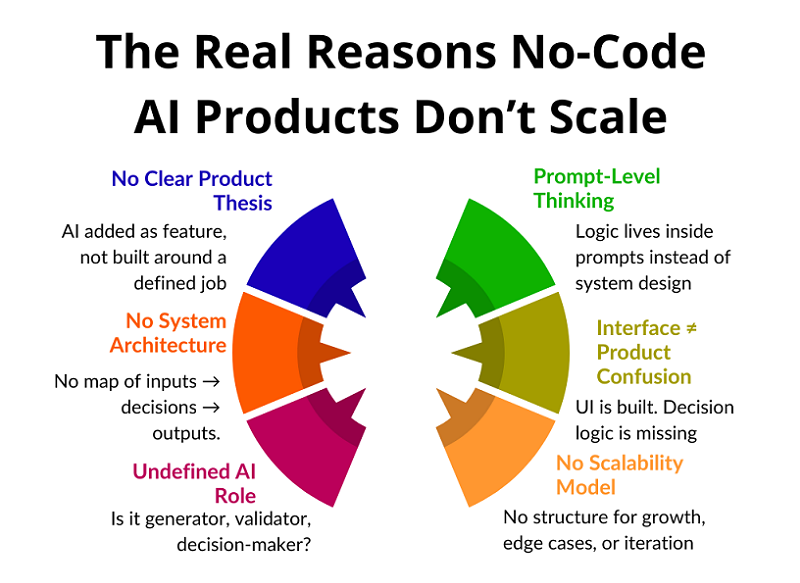
1. Why Most No-Code AI Products Don’t Scale

Most no-code AI products don’t break when they reach a large number of users. They break much earlier—when the product needs to do more than just one simple function. This is where architectural flaws, disguised as “tool limitations,” emerge.

The typical scenario goes like this: everything works at first, users are happy, and the requests are simple. Then edge cases emerge, new scenarios emerge, different user types emerge, and decisions need to be made. And suddenly, the product doesn’t understand itself.

People start adding workarounds: new prompts, additional steps, more automation. But each such patch increases chaos rather than solving the root problem. The product becomes fragile, unpredictable, and difficult to maintain.

It’s important to understand the key thing: scaling isn’t about load, but about structure. If the product’s logic isn’t formalized, no amount of AI will save it. And that’s precisely why most no-code AI projects never achieve sustainable growth.

Why Products Break

Most no-code AI products don’t “die” abruptly. They fail gradually, almost unnoticed by the creator. First, strange responses appear, then inconsistent behavior, and then users simply stop trusting the product, even if it formally continues to function.

The key cause of failure is the discrepancy between expectations and the product’s behavior. The user begins to perceive the product as a system capable of understanding context and goals. But the product, in essence, remains a set of isolated reactions. This creates a feeling of instability and unpredictability.

In the early stages, such problems are masked. A small number of users, simple scenarios, and manual intervention create the illusion that everything is under control. But as the load increases, each new scenario intensifies chaos because the product lacks a centralized decision-making center.

Products fail not because of growth, but because growth reveals a lack of architecture. AI begins to respond “incorrectly” because it has nothing to guide it beyond the local request. There are no rules, no priorities, no system-level memory.

As a result, the product becomes unreliable. The user doesn’t know what to expect next, and the creator can’t explain why the product behaved the way it did. At this point, scaling becomes impossible—not technically, but conceptually.

If this pattern feels familiar, it’s not accidental. Most AI products fail long before technical scaling becomes an issue — not because of models or APIs, but because of structural thinking mistakes.

We break this down in detail in Why Most AI Products Fail Before Reaching Real Users, where we analyze the recurring product-level errors that prevent AI services from becoming stable, trusted systems.

Where People Get Stuck

The main bottleneck arises when the product needs to start behaving like a system, not a reactive script. As long as the user asks simple questions, the AI can successfully respond, even if there’s chaos under the hood. But as soon as it needs to take into account context, interaction history, user goals, or the state of the product, everything begins to fall apart.

At this point, it becomes clear that the product doesn’t “think.” It simply reacts. It has no model of the world, no understanding of why the user is there, or what should happen next. Each request is processed in isolation, as if the previous steps didn’t exist.

Instead of a system, a set of disjointed reactions emerges. One prompt is responsible for one thing, another for another, with no connections between them. The logic isn’t formalized, and the product’s behavior becomes random. Sometimes the result is good, sometimes it’s strange, and no one can explain exactly why.

When the user base is small, this may seem like “normal AI error.” But as the number of users grows, such products lose credibility. Users expect predictability and consistency, but instead receive a chaotic experience. This is where most no-code AI products hit a ceiling that’s impossible to break without restructuring their thinking.

Why the Problem Isn’t in the Tools

When a product starts to break, the first reaction is to blame the tools. People point to limitations, APIs, model quality, or the platform’s lack of maturity. This is psychologically convenient because it removes responsibility from the product’s architecture.

But tools almost always do exactly what they’re told. If the result is unstable, it means the problem statement is unstable. If the responses are unpredictable, it means the product hasn’t defined clear behavioral boundaries. AI can’t compensate for the lack of structure.

Modern no-code and AI platforms are already powerful enough to implement complex scenarios. They don’t limit thinking—they expose it. All the logical holes previously hidden behind code come to the surface.

Without architecture, even the most flexible stack devolves into chaos. Adding new elements only increases entropy. The problem isn’t the tools, but that the product wasn’t designed as a system from the start.

Lack of Systems Thinking

The main reason for failure is the lack of systems thinking at the product level. Most people think in terms of interfaces, screens, and individual features. This works for simple SaaS, but in AI products, this approach quickly breaks down.

An AI product isn’t a set of screens, but a chain of processes. It has input data, interpretation rules, decision points, and an expected outcome. If these elements aren’t explicitly described, the product begins to guess instead of work.

The key question that almost no one asks is: how does a product make decisions? Not what it answers, but why it chooses this particular scenario. If you can’t explain this, then the decisions aren’t built in.

Guessing might work at first, but it doesn’t scale. As users grow, the number of scenarios grows, and with it, chaos. Without systems thinking, an AI product inevitably becomes unpredictable and fragile.

2. ChatGPT Is Not a Tool. It’s a System Layer

The key mistake most AI products make is treating ChatGPT as a tool. They invoke the tool, get a result, and move on. The system layer works differently: all product logic flows through it.

When ChatGPT is used as a layer, it ceases to be a “chat tool.” It becomes an intermediary between input data, business logic, and user output. This is where codeless scalability becomes possible.

ChatGPT handles roles, rules, and contexts very well. But only if you think in terms of functions, not requests. A single prompt is not an architecture. Architecture begins where there is a separation of concerns.

It’s also important to understand the difference between generation and decision making. Most products use AI for text generation, but rarely use it for logic. And it’s logic that determines scale.

When ChatGPT is built as a system layer, the product becomes flexible. Adding new scenarios doesn’t break old ones. Behavior becomes predictable, and development is manageable.

This is the fundamental difference between a scalable AI product and a set of automations.

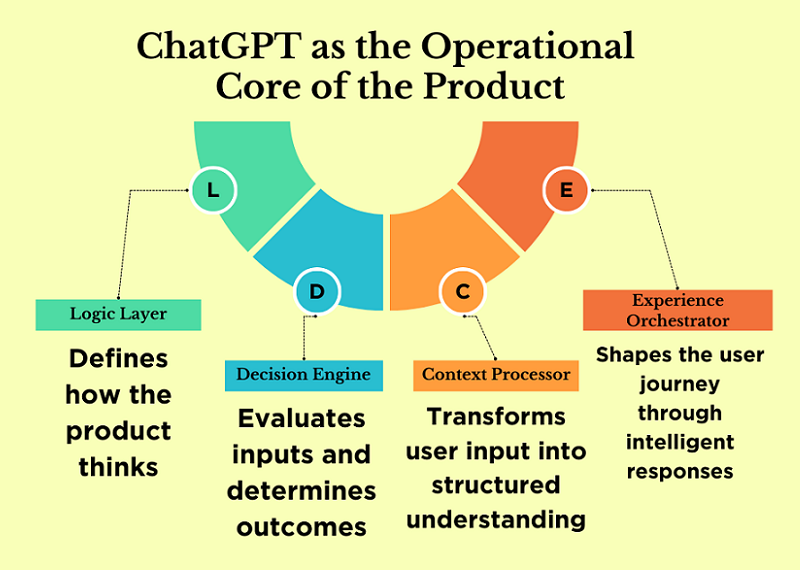
ChatGPT as Product Logic

When ChatGPT is used as product logic, it ceases to be a response generator. In this role, it is responsible for the product’s behavioral rules: what is acceptable, what is not, what steps are possible, and in what order they should occur.

This is the interpretation layer, not the generation layer. The model doesn’t simply output text; it interprets input data according to defined principles. Essentially, ChatGPT becomes the carrier of the product’s business logic.

The product ceases to be rigidly coded. Fixed scenarios are replaced by rules that can be expanded and refined. This allows for the addition of new features without rewriting the entire logic.

It is at this level that codeless scalability emerges. When logic is moved to the system layer, the product can grow in complexity without losing manageability.

ChatGPT as a Decision Engine

A decision engine is a component that determines what to do next: which scenario to choose, which step is logical in the current context, which action will bring the most value to the user.

Most no-code AI products simply lack this layer. All decisions are hardcoded into prompts or delegated to the user. As a result, the product doesn’t manage the process—it merely reacts.

ChatGPT is ideal as a decision engine because it can handle context, conditions, and priorities. But only if decisions are formalized. The model must understand which factors are important and how to weigh them.

The decision engine is the heart of the product. Without it, neither scalability nor predictability is possible. It is the absence of this layer that often limits the growth of no-code AI projects.

ChatGPT as a UX Layer

User experience isn’t a design or an interface. It’s how a product interacts with the user over time. In AI-powered products, UX is defined by dialogue logic, reactions, and contextual adaptation.

When ChatGPT is used as a UX layer, it manages this interaction. It adapts product behavior to the user’s level, their goals, and their current stage. Meanwhile, the product’s structure can remain unchanged.

This approach allows for personalized experiences without complicating the architecture. The same product feels different to different users, but remains manageable internally.

When UX is integrated into the AI layer, personalization becomes the standard, not the exception. This provides a significant advantage during growth and makes the product resilient to increasing complexity.

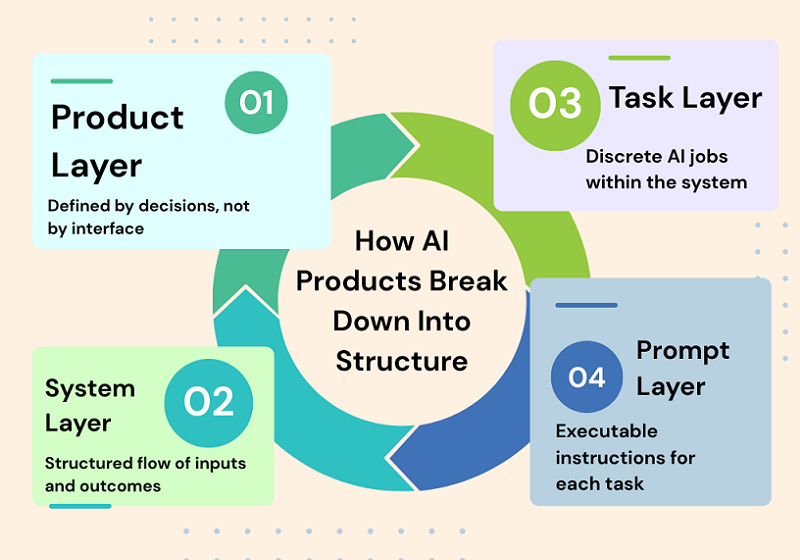
3. The Core Mental Model: From Product → Systems → Tasks → Prompts

Most no-code AI products fail not because of bad prompts or weak models, but because of a faulty mental model. People start with the interface, then move on to individual screens, buttons, and automations, and only at the very end do they consider the logic. This approach doesn’t work in AI products. It’s important to start not with how the product looks, but with how it makes decisions.
An AI product isn’t a UI or a set of features. It’s a chain of decisions that is triggered by input data, processed through context and rules, and culminates in a meaningful outcome. If this chain isn’t described, no amount of prompts will save it. That’s why scalable AI products are always designed top-down: from the system to the tasks, and only then to specific prompts.

Product ≠ Interface

One of the most common mistakes is to assume that the product is equal to the interface. A screen, an input form, or a “Generate” button create the impression of a product, but they are not a product in themselves. The user comes not for the interface, but for the result: a decision, a recommendation, an action, or a response.

In an AI product, the interface is merely a way to convey context and obtain an output. All the value lies between these points. If you remove the UI and the product ceases to exist, then the product never existed.

Strong AI products can be described without a single screenshot: through the decisions they make and in what order. The interface can be changed, simplified, or completely redesigned, but the product logic must remain stable.

This shift — from interface thinking to behavioral thinking — is what separates experimental AI projects from real products. In AI systems, UX doesn’t start with screens; it starts with decision logic, context handling, and predictable behavior.
If you want a deeper breakdown of how UX and system architecture merge in AI products, read our detailed guide on Designing and Building AI Products and Services — From UX to System Architecture.

It explores how user experience, context design, and system structure must be treated as a unified layer — especially in no-code AI environments.

Product as a chain of decisions

It’s more accurate to think of a product as a sequence of decisions rather than a set of features. At each step, the system answers a specific question: what’s important now, what should be ignored, what’s the logical next step.

For example, an AI assistant doesn’t “answer a request,” but first determines the type of task, then evaluates the user’s context, then chooses a response strategy, and only then generates a conclusion.

If these steps aren’t explicitly described, the model begins to guess. While this seems acceptable when the user base is small, as the system grows, it becomes unstable and unpredictable.

Scalability emerges when each decision in the chain can be explained, repeated, and modified if necessary.

Decomposition of an AI product: input → processing → context → output

Any AI product, regardless of complexity, can be decomposed into four basic blocks. The first is input: what exactly the user transmits to the system and in what form. The second is processing: what rules, filters, and checks are applied before accessing the model.

The third block is context. This is the most underestimated part, where the user’s history, goals, product constraints, and business rules are stored. Without context, the model operates blindly. And only the fourth block is output: response format, tone, structure, and constraints. When these blocks are separated, the product becomes manageable. Individual parts can be improved without disrupting the entire system.

This decomposition makes it possible to build complex AI products without code, but with a clear architecture.

4. Defining the AI Job (Before Any Prompting)

Before writing the first prompt, you need to answer the key question: what work does the AI do for the user? Not “what does it generate,” but what problem does it solve and what decisions does it make instead of humans?

Most no-code projects skip this step and immediately move on to experimenting with prompts. The result is a set of answers that lack logic and predictability.

Defining the AI job is the foundation of the product. If you can’t describe it in one or two sentences, the product isn’t ready for implementation. This step saves dozens of hours of rework and scaling down the road.

This is exactly where most founders get stuck — not because they can’t build, but because they start building without a validated direction.

Before defining prompts, flows, or system rules, there must be clarity around the problem itself. A scalable AI product doesn’t start with automation; it starts with a clear, narrow SaaS idea that solves a painful, repeatable problem for a specific user group.

Many no-code AI projects fail not due to poor execution, but because the initial idea was too abstract, too broad, or disconnected from real user demand. Without pressure from a real market, even the most elegant system architecture ends up solving the wrong problem.

If you’re still exploring where strong SaaS ideas actually come from — and how to quickly filter signal from noise — I’ve shared the exact process I use in this free lesson: Day 1 — Where to Find Great SaaS Ideas (and how to vet them)

The focus is not on brainstorming, but on identifying problems worth building systems around, before any prompts, tools, or automation come into play.

If you’re still at the idea stage and need a practical walkthrough from defining the concept to launching with first users, read our guide: How to Build an AI Product Step by Step — From Idea to First Users (No Code). It breaks down the entire path from idea clarity to real-world validation without requiring technical skills.

What exactly does AI do for the user?

AI shouldn’t be a “smart conversationalist” or a “universal assistant.” It should have a clear role. For example, analyzing data, helping with decision-making, structuring information, or automating routine tasks.

The more precisely the AI’s role is defined, the more stable the product will be. The user should understand what they’re paying for and what results they’ll get.

It’s also important to define boundaries: what the AI always does and what it never does. These limitations build trust and facilitate scaling.

A good AI job sounds like a job description, not a marketing slogan.

What decisions does AI make independently?

The next level is decisions. It’s important to clearly define where the AI makes decisions independently and where it simply executes instructions. This could be scenario selection, information prioritization, or determining the next step.

If the AI doesn’t make decisions but only reacts, the product quickly hits a ceiling. It can’t adapt to complex cases and non-standard users.

Decisions must be formalized: what signals are used to make them and what options are acceptable.

This approach transforms AI from a text generator into a decision engine that delivers real business value.

Task types: generation, transformation, analysis, classification

All AI tasks can be reduced to a few basic types. Generation is the creation of new content from scratch. Transformation is the modification or improvement of existing data. Analysis is the extraction of meaning, conclusions, and insights.

Classification is the distribution of information into categories or scenarios.

It’s important not to mix these types in the same step. When a single prompt tries to do everything at once, the result becomes unstable.

Separating tasks by type simplifies the architecture and makes the product predictable. This is especially critical for no-code solutions, where logic is more important than tools.

5. Turning a Product Into Prompt Blocks

Once the AI Job is defined, you can move on to the next step: transforming the product into prompt blocks. And this is where what distinguishes a scalable AI product from a collection of tooltips begins.

Most projects use one big prompt and hope it will solve everything. In practice, this leads to instability, errors, and the inability to further develop the product.

Prompt blocks are a way to break down product logic into manageable parts. Each block is responsible for its own function and can be modified independently.

This approach allows you to update the product without rewriting the entire logic. This is especially important as users grow and new scenarios emerge.

It’s important to understand: prompt blocks are not about text, but about structure. They reflect how the product thinks, not what it writes.

This is where the no-code approach truly shines: you work with logic and rules, not code and architecture.

The system prompt as a product foundation

The system prompt defines the basic rules of AI behavior. This isn’t a “be an expert” instruction, but a description of the system’s role, boundaries, and operating principles.

It answers questions such as what is acceptable and what is unacceptable, and how the product interacts with the user. Without this, the AI begins to “float” between scenarios.

A good system prompt rarely changes. It reflects the product’s philosophy and positioning.

If the system prompt isn’t defined, each task prompt begins to pull the product in its own direction. Ultimately, the logic falls apart.

Task prompts, guardrails, and output rules

A task prompt is responsible for a specific task at a specific moment. It is always shorter and more focused than a system prompt.

Guardrails are used to restrict AI behavior: what it shouldn’t do, what errors are unacceptable, what formats are prohibited.

Output rules determine the appearance of the output, not its contents. This reduces variability and improves quality. Together, these elements transform generation into a controlled process, not a lottery.

Fallback Logic and Reusable Prompts

Even the best system makes mistakes sometimes. Therefore, a scalable product always includes fallback logic: what to do if the AI is unsure or the context is insufficient.

This could be a clarifying question, a simplified scenario, or a safe default response. The main thing is that the product shouldn’t break.

Reusable prompts allow the same logic blocks to be used in different parts of the product. This speeds up development and reduces errors.

When prompts become reusable, the product begins to grow as a system, not as a set of workarounds.

6. Designing Prompt Chains That Don’t Break at Scale

In the early stages, almost any AI product relies on a single, large prompt. This seems convenient: everything is in one place, fast, and without unnecessary structure. But this is precisely where future failures occur.

One long prompt may work for a dozen users, but as it grows, it becomes fragile, unpredictable, and practically unmanageable. Any change breaks something else.

Prompt chains are a way to turn generation into a process. Instead of a single “magic prompt,” the product begins to think in steps. Each step solves its own problem and passes the result on.

This approach reduces complexity, simplifies debugging, and allows the system to scale without rewriting everything from scratch.

It’s important to understand: prompt chains are not a technical optimization, but a product optimization. They reflect how the product makes decisions.

When prompt chains are designed correctly, the AI becomes predictable and reliable, even as the workload and number of users grows.

In this section, we’ll look at why chains always win over single prompts and how to build them so they don’t fall apart over time.

Single Prompt vs. Chained Processes: What’s the Real Difference?

A single prompt tries to handle everything at once: understand the context, make a decision, and return a result. This overloads the model and increases the likelihood of errors.

In a chained process, each prompt performs a single role: analyze, clarify, make a decision, or generate a response. This reduces the cognitive load on the system.

The main advantage of chained processes is manageability. You can improve one step without affecting the others. This approach makes the product flexible: adding new logic doesn’t require rewriting everything.

To the user, it feels like a “smart product,” not like a chat with good answers. Chained processes allow the AI to guide the user, rather than simply react to requests.

Why long prompts break with growth

A long prompt is a hidden monolith. It’s difficult to read, hard to update, and almost impossible to test. When new conditions are added, it becomes inconsistent: some instructions begin to conflict with others. The model begins to “guess” which rules are more important, and response quality becomes unstable.

As users grow, this becomes especially pronounced: identical queries yield different results. Breaking the prompt into chains allows you to clearly define priorities and the order of actions. This reduces the number of unexpected responses and simplifies quality control.

Conveying context and reducing errors in flowcharts

Context isn’t just a message history. It’s the user’s goal, the current state of the task, and the product’s limitations.

In flowcharts, context is conveyed deliberately: each step receives only what it needs. This reduces noise and reduces the likelihood of hallucinations. Errors are easier to localize: if something goes wrong, you know which step.

Additional checks between steps allow you to filter out weak or incomplete results. As a result, the product becomes resilient even in complex use cases.

7. Human-in-the-Loop Without Killing Automation

Full automation is a beautiful idea, but it rarely works 100% in real AI products, especially during the growth phase. Attempts to completely remove humans often lead to a drop in quality and a loss of user trust.

Human-in-the-loop isn’t a sign of system weakness, but rather a sign of product maturity. The goal isn’t to “check everything,” but to intervene where it’s truly needed. A properly integrated human enhances automation, not hinders it.

Human verification helps the system learn, adjust, and remain reliable in challenging situations.

In this section, we’ll discuss how to integrate manual verification so that the product remains scalable. We’ll also discuss why quality is a product strategy, not a technical metric.

Where manual verification is truly necessary

Human verification is needed where errors are costly: legal formulations, finances, and reputational risks. Manual verification is also important in new or rare scenarios where data is still scarce.

In the early stages, this helps quickly identify system failures.

It’s important that verification be targeted, not comprehensive. Otherwise, the product becomes a high-cost semi-automated system. Manual verification should enhance the system, not replace it.

Where automation should work without human intervention

Repetitive, standardized tasks are ideal for full automation.

If the scenario is stable and well-defined, human intervention only slows down the process. Here, it’s important to trust the system and measure overall quality, not individual errors.

Automation should resolve 80–90% of typical cases. This creates a sense of speed and reliability for the user. Human intervention is only necessary in exceptional cases.

Quality, Hallucinations, and Product Trust

Hallucinations aren’t a model bug, but a consequence of poor product logic. They most often occur when AI is forced to respond without sufficient context or constraints.

Human-in-the-loop technology allows us to detect such cases and adjust the system accordingly.

But even more important is to design the product so that AI can honestly say, “I’m not sure.” This paradoxically increases user trust. A high-quality AI product isn’t one that always responds, but one that knows when not to respond.

8. Making the AI System Upgradeable (Very Important)

Most AI products look good at the start, but start to fall apart with the first changes. If you need to change the logic, everything breaks. If you need to improve the quality, you have to rewrite half the system. This happens because the product was initially designed as one big prompt, not as an upgradable system.

An upgradable AI product is one where change is not a concern. You can strengthen the logic, change behavior, add constraints, and improve the result without rewriting everything from scratch. This approach is especially important for no-code projects, where the cost of error is higher and technical debt is not visible until the very last moment. In this section, we’ll explore how to think about an AI system so that it lives and evolves alongside the product.

Decoupling Logic From Prompts

The biggest mistake is storing all the logic within a single prompt. When logic is mixed with text, any change becomes risky. An upgradable system takes rules, steps, and conditions outside the wording.

A prompt should execute logic, not contain it entirely. This way, you can change behavior without rewriting instructions. This reduces bugs and speeds up iterations. As a result, the product becomes manageable, not brittle.

Prompt Versioning as a Product Primitive

Versioning isn’t about accuracy, but about product survival. Without versions, you don’t know what exactly improved or worsened the result. Every logic change should have its own version and purpose. This allows for rollbacks, comparisons, and hypothesis testing.

Versioning transforms chaotic edits into managed development. Even without code, you can build a simple yet reliable versioning system. This way, an AI product begins to evolve, not degrade.

Scaling Users Without Scaling Chaos

User growth always exacerbates a system’s weaknesses. What worked for 10 users breaks down for 100. An upgradable AI system anticipates increased load and a variety of scenarios. This means clear constraints, fallback logic, and predictable outputs.

It’s important for the system to behave reliably even with erroneous input data. This is where
most no-code products begin to fail. A good architecture scales more smoothly than it seems.

Why Most AI Products Break at This Stage

Most products fail not because of the model, but because of the structure. Founders try to “improve the answers” instead of improving the system. Every change increases complexity and reduces control. At some point, no one understands how the product works. This is the point where development stalls.

Upgradeable thinking prevents this scenario from happening. It transforms AI from a hack into a long-term asset.

9. Real Examples: From Prompt → Micro SaaS Feature

Abstract concepts are useful, but real-world examples best demonstrate the product’s thinking. It’s important to understand: a Micro SaaS feature isn’t “AI that writes something.” It’s a limited, repeatable value for a specific user.

In all the examples below, AI is just one layer within the system. We won’t discuss specific tools or platforms. The focus is on the logic, structure, and product presentation. This is how a prompt becomes a commercial feature.

From Text Generation to a Writing Workflow

AI writers as a product aren’t just text generation on demand. It’s a controlled process with a goal, style, and constraints. The user doesn’t receive “options,” but a result tailored to their task.

The system knows what to write, why, and in what format. Context and rules are more important than wording. Thus, AI becomes part of the workflow. This is a Micro SaaS feature, not a demo model.

Turning Analysis Into a Decision Engine

An AI analyzer isn’t just about analyzing input data. Value emerges when the system makes conclusions and recommendations. The user pays for time savings and clarity. A good feature hides complexity but preserves logic. Analysis is always tied to context and purpose. The output is an action, not a report. This is how AI begins to influence business decisions.

Building an Assistant That Knows Its Role

An AI assistant breaks down when it tries to be “everyone.” A product assistant always has a clear role. It knows what it can and cannot do. It remembers the state of the process and the next step. Such an assistant doesn’t just chatter—it helps. The role constrains the model and amplifies the result. This turns the assistant into a valuable feature, not a toy.

10. Common Mistakes Non-Technical Founders Make

Almost all mistakes in AI products appear technical, but they are actually product-related.

Founders without a technical background rarely make mistakes due to a lack of code—they make mistakes due to a lack of structured thinking. AI appears “smart,” which creates the illusion that it will figure out how to work correctly. As a result, the product is assembled as a set of chaotic solutions that only work under ideal conditions.

It’s important to understand: these mistakes are not made by newbies, but by smart, motivated people. They simply think in terms of tools, not systems. Below are the most common patterns that prevent an AI product from reaching real users and achieving stable growth.

The “One Big Prompt” by Fallacy

One huge prompt seems like a simple and quick solution. At first, it can actually produce good results. But the more logic you cram into it, the less manageable it becomes. Any change starts to break behavior in unexpected places. You lose track of why the product works the way it does. A large prompt is impossible to scale and improve systemically. Ultimately, it becomes a single point of failure for the entire product.

Believing One Model Can Do Everything

The idea that “one model can solve everything” sounds tempting. But in real-world products, the tasks are too diverse in nature.

Decision generation, analysis, and decision making require different approaches. When everything is mixed in a single request, quality deteriorates unnoticeably. The model begins to guess instead of acting logically.

The product loses predictability and user trust. Good AI systems separate roles, rather than relying on magic.

Building Without a Systemic Structure

Lack of structure is the most costly mistake. The product is built around screens, not logic. There’s no clear understanding of input, processing, and output. Each new feature is added on top of the old, not within the system. Over time, the product becomes fragile and complex. Fixes begin to cost more than the initial build. Without structure, an AI product doesn’t last long.

Ignoring Constraints and Guardrails

Many founders are afraid to limit AI. It seems that limitations reduce the product’s intelligence. In fact, it’s the opposite: limitations create reliability. Without guardrails, AI begins to behave unpredictably. Errors don’t appear immediately, but as users grow. Users see chaos where they expected stability. A good product always knows what it shouldn’t do.

Final Thoughts: AI Products Are Built With Thinking, Not Code

AI products win not through technology, but through thinking. Code is now accessible to everyone, and models are becoming cheaper and more powerful every month.

Real advantage emerges where there is clarity, structure, and focus. A product is not an interface or a prompt, but a decision system. When you start thinking about AI as a logical layer, everything changes. You stop chasing “better answers” and start building controlled behavior. That’s when predictability, quality, and scalability begin to appear.

Long-term AI products aren’t built over a weekend. But they also don’t require large teams or complex code. They require disciplined thinking and a product-first approach. This is especially important in a no-code environment, where architectural mistakes are invisible at first — and expensive later.

For a solo founder, this isn’t a limitation, but an advantage. You can design your system intentionally, without unnecessary complexity. You move faster, iterate faster, and learn faster. AI amplifies founders who think in systems.

But architecture alone isn’t enough. A scalable system only matters when it’s tested in the real world with real users. Once your AI logic is structured and your product thinking is clear, the next step is execution and validation.

If you’re ready to move from system design to real-world traction, follow our step-by-step guide on how to launch an AI SaaS and get your first users in 30 days.

how-to-scale-a-saas-business

How to Scale a SaaS Business: Step-by-Step Guide to 10 – 50 Paid Users

How to scale a SaaS business from zero to 10–50 paying users isn’t about growth hacks or complex automation. What matters most is putting your product in front of the right audience early, so they clearly understand its value and functionality.

It’s been noted that many new micro SaaS projects fail not because they’re ineffective, but because their launch was initially poorly coordinated. Founders build the product and then think they’ll find paying users, wasting time without feedback or initial profit.

The fastest path to first sales begins even before development is complete. A smart pre-launch strategy allows you to capture demand, test willingness to pay, and build momentum before release.

This guide describes steps to quickly get your first 10-50 paying customers. Each approach is designed for working with limited resources and minimal automation.

You’ll learn how to attract users with high purchase intent, convert them at the start, and turn early demand into scalable growth. The goal here isn’t growth at any cost, but rather building a business with rapid momentum from the very beginning.

1. Start with a Narrow Audience with High Purchase Intent

The biggest mistake founders make is trying to please everyone at the start. Don’t focus on a mass audience, as it requires large budgets, a long decision-making cycle, and complex marketing.

Always focus on a narrow target group that already has a pain point and needs a solution right now. That’s how you’ll get your first 10-50 paying users.

a) Formulate an Urgent Problem

When you go to the pharmacy and buy a medicine, you’re actually paying not for the product but for the opportunity to relieve pain. It’s exactly the same in the world of SaaS products. The user wants to eliminate their pain. You need to identify the user’s problem—one that they regularly face, one that’s already being solved with spreadsheets, hacks, or manual labor, and one that impacts their money, time, and reputation. The urgency of the user’s problem is key to driving quick sales. If you’re unsure how to consistently find urgent, high-value problems like this, start with Day 1 — Where to Find Great SaaS Ideas (and how to vet them). It walks through a practical framework for spotting real SaaS opportunities and validating them before building anything.
b) Choose a Niche that You can Reach Manually

When launching your micro SaaS, it’s important to select an audience you can reach in person, via email, private message, or through niche communities like Reddit, LinkedIn, and Discord. This immediate, direct contact will allow you to quickly understand needs, refine your product, and close your first sales without complex marketing.

c) Confirm Demand Through Conversations

Personal contact with users is the best way to understand their problem and provide them with a solution. If they have a product but aren’t satisfied with it, find out what you can do to make them happy. Gently offer early access to your SaaS product. If people are willing to discuss pricing and ask probing questions about your product, you’re on the right track. This is how you build a pipeline of early paying users.

2. Create a High-Converting Opt-In Page Before Launch

Your core SaaS product may be unfinished, but that’s no reason to wait with marketing. Creating a well-designed pre-launch opt-in page allows you to gather your first subscribers and customers, test demand, and prepare your audience for payment immediately after launch.

This isn’t just a web page; it’s a tool for early marketing and testing your product’s value.

a) Sell the Outcome, not the Product

Users aren’t interested in how your product looks, and they don’t want to delve into technical details. They want a concrete result that solves their problem. To achieve this, describe the end value on your opt-in page, using language your audience can understand without complex technical jargon, and avoid long, dense descriptions that are difficult to understand. Your goal is for the website visitor to immediately understand that the product solves their problem.

b) Use Scarcity and Positioning

You need to understand the unique features of your micro SaaS and showcase them to future customers. You also need to create a sense of scarcity. This can be achieved through limited access, such as limited access to 50 seats at a certain price, with a discount for early adopters. Early adopters can also receive certain bonuses. You can also break the launch into stages, introducing new features to users. This also generates interest in the product. All this creates a sense of value and accelerates the decision to subscribe.

c) Capture Emails with Clear Intent

Don’t assume that quickly creating a pre-launch page will generate subscriptions. The key is to capture the user’s intent to pay. For example, you can inform the user that they will receive early access for $X. You can also collect not only the user’s name and email address, but if this is important to your business, you can also collect information about the user’s company size, their role in the business, and so on. These leads will form the basis of your pre-launch email funnel, with high conversion rates and initial payments expected at the start.

3. Build a Pre-Launch Email Funnel That Warms Users Up

If your product is still in development, that’s not a problem. It’s important to create a pre-launch email funnel now that builds trust, demonstrates the product’s value, and generates user interest.

Set up a consistent email sequence, and you’ll be able to not only talk about the problem and its solution but also highlight progress, feedback, and insights. This will ensure that your first paid users get started immediately after launch, already understanding the functionality of your micro SaaS.

a) Educate Users about the Problem

At this stage, your goal is to convey to your audience the importance of the problem you’re solving. You need to show examples of the difficulties other users are experiencing without your product and why this is critical for their business. If you have case studies, use them to clearly define the scale of the problem. This will create an emotional connection with the user, and such users are more likely to purchase micro SaaS products when they understand the consequences of ignoring the problem.

b) Show Progress and Social Proof

Share stories from early testers, beta results, and feedback. When users see you regularly displaying such content, it means your micro SaaS is gradually moving toward launch. Audiences feel like they’re participating in something exclusive when they see social proof. People enjoy the feeling of being part of the process at the same time. It’s almost a sign of willingness to pay for the product upon launch.

c) Pre-Sell Before the Product is Finished

You don’t need to wait until your product is fully ready to start monetizing. Offer early access, exclusive terms, and a discount to subscribers of your pre-launch marketing funnel as soon as possible. This way, you’ll quickly build a core of paying users, receive your first revenue, and validate real demand before investing more time into development. If you’re still shaping your idea, positioning, and first-user strategy, follow the AI SaaS Roadmap: From Idea to First Users in 30 Days Without Heavy Coding. It outlines a practical path from validation to your first paying customers without heavy technical complexity. The value and limited nature of your early offer are exactly what you need to emphasize. When people see clear benefits and defined limits, they’re far more likely to act immediately instead of postponing the decision.

4. Launch with a Clear Offer, Not Just a Product

When you launch a SaaS product, as we’ve already learned, people are buying a solution to their problem. Therefore, it’s important to formulate a clear offer. Users should understand what they’re getting, why it’s better than other options, and why it’s worth starting now.

Especially during the initial stage of recruiting the first 10-50 paying users, it’s important to give them a sense of exclusivity and a simple path to success.

a) Limited-Time Pricing for Early Adopters

Don’t be afraid to offer something mega-exclusive. For example, the first 50 users receive a 50% discount for the entire year. People see the obvious benefit and are afraid they might miss out on such a great chance to get your SaaS with such a discount. Always clearly state the expiration date or user limit. This helps convert interest into quick action.

b) Remove Friction from Onboarding and Payment

Make the launch process as simple and transparent as possible. Minimize the number of steps, such as enabling popular payment methods like PayPal or Stripe, and allowing users to use the product without complicated registration or verification. These are all important factors, as any obstacle of this kind reduces conversion. Even a minor complication can reduce customer acquisition by half. To do this, ask your colleagues and friends if they encounter any barriers on the site, and you’ll get excellent feedback on what needs to be eliminated to ensure everything runs smoothly.

c) Personally Onboard Your First Users

There are some SaaS projects where every user is truly cared for. You can do this at the initial stage, for example, by holding a demo session of your product or configuring it together with the user. This way, you’ll get even more user feedback, which will allow you to implement improvements. This works wonders, as your first customers are the ones who provide reviews of your product on other websites, which is crucial for your business. Also, ask them for reviews and post them on your website.

5. Use Direct Outreach to Get Your First 50 Paid Users

At the launch stage of your product, there’s no point in waiting for users to accidentally discover it. Directly reaching your target audience is the fastest way to attract paying customers.

Your goal here is not just to talk about your product, but to demonstrate how it solves a specific problem right now.

If you have a micro SaaS that would be useful to online companies, then even if you reach 500 online companies and only 10% become paying users, you’ll already have 50 consistently paying users every month.

Therefore, don’t delay this method of attracting paying users. This will allow you to quickly receive your first payments and validate your product. You’ll also establish personal contact with users and collect valuable feedback to improve your product.

a) Cold Emails with a Problem – First Approach

Cold emails should never be about product promotion. First, highlight a problem your prospect has likely already encountered and demonstrate how your micro SaaS solution can help them solve it. This works because each of us responds to a real, personal pain point, not to yet another out-of-the-box service. To be even more convincing, use specific figures or examples from your experience. This also plays a role whenengaging with the user.

b) Leverage Your Waitlist and Early Signups

Create a sense of urgency in your waitlist for your users. This will increase conversion and attract more paying users. They’re already interested, but they need a little nudge to make a quick decision—that is, to pay. Offering some kind of exclusive access or bonus will further strengthen your offer.

c) Turn Conversations into Paid Trials

Once you’ve successfully established a dialogue with your user, it’s important to offer value through a paid trial. Here, you need to demonstrate the product in action and motivate users to pay without leaving any room for doubt. You can offer a short paid trial instead of a free period. Many perceive this as an indicator of the product’s credibility. For example, an offer that allows users to try all product features for 7 days for $1. The key here is not to engage in dialogue for the sake of dialogue, but to clearly lead users to a paid trial by demonstrating the product’s value and alleviating any doubts.

6. Turn Early Users Into Proof and Growth Assets

Don’t ignore the growth phase at the initial stage of launching your micro SaaS project. Your asset is when 10-50 paying users are already solving a real problem, and it’s important to capture this evidence now.

Don’t try to generate huge amounts of traffic right away. It should be highly targeted to gain a special degree of trust from users and social proof of the need for your product.

Try to focus on extracting maximum value from existing users. Even a few successful case studies can significantly increase conversion rates on your landing page and in sales. Your task is to quickly transform the initial results into clear and compelling stories.

a) Collect Testimonials and Quick Wins

If you already have 10-50 paid users, some of them will quickly experience positive results when interacting with your product. It’s important to capture this moment. Reach out to your users after a while and ask them to leave a review. Even a 3-4 sentence format works better than a long text in the early stages. Use real customer feedback, screenshots, and real numbers. Typically, the more positive case studies you have, the faster new users will start subscribing to your product. In any case, it’s minimal effort with maximum impact.

b) Create Simple Case Studies Fast

Case studies don’t have to be complex or detailed. A simple structure is sufficient: problem → solution → result. Even one specific use case can demonstrate the product’s value better than any marketing text. Publish such case studies on your website, for example, as articles on your blog, in your newsletter, or use them in personal messages. The sooner you start collecting them, the easier it will be to scale. At this stage, quantity and relevance are more important than perfect presentation.

c) Use Referrals and Founder Credibility

f you connect with a couple of founders of SaaS brands or even mid-sized companies whose names are household names, people will be more likely to buy your product. This is a recommendation from the brand’s founder, not just some guy from the streets.

7. Systemize What Works to Reach 50 Paid Users

Once you understand where your first paying customers are coming from, it’s time to systematize. Scaling isn’t about adding new channels, but rather strengthening what’s already producing results.

Many SaaS projects make the mistake of spreading their efforts too thin. Instead, it’s important to solidify your workflows and eliminate any unnecessary clutter.

The goal of this stage is to create a repeatable system for attracting and activating users. This is what will allow you to consistently reach the 50 paying customer mark.

a) Double Down on the Best Acquisition Channel

Don’t spread your attention too thin across a ton of different traffic sources. Simply find one channel that brings you more targeted traffic than the rest. This could be social media or cold emails, for example. Focus on improving it while simultaneously searching for new traffic sources. In the early stages, focus is more important than scale. Then, gradually increase traffic volume and improve conversion.

b) Automate Onboarding and Email Sequences

Manual onboarding works well at the start, but then you need to automate key stages. Welcome emails, prompts, and follow-ups save time and increase activation. It’s important for users to quickly understand the value of your product without your intervention. A simple email series can significantly increase retention. We’re not talking about complex funnels here, but rather a basic structure and sequence of actions. The less friction, the higher the chance of payment.

c) Avoid Premature Scaling Mistakes

One of the most common mistakes is launching ads or scaling a team too early. If the product isn’t yet stable and the funnel isn’t polished, scaling will only exacerbate the problems. Before you reach 50 paying users, it’s crucial to remain flexible and close to the user. Repeatable results come first, then growth. A solid foundation is always more important than quick numbers. Patience at this stage pays off many times over.

Final Thoughts

Reaching 10–50 paying users isn’t a matter of luck, but the result of the right sequence of actions. At this stage, the most technologically advanced products win, but rather those that best understand their users. Focus, speed, and consistency are key. Use early results as an asset, strengthen existing channels, and take your time scaling. This approach lays the foundation for further growth in a SaaS business.

How to Set Up Freemius Payments

How to Set Up Freemius Payments for Your AI Micro-Saas Project

The freemium model is a common monetization approach for micro SaaS products, where users start with free access to limited features and pay to unlock advanced functionality.

People rarely commit to paying for software they haven’t experienced. Giving users the ability to explore a product before spending money significantly reduces friction and makes adoption easier.

For SaaS businesses, the freemium model works especially well because it allows users to see real, practical value in action. Once the product proves its usefulness in day-to-day scenarios, upgrading to a paid plan becomes a natural next step rather than a forced decision.

That said, freemium is not just a pricing tactic — it’s a system. Without a clear understanding of how it should be implemented across your product, payments, and growth infrastructure, it’s almost impossible to build predictable and sustainable revenue. Poor execution often leads to large numbers of free users with little to no monetization.

This is where Freemius comes in. It’s a platform designed to help SaaS founders implement freemium and paid models correctly, without turning monetization into a technical or operational burden. In this article, we’ll look at how Freemius works and which marketing capabilities it provides to support growth.

1. Turning Free Users into Paying Customers

a) Subscriptions, Licensing, and Payments in One System

Freemius provides an all-in-one infrastructure for handling subscriptions, license management, payments, taxes, marketing automation, and analytics for digital products, including SaaS. It allows you to manage free and paid access from a single dashboard, without building complex custom solutions.

The platform takes care of subscription billing, payment processing, tax compliance, and security by default. On top of that, it offers a wide range of built-in features that simplify monetization. Instead of stitching together multiple tools, you get a unified system that lets you focus on product and growth rather than payment logic.

b) Designed for Conversion, Not Just User Acquisition

Freemius is built with one core objective in mind: converting free users into paying customers. Every marketing feature inside the platform supports this goal.

Tools such as behavioral analytics, in-product upsells, discount campaigns, and automated triggers are designed to nudge users toward upgrading at the right moment. The self-service user portal allows customers to upgrade plans, manage licenses, and update payment details on their own — reducing friction, improving retention, and lowering support overhead.

Beyond surface-level growth metrics, Freemius helps you understand how users interact with your product, identify blockers in the payment journey, and increase customer lifetime value. The focus is not on collecting free sign-ups, but on building a monetization engine that scales with your SaaS.

2. Planning Pricing Tiers and Paid Features

Pricing drives growth in every SaaS business. Founders need to decide not only how much to charge, but also which features belong in free access and which ones create real incentive to upgrade.

Users should experience value before they see a paywall. When people understand what your product does and how it helps them, moving to a paid tier feels natural. A well-designed pricing model increases the chances that free users turn into paying customers instead of staying stuck on the entry level.

a) Structuring Free and Paid Access

Imagine a micro-SaaS that solves one clear problem. The free plan lets users achieve a meaningful result and understand the product’s core benefit. At the same time, it clearly shows that more advanced capabilities exist in the paid version.

This balance matters. You want users to succeed with the free tier, but you don’t want to give away everything. Freemius helps manage this boundary. It allows founders to define plans and feature sets with precision, enabling or disabling functionality per tier. This approach keeps the free plan useful while protecting premium value.

b) How Pricing Structure Affects Conversion

Pricing structure directly influences upgrade behavior. When the free plan includes too many features, users see no reason to pay. When it offers too little, users fail to understand the product’s real value and leave.

The strongest conversion happens when the free tier solves a simple, narrow use case, while paid plans unlock broader capabilities and efficiency gains. Freemius supports this strategy with tools such as time-limited trials, feature-based plan configuration, and automated upgrade flows.

These mechanisms help founders observe how users interact with pricing, identify upgrade triggers, and present paid options at the right moment. Instead of forcing upgrades, the system guides users toward higher-value plans as their needs grow.

3. How Freemius Strengthens Your Marketing Funnel and Freemium Conversion

After you solve the technical side of payments, the real work begins. You need to guide users through a clear and efficient marketing funnel—from their first interaction with your product to the moment they decide to pay.

In SaaS, marketing doesn’t stop at ads or landing pages. Monetization plays a direct role in how users move through the funnel. Pricing logic, upgrade timing, and in-product messaging all influence conversion.

Monetization tools like Freemius work best when they’re part of a broader SaaS strategy — one that starts long before payments, with idea validation, positioning, onboarding, and a clear path to your first users.

If you want to see how all these elements connect into a single, structured process, this AI SaaS Roadmap: From Idea to First Users in 30 Days Without Heavy Coding walks through the full journey step by step.

Freemius helps founders shape flexible and personalized conversion paths without heavy engineering. You can test ideas, react to user behavior, and improve monetization without rebuilding your product.

a) Automated Messaging and Purchase Triggers

When a user shows exit intent, Freemius can display a targeted message instead of letting them leave silently. This small intervention often shifts hesitation into action and keeps the user engaged.

Freemius also supports discounts, upsells, and other purchase incentives that work together as part of a single system. Each message responds to user behavior, not guesswork. You create timely nudges that feel relevant instead of aggressive, which improves conversion without harming trust.

b) Marketing Integrations and Behavior Insights

Freemius connects with external marketing and analytics platforms to extend your funnel beyond the product itself. You can send data about user actions, trials, upgrades, and cancellations directly into your CRM or analytics stack through webhooks or built-in integrations.

This setup gives founders a clear view of where users slow down or drop out. You see which stages of the funnel need better value communication and which actions trigger upgrades. With data and automation working together, you build a marketing system that supports long-term growth instead of one-off campaigns.

4. Using Freemius Analytics to Drive Growth and Increase Customer Lifetime Value

Sustainable SaaS growth doesn’t happen by accident. Setting up payments alone won’t create predictable revenue. Founders need visibility into how users behave and what motivates them to stay, upgrade, or leave.

Freemius gives you direct access to these insights. The platform shows live performance metrics and lets you compare user segments so you can make informed growth decisions for your micro-SaaS. This approach matters even more when your business relies on subscriptions and ongoing engagement.

a) Metrics That Matter for Growth and LTV

Running a micro-SaaS means tracking the right numbers. Metrics like monthly recurring revenue (MRR), churn rate, average revenue per user (ARPU), and customer lifetime value (LTV) shape every strategic decision.

Freemius displays these metrics in real time inside the dashboard. You can quickly identify which plans generate the most value and which features need refinement. By exploring the data, founders understand which users stay longest, which segments drive revenue, and where additional engagement can improve retention.

b) User Segmentation and Cohort Analysis

Cohort analysis groups users by shared characteristics such as acquisition source, plan type, or signup period. Tracking these groups over time reveals patterns that individual metrics can’t show.

With Freemius, you create cohorts automatically and monitor their behavior without exporting data or building complex spreadsheets. This visibility helps founders pinpoint when churn spikes, which features push users to upgrade, and which customer groups deliver the highest long-term value.

5. User Retention and Churn Reduction with Freemius

User acquisition is only part of the success of the freemium model. It’s also important to retain paying customers, increase their lifetime value (LTV), and thus generate the core profit of your micro SaaS.

Freemius provides a complete set of tools for subscription management, user behavior analysis, and developing strategies aimed at reducing churn and increasing repeat sales.

a) Working with Subscription Renewals and Reminders

One of the reasons paid subscriptions are cancelled is unintentional cancellations of renewals. Users may forget about license renewal deadlines, misunderstand the value of upgrades, or simply hesitate over their decision. There are factors that reduce passive cancellation and make subscription renewal a natural continuation of product use. This is achieved by Freemius sending reminders about the upcoming subscription expiration. The service also notifies users of renewal benefits, such as updates, security, and support. Users can also renew their subscription without entering payment information.

b) Segmentation of Users by Behavior and Status

Not all users behave the same when interacting with the service. The service collects data on license type, frequency of updates and interactions with the product, user activity, and customer lifecycle stage. Based on this data, you can send personalized information to different segments, offer upgrades to those users who are ready to purchase, and immediately identify users at high risk of churn. This segmentation increases marketing effectiveness.

c) Win-back Strategies for Returning lost Customers

A churn isn’t always a permanent loss. Freemius provides data that helps you understand at what point a user terminated their paid subscription, which plan was a barrier, and how much time has passed since the churn. Once you have this information, you can launch win-back campaigns, such as personalized discount offers, access to new features, or temporary trial periods for paid plans. This way, you can increase your overall LTV and regain some of your lost users without spending money on acquiring new traffic.

6. Scaling Sales and Automating Monetization with Freemius

Once the freemium model has proven its effectiveness, the primary objective now becomes scaling. Freemius allows you to automate key monetization processes, reduce operating costs, and focus on product improvement rather than payment management.

a) Automation of Payments, Taxes and Licensing

Selling digital products globally can pose various financial and legal challenges. Freemius can not only process payments but also calculate and pay taxes, manage licenses and access, and issue invoices and refunds. This is especially important if your business team is small and you don’t need to build your own billing infrastructure.

b) A/B Testing of Prices and Offers

The optimal price isn’t a guess, but the result of experimentation. Freemius can test different pricing plans, monthly and annual subscriptions, bundles and upsells, and special offers for new and existing users. You can analyze conversion and revenue for each option and gradually increase ARPU (Average Revenue per User) and find the most profitable monetization models.

c) Entering the Global Market and Localizing Sales

Freemius is focused on international sales. The platform supports local payment methods, trusted checkout pages, multi-currency payments, and adaptations for different regions and markets. Developers can scale globally without having to create separate payment solutions for each country.

7. Common Mistakes When Working with Freemius and How to Avoid Them

The service provides a powerful monetization infrastructure, but developers must also know how to properly use the tools provided.

Many projects fail to realize the potential of the freemium model due to common mistakes in pricing, communication, and data management.

In practice, many of these mistakes don’t originate at the monetization stage. They usually start much earlier — when the initial SaaS idea hasn’t been clearly defined or properly validated.

If you want to begin at the very start and learn how to find and vet strong micro SaaS ideas, you can begin with Day 1 — Where to Find Great SaaS Ideas (and how to vet them).

Understanding these mistakes allows you to accelerate growth and avoid lost revenue in the initial stages of a project’s launch.

a) Generous Free Version Without Upgrade Motivation

Providing users with too much functionality in the free version of your product is a big mistake. If users perceive that they’ve received too much value, they’ll be less inclined to upgrade to a paid plan. The best approach is to ensure that the free version doesn’t address key use cases but merely demonstrates value. Paid features are a logical extension of product use. Functionality limitations shouldn’t feel like an artificial barrier. Users should see this as a natural part of their growth. Freemius allows you to track where users are stuck on the free plan and haven’t yet reached a paid plan. This is a valuable feature that will allow you to properly adjust your product growth strategy.

b) Ignoring Analytics and User Behavior

Many developers use Freemius solely as a payment tool without analyzing the data. As a result, decisions are made based on intuition rather than facts. Common problems include ignoring churn rate and LTV data, misunderstanding what influences conversion, and a lack of analysis of payment abandonment points. Regularly working with Freemius analytics, however, allows you to adjust pricing, improve onboarding, and increase overall monetization efficiency.

c) Lack of Interaction with Users After Installation

You need to constantly communicate with users so that after installing the free version of your micro SaaS, they understand the benefits of the paid version. To do this, use email notifications and in-app messages. Also, explain the value of paid features using case studies, and guide users from the first launch to the upgrade. You build all of this systemically together with the Freemius service.

Final Thoughts

The freemium model alone doesn’t guarantee success. True success lies in building the right funnel and consciously designing each stage.

If you’re a WordPress plugin developer or a micro SaaS company, Freemius becomes more than just a payment solution, but a full-fledged growth platform. This is because it allows you to convert free users into paying customers, helps you build the right marketing funnel, increases conversion, and performs a host of other essential tasks.

When you use its tools strategically, you can build a sustainable business model where product, marketing, and monetization work seamlessly.

If you plan to scale a freemium product or increase revenue without overcomplicating your infrastructure, Freemius is one of the most powerful online platforms for achieving these goals.

ai-saas-platform-vs-micro-saas

AI SaaS Platform vs Micro-SaaS: How to Build, Scale and Monetize Your Product Successfully

The AI SaaS Platform approach has fundamentally changed how software products are built. Many of these platforms embed AI-driven functionality, allowing applications to handle tasks traditionally associated with human support, such as responding to user queries in real time.

Today, you can create micro SaaS products that solve specific user problems in as little as one week — without deep technical expertise. An AI-powered SaaS product can now be built even without programming skills.

In recent years, no-code tools and AI-driven solutions have emerged, allowing virtually anyone to launch a micro SaaS business and start generating revenue.

In this article, you’ll learn the key differences between AI SaaS platforms and micro SaaS products. You’ll also discover how to build, scale, and monetize a product, and how to turn an idea into a profitable business.
Whether you’re a beginner or an experienced startup founder, this guide will help you navigate the world of AI driven micro SaaS products.

1. What is the AI SaaS Platform and How Everything Works

a) Definition of an AI SaaS Platform

An AI SaaS platform is a cloud-based software solution that uses AI to automate tasks, analyze data, or improve user experience. These platforms operate on a subscription model and require no installation. Users access the platform through a browser and pay a monthly fee to use the service. AI SaaS can solve complex business problems and specific issues within the context of micro-SaaS.

b) Core Components of an AI SaaS Platform

The days of building software entirely from scratch are largely behind us. Today, many components are available through ready-made services and integrations. As a result, assembling an AI SaaS product can take just a few days. A typical AI SaaS platform consists of several core components: an AI model or API (such as machine learning or NLP), cloud infrastructure, a backend that handles business logic, a frontend user interface, and a subscription and billing system.

c) How AI SaaS Platforms Work in Practice

Some of the mechanisms within your micro SaaS may be complex, but from the user’s perspective, everything appears simple. They enter data or requests, the AI processes the information, and the platform returns the result in real time. The user sees it, receives value, and then uses the product.

d) Why AI SaaS Platforms Are Popular for Startups

More and more newcomers are choosing to build AI powered micro-SaaS rather than large, complex platforms. This is because it offers a low entry barrier, the ability to scale quickly, and the ability to generate monthly profits.

This is exactly why many founders start not with a complex platform, but with a focused micro-SaaS idea that can be validated quickly. If you want to see how this process works step by step in practice, you can start with the first free lesson, which shows where to find strong SaaS ideas and how to validate them before building anything.

2. Micro SaaS: Small Product, Big Potential

Micro SaaS is a marketing-focused product. It solves a single problem for a specific audience.

Instead of trying to capture a huge market share, these SaaS solutions focus on one thing and offer a single, measurable value.

Due to the product’s simplicity and clear positioning, micro SaaS attracts its first customers faster.

Very low development and promotion costs allow for rapid profitability. As a result, micro SaaS becomes a rapidly growing business.

a) Focused Problem, Targeted Audience

Micro SaaS that’s focused on success starts with a narrow market segment and a specific user scenario. This focus simplifies marketing messages, reduces customer acquisition costs, and increases conversion. If your product aligns with what the customer wants and solves a clear pain point, it quickly becomes a must-have niche tool.

b) Quick Launch and early Demand Validation

Micro SaaS allows you to test your idea without large-scale investments in marketing and development. Minimal functionality simplifies market entry and allows you to test demand through a website, early access, and paid subscriptions. This means, with minimal risk, you can further scale only those solutions that have proven successful.

c) Predictable Monetization and Sustainable Growth

Micro SaaS is based on a marketing model with clear value and transparent pricing. Models such as subscription and freemium are easily understood and don’t require complex sales. Due to its high LTV and low operating costs, micro SaaS can grow steadily even with a small but targeted customer base.

3. AI SaaS vs Micro-SaaS: Key Differences You Should Know

The choice between AI SaaS and Micro SaaS directly impacts product strategy, marketing, and growth model. While both approaches can utilize AI, their scaling requirements differ. Business logic can also sometimes differ.

AI SaaS is often focused on a broader market and a more complex technical model. Micro SaaS focuses on a clear offer and niche.

The differences between them may be subtle, including in user expectations and user acquisition budgets.

a) Market Scale and Product Positioning

AI-based SaaS typically solves complex user or business problems. This requires universal positioning and significant investments in brand and trust. Micro SaaS focuses on a narrow niche where the product is easily visible and can quickly become a leader through deep specialization.

b) Marketing Complexity and Cost of Acquisition

Micro SaaS wins over AI SaaS because everything is much simpler. The message is simple, the path to purchase is short, and the CAC (Customer Acquisition Cost) is low. AI SaaS is a bit more complex, with a longer decision making cycle and more complex marketing.

c) Monetization, Growth and Operational Risks

AI SaaS typically requires investment in the model and team, which can increase financial risks in the early stages of launch. Micro SaaS offers more predictable monetization and reaches profitability much faster, maintains flexibility, and grows organically. You retain control of the business.

4. How to Build a Micro-SaaS Without Coding

Building a micro SaaS project without coding knowledge in the modern internet world is a viable strategy, and it works wonders.

You don’t even need modern paid no-code tools. You just need ChatGPT, and it will quickly give you everything you need to turn your idea into a working product and test market demand. This will allow you to accelerate the launch of your micro SaaS project and minimize financial risks.

Instead of spending months developing code, the founder can focus on marketing, value, and user feedback. For a micro SaaS project, speed and product accessibility are more important than a complex technical architecture.

a) Using No-Code Tools

There are plenty of AI platforms and no-code builders online that will help you build a functional product without writing code. However, it’s better to avoid spending money on them and instead use ChatGPT, which also handles all complex coding tasks perfectly. It can create the interface, logic, and integrations for you. This speeds up your time to market and allows you to test your micro SaaS from different angles, checking everything in real time and without significant delays.

b) Validation and Marketing First, Scaling Later

The No-Code approach allows you to validate your product’s value in just a couple of days, and your website and early access help you determine whether your audience is interested in the product before complex development. After receiving your first sales, you can gradually strengthen the technical side or bring in developers based on existing demand.

5. Validating Your Idea Before You Build

Before developing your product, make sure the market has a problem and that there’s a willingness to pay for its solution. This validation of your idea will help you avoid wasting time and resources.

If you see demand early, you’ll be able to focus on the right audience and value proposition.

This stage also forms the basis for future marketing and product positioning. The sooner you receive a positive response from the market, the higher your chances of a successful launch.

a) Identify the Real Problem and Target Audience

Start with a specific pain point for a specific group of online users. Ask them how they currently solve the problem and why they’re dissatisfied with existing solutions. Understanding your audience’s thinking clearly helps you craft your offer and increase the likelihood of a response.

b) Test Demand Before Product Development

You can measure interest using websites, early access forms, or even incredibly simple MVPs. Even a small number of registrations is a powerful signal of interest in your product. This approach allows you to make decisions based on data, not assumptions.

c) Users’ Willingness to Pay

If you want complete validation, it’s important to see that users confirm this with their willingness to pay for the solution. Pre-orders, early subscriptions, and price tests help determine how critical the problem is for the audience. Willingness to pay for a solution is the best indicator of the viability of a micro SaaS solution.

6. Monetization Strategies for Your Micro-SaaS

Choosing the right monetization strategy directly impacts the sustainability and growth of micro SaaS. You need to align pricing with the true value your product provides to the user.

Micro SaaS benefits from simple and transparent models that are understandable to virtually everyone.

Flexible monetization will help you test your product and adapt to the market. The sooner you see an influx of revenue, the faster you’ll confirm your product’s viability.

a) Subscription with Clear Value

Thanks to the expected revenue, the subscription model for micro SaaS remains popular to this day. When users see clear pricing based on usage volume, they quickly understand what they want to pay for. The key is tying the price to the outcome, not to the feature set.

b) Freemium and Trial Period

Freemium or a free trial period speeds up the acquisition of the first wave of users. This model works perfectly for niche products, where value is immediately apparent after a short period of use. It’s important to consider early on what limitations will encourage users to upgrade, rather than devalue the product.

c) Usage-Based and One-Time Payments

One-time payments work for highly specialized solutions with a clear outturn. If you have micro SaaS with variable value, such as tools with automation or AI solutions, then a pay-per-use model is better. These two models allow for flexible adaptation to different user segments and increase overall LTV.

7. Scaling Your Micro-SaaS Without Overcomplicating Things

Sustainable growth of your micro SaaS is built on maintaining focus and eliminating unnecessary clutter. This is where simplicity comes in: the fewer dependencies and manual operations, the easier it is to scale. The key is to increase value for users, not the number of features.

This approach will allow you to grow predictably and without losing control of your business.

a) Scale what’s already Working

Strengthen your existing core product before expanding to other markets. Improving the key user experience often yields greater results than expanding functionality. Scaling should be based on data: retention, LTV, and real growth points.

b) Automation Instead of Team Expansion

The great news is that a single founder is enough to run a successful micro SaaS business. They can scale everything not by hiring employees but through automation. Support, billing, onboarding, and marketing are automated with minimal overhead. This maintains business flexibility and reduces costs at all stages.

c) Controlled Growth Without Unnecessary Complexity

Not every growth is beneficial. Even if you have a strong influx of customers at the start, without a ready-made infrastructure, this can be detrimental to the start of your business. Only focusing on gradual scaling will yield long-term benefits. Clear analytics, a minimal stack, and simple processes allow you to grow without overloading your business.

Final Thoughts

Creating an AI SaaS product doesn’t necessarily require a complex infrastructure. A micro SaaS approach reduces risks and launches the product faster. You’ll be able to deliver a single, tangible value to users.

A clear 30-day roadmap, outlined in AI SaaS Roadmap: From Idea to First Users in 30 Days Without Heavy Coding, helps transform an idea into a working product and acquire your first users — all without protracted development or heavy coding

Validation before development saves time and money by allowing you to build a product based on demand, not user demand. No-code tools, on the other hand, give you access to creating micro SaaS products even without coding knowledge.

Simple monetization methods make your business sustainable from the first few months. Scaling a micro SaaS product doesn’t require complexities—focus and automation often yield better results than expanding a team. This approach maintains control over the product and growth strategy. AI enhances micro SaaS  without becoming an end in itself.

By starting small, you create a solid foundation for future scaling. As a result, AI micro SaaS becomes not an experiment, but a conscious and sustainable business mode

effective-saas-marketing-strategy

Effective SaaS Marketing Strategy for AI Startups

Building an effective SaaS marketing strategy for AI startups is very different from traditional marketing for other online products. Here, everything is built not on grandiose promises and advertising channels, but on
how quickly the user receives real value from the product.

With AI-powered products, expectations are always higher and the bar for patience is lower. Users don’t need explanations; they want results. Based on this, it’s safe to say that effective marketing strategies for AI-powered SaaS start within the product, not outside it.

The faster the user achieves the most tangible result, the higher the likelihood of activation, trust, and long-term use. And with AI-powered SaaS, the product itself is the marketing funnel, not just part of it.

1. Product-Led Growth (PLG) with AI Value First

For AI startups, a product-led growth delivers results when users can sense the value of your AI SaaS product almost immediately. The product’s goal isn’t to explain how the algorithm works, but to demonstrate its purpose. This is crucial within the first few minutes of interaction with the product.

a) Design the Fastest Possible “Aha” Moment

Onboarding should lead the user directly to the result, not to settings. In AI-powered SaaS startups, this could be a generated response, an automated action, or some other action that shortens the path from the start to the first useful result. The faster the user gets this result, the higher the chance they’ll remain your customer.

b) Let the AI Do The Talking

Instead of long descriptions and feature lists, let users experience how your AI-powered product works. Demos, sandboxes, and output samples convey product value better than any marketing copy. In AI SaaS, trust is built on results, not on vague promises.

c) Use Limitations to Drive Upgrades, Not Frustration

You should have both a free and a paid product. If a user takes control of the free version of your AI-powered SaaS, they see value, even if you don’t fully disclose the product. Usage limits aren’t a problem. If the user understands they need advanced features, they’ll still pay for the premium version. Properly designed limits turn the product itself into a conversion tool.

2. Education-Driven Content Marketing

For AI-powered startups and SaaS products, effective marketing often relies on educational content. The goal here isn’t simply to sell, but to demonstrate expertise and help potential customers understand the product and see its value. Below, we’ll explore three key approaches to educational content.

a) Learning through Blog

Many newcomers and even mid-sized internet companies greatly underestimate the power of blogs. This is often a very powerful channel for presenting complex concepts in simple language. Even if your clients find AI technologies complex, regular articles help them understand how your product solves their problems. On your blog, you share insights, trends, and explain complex terms simply and clearly. Include clear explanations in your articles about why AI solutions work best on the modern internet. This builds trust and brand recognition. This approach works best when educational content is built on a clear understanding of where strong SaaS ideas come from and how to evaluate them early — before investing months into development.

b) Guides and Instructions

You can distribute guides on forums, social media, and popular niche platforms to attract attention to your AI SaaS product. Step-by-step guides help customers understand the product and its capabilities in a practical way, making training useful and interactive. An example of such a guide is “How to Integrate Our Platform into a Business Process.” You can also combine guides with visual materials such as screenshots, diagrams, and videos. Don’t forget to include them on your blog. Such useful content increases time spent on the site, which positively impacts conversion.

c) Use Cases and Tutorials

Cases and tutorials are powerful educational marketing tools. They demonstrate the real value of your AI-powered SaaS product in practice. Tutorials don’t just talk about functionality, as blog posts do. They demonstrate step-by-step how the product solves your customers’ problems. This helps users see real results and believe in the product’s power. Case studies demonstrate specific problems and how to solve them using your AI-powered micro SaaS. This increases your brand’s authority. For example, excellent case studies include: “How to Set Up Our WordPress Plugin in 10 Minutes” or “How to Automate Lead Generation with Our AI Tool.”

3. Category Positioning & Clear Messaging

When you’re a newbie trying to launch your startup, you may fail not because you have a weak product, but because you can’t communicate to the market what exactly your micro SaaS does and why.

If you formulate something like “AI-Powered Platform for Everything” there’s no value, just noise.

An effective SaaS strategy starts with a clear focus: one category, one promise, and one expected outcome. The simpler and clearer your formula, the faster you’ll be able to scale your product.

a) One Category and One Market

There’s no need to invent a new, fictitious category or cover several at once. Your client should immediately understand how they should classify your product. Maybe it’s an AI recruiting tool or a micro SaaS solution in the field of AI analytics for e-commerce. If the product can’t be categorized in any way, then the positioning is ineffective.

b) One Clear Promise Instead of “AI Powered Everything”

If your message doesn’t answer the question of what specific outcome a customer will achieve using your product, then you’re better off not even starting your AI-powered SaaS business. Many people write slogans like “We Will Improve Your Business with AI,” but they should be more like this: “Our product will reduce your lead processing time by 50%.”

c) Formula Instead of Poetry

The best message is a formula: We help (our target audience) achieve (effective result) with (one key feature). If the formula can’t be repeated word for word, it’s too vague.

d) Consistency at All Touchpoints

If you use different wording on your landing page, pitch deck, advertising, and sales scripts, it immediately undermines trust in your business. Clear repetition, on the other hand, leads to increased recognition of your
product in the market and increased conversions. Most AI SaaS teams that get this right don’t start with messaging at launch — they align positioning, product logic, and early user acquisition much earlier, at the stage where the idea is still being shaped and tested with first users.

4. True-Based Marketing (Proof Over Promises)

In AI startups, trust is the currency without which even the strongest product won’t function. You know the market is full of promises like “faster,” “better,” and “higher quality,” but without evidence, these promises won’t deliver. Your investors and clients need to be shown real value. This is why true-based marketing is a key element of an effective AI SaaS marketing strategy.

What’s the point? Simply honestly showing how the product actually works. The more complex your technology, the more transparent it should be. AI can foster skepticism, so feel free to juggle real numbers and examples. Then, marketing immediately becomes an evidence-based system.

Below we will look at the key principles of true-based marketing:

a) Real Cases Instead of Abstract Scenarios

Your AI startup should demonstrate that the product clearly solves a specific customer’s problem. No hypothetical possibilities are necessary. It’s simple and clear: (1) this is how it was initially – (2) this is how we did everything – (3) we got the result. A good case study includes context, the problem, implementation, and measurable results—improved metrics, time and money savings. Customers now see everything clearly, and their fear of complex technology disappears, as your product gradually becomes a familiar tool. The sooner you provide marketing case studies, the more your micro SaaS will be taken seriously.

b) Transparency as a Source of Trust

True-based marketing isn’t afraid to reveal a product’s limitations. You don’t need to idealize your product if it’s not even idealized. Honestly show where your AI startup excels and where you still have minor flaws. This will build trust more than if you constantly praise your product without revealing the full truth. Full transparency lowers the barrier to entry for customers. Even if you’ve already launched your product, but openly admit you’re still testing it and are still in the growth stage, it will look like the right decision. Especially in a highly competitive environment, honesty is key.

c) Evidence in Every Element of Communication

Let’s imagine you’ve created a practically perfect landing page. Customers come to you from one channel to the landing page, are delighted by the information they see, and immediately purchase your product. However, marketing should work at all levels, not just the landing page. Articles, customer reviews, and descriptions of product options are all ways to build customer trust in your product. Instead of “They Trust Us,” use quotes from real users. This approach reduces the cognitive load on the customer. They don’t have to take your word for it. They see evidence. Gradually, trust snowballs, bringing you more and more customers. It becomes a driver of conversion and growth.

5. Pre-Launch Demand Capture

You need to start winning over your future customers long before your product is publicly available. Pre-launch demand capture allows you to test the market’s interest in your AI-powered SaaS and build trust in the product before launch. This is important for AI startups, as users want to understand your new technology and who’s creating it.

Marketing shouldn’t sell here. It simply educates and engages. Focus on user problems and show them how to solve them. The faster you demonstrate everything, the faster a loyal community will grow around your product. As a result, your launch will be a logical extension of existing demand.

Now you’ll learn about key demand capture channels before launching your product.

a) AI Startup Directories and Launch Platforms

Various startup platforms are the primary entry point for pre-launch demand. Web services like Product Hunt, BetaList, Indie Hackers, and other AI-focused directories allow you to showcase your product to early adopters. While many newcomers simply post their startups and wait for approval, you’re better off highlighting the problem your AI startup solves and the value of the product itself. Even at this stage, people start clicking, subscribing, and asking questions about the product. This feedback not only increases awareness of your product but also helps you refine your positioning before scaling.

b) Niche Communities Around Pain Not Product

There are niche communities where your customers are already hanging out. They discuss their problems there, and these communities include Discord servers, Reddit, forums, and Telegram. Just be sure not to try to sell anything there. Instead, share your ideas and experiments, and you’ll understand people’s pain points. Plus, you’ll establish yourself as an expert, not a salesperson. Your goal is to engage as many people as possible in the communication process. Once the product is ready, they’ll come to you on their own, since they’ve already been involved in the process.

c) Founder-LED Platforms: Personal Brand as a Demand Channel

Platforms that highly value process and thinking, such as Hacker News, X, LinkedIn, and blogs, are particularly effective for AI startups. Here, as the founder, you become the product’s primary media outlet. You show everyone how you’re building the product, and information about your AI startup is built around this. There’s no room for abstraction here, as everything is live and open. People see this and begin following your product long before its release because they feel like they’re part of its creation.

d) Early Partnerships and Integrations as a Source of Trust

Even in the pre-launch stage, integrations and partnerships can increase trust in your product. Integration with a well-known influencer can be seen by your future customers as a powerful signal to purchase your AI-powered product. If your partner shares their experience using your product with their followers, it’s more effective than any advertising. Such successful collaborations transform early demand into trust and accelerate your product’s market launch.

6. Pricing, Access & Friction as Traffic Qualifiers

AI-powered SaaS marketing isn’t about acquiring a huge number of subscriptions, but rather about managing the quality of incoming demand. Overly easy access often attracts users who don’t understand the product’s value and aren’t ready to change their business processes.

For AI products, the critical fact is that misuse leads to low activation. Therefore, restrictions, pricing, and access control become tools for audience selection. A well-designed friction strategy will attract precisely those target audiences who are ready to start benefiting from the product immediately.

a) Limited Access as a Value Signal

Waiting lists aren’t about scarcity for the sake of scarcity, but about selecting interested users. When access is limited, people understand the need for engagement. The quality of early users increases. You also see how you can skillfully segment your audience and launch your product gradually. You engage right from the start with those who already understand the value of your SaaS and are ready to move forward with you.

b) Usage Limits Instead of Unlimited as a Training Tool

When you limit access by requests, data volume, or number of operations, you make the user understand what they’re paying for. This helps establish appropriate usage patterns and emphasizes the value of each action. Limiting usage also helps highlight where the product delivers the most value. This approach increases the likelihood that the user will actually activate it, rather than just drop in for the fun of it.

c) Price and Gated Features as Demand Qualifiers

Price isn’t just a monetization tool but also a powerful positioning signal. A price that’s too low is alarming and attracts those unwilling to invest time in the product. Gated features demonstrate value step by step, unlocking key capabilities step by step only to interested users. This helps eliminate unnecessary traffic and focus on those who see long-term value. Marketing immediately begins to improve activation and retention.

Final Thoughts

Effective marketing for AI SaaS startups begins with clarity, focus, and trust. In a saturated market, those who clearly understand their category and formulate a single, clear value proposition prevail. Proof-of-concept marketing transforms marketing from a showcase into a system of evidence, where real-world cases, transparency, and testimonials are more effective than any slogan. Prelaunch demand capture demonstrates that demand can and should be generated early – through communities, the founder’s personal brand, and early partnerships.

Remember that growth isn’t about maximizing traffic, but about carefully selecting users. Restrictions, pricing, and access control help you select the target audience that’s already willing to use your product consciously. This approach will improve activation quality, accelerate user learning, and narrow the gap between expectations and actual value. As a result, marketing ceases to be a separate function and becomes an extension of the product strategy. This combination is what drives sustainable growth for AI startups

How to Choose the Best Domain Name for Your AI SaaS Project

Selecting a domain name is one of the earliest decisions you’ll make when starting an AI SaaS project, and it has a direct impact on everything that follows.

A domain name shapes how users perceive your product, influences their level of trust, and can also affect how your website performs in search results.

Picking a domain shouldn’t be a random decision — it plays a key role in establishing credibility, defining your SaaS positioning, and supporting long-term brand growth.

Below, we’ll break down how to select the right domain and highlight the key factors worth considering.

1. Short and Memorable Domain for AI SaaS Project

Instead of relying heavily on domain name generators, take time to clearly define what your brand stands for. A strong domain grows from a solid understanding of your product, values, and audience. This approach helps create a business that’s not only recognizable, but also sustainable. Ultimately, the best domain choice comes from your own strategic thinking.

Start by writing down around 30 potential domain names that could fit your project. Then, remove any options that don’t clearly match your product’s concept or tone. This filtering process should leave you with a short list of 5–7 domains that feel credible and professional to your future customers.

Another effective approach is to research existing websites that operate in a similar niche to your future AI SaaS project by using Google search.

Let’s say you’re creating an SEO-related platform, and the domain surferseo.com is already taken, so you create a variant based on it.

In other words, rather than copying domain names already in use by other companies, focus on crafting original domains that stand out and leave a lasting impression on your clients.

In practice, domain choices rarely work in isolation. They are a continuation of much earlier decisions—how the product idea was formed, what problem it solves, and who it’s built for. If that foundation is still taking shape, it makes sense to start from the very beginning of the SaaS journey in Day 1 — Where to Find Great SaaS Ideas (and how to vet them).

2. The Psychology Behind AI-Powered SaaS Brands

If you’re starting your own online store, you should choose a domain name based on creative logic. However, if you’re choosing a name for an AI or SaaS project, you’ll be guided by the clarity of the domain name and your reputation as an online entrepreneur.

In other words, you need a domain that enhances the value of the product you’re bringing to the market. A domain name for an AI or SaaS project should sound convincing to investors. Once you’ve answered these questions, your domain is strong.

Think about the words that best reflect your brand’s essence. Terms like “Agent,” “Suite,” “Brain,” “Vision,” or “Score” can instantly evoke ideas related to intelligence, analytics, and AI functionality. By thoughtfully merging two meaningful words, you can create a domain that feels both memorable and authoritative. Names like “BrainFlow” or “LogicAI” already convey strength and perfectly suit the AI SaaS niche.

Once you have a clear picture of your customers’ mindset and a solid understanding of your AI SaaS product, picking the right domain becomes much simpler. You’ll naturally envision the ideal brand identity, making it easier to create a domain that is unique, memorable, and perfectly aligned with your product.

3. What Makes an AI SaaS Domain Valuable?

Choosing the right domain for your AI SaaS project is more than just a creative exercise. Many founders get caught up in trying to make their domain short, catchy, or easy to read, while losing sight of the bigger picture: branding and long-term positioning. This can lead to confusion and missed opportunities.

The true impact of your domain lies in three critical areas:

a) Communicate Your Product’s Core Function Clearly

A domain is most effective when it immediately tells users what your AI-powered SaaS does. Whether your software automates workflows, performs risk analysis, processes data, or supports decision-making, a clear domain helps your audience understand your product at a glance. When the domain aligns with your software’s core functions, adoption becomes easier, and your brand gains credibility faster.

b) Convey Competence, Not Emotion

Avoid letting personal feelings or abstract ideas dictate your domain choice. Instead, focus on projecting professionalism and trust. Strong SaaS domains communicate logic, reliability, and expertise—qualities that inspire confidence in prospective users and investors alike. Abstract or overly playful names may be memorable, but they risk undermining your authority in a competitive AI SaaS market.

c) Ensure Scalability and Long-Term Fit

Your domain should grow with your product. Consider whether it can accommodate future features, expansions, or changes in your AI SaaS offering. A scalable, versatile domain appeals to a broader audience and supports long-term branding. Conversely, a domain that is too narrow or limiting can restrict your product’s potential and make future growth more challenging.

For example, if we take the domain names PrimeSaas.ai and InvoiceSoft.ai, the former will have very high scalability, and to an investor, it will look like a universal, large brand. If we take the InvoiceSoft.ai domain, it has medium-low scalability and a narrow, financially constrained niche.

4. Categories of Domains Determining Demand for AI and Saas

When choosing a domain for your AI SaaS project, it’s important to consider the product’s functionality rather than just keywords. Domains that clearly reflect the AI service type tend to be more memorable, scalable, and attractive to both customers and investors. Below is a structured overview of key domain categories in the AI SaaS space.

a) Autonomous Agent Domains

These domains represent AI that acts as a self-sufficient agent performing user tasks, such as automated content creation, email and communication management, task planning, and workflow automation. Examples include TaskAI.io, AgentSaaS.ai, and AutoBot.ai. High demand exists here, as autonomous agents are a fast growing trend, offering strong scalability potential and investor appeal.

b) Process Automation Domains

Automation domains focus on optimizing workflows without necessarily acting as autonomous agents. Key applications include reporting, data processing, marketing, CRM, and billing. Examples: SmartWorkFlow.ai, SaaSify.ai. Ideal for niche B2B products, these domains can be expanded across related processes, enhancing long-term value.

c) Analytics and Insights Domains

Domains in this category highlight AI SaaS that analyzes data, generates forecasts, and provides actionable insights rather than automated execution. Examples include InsightAI.io, DataMind.ai, and AnalyticsSaaS.ai. These are particularly attractive to corporate clients and large enterprises, where data-driven decision-making is critical.

d) Verification and Compliance Domains

SaaS AI in this sphere ensures authenticity, security, and regulatory compliance, including document verification, fraud prevention, and identity checks. Domain examples: VerifyAI.io, TrustLayer.ai. These domains have medium-to-high scalability and are especially valuable to banks, financial institutions, and other regulated industries.

e) Data Infrastructure Domains

Domains that reflect AI SaaS focused on data storage, integration, and processing. Applications include data pipelines, lakes, and quality monitoring. Examples: DataOps.ai, CloudAI.io, SmartDB.ai. These domains attract large SaaS enterprises and strategic buyers due to their cross-industry applicability, from finance to marketing and HR.

f) Productivity and Workflow Domains

These domains represent AI that enhances team efficiency and internal workflows, such as smart assistants, document automation, team chatbots, and workflow optimization. Examples: WorkAI.io, FlowSaaS.ai, TaskMind.ai. High scalability and broad industry application make these domains appealing to investors.

g) Developer and API Platform Domains

Focused on SaaS AI that provides SDKs, APIs, or developer tools, enabling integration of AI into web projects. Examples: DevAI.io, APIHab.io, CodeSaaS.ai. This segment is highly expandable into analytics, fintech, gaming, and marketing, attracting startups and investors building AI ecosystems.

h) Customer Experience Domains

Domains for SaaS AI improving customer interactions through chatbots, personalized recommendations, and automated support. Examples: SupportBot.ai, CustomerFlow.ai, AssistAI.io. Demand is high across e-commerce, fintech, education, and SaaS, with ROI easily measurable, making these domains attractive to investors.

i) Retail and E-Commerce Domains

These domains optimize sales, recommendations, pricing, and marketing for online and physical stores. Examples: RetailAI.io, ShopSaaS.ai, SmartStore.ai. They can scale across marketplaces, SaaS trading platforms, and warehouse management, offering high demand potential from online sellers.

j) Professional Corporate Domains

Short, technologically advanced domains that convey reliability and professionalism. Ideal for B2B SaaS and large AI platforms. Examples: PrimeSaaS.ai, DataBridge.ai, FlowSaaS.ai. High demand and scalability make them attractive to corporate clients and investors.

k) Hybrid Functional Domains

Domains combining a product keyword with AI/SaaS/Bot or an industry term with a tech term. These names are clear, moderately formal, and SEO-friendly. Examples: MarketingAI.io, AutoWorkFlow.ai. They balance brand identity with product functionality, offering medium-to-high scalability.

l) Human-Like AI Domains

Domains that sound personal or human, creating an emotional connection with users. Best suited for AI assistants, chatbots, and B2C products. Examples: EvaAI.io, AlexBot.ai. These domains are niche, moderately scalable, and excel in branding, though less impactful for SEO.

5. The Future of AI & SaaS Domains

The future of domains for SaaS projects and AI platforms is being shaped not by hype, but by how quickly the way products are being built is changing. Today, you can launch any startup in literally a week, sometimes a weekend, and a domain is increasingly becoming the first strategic decision, not a formality. In the AI ​​niche, a domain name is increasingly perceived less as just a website address and more as part of the product and brand. This is especially noticeable in micro-SaaS projects, where a domain can immediately provide a top-notch trust framework.

The market is gradually moving away from complex, difficult-to-read names toward short, clear, and easily scalable domains. AI projects no longer need to explain their name—you simply glance at it and read it intuitively. At the same time, the value of domains that aren’t tied to a single function or model is growing. Name flexibility is now more important than specificity.

We are also seeing a trend toward domains that can be used globally, without any linguistic or cultural barriers. AI-SaaS is increasingly being built for a single country or market. This means that domain versatility will likely only increase in value. In the future, a domain for an AI project will become an asset that can be scaled, repositioned, and even sold separately from the product. This is why understanding future trends is crucial even at the naming stage.

6. The Smart Investor’s Guide to High-Potential AI & SaaS Domains

In today’s fast-moving world of AI and SaaS, a domain name isn’t just a web address—it’s a strategic asset. The right domain can increase a startup’s perceived value, attract investors, and support long-term growth. But finding such a domain requires more than speed or luck; it demands understanding the market niche, branding, and emerging trends.

Below, we outline five key principles that savvy investors use to identify domains with genuine potential and lasting value.

a) Secure a Strong Category Before Making a Purchase

Never buy a domain without first evaluating the strength of the niche behind it. A domain that belongs to a growing market automatically benefits from demand momentum, making it more valuable over time. Even outside your own product, such a domain can retain value on the secondary market because it is supported by real industry growth.

b) Use the A.I.R. Framework: Attract, Identify, Retain

A well-chosen domain should work for your brand from the very beginning. The A.I.R. framework helps with this. An effective name attracts attention instantly, is easy to recognize and remember, and clearly reflects what the product does. Most importantly, it creates trust, turning a simple domain into a long-term brand asset rather than just a web address.

c) Choose Domains That Strengthen Brand Identity

Your domain is often the first interaction users and investors have with your startup. Strong domains communicate clarity, confidence, and authority. When a name clearly reflects who you are and what you offer, it becomes easier to build credibility and position your product in a competitive AI SaaS market from day one.

d) Learn from Proven Startups and Market Leaders

Analyzing successful startups provides valuable insight into naming patterns, keyword usage, and branding strategies that actually work. This research helps you understand how your target audience perceives certain terms and allows you to select a domain that feels modern, professional, and aligned with current market expectations.

e) Avoid Short-Term Trends and Gimmicks

Trendy or overly creative domains may look appealing at first, but they rarely age well. Many of them lose relevance as markets evolve. Instead, focus on domain names that are timeless, trustworthy, and flexible enough to grow with your AI SaaS business. Domains built on solid logic and clarity are far more likely to hold long-term value.

By relying on market analysis, brand alignment, and real industry signals—rather than buzzwords or fleeting trends—you increase your chances of choosing a domain that supports sustainable growth and long-term success.

7. How Investors Assess the Real Value of AI & SaaS Domains

The pricing of AI and SaaS domains follows very different rules compared to standard domain names. Value is influenced not only by how short or catchy a name is, but also by the market it serves, the strength of the niche, and its branding potential. A well-positioned domain in a fast-growing category can be worth many  times more than a similar name in a less competitive space.

a) Base Value: Clarity, Length, and Ease of Use

Domains that are short, easy to pronounce, and simple to remember form the foundation of any valuation. For SaaS projects, a clean two-word .com domain often starts around the $5,000 range. Strong branding combinations can push this value toward $50,000 or more, especially when investors see clear upside.

b) Category Premium: Demand Drives Price

Market demand plays a major role in pricing. Domains tied to rapidly expanding sectors—such as AI copywriting tools, generative media, automation, fintech, or cybersecurity—often command significantly higher prices. In some cases, niche momentum alone can increase a domain’s value by 150–200% compared to generic alternatives.

c) Brand Strength: Ready for a Startup from Day One

A valuable domain must work as a brand, not just a label. Startup-friendly names that clearly communicate purpose and identity allow companies to launch faster and with more confidence. Premium, highly brandable AI SaaS domains commonly trade in the $30,000 range, and in high-growth scenarios, valuations can exceed $100,000.

d) Comparable Sales and Market Reality

To understand true market value, investors analyze real transactions on platforms such as Sedo and Flippa. Recent sales show that two- or three-word SaaS domains in strong categories typically sell between $5,000 and $50,000. Short, single-word premium domains operate in a different tier, often reaching $50,000 to $200,000 or more.

e) Liquidity and Exit Potential

Domains that can be easily reused, resold, or positioned as a credible startup brand have high liquidity. This perception alone can add 30–50% to the base valuation. Domains lacking resale appeal, even if they sound attractive, tend to remain illiquid and offer little long-term investment value.

f) Investor Shortcut: A Practical Valuation Model

Many investors rely on a simple multiplier-based approach. The base price is adjusted by niche strength, brand quality, and liquidity. Example: Base value: $5,000 / Strong AI category multiplier: 1.5 → $7,500 / Branding strength multiplier: 2 → $15,000 / High liquidity multiplier: 1.3 → $19,500

This framework provides a fast, realistic snapshot of a domain’s investment potential.

8. The Mistakes that Kill AI & SaaS Domain Potential

Many people believe that domain problems arise from short-term thinking. A common mistake you can make is choosing a domain “for a current feature” rather than for a future product. Today it’s an AI chat, tomorrow a platform, but the domain is already limiting growth. You can’t fix such decisions without rebranding.

If you’re overcomplicating things, that’s your second mistake. Adding unnecessary words, hyphens, or non-standard endings reduces memorability and trust. A user may forget your domain name within minutes of their first visit. This isn’t ideal for your micro SaaS project.

Also, many underestimate the negative value of a domain. If a name looks cheap or lacking confidence, it automatically diminishes the overall product’s perception. Even powerful technology can’t compensate for a bad first impression.

Another mistake is trying to copy trends without understanding the context. Not every AI term will be relevant in a year. Domains tied to temporary hype often quickly lose value. As a result, the project starts with a limitation that is not immediately apparent, but which can become a problem in the future, especially as it gradually becomes a problem as you grow.

9. Selling AI & SaaS Domains: The Proven Conversion Method

Selling domains in the AI ​​and SaaS niches doesn’t work by listing a domain and then expecting it to be bought. The value of your domain should be immediately apparent. Buyers aren’t paying for symbols—they’re paying for potential. That’s why it’s crucial to know how to properly present a domain to a buyer.

If you can demonstrate the actual use case for a domain, it will sell well. When a potential buyer immediately sees what a product under that name could be, conversion rates soar. This is especially noticeable in the AI ​​niche, where the domain often becomes part of the positioning.

It’s also important to understand the type of buyer you’re dealing with. A founder, a marketer, and an investor will always view a domain differently. This should also be taken into account.

Another key point is the right entry point. AI domains sell best where there’s an entrepreneurial mindset, not just hunters for rare names. As a result, the domain ceases to be some abstract asset and becomes a logical part of the business strategy. This approach leads to stable transactions, not random sales.

Final Thoughts

In practice, there are two clear paths forward. You can either select a domain and grow it together with your AI-powered SaaS product, or deliberately build a strong, market-ready domain and treat it as a standalone digital asset. In both cases, the focus should be on concise two-word names that clearly express what your SaaS business stands for and show real potential from both a branding and market standpoint.

Domain decisions make the most sense when viewed as part of a larger sequence—from shaping the initial idea to validating it, building the product, and reaching the first real users. This broader perspective is outlined in AI SaaS Roadmap: From Idea to First Users in 30 Days Without Heavy Coding, where domain strategy fits naturally into the overall launch process.

This mindset allows you to create domains that become the backbone of a successful AI SaaS product—or assets that retain long-term value on their own. A thoughtfully chosen domain does more than label a project; it helps establish credibility and confidence from the very first interaction.

Remember, a domain is not just a technical detail or a URL. It is a core component of your brand and a signal of seriousness to users, partners, and investors. Apply the principles outlined in this guide to ensure that every decision you make contributes to sustainable growth and lasting business value.