

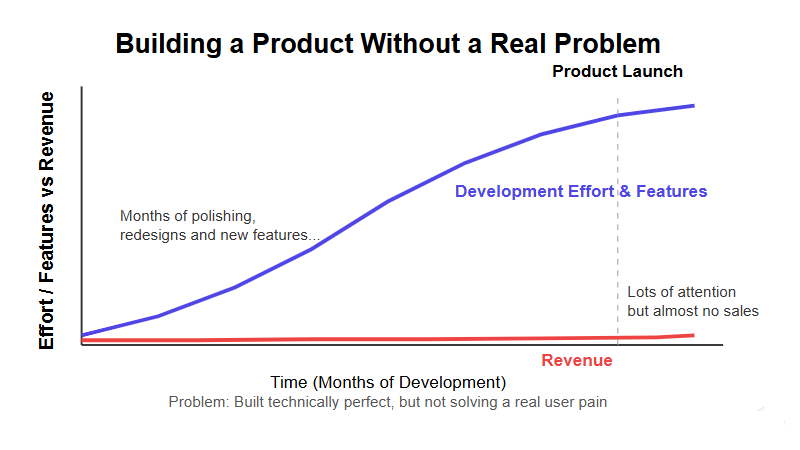
Developers can often follow the same path. First, an idea for what they consider to be yet another brilliant micro-SaaS emerges. The developer sits down to code, creates a beautiful interface, thinks through the architecture, and gradually transforms the idea into a technically perfect product.
But then endless refinement begins. It seems that just a little more and the product will be perfect. Another feature, another redesign, another month of development.
Six months later, the product finally launches on Product Hunt. Upvotes, comments, congratulations pour in… but sales are almost nonexistent.
The problem is that the product was created technically, but not problem-oriented. It doesn’t solve a specific user pain point.
The irony is that the real money often lies not in “sexy” startup ideas, but in boring, simple, and practical SaaS solutions that solve one specific problem better than anything else.
If you’re curious why so many AI SaaS products fail while others quietly succeed, you can learn more about the underlying formula here.
1. Why Boring SaaS Ideas Often Make More Money
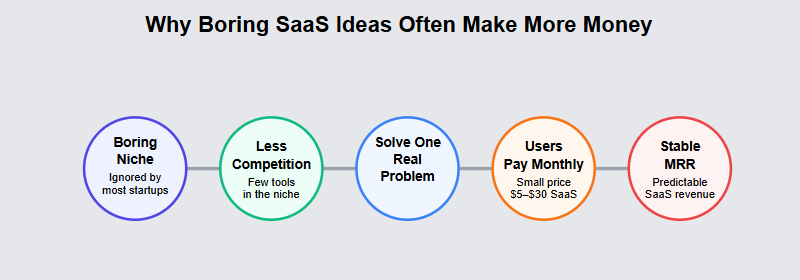
It’s common among software developers to think that a successful SaaS must be innovative and exciting. It seems that only complex and technologically advanced products can attract users’ attention. Therefore, startup founders often try to create something revolutionary that will upend the market. But the reality of startups is quite different. The most stable SaaS revenues often come from completely unexpected and “boring” niches.
✔ Boring business ideas rarely attract the attention of startup media and investors.
✔ This is why such niches typically have significantly less competition.
✔ Many entrepreneurs simply ignore small and simple problems.
✔ But users face these problems every day in their work.
✔ If SaaS solves one specific pain point, it quickly becomes a useful tool.
As a result, users begin to pay regularly for a service that truly helps them in their work. Even a small product can gradually build a stable customer base. The subscription model makes revenue predictable and allows for scalability. This is how many micro-SaaS projects achieve stable MRR. And often, this happens not thanks to a flashy idea, but rather through a simple and practical solution to a specific problem.
Boring Businesses Face Less Competition
There are startups who seek out ideas that sound exciting and cutting-edge. They want to create products related to artificial intelligence, social platforms, or emerging technology trends. As a result, thousands of developers compete in the same niches. This creates an oversaturated market and significantly complicates customer acquisition.
Boring business ideas typically fly under the radar of the startup community. Such projects are rarely discussed in the media and rarely make it onto “most promising startups of the year” lists. However, it is precisely in these niches that real opportunities for stable income often lie.
When a problem seems too simple or mundane, most entrepreneurs simply ignore it. But this means that competition in such a niche can be minimal. In some cases, there are only a few specialized tools on the market, or none at all.
If you want to systematically discover these overlooked opportunities, read here about how to find profitable SaaS ideas.
This gives independent developers and small teams the opportunity to carve out a niche without huge marketing budgets. Instead of competing with dozens of large startups, you can focus on a specific audience and their needs. Over time, such a product can become a standard tool for its small but solvent audience.
Users Pay for Solving a Specific Problem
Take yourself as an example. You’re unlikely to simply pay for an interesting idea or a beautiful interface. In \ most cases, you make a purchasing decision when a product solves a specific problem. This is especially true in a business environment, where time and efficiency have direct financial value.
If SaaS helps automate a routine task, reduce errors, or speed up a workflow, it quickly becomes a useful tool. Users begin to perceive it not as an additional service, but as a necessary part of their work.
It’s important to understand that a good micro-SaaS typically solves one problem, but does it extremely well. It doesn’t try to be a universal platform for all tasks. On the contrary, its value lies in its simplicity and focus.
When a product perfectly addresses one specific pain point, users are willing to pay a monthly subscription for it. Even if the service’s cost is relatively low, its practical benefit makes it indispensable. That’s why many successful SaaS products began by solving one small but real problem.
Small Problems Often Turn Into Stable MRR
At first glance, a small problem might seem too insignificant to warrant a separate product. Programmers might think that such a tool can’t generate significant revenue. However, in a subscription business model, even small solutions can generate stable income.
Micro-SaaS is often relatively inexpensive—for example, $10 to $30 per month. For a user, this is a small amount, especially if the service saves time or simplifies work. Services sometimes cost $3 to $5, and after a certain point, the paid user base grows exponentially. This reduces the barrier to purchase.
When a product begins to be used regularly, users continue to pay for a subscription for months or even years. This results in a predictable revenue stream called MRR (Monthly Recurring Revenue).
Even a small customer base can generate significant revenue. For example, several hundred or a thousand users can generate tens of thousands of dollars monthly. This is why many successful micro-SaaS projects focus on small but very specific tasks. Over time, such products develop into a stable and profitable online business.
2. Why Now Is the Best Time to Build a Micro SaaS
Just ten years ago, creating a software product required a team, investment, and a complex infrastructure. Today, the situation has changed dramatically thanks to the development of cloud services and the global internet. This is why more and more successful micro-SaaS projects are emerging.
✔ The barrier to entry for SaaS development has become much lower thanks to ready-made tools and platforms.
✔ Small teams can launch products faster than large corporations.
✔ The internet has opened up access to a global user base.
✔ More and more companies are switching to subscription models and online tools.
✔ Users are accustomed to paying a small monthly fee for useful services.
✔ Developers can test ideas faster and more affordably than ever before.
As a result, today even a single person can launch a SaaS product and start attracting their first customers. What previously required an office, a team of developers, and investment can now be done from anywhere in the world. This is why many entrepreneurs are beginning to consider micro-SaaS as a viable business model. And for those willing to solve specific user problems, the market now offers enormous opportunities.
The SaaS Market Is Growing Like E-Commerce Once Did
You probably remember a time when e-commerce was considered a niche that not everyone believed in. Some entrepreneurs doubted that people would actively buy goods online. However, over time, the situation has changed dramatically, and online retail has become a huge industry. Today, platforms like Shopify and WooCommerce power millions of online stores worldwide.
A similar dynamic is currently occurring in the SaaS market. More and more companies are switching to cloud solutions and subscription services. Instead of complex corporate systems, businesses prefer to use specialized tools for specific tasks.
Freelancers, marketers, agencies, and small businesses are constantly looking for tools that simplify their work. They are willing to pay a small monthly fee for a service that saves time and automates processes. This is why the SaaS market continues to grow rapidly and create new opportunities for developers.
Small Teams Can Beat Big Companies
It’s natural and logical that large tech companies typically target large markets and large-scale products. Their goal is to create a platform that will be used by millions of users. Therefore, they rarely focus on small niches or narrow problems.
For solo developers, this creates a great opportunity. You alone can focus on one specific problem and solve it much faster. The development process becomes flexible, and updates can be released much more frequently.
Furthermore, small projects respond more quickly to user feedback. Developers can communicate directly with customers and improve the product based on their real needs. As a result, micro-SaaS can develop much faster than large enterprise products. This flexibility is often the main advantage of solo developers.
The Internet Became a Global Market for Small Products
Who would have thought that just a few years ago, launching a software product required a local market, an office, and a sales team? Product promotion could be limited by geography and the company’s capabilities? Today, the internet has completely changed this model.
Even a small SaaS product can be sold to users worldwide. A developer can launch a product, promote it in online communities, and immediately attract their first customers from different countries. Payment platforms and product launch services have significantly simplified this process.
For example, you can present your product on platforms like Product Hunt and accept payments through services like Stripe. This allows small projects to quickly enter the international market. As a result, even a single developer can build an online business with a global audience.
3. Boring Micro SaaS Ideas That Can Actually Make Money
In fact, you can see for yourself that profitable SaaS projects don’t start with a brilliant idea, but with the observation of a real operational problem. Often, such problems seem too simple, so most developers ignore them. But it’s precisely these small and “boring” tasks that hide sustainable opportunities for creating profitable products.
✔ Businesses face dozens of routine processes every day that could be automated.
✔ Many industries still use spreadsheets, manual processes, and outdated tools.
✔ Even a small service can save hours of work each week.
✔ When a product solves a specific operational problem, users quickly become accustomed to it.
✔ Highly specialized tools often become the standard within their niche.
✔ A small SaaS can start generating revenue with just its first dozen clients.
Therefore, sometimes it’s enough to take a close look at the workflows of a specific industry. A small problem experienced by thousands of people can become the foundation for a sustainable SaaS business. Below are a few examples of such “boring” but potentially profitable micro-SaaS ideas.
The Freelancer Onboarding and Document Hub
Freelancers often work with multiple clients and projects simultaneously. Each new client requires a specific set of documents: contracts, NDAs, invoices, and sometimes tax forms. Over time, all these files begin to be stored in different folders, email chains, or cloud services.
This creates chaos and complicates workflow management, especially as freelancers begin to scale their operations and work with more clients.
Micro-SaaS can solve this problem by creating a single document management center for freelancers. Such a service can store contracts, automatically generate document templates, and organize the onboarding process for new clients.
For example, a user can send a client a link that automatically signs the necessary documents and collects the necessary collaboration data. This significantly saves time and simplifies administrative work. As a result, freelancers receive a structured system for managing client documents.
The Wedding Planner Inventory Tracker
Wedding agencies handle a large amount of physical inventory. This can include decorative elements, wedding arches, tables, chairs, linens, floral arrangements, and various equipment. Each item is used for different events and must be properly reserved.
However, many agencies still track this inventory in standard spreadsheets. Over time, this leads to confusion: it’s difficult to understand which items are already reserved and which are available for a new event.
A SaaS wedding inventory management app can significantly simplify this process. Such a tool can track item availability, automatically reserve them for specific events, and display current inventory.
Furthermore, the system can send notifications about shortages of certain items or help plan purchases. For wedding agencies, this can be a convenient logistics management tool. As a result, the agency gains a more structured and efficient event planning process.
The YouTube Thumbnail Comparison Tool
YouTube content creators are constantly looking for ways to increase views of their videos. One of the most important factors is an attractive thumbnail, which influences CTR. Many creators create multiple thumbnail variations and try to determine which one performs best.
However, manually comparing the performance of different thumbnails is quite difficult. Typically, it requires changing images and monitoring statistics over several days.
Micro-SaaS can offer a simple tool for A/B testing thumbnails. Users can upload multiple thumbnail variations and automatically compare their performance. The system can analyze CTR, impressions, and audience engagement.
Based on this data, the service can provide recommendations for thumbnail optimization. This tool could be a useful aid for YouTube creators looking to increase views of their videos. Over time, the service could evolve into a full-fledged analytics tool for content optimization.
Saas Insights & FAQ
How to build a SaaS without any money?
Creating a SaaS without start-up capital is much easier today than it was a few years ago. You can easily begin building a minimal product that solves a single, specific problem. Instead of a complex infrastructure, you can use ready-made cloud services and open-source tools. It’s also important to validate your idea first—for example, by talking to potential users or creating a simple landing page. Early customers are often found through communities, forums, or cold emails. Once the first users arrive, subscription revenue can be reinvested in product development.
Are SaaS applications dead?
The SaaS model is far from dead—in fact, it continues to grow rapidly. Companies and professionals are increasingly using cloud services instead of on-premises software. The subscription model is convenient for both users and developers. Users receive regular updates and support, and developers receive stable recurring revenue. At the same time, the market is gradually shifting from large, general-purpose platforms to highly specialized tools. This is why micro-SaaS projects are now seeing increasing growth opportunities.
What percentage of SaaS fails?
Like any business, SaaS has a high failure rate. According to various estimates, a significant portion of startups close within the first few years. The main reason is not technical problems, but the lack of a real market need. Many products are created without a deep understanding of user pain. When SaaS doesn’t solve a specific problem, users simply don’t see the point in paying for it. This is why successful projects usually start with a small but clearly defined use case.
Is selling SaaS difficult?
Selling SaaS can be difficult if the product doesn’t solve a real problem. Users rarely pay for a service simply because it looks interesting. But if SaaS saves time, money, or simplifies workflow, it’s much easier to sell. In such cases, the product essentially sells itself through the value it creates. Micro-SaaS projects can acquire their first customers through content, communities, or user recommendations. Over time, positive customer experiences become a primary marketing channel.
Is it difficult to get 100 subscribers for a SaaS?
Getting your first 100 subscribers can be challenging, but it’s certainly achievable. Typically, early adopters come from a small community or a specific professional niche. It’s important to focus on a single audience and deeply understand their problem. If the product truly helps solve a daily problem, users will start recommending it to each other. Furthermore, even a small audience can grow quickly through content, forums, and professional communities. For many micro-SaaS businesses, the first 100 customers become the foundation for further growth.
Final Thoughts
Building a $25K MRR SaaS isn’t always a story about a brilliant idea, complex technology, or a revolutionary product. More often, it’s the result of consistent work on a simple and clear problem that many people face every day. When a product solves a specific problem, it begins to deliver real value to users.
You can find stories online about successful micro-SaaS projects and notice that they all had very humble beginnings. The developer didn’t have a team, investment, or a large marketing budget. Often, it was a single person who simply wanted to solve a problem they or their professional network were facing.
In the beginning, there are usually just a few simple elements:
— one developer
— one core function
— one specific audience
Such a product may seem very simple, but it’s precisely this focus that makes it powerful. Instead of dozens of features, it solves one problem with extreme efficiency. Users quickly understand its value and begin using it in their daily work.
Over time, such projects begin to grow. User feedback is received, new features are added, and the product becomes more stable and user-friendly. The number of subscribers gradually increases, and with them, so does the monthly income.
This is how micro-SaaS projects achieve a stable monthly recurring revenue. Sometimes, a few hundred or a thousand active users paying a small monthly subscription is enough.
If you start today, carefully observe people’s workflows, and identify one small problem, it’s entirely possible to build a sustainable SaaS business. The key is not to try to create a perfect product or a complex platform right away.
It’s much more effective to create a useful tool that genuinely helps people work faster, easier, or more efficiently. When a product delivers real value, users are willing to pay for it again and again. This is how “boring” SaaS ideas eventually turn into stable and profitable online businesses.