
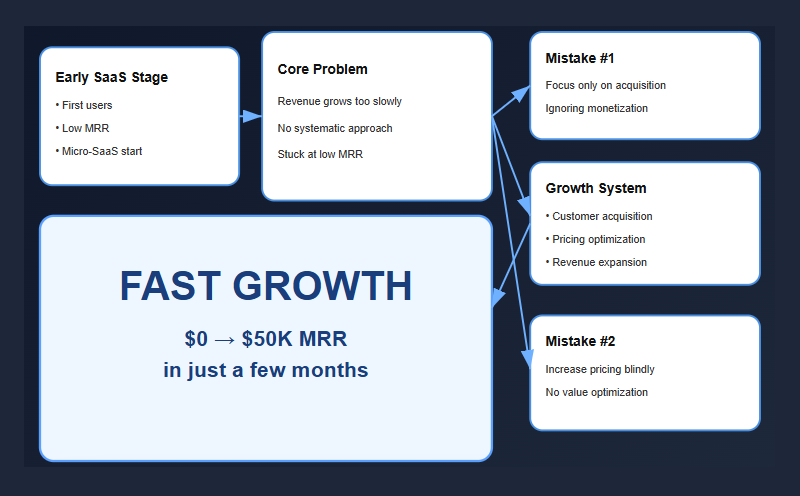
It’s quite obvious that SaaS product growth almost always begins with very modest numbers. As a founder, you might launch a micro SaaS product and acquire your first users, but then you run into a problem: revenue growth is too slow. This is why more and more startups are studying how to quickly increase SaaS revenue using product-led growth strategies and scalable customer acquisition frameworks. Without a systematic approach, even a good product can remain at a few thousand dollars in MRR for a long time.
In the early stages, it’s especially important to understand which actions truly impact growth. Many founders start by exploring different product ideas—if you want a practical starting point, you can check out this trial lesson on how to find and vet SaaS ideas. Some SaaS teams focus solely on acquiring new users, forgetting about monetizing their existing audience. Others, on the contrary, try to increase prices without optimizing their product and value proposition.
But the reality is that significant growth can be achieved much faster. With the right customer acquisition strategy, optimized pricing model, and revenue expansion mechanisms, a SaaS business can grow very dynamically. As successful projects have proven, going from zero to tens of thousands of MRR is possible in a short period of time.
In this article, we’ll explore proven strategies that help SaaS companies accelerate revenue growth. You’ll learn how to attract more customers, increase average revenue per user, and reduce churn. We’ll also explore data-driven SaaS revenue optimization strategies for increasing monthly recurring revenue and improving long-term customer value. All of this forms a systematic approach that helps a SaaS product transition from initial users to stable revenue growth.
1. Customer Acquisition Strategies That Rapidly Grow SaaS Revenue
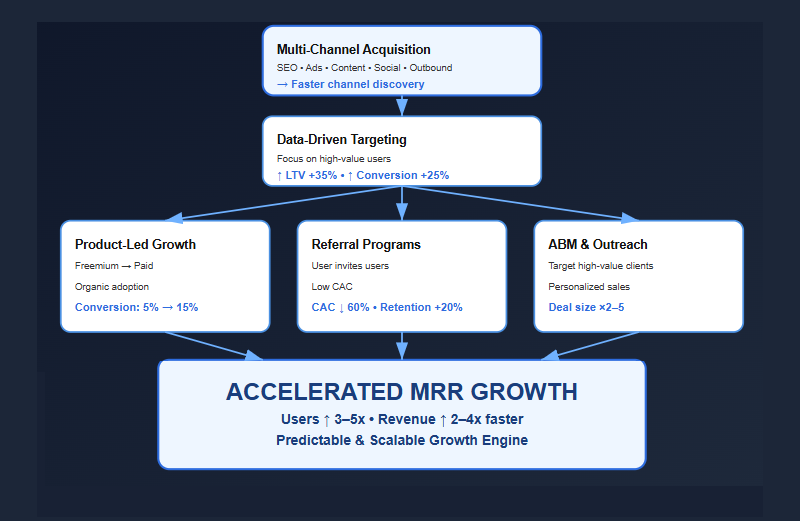
Acquiring new customers is one of the most powerful growth drivers for a SaaS product. However, some SaaS startups make the mistake of focusing on just one marketing channel — learn how the most successful startups structure their growth formula. In today’s SaaS market, it’s much more effective to use a multi-channel SaaS customer acquisition strategy designed to accelerate early-stage revenue growth. This approach allows for faster discovery of new user sources.
It’s also important to understand that not all customers are equally valuable to a business. Some audience segments are more likely to convert into paying users and stay with the product longer. This is why companies are actively using a data-driven SaaS customer acquisition framework focused on identifying high-value users and scalable growth channels. This helps direct resources to the most effective channels.
Furthermore, the Product-Led Growth model is becoming increasingly popular. It allows the product itself to become the primary marketing tool. With a product-led growth strategy for SaaS startups aiming to convert free users into paying customers, companies can efficiently attract users through the value of the product itself.
When different customer acquisition methods work together, a SaaS company achieves a sustainable growth system. This approach not only helps increase the number of users but also accelerates MRR growth.
Using Product-Led Growth to Attract and Convert SaaS Users
The Product-Led Growth model is becoming increasingly popular among SaaS companies, especially in the early stages of development. In this strategy, the product itself becomes the primary user acquisition tool. Instead of aggressive sales, users are introduced to the service through a freemium model or free access. This approach allows people to see the product’s value before they decide to purchase. When users experience real value, the likelihood of upgrading to a paid plan increases significantly. This is why SaaS founders are implementing a product-led growth strategy for SaaS startups that utilizes freemium onboarding to convert free users into paying customers. Furthermore, a good user experience within the product often leads to organic distribution through recommendations. As a result, the product begins to attract new customers almost on its own.
Leveraging Referral Programs to Generate High-Quality SaaS Leads
Referral programs are one of the most effective ways to attract new customers. When existing users recommend a product to their colleagues or friends, the level of trust in the service is significantly increased. This allows for higher-quality leads compared to traditional advertising. You may also notice that SaaS companies offer bonuses, discounts, or additional features for inviting new users. This mechanism encourages audiences to actively share the product. This strategy is often built on a referral marketing system for SaaS companies designed to generate high-quality leads through incentivized customer recommendations. As a result, the company acquires new users with virtually no marketing costs. Furthermore, customers who come
through referrals tend to stay with the product longer.
Combining Account-Based Marketing and Targeted Outreach for Faster Revenue Growth
Account-Based Marketing is particularly effective for SaaS products targeting the B2B segment. Instead of attracting mass traffic, the company focuses on specific organizations or market segments. This approach allows for more personalized communications and increases the likelihood of a sale. The team can research the potential client, understand their needs, and offer a solution to a specific problem. This process is often complemented by targeted outreach via email or LinkedIn. A similar strategy is used in account-based marketing and outbound outreach strategies for SaaS companies targeting high-value enterprise customers. As a result, a SaaS company can attract larger customers and more quickly increase MRR. This is
especially important for products with a high average order value.
2. Pricing Optimization Strategies to Increase MRR Faster
Pricing strategy plays a key role in the growth of a SaaS product. Even small changes in pricing can significantly impact MRR and overall profit. Therefore, SaaS companies place great emphasis on SaaS pricing optimization strategy and regularly review their monetization models.
In the early stages, founders may set prices intuitively. However, over time, it becomes clear that pricing must reflect the product’s value to different user segments. This is why the tiered SaaS pricing model strategy is developing, allowing for the offering of different levels of functionality.
Furthermore, a smart pricing policy helps increase average revenue per user. When customers see clear pricing tiers, they are more likely to choose a more expensive plan. This is an important part of MRR growth through pricing strategy.
It is also important to regularly test pricing hypotheses. Companies that experiment with pricing plans often find more profitable monetization models. This approach helps gradually improve SaaS revenue optimization through pricing experiments.
Structuring Tiered Pricing Models That Encourage Plan Upgrades
A tiered pricing model is one of the most popular approaches in SaaS. Companies typically offer three plan levels: Basic, Professional, and Enterprise. This structure helps users choose a plan that suits their needs and budget. This is a classic example of a tiered SaaS pricing model structure.
It’s important that each subsequent plan offers tangible added value. For example, higher plans may include advanced features, integrations, or increased limits. This approach naturally encourages users to upgrade to more expensive plans. Many companies use an upgrade-driven SaaS pricing strategy to increase the average order value.
Furthermore, the correct placement of plans on the pricing page can significantly influence user choice. Often, one plan is highlighted as the “most popular.” This helps direct user attention and increase conversion. This approach is part of a pricing page conversion optimization strategy.
Offering Annual Subscription Discounts to Improve Revenue Predictability
Annual subscriptions are a powerful tool for increasing revenue stability. When users pay for a service year in advance, the company receives a more predictable cash flow. This is especially important for startups building a predictable SaaS recurring revenue model.
To encourage users to switch to an annual plan, many companies offer a discount. Typically, the savings range from 10 to 30 percent compared to monthly payments. This approach helps increase conversion to annual SaaS subscription plans.
Furthermore, annual plans often reduce churn. Users who pay for a year in advance typically stay with the product longer. Therefore, this strategy is considered part of a SaaS retention and revenue stability strategy.
Annual subscriptions also allow for faster investment in product development. By receiving payment upfront, the company can more actively develop marketing and new features.
Running Pricing Experiments to Discover the Most Profitable SaaS Price Points
Even a well-designed pricing model requires constant experimentation. User behavior and the market change over time, so pricing plans need to be tested regularly. Various SaaS companies use a SaaS pricing experiment strategy to find the most profitable prices.
One of the most popular methods is A/B testing. A company can show different prices or pricing page variations to different users. This helps determine which model best converts users into paying customers. This approach is referred to as A/B testing for SaaS pricing optimization.
It’s also useful to test different ways of presenting product value. Sometimes changing feature descriptions can increase conversion without changing the price. This is part of conversion-focused SaaS pricing experiments.
When a company regularly analyzes the results of such tests, it gradually finds the optimal monetization model. In the long run, this helps significantly increase MRR.
3. Expansion Revenue Strategies That Increase Average Customer Value
You might think that SaaS business growth depends on attracting new customers, but this isn’t always the case. Increasing revenue from existing customers is often the key factor. This is why many companies are actively developing a SaaS expansion revenue growth strategy.
When users begin to derive value from a product, they are willing to pay more for additional features. This could include increased limits, new features, or upgrades to a higher plan. This approach helps build a customer lifetime value growth strategy.
Expansion revenue is especially important for business stability. Even if new customer acquisition rates temporarily slow, revenue can continue to grow thanks to existing users. This makes the SaaS recurring revenue expansion model more sustainable.
Therefore, successful SaaS companies build systematic upgrade mechanisms. They demonstrate the value of new features to users precisely when they become relevant. This approach strengthens a product-driven SaaS revenue expansion strategy.
Boosting Expansion Revenue with Usage-Based Billing and Add-Ons
The pay-per-use model is becoming increasingly popular among SaaS companies. In this system, users pay more as their usage of the product increases. This could be the number of API requests, data storage, or the number of tasks processed. This approach is part of the usage-based SaaS pricing model.
For example, a service might offer a basic plan with limited limits. As users begin actively using the product, they are automatically upgraded to a higher tier. This helps implement a scalable SaaS revenue expansion strategy.
Additional paid features also play an important role. Many products offer add-ons that expand the service’s capabilities. This could include additional storage, advanced analytics, or integrations. This mechanism is part of the SaaS add-on monetization strategy.
The main advantage of this model is that revenue grows along with the product’s value to the customer. Users pay more only when they actually receive more value. As a result, the company increases MRR without having to acquire new customers.
Implementing Cross-Selling and Upselling Inside Your SaaS Product
Cross-selling and upselling are powerful revenue-increasing tools. These strategies help offer users additional products or higher-priced plans. In SaaS, this is often accomplished through in-product upselling and cross-selling strategies.
Sometimes a user might start with a basic tool and then discover additional features within the platform. If these features solve new problems, the likelihood of a purchase increases significantly. This approach is used in the SaaS feature-based upselling model.
Integrations with other services can also be a source of additional revenue. Users often need additional tools that expand the platform’s capabilities. Therefore, many companies implement a SaaS integration monetization strategy.
It’s important to present upgrade offers at the right time. When a user encounters limitations with their current plan, they are much more willing to consider upgrading. This makes the upselling strategy a natural part of the user experience.
Encouraging Customers to Upgrade Through Feature-Based Value Communication
One common mistake SaaS companies make is selling features instead of value. Users are rarely interested in the technical details of a product. Understanding the problem the service solves is far more important. This is why companies employ a benefit-driven SaaS feature communication strategy.
When customers understand the real impact of using a feature, the likelihood of upgrading significantly ncreases. For example, instead of describing a technical feature, you can demonstrate how much time or money it saves. This is part of the value-based SaaS product marketing approach.
It’s also helpful to demonstrate examples of feature use. Case studies and real-world scenarios help users see the practical value. This method reinforces a customer-focused SaaS feature positioning strategy.
When communication is built around results rather than product features, users are more likely to upgrade to higher-priced plans. Ultimately, the company increases average revenue per customer and accelerates MRR growth.
4. Retention and Customer Success Strategies That Protect SaaS Revenue
Customer retention is a key growth factor for any SaaS product. Even with active new user acquisition, high churn can significantly slow business growth. Therefore, many companies are building a systemic SaaS customer retention strategy framework.
When users stay with a product longer, the company receives more stable revenue. This directly impacts MRR growth and overall customer lifetime value. This approach is the foundation of the long-term SaaS customer retention model.
It’s also worth noting that customer retention is often cheaper than acquiring new ones. Improving the user experience, support, and training help strengthen relationships with the audience. This is why companies are implementing a customer success-driven SaaS growth strategy.
Modern SaaS companies also actively use analytics. User behavior data helps proactively identify churn risks and identify growth opportunities. This approach strengthens a data-driven SaaS retention optimization strategy.
Using Free Trials to Accelerate User Adoption and Product Familiarity
Free trials are one of the most effective user acquisition tools. They allow potential customers to get acquainted with the product without financial risk. This approach is widely used in the free trial SaaS user acquisition strategy.
During the trial period, users can evaluate the service’s key features. If the product solves their needs, the likelihood of upgrading to a paid plan increases significantly. This is why the trial onboarding user activation flow is so important.
A well-designed trial helps quickly demonstrate the product’s value. For example, you can guide the user through key features with prompts and tutorials. This strengthens the guided SaaS onboarding experience strategy.
It’s also important to track user behavior during the trial period. If users actively use the product, the likelihood of conversion is significantly higher. Therefore, many companies build a free trial conversion optimization strategy.
Reducing Churn Through Proactive Customer Support and Better Onboarding
One of the main reasons for user churn is a lack of support or a complex onboarding process. When users struggle to understand a product, they quickly lose interest. Therefore, companies are actively implementing a proactive SaaS customer support strategy.
High-quality onboarding helps users quickly realize the first value from the service. The faster a user achieves results, the higher the likelihood that they will continue using the product. This approach is part of the SaaS onboarding and activation strategy.
Customer success teams also play a crucial role in customer retention. They help users solve problems and demonstrate new product features. This creates a customer success workflow for SaaS retention.
I would also like to point out that proactive support allows you to identify issues before a user decides to cancel a subscription. As a result, a company can significantly reduce churn and strengthen customer relationships.
Leveraging Product Analytics to Identify Growth Opportunities and At-Risk Users
User behavior analytics helps SaaS companies make more accurate decisions. When the team sees how people interact with the product, it becomes easier to understand their needs. This approach is the foundation of the SaaS product analytics growth strategy.
Data helps identify features that deliver the greatest value. This helps focus on developing key product capabilities. This results in a data-driven SaaS product improvement model.
Analytics also helps identify users at risk. For example, if a user has stopped actively using the product, this can be an early sign of potential churn. Therefore, many companies use a SaaS churn prediction analytics model.
When such signals are detected early, the team can offer assistance or additional resources. This helps bring the user back into active use and reduce the likelihood of churn.
FAQ Section
How to increase SaaS sales?
Increasing SaaS product sales usually requires a comprehensive approach. It’s important to simultaneously focus on attracting new users, improving the pricing model, and increasing the product’s value to customers. SaaS startups can employ a SaaS revenue growth strategy through product-led growth, which allows them to acquire users through the product itself. It’s also important to develop an upselling and cross-selling system within the platform. This helps increase average revenue per customer without constantly increasing marketing costs. As a result, a SaaS company can steadily increase MRR and scale its business.
Can SaaS be profitable?
Yes, SaaS can be a very profitable business model. The main advantage is the subscription-based revenue system, which creates a stable revenue stream. Once a company reaches a stable user base, it begins to receive predictable recurring revenue. Furthermore, scaling a SaaS product often doesn’t require a proportional increase in costs. This allows for increased profitability as the customer base grows. This is why many startups strive to develop SaaS projects.
Is SaaS profitable in 2026?
SaaS remains one of the most promising business models in 2026. The software market continues to grow rapidly thanks to business digitalization and the development of AI tools. SaaS companies are introducing new services to automate processes and improve efficiency. As a result, demand for SaaS products remains high. Projects using an AI-powered SaaS product growth strategy are particularly active. As a result, the SaaS market continues to attract entrepreneurs and investors.
How to build a SaaS without a large budget?
Creating a SaaS without a large budget is possible, especially today. Founders can start with a minimal product and gradually develop it based on user feedback. This approach is called a bootstrapped SaaS startup development strategy. Using no-code tools, open-source solutions, and cloud services helps significantly reduce development costs. It is also important to first test the demand for an idea before investing significant time and resources. This allows you to build a product gradually, without major investments.
What is a good profit margin for a SaaS company?
SaaS companies typically have higher profit margins than many other businesses. After covering development and marketing costs, margins can increase significantly. On average, a good profit margin for SaaS is considered to be around 20-30% net profit. However, many mature companies strive for even higher margins. This is due to the scalability of the high-margin SaaS subscription business model. As the customer base grows, additional sales require relatively little investment.
Final Thoughts
Growing a SaaS product to significant revenue levels rarely happens by accident. It usually involves a well-thought-out strategy that includes several key elements. Companies that achieve high results systematically work on customer acquisition, pricing model optimization, and increasing product value.
One of the key growth factors is a well-designed user acquisition strategy. Using Product-Led Growth, referral programs, and targeted marketing helps quickly expand the audience. When a product truly solves a user problem, organic growth is significantly stronger.
Pricing strategy is equally important. Well-designed pricing tiers allow users to gradually move up to more expensive plans. Annual subscriptions and pricing optimization also help increase revenue stability.
Expansion revenue is becoming another powerful source of growth. Upselling, cross-selling, and additional features help increase the average revenue per customer. This allows a SaaS company to significantly increase MRR without constantly acquiring new users.
However, long-term success is impossible without customer retention. Good onboarding, user support, and in-product behavior analysis help reduce churn. When customers stay with a product longer, the business becomes more resilient.
Analytics plays an increasingly important role in the development of SaaS companies. Data helps understand which features are most valuable to users and which actions lead to revenue growth. This allows for more accurate decisions and faster adaptation to market changes.
It’s also important to remember that SaaS growth is a gradual process. Even if a company starts with a small audience, systematic work on the product and marketing can lead to significant results. Almost all successful SaaS projects began with a small team and a minimal budget.
Ultimately, the key to success lies in the combination of several factors: a strong product, the right growth strategy, and continuous improvement of the user experience. When these elements work together, a SaaS business can quickly scale and achieve high revenue.