
how-to-scale-a-saas-business

How to Scale a SaaS Business: Step-by-Step Guide to 10 – 50 Paid Users

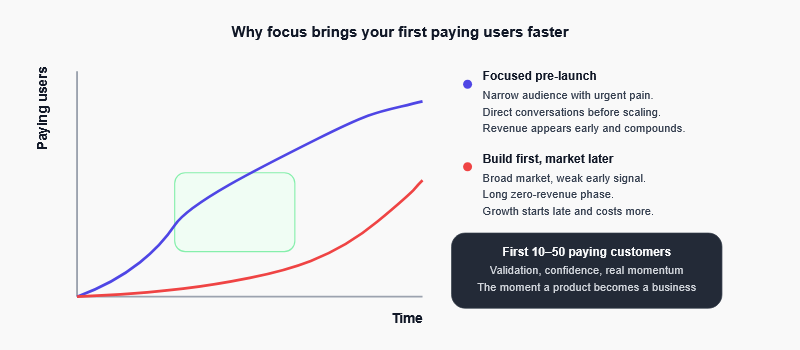
How to scale a SaaS business from zero to 10–50 paying users isn’t about growth hacks or complex automation. What matters most is putting your product in front of the right audience early, so they clearly understand its value and functionality.

It’s been noted that many new micro SaaS projects fail not because they’re ineffective, but because their launch was initially poorly coordinated. Founders build the product and then think they’ll find paying users, wasting time without feedback or initial profit.

The fastest path to first sales begins even before development is complete. A smart pre-launch strategy allows you to capture demand, test willingness to pay, and build momentum before release.

This guide describes steps to quickly get your first 10-50 paying customers. Each approach is designed for working with limited resources and minimal automation.

You’ll learn how to attract users with high purchase intent, convert them at the start, and turn early demand into scalable growth. The goal here isn’t growth at any cost, but rather building a business with rapid momentum from the very beginning.

1. Start with a Narrow Audience with High Purchase Intent

The biggest mistake founders make is trying to please everyone at the start. Don’t focus on a mass audience, as it requires large budgets, a long decision-making cycle, and complex marketing.

Always focus on a narrow target group that already has a pain point and needs a solution right now. That’s how you’ll get your first 10-50 paying users.

a) Formulate an Urgent Problem

When you go to the pharmacy and buy a medicine, you’re actually paying not for the product but for the opportunity to relieve pain. It’s exactly the same in the world of SaaS products. The user wants to eliminate their pain. You need to identify the user’s problem—one that they regularly face, one that’s already being solved with spreadsheets, hacks, or manual labor, and one that impacts their money, time, and reputation. The urgency of the user’s problem is key to driving quick sales. If you’re unsure how to consistently find urgent, high-value problems like this, start with Day 1 — Where to Find Great SaaS Ideas (and how to vet them). It walks through a practical framework for spotting real SaaS opportunities and validating them before building anything.

b) Choose a Niche that You can Reach Manually

When launching your micro SaaS, it’s important to select an audience you can reach in person, via email, private message, or through niche communities like Reddit, LinkedIn, and Discord. This immediate, direct contact will allow you to quickly understand needs, refine your product, and close your first sales without complex marketing.

c) Confirm Demand Through Conversations

Personal contact with users is the best way to understand their problem and provide them with a solution. If they have a product but aren’t satisfied with it, find out what you can do to make them happy. Gently offer early access to your SaaS product. If people are willing to discuss pricing and ask probing questions about your product, you’re on the right track. This is how you build a pipeline of early paying users.
2. Create a High-Converting Opt-In Page Before Launch

Your core SaaS product may be unfinished, but that’s no reason to wait with marketing. Creating a well-designed pre-launch opt-in page allows you to gather your first subscribers and customers, test demand, and prepare your audience for payment immediately after launch.

This isn’t just a web page; it’s a tool for early marketing and testing your product’s value.

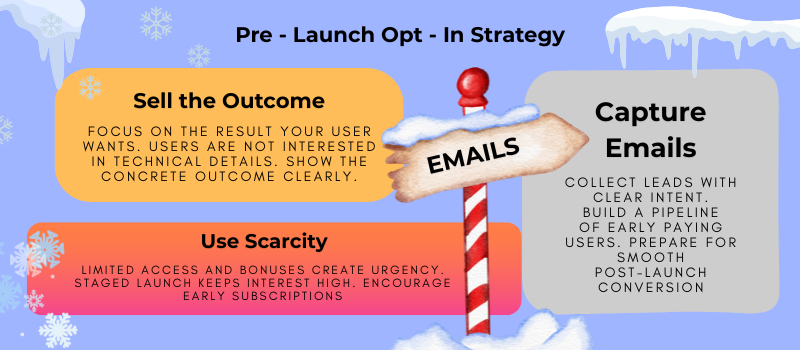
a) Sell the Outcome, not the Product

Users aren’t interested in how your product looks, and they don’t want to delve into technical details. They want a concrete result that solves their problem. To achieve this, describe the end value on your opt-in page, using language your audience can understand without complex technical jargon, and avoid long, dense descriptions that are difficult to understand. Your goal is for the website visitor to immediately understand that the product solves their problem.

b) Use Scarcity and Positioning

You need to understand the unique features of your micro SaaS and showcase them to future customers. You also need to create a sense of scarcity. This can be achieved through limited access, such as limited access to 50 seats at a certain price, with a discount for early adopters. Early adopters can also receive certain bonuses. You can also break the launch into stages, introducing new features to users. This also generates interest in the product. All this creates a sense of value and accelerates the decision to subscribe.

c) Capture Emails with Clear Intent

Don’t assume that quickly creating a pre-launch page will generate subscriptions. The key is to capture the user’s intent to pay. For example, you can inform the user that they will receive early access for $X. You can also collect not only the user’s name and email address, but if this is important to your business, you can also collect information about the user’s company size, their role in the business, and so on. These leads will form the basis of your pre-launch email funnel, with high conversion rates and initial payments expected at the start.
3. Build a Pre-Launch Email Funnel That Warms Users Up

If your product is still in development, that’s not a problem. It’s important to create a pre-launch email funnel now that builds trust, demonstrates the product’s value, and generates user interest.

Set up a consistent email sequence, and you’ll be able to not only talk about the problem and its solution but also highlight progress, feedback, and insights. This will ensure that your first paid users get started immediately after launch, already understanding the functionality of your micro SaaS.

a) Educate Users about the Problem

At this stage, your goal is to convey to your audience the importance of the problem you’re solving. You need to show examples of the difficulties other users are experiencing without your product and why this is critical for their business. If you have case studies, use them to clearly define the scale of the problem. This will create an emotional connection with the user, and such users are more likely to purchase micro SaaS products when they understand the consequences of ignoring the problem.

b) Show Progress and Social Proof

Share stories from early testers, beta results, and feedback. When users see you regularly displaying such content, it means your micro SaaS is gradually moving toward launch. Audiences feel like they’re participating in something exclusive when they see social proof. People enjoy the feeling of being part of the process at the same time. It’s almost a sign of willingness to pay for the product upon launch.

c) Pre-Sell Before the Product is Finished

You don’t need to wait until your product is fully ready to start monetizing. Offer early access, exclusive terms, and a discount to subscribers of your pre-launch marketing funnel as soon as possible. This way, you’ll quickly build a core of paying users, receive your first revenue, and validate real demand before investing more time into development. If you’re still shaping your idea, positioning, and first-user strategy, follow the AI SaaS Roadmap: From Idea to First Users in 30 Days Without Heavy Coding. It outlines a practical path from validation to your first paying customers without heavy technical complexity. The value and limited nature of your early offer are exactly what you need to emphasize. When people see clear benefits and defined limits, they’re far more likely to act immediately instead of postponing the decision.

4. Launch with a Clear Offer, Not Just a Product

When you launch a SaaS product, as we’ve already learned, people are buying a solution to their problem. Therefore, it’s important to formulate a clear offer. Users should understand what they’re getting, why it’s better than other options, and why it’s worth starting now.

Especially during the initial stage of recruiting the first 10-50 paying users, it’s important to give them a sense of exclusivity and a simple path to success.

a) Limited-Time Pricing for Early Adopters

Don’t be afraid to offer something mega-exclusive. For example, the first 50 users receive a 50% discount for the entire year. People see the obvious benefit and are afraid they might miss out on such a great chance to get your SaaS with such a discount. Always clearly state the expiration date or user limit. This helps convert interest into quick action.

b) Remove Friction from Onboarding and Payment

Make the launch process as simple and transparent as possible. Minimize the number of steps, such as enabling popular payment methods like PayPal or Stripe, and allowing users to use the product without complicated registration or verification. These are all important factors, as any obstacle of this kind reduces conversion. Even a minor complication can reduce customer acquisition by half. To do this, ask your colleagues and friends if they encounter any barriers on the site, and you’ll get excellent feedback on what needs to be eliminated to ensure everything runs smoothly.

c) Personally Onboard Your First Users

There are some SaaS projects where every user is truly cared for. You can do this at the initial stage, for example, by holding a demo session of your product or configuring it together with the user. This way, you’ll get even more user feedback, which will allow you to implement improvements. This works wonders, as your first customers are the ones who provide reviews of your product on other websites, which is crucial for your business. Also, ask them for reviews and post them on your website.

5. Use Direct Outreach to Get Your First 50 Paid Users

At the launch stage of your product, there’s no point in waiting for users to accidentally discover it. Directly reaching your target audience is the fastest way to attract paying customers.

Your goal here is not just to talk about your product, but to demonstrate how it solves a specific problem right now.

If you have a micro SaaS that would be useful to online companies, then even if you reach 500 online companies and only 10% become paying users, you’ll already have 50 consistently paying users every month.

Therefore, don’t delay this method of attracting paying users. This will allow you to quickly receive your first payments and validate your product. You’ll also establish personal contact with users and collect valuable feedback to improve your product.

a) Cold Emails with a Problem – First Approach

Cold emails should never be about product promotion. First, highlight a problem your prospect has likely already encountered and demonstrate how your micro SaaS solution can help them solve it. This works because each of us responds to a real, personal pain point, not to yet another out-of-the-box service. To be even more convincing, use specific figures or examples from your experience. This also plays a role whenengaging with the user.

b) Leverage Your Waitlist and Early Signups

Create a sense of urgency in your waitlist for your users. This will increase conversion and attract more paying users. They’re already interested, but they need a little nudge to make a quick decision—that is, to pay. Offering some kind of exclusive access or bonus will further strengthen your offer.

c) Turn Conversations into Paid Trials

Once you’ve successfully established a dialogue with your user, it’s important to offer value through a paid trial. Here, you need to demonstrate the product in action and motivate users to pay without leaving any room for doubt. You can offer a short paid trial instead of a free period. Many perceive this as an indicator of the product’s credibility. For example, an offer that allows users to try all product features for 7 days for $1. The key here is not to engage in dialogue for the sake of dialogue, but to clearly lead users to a paid trial by demonstrating the product’s value and alleviating any doubts.

6. Turn Early Users Into Proof and Growth Assets

Don’t ignore the growth phase at the initial stage of launching your micro SaaS project. Your asset is when 10-50 paying users are already solving a real problem, and it’s important to capture this evidence now.

Don’t try to generate huge amounts of traffic right away. It should be highly targeted to gain a special degree of trust from users and social proof of the need for your product.

Try to focus on extracting maximum value from existing users. Even a few successful case studies can significantly increase conversion rates on your landing page and in sales. Your task is to quickly transform the initial results into clear and compelling stories.

a) Collect Testimonials and Quick Wins

If you already have 10-50 paid users, some of them will quickly experience positive results when interacting with your product. It’s important to capture this moment. Reach out to your users after a while and ask them to leave a review. Even a 3-4 sentence format works better than a long text in the early stages. Use real customer feedback, screenshots, and real numbers. Typically, the more positive case studies you have, the faster new users will start subscribing to your product. In any case, it’s minimal effort with maximum impact.

b) Create Simple Case Studies Fast

Case studies don’t have to be complex or detailed. A simple structure is sufficient: problem → solution → result. Even one specific use case can demonstrate the product’s value better than any marketing text. Publish such case studies on your website, for example, as articles on your blog, in your newsletter, or use them in personal messages. The sooner you start collecting them, the easier it will be to scale. At this stage, quantity and relevance are more important than perfect presentation.

c) Use Referrals and Founder Credibility

f you connect with a couple of founders of SaaS brands or even mid-sized companies whose names are household names, people will be more likely to buy your product. This is a recommendation from the brand’s founder, not just some guy from the streets.

7. Systemize What Works to Reach 50 Paid Users

Once you understand where your first paying customers are coming from, it’s time to systematize. Scaling isn’t about adding new channels, but rather strengthening what’s already producing results.

Many SaaS projects make the mistake of spreading their efforts too thin. Instead, it’s important to solidify your workflows and eliminate any unnecessary clutter.

The goal of this stage is to create a repeatable system for attracting and activating users. This is what will allow you to consistently reach the 50 paying customer mark.

a) Double Down on the Best Acquisition Channel

Don’t spread your attention too thin across a ton of different traffic sources. Simply find one channel that brings you more targeted traffic than the rest. This could be social media or cold emails, for example. Focus on improving it while simultaneously searching for new traffic sources. In the early stages, focus is more important than scale. Then, gradually increase traffic volume and improve conversion.

b) Automate Onboarding and Email Sequences

Manual onboarding works well at the start, but then you need to automate key stages. Welcome emails, prompts, and follow-ups save time and increase activation. It’s important for users to quickly understand the value of your product without your intervention. A simple email series can significantly increase retention. We’re not talking about complex funnels here, but rather a basic structure and sequence of actions. The less friction, the higher the chance of payment.

c) Avoid Premature Scaling Mistakes

One of the most common mistakes is launching ads or scaling a team too early. If the product isn’t yet stable and the funnel isn’t polished, scaling will only exacerbate the problems. Before you reach 50 paying users, it’s crucial to remain flexible and close to the user. Repeatable results come first, then growth. A solid foundation is always more important than quick numbers. Patience at this stage pays off many times over.

Final Thoughts

Reaching 10–50 paying users isn’t a matter of luck, but the result of the right sequence of actions. At this stage, the most technologically advanced products win, but rather those that best understand their users. Focus, speed, and consistency are key. Use early results as an asset, strengthen existing channels, and take your time scaling. This approach lays the foundation for further growth in a SaaS business.
effective-saas-marketing-strategy

Effective SaaS Marketing Strategy for AI Startups

Building an effective SaaS marketing strategy for AI startups is very different from traditional marketing for other online products. Here, everything is built not on grandiose promises and advertising channels, but on
how quickly the user receives real value from the product.

With AI-powered products, expectations are always higher and the bar for patience is lower. Users don’t need explanations; they want results. Based on this, it’s safe to say that effective marketing strategies for AI-powered SaaS start within the product, not outside it.

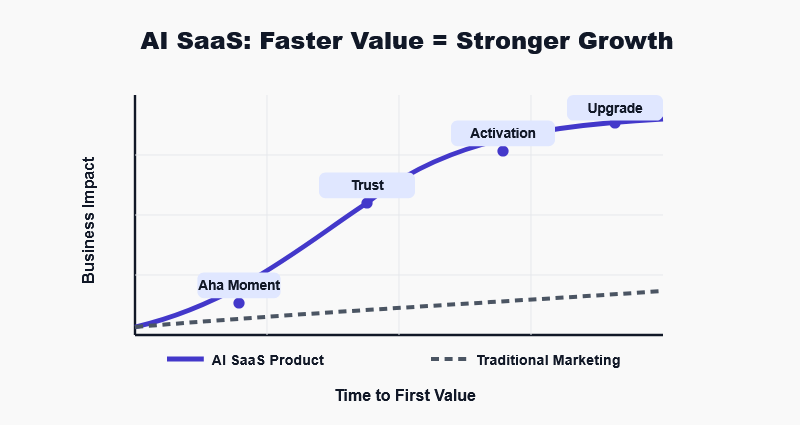
The faster the user achieves the most tangible result, the higher the likelihood of activation, trust, and long-term use. And with AI-powered SaaS, the product itself is the marketing funnel, not just part of it.

1. Product-Led Growth (PLG) with AI Value First

For AI startups, a product-led growth delivers results when users can sense the value of your AI SaaS product almost immediately. The product’s goal isn’t to explain how the algorithm works, but to demonstrate its purpose. This is crucial within the first few minutes of interaction with the product.

a) Design the Fastest Possible “Aha” Moment

Onboarding should lead the user directly to the result, not to settings. In AI-powered SaaS startups, this could be a generated response, an automated action, or some other action that shortens the path from the start to the first useful result. The faster the user gets this result, the higher the chance they’ll remain your customer.

b) Let the AI Do The Talking

Instead of long descriptions and feature lists, let users experience how your AI-powered product works. Demos, sandboxes, and output samples convey product value better than any marketing copy. In AI SaaS, trust is built on results, not on vague promises.

c) Use Limitations to Drive Upgrades, Not Frustration

You should have both a free and a paid product. If a user takes control of the free version of your AI-powered SaaS, they see value, even if you don’t fully disclose the product. Usage limits aren’t a problem. If the user understands they need advanced features, they’ll still pay for the premium version. Properly designed limits turn the product itself into a conversion tool.

2. Education-Driven Content Marketing

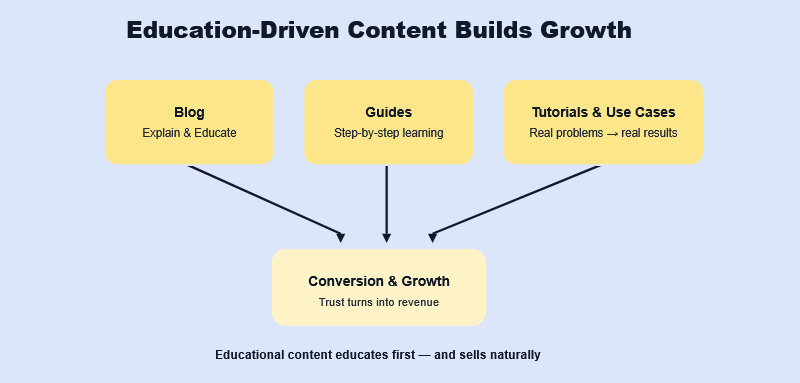
For AI-powered startups and SaaS products, effective marketing often relies on educational content. The goal here isn’t simply to sell, but to demonstrate expertise and help potential customers understand the product and see its value. Below, we’ll explore three key approaches to educational content.

a) Learning through Blog

Many newcomers and even mid-sized internet companies greatly underestimate the power of blogs. This is often a very powerful channel for presenting complex concepts in simple language. Even if your clients find AI technologies complex, regular articles help them understand how your product solves their problems. On your blog, you share insights, trends, and explain complex terms simply and clearly. Include clear explanations in your articles about why AI solutions work best on the modern internet. This builds trust and brand recognition. This approach works best when educational content is built on a clear understanding of where strong SaaS ideas come from and how to evaluate them early — before investing months into development.

b) Guides and Instructions

You can distribute guides on forums, social media, and popular niche platforms to attract attention to your AI SaaS product. Step-by-step guides help customers understand the product and its capabilities in a practical way, making training useful and interactive. An example of such a guide is “How to Integrate Our Platform into a Business Process.” You can also combine guides with visual materials such as screenshots, diagrams, and videos. Don’t forget to include them on your blog. Such useful content increases time spent on the site, which positively impacts conversion.

c) Use Cases and Tutorials

Cases and tutorials are powerful educational marketing tools. They demonstrate the real value of your AI-powered SaaS product in practice. Tutorials don’t just talk about functionality, as blog posts do. They demonstrate step-by-step how the product solves your customers’ problems. This helps users see real results and believe in the product’s power. Case studies demonstrate specific problems and how to solve them using your AI-powered micro SaaS. This increases your brand’s authority. For example, excellent case studies include: “How to Set Up Our WordPress Plugin in 10 Minutes” or “How to Automate Lead Generation with Our AI Tool.”

3. Category Positioning & Clear Messaging

When you’re a newbie trying to launch your startup, you may fail not because you have a weak product, but because you can’t communicate to the market what exactly your micro SaaS does and why.

If you formulate something like “AI-Powered Platform for Everything” there’s no value, just noise.

An effective SaaS strategy starts with a clear focus: one category, one promise, and one expected outcome. The simpler and clearer your formula, the faster you’ll be able to scale your product.

a) One Category and One Market

There’s no need to invent a new, fictitious category or cover several at once. Your client should immediately understand how they should classify your product. Maybe it’s an AI recruiting tool or a micro SaaS solution in the field of AI analytics for e-commerce. If the product can’t be categorized in any way, then the positioning is ineffective.

b) One Clear Promise Instead of “AI Powered Everything”

If your message doesn’t answer the question of what specific outcome a customer will achieve using your product, then you’re better off not even starting your AI-powered SaaS business. Many people write slogans like “We Will Improve Your Business with AI,” but they should be more like this: “Our product will reduce your lead processing time by 50%.”

c) Formula Instead of Poetry

The best message is a formula: We help (our target audience) achieve (effective result) with (one key feature). If the formula can’t be repeated word for word, it’s too vague.

d) Consistency at All Touchpoints

If you use different wording on your landing page, pitch deck, advertising, and sales scripts, it immediately undermines trust in your business. Clear repetition, on the other hand, leads to increased recognition of your
product in the market and increased conversions. Most AI SaaS teams that get this right don’t start with messaging at launch — they align positioning, product logic, and early user acquisition much earlier, at the stage where the idea is still being shaped and tested with first users.

4. True-Based Marketing (Proof Over Promises)

In AI startups, trust is the currency without which even the strongest product won’t function. You know the market is full of promises like “faster,” “better,” and “higher quality,” but without evidence, these promises won’t deliver. Your investors and clients need to be shown real value. This is why true-based marketing is a key element of an effective AI SaaS marketing strategy.

What’s the point? Simply honestly showing how the product actually works. The more complex your technology, the more transparent it should be. AI can foster skepticism, so feel free to juggle real numbers and examples. Then, marketing immediately becomes an evidence-based system.

Below we will look at the key principles of true-based marketing:

a) Real Cases Instead of Abstract Scenarios

Your AI startup should demonstrate that the product clearly solves a specific customer’s problem. No hypothetical possibilities are necessary. It’s simple and clear: (1) this is how it was initially – (2) this is how we did everything – (3) we got the result. A good case study includes context, the problem, implementation, and measurable results—improved metrics, time and money savings. Customers now see everything clearly, and their fear of complex technology disappears, as your product gradually becomes a familiar tool. The sooner you provide marketing case studies, the more your micro SaaS will be taken seriously.

b) Transparency as a Source of Trust

True-based marketing isn’t afraid to reveal a product’s limitations. You don’t need to idealize your product if it’s not even idealized. Honestly show where your AI startup excels and where you still have minor flaws. This will build trust more than if you constantly praise your product without revealing the full truth. Full transparency lowers the barrier to entry for customers. Even if you’ve already launched your product, but openly admit you’re still testing it and are still in the growth stage, it will look like the right decision. Especially in a highly competitive environment, honesty is key.

c) Evidence in Every Element of Communication

Let’s imagine you’ve created a practically perfect landing page. Customers come to you from one channel to the landing page, are delighted by the information they see, and immediately purchase your product. However, marketing should work at all levels, not just the landing page. Articles, customer reviews, and descriptions of product options are all ways to build customer trust in your product. Instead of “They Trust Us,” use quotes from real users. This approach reduces the cognitive load on the customer. They don’t have to take your word for it. They see evidence. Gradually, trust snowballs, bringing you more and more customers. It becomes a driver of conversion and growth.

5. Pre-Launch Demand Capture

You need to start winning over your future customers long before your product is publicly available. Pre-launch demand capture allows you to test the market’s interest in your AI-powered SaaS and build trust in the product before launch. This is important for AI startups, as users want to understand your new technology and who’s creating it.

Marketing shouldn’t sell here. It simply educates and engages. Focus on user problems and show them how to solve them. The faster you demonstrate everything, the faster a loyal community will grow around your product. As a result, your launch will be a logical extension of existing demand.

Now you’ll learn about key demand capture channels before launching your product.

a) AI Startup Directories and Launch Platforms

Various startup platforms are the primary entry point for pre-launch demand. Web services like Product Hunt, BetaList, Indie Hackers, and other AI-focused directories allow you to showcase your product to early adopters. While many newcomers simply post their startups and wait for approval, you’re better off highlighting the problem your AI startup solves and the value of the product itself. Even at this stage, people start clicking, subscribing, and asking questions about the product. This feedback not only increases awareness of your product but also helps you refine your positioning before scaling.

b) Niche Communities Around Pain Not Product

There are niche communities where your customers are already hanging out. They discuss their problems there, and these communities include Discord servers, Reddit, forums, and Telegram. Just be sure not to try to sell anything there. Instead, share your ideas and experiments, and you’ll understand people’s pain points. Plus, you’ll establish yourself as an expert, not a salesperson. Your goal is to engage as many people as possible in the communication process. Once the product is ready, they’ll come to you on their own, since they’ve already been involved in the process.

c) Founder-LED Platforms: Personal Brand as a Demand Channel

Platforms that highly value process and thinking, such as Hacker News, X, LinkedIn, and blogs, are particularly effective for AI startups. Here, as the founder, you become the product’s primary media outlet. You show everyone how you’re building the product, and information about your AI startup is built around this. There’s no room for abstraction here, as everything is live and open. People see this and begin following your product long before its release because they feel like they’re part of its creation.

d) Early Partnerships and Integrations as a Source of Trust

Even in the pre-launch stage, integrations and partnerships can increase trust in your product. Integration with a well-known influencer can be seen by your future customers as a powerful signal to purchase your AI-powered product. If your partner shares their experience using your product with their followers, it’s more effective than any advertising. Such successful collaborations transform early demand into trust and accelerate your product’s market launch.

6. Pricing, Access & Friction as Traffic Qualifiers

AI-powered SaaS marketing isn’t about acquiring a huge number of subscriptions, but rather about managing the quality of incoming demand. Overly easy access often attracts users who don’t understand the product’s value and aren’t ready to change their business processes.

For AI products, the critical fact is that misuse leads to low activation. Therefore, restrictions, pricing, and access control become tools for audience selection. A well-designed friction strategy will attract precisely those target audiences who are ready to start benefiting from the product immediately.

a) Limited Access as a Value Signal

Waiting lists aren’t about scarcity for the sake of scarcity, but about selecting interested users. When access is limited, people understand the need for engagement. The quality of early users increases. You also see how you can skillfully segment your audience and launch your product gradually. You engage right from the start with those who already understand the value of your SaaS and are ready to move forward with you.

b) Usage Limits Instead of Unlimited as a Training Tool

When you limit access by requests, data volume, or number of operations, you make the user understand what they’re paying for. This helps establish appropriate usage patterns and emphasizes the value of each action. Limiting usage also helps highlight where the product delivers the most value. This approach increases the likelihood that the user will actually activate it, rather than just drop in for the fun of it.

c) Price and Gated Features as Demand Qualifiers

Price isn’t just a monetization tool but also a powerful positioning signal. A price that’s too low is alarming and attracts those unwilling to invest time in the product. Gated features demonstrate value step by step, unlocking key capabilities step by step only to interested users. This helps eliminate unnecessary traffic and focus on those who see long-term value. Marketing immediately begins to improve activation and retention.

Final Thoughts

Effective marketing for AI SaaS startups begins with clarity, focus, and trust. In a saturated market, those who clearly understand their category and formulate a single, clear value proposition prevail. Proof-of-concept marketing transforms marketing from a showcase into a system of evidence, where real-world cases, transparency, and testimonials are more effective than any slogan. Prelaunch demand capture demonstrates that demand can and should be generated early – through communities, the founder’s personal brand, and early partnerships.

Remember that growth isn’t about maximizing traffic, but about carefully selecting users. Restrictions, pricing, and access control help you select the target audience that’s already willing to use your product consciously. This approach will improve activation quality, accelerate user learning, and narrow the gap between expectations and actual value. As a result, marketing ceases to be a separate function and becomes an extension of the product strategy. This combination is what drives sustainable growth for AI startups

How to Choose the Best Domain Name for Your AI SaaS Project

Selecting a domain name is one of the earliest decisions you’ll make when starting an AI SaaS project, and it has a direct impact on everything that follows.

A domain name shapes how users perceive your product, influences their level of trust, and can also affect how your website performs in search results.

Picking a domain shouldn’t be a random decision — it plays a key role in establishing credibility, defining your SaaS positioning, and supporting long-term brand growth.

Below, we’ll break down how to select the right domain and highlight the key factors worth considering.

1. Short and Memorable Domain for AI SaaS Project

Instead of relying heavily on domain name generators, take time to clearly define what your brand stands for. A strong domain grows from a solid understanding of your product, values, and audience. This approach helps create a business that’s not only recognizable, but also sustainable. Ultimately, the best domain choice comes from your own strategic thinking.

Start by writing down around 30 potential domain names that could fit your project. Then, remove any options that don’t clearly match your product’s concept or tone. This filtering process should leave you with a short list of 5–7 domains that feel credible and professional to your future customers.

Another effective approach is to research existing websites that operate in a similar niche to your future AI SaaS project by using Google search.

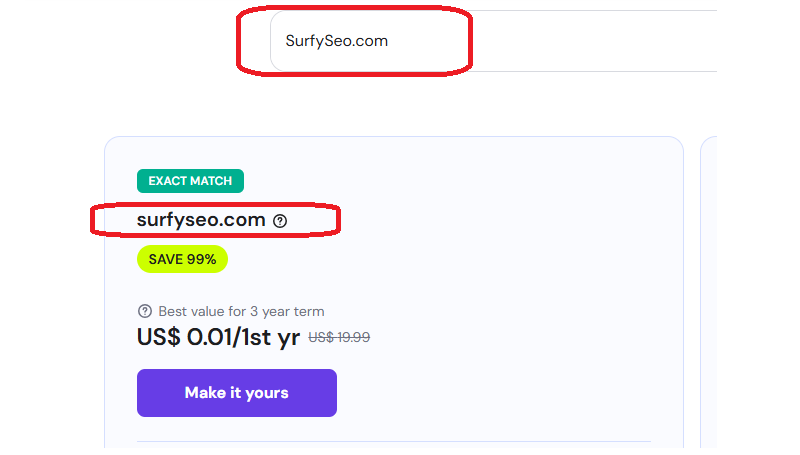
Let’s say you’re creating an SEO-related platform, and the domain surferseo.com is already taken, so you create a variant based on it.

In other words, rather than copying domain names already in use by other companies, focus on crafting original domains that stand out and leave a lasting impression on your clients.

In practice, domain choices rarely work in isolation. They are a continuation of much earlier decisions—how the product idea was formed, what problem it solves, and who it’s built for. If that foundation is still taking shape, it makes sense to start from the very beginning of the SaaS journey in Day 1 — Where to Find Great SaaS Ideas (and how to vet them).

2. The Psychology Behind AI-Powered SaaS Brands

If you’re starting your own online store, you should choose a domain name based on creative logic. However, if you’re choosing a name for an AI or SaaS project, you’ll be guided by the clarity of the domain name and your reputation as an online entrepreneur.

In other words, you need a domain that enhances the value of the product you’re bringing to the market. A domain name for an AI or SaaS project should sound convincing to investors. Once you’ve answered these questions, your domain is strong.

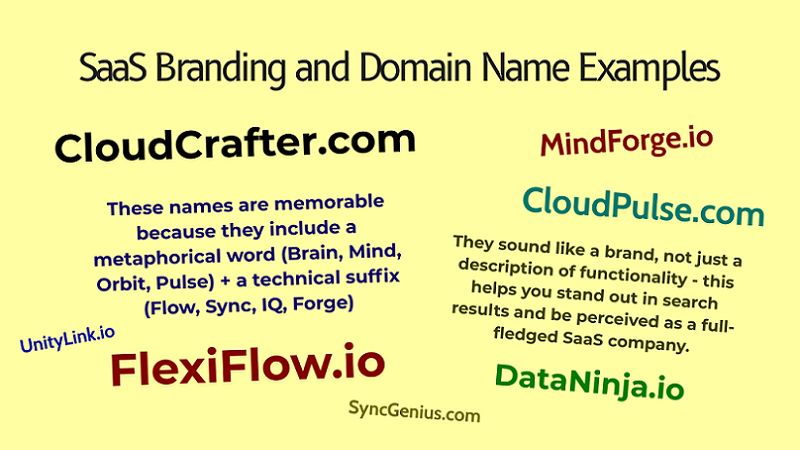
Think about the words that best reflect your brand’s essence. Terms like “Agent,” “Suite,” “Brain,” “Vision,” or “Score” can instantly evoke ideas related to intelligence, analytics, and AI functionality. By thoughtfully merging two meaningful words, you can create a domain that feels both memorable and authoritative. Names like “BrainFlow” or “LogicAI” already convey strength and perfectly suit the AI SaaS niche.

Once you have a clear picture of your customers’ mindset and a solid understanding of your AI SaaS product, picking the right domain becomes much simpler. You’ll naturally envision the ideal brand identity, making it easier to create a domain that is unique, memorable, and perfectly aligned with your product.

3. What Makes an AI SaaS Domain Valuable?

Choosing the right domain for your AI SaaS project is more than just a creative exercise. Many founders get caught up in trying to make their domain short, catchy, or easy to read, while losing sight of the bigger picture: branding and long-term positioning. This can lead to confusion and missed opportunities.

The true impact of your domain lies in three critical areas:

a) Communicate Your Product’s Core Function Clearly

A domain is most effective when it immediately tells users what your AI-powered SaaS does. Whether your software automates workflows, performs risk analysis, processes data, or supports decision-making, a clear domain helps your audience understand your product at a glance. When the domain aligns with your software’s core functions, adoption becomes easier, and your brand gains credibility faster.

b) Convey Competence, Not Emotion

Avoid letting personal feelings or abstract ideas dictate your domain choice. Instead, focus on projecting professionalism and trust. Strong SaaS domains communicate logic, reliability, and expertise—qualities that inspire confidence in prospective users and investors alike. Abstract or overly playful names may be memorable, but they risk undermining your authority in a competitive AI SaaS market.

c) Ensure Scalability and Long-Term Fit

Your domain should grow with your product. Consider whether it can accommodate future features, expansions, or changes in your AI SaaS offering. A scalable, versatile domain appeals to a broader audience and supports long-term branding. Conversely, a domain that is too narrow or limiting can restrict your product’s potential and make future growth more challenging.

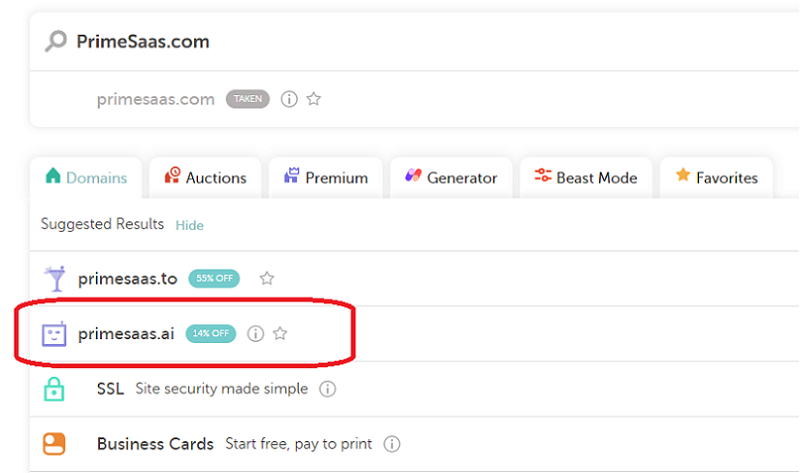
For example, if we take the domain names PrimeSaas.ai and InvoiceSoft.ai, the former will have very high scalability, and to an investor, it will look like a universal, large brand. If we take the InvoiceSoft.ai domain, it has medium-low scalability and a narrow, financially constrained niche.

4. Categories of Domains Determining Demand for AI and Saas

When choosing a domain for your AI SaaS project, it’s important to consider the product’s functionality rather than just keywords. Domains that clearly reflect the AI service type tend to be more memorable, scalable, and attractive to both customers and investors. Below is a structured overview of key domain categories in the AI SaaS space.

a) Autonomous Agent Domains

These domains represent AI that acts as a self-sufficient agent performing user tasks, such as automated content creation, email and communication management, task planning, and workflow automation. Examples include TaskAI.io, AgentSaaS.ai, and AutoBot.ai. High demand exists here, as autonomous agents are a fast growing trend, offering strong scalability potential and investor appeal.

b) Process Automation Domains

Automation domains focus on optimizing workflows without necessarily acting as autonomous agents. Key applications include reporting, data processing, marketing, CRM, and billing. Examples: SmartWorkFlow.ai, SaaSify.ai. Ideal for niche B2B products, these domains can be expanded across related processes, enhancing long-term value.

c) Analytics and Insights Domains

Domains in this category highlight AI SaaS that analyzes data, generates forecasts, and provides actionable insights rather than automated execution. Examples include InsightAI.io, DataMind.ai, and AnalyticsSaaS.ai. These are particularly attractive to corporate clients and large enterprises, where data-driven decision-making is critical.

d) Verification and Compliance Domains

SaaS AI in this sphere ensures authenticity, security, and regulatory compliance, including document verification, fraud prevention, and identity checks. Domain examples: VerifyAI.io, TrustLayer.ai. These domains have medium-to-high scalability and are especially valuable to banks, financial institutions, and other regulated industries.

e) Data Infrastructure Domains

Domains that reflect AI SaaS focused on data storage, integration, and processing. Applications include data pipelines, lakes, and quality monitoring. Examples: DataOps.ai, CloudAI.io, SmartDB.ai. These domains attract large SaaS enterprises and strategic buyers due to their cross-industry applicability, from finance to marketing and HR.

f) Productivity and Workflow Domains

These domains represent AI that enhances team efficiency and internal workflows, such as smart assistants, document automation, team chatbots, and workflow optimization. Examples: WorkAI.io, FlowSaaS.ai, TaskMind.ai. High scalability and broad industry application make these domains appealing to investors.

g) Developer and API Platform Domains

Focused on SaaS AI that provides SDKs, APIs, or developer tools, enabling integration of AI into web projects. Examples: DevAI.io, APIHab.io, CodeSaaS.ai. This segment is highly expandable into analytics, fintech, gaming, and marketing, attracting startups and investors building AI ecosystems.

h) Customer Experience Domains

Domains for SaaS AI improving customer interactions through chatbots, personalized recommendations, and automated support. Examples: SupportBot.ai, CustomerFlow.ai, AssistAI.io. Demand is high across e-commerce, fintech, education, and SaaS, with ROI easily measurable, making these domains attractive to investors.

i) Retail and E-Commerce Domains

These domains optimize sales, recommendations, pricing, and marketing for online and physical stores. Examples: RetailAI.io, ShopSaaS.ai, SmartStore.ai. They can scale across marketplaces, SaaS trading platforms, and warehouse management, offering high demand potential from online sellers.

j) Professional Corporate Domains

Short, technologically advanced domains that convey reliability and professionalism. Ideal for B2B SaaS and large AI platforms. Examples: PrimeSaaS.ai, DataBridge.ai, FlowSaaS.ai. High demand and scalability make them attractive to corporate clients and investors.

k) Hybrid Functional Domains

Domains combining a product keyword with AI/SaaS/Bot or an industry term with a tech term. These names are clear, moderately formal, and SEO-friendly. Examples: MarketingAI.io, AutoWorkFlow.ai. They balance brand identity with product functionality, offering medium-to-high scalability.

l) Human-Like AI Domains

Domains that sound personal or human, creating an emotional connection with users. Best suited for AI assistants, chatbots, and B2C products. Examples: EvaAI.io, AlexBot.ai. These domains are niche, moderately scalable, and excel in branding, though less impactful for SEO.

5. The Future of AI & SaaS Domains

The future of domains for SaaS projects and AI platforms is being shaped not by hype, but by how quickly the way products are being built is changing. Today, you can launch any startup in literally a week, sometimes a weekend, and a domain is increasingly becoming the first strategic decision, not a formality. In the AI ​​niche, a domain name is increasingly perceived less as just a website address and more as part of the product and brand. This is especially noticeable in micro-SaaS projects, where a domain can immediately provide a top-notch trust framework.

The market is gradually moving away from complex, difficult-to-read names toward short, clear, and easily scalable domains. AI projects no longer need to explain their name—you simply glance at it and read it intuitively. At the same time, the value of domains that aren’t tied to a single function or model is growing. Name flexibility is now more important than specificity.

We are also seeing a trend toward domains that can be used globally, without any linguistic or cultural barriers. AI-SaaS is increasingly being built for a single country or market. This means that domain versatility will likely only increase in value. In the future, a domain for an AI project will become an asset that can be scaled, repositioned, and even sold separately from the product. This is why understanding future trends is crucial even at the naming stage.

6. The Smart Investor’s Guide to High-Potential AI & SaaS Domains

In today’s fast-moving world of AI and SaaS, a domain name isn’t just a web address—it’s a strategic asset. The right domain can increase a startup’s perceived value, attract investors, and support long-term growth. But finding such a domain requires more than speed or luck; it demands understanding the market niche, branding, and emerging trends.

Below, we outline five key principles that savvy investors use to identify domains with genuine potential and lasting value.

a) Secure a Strong Category Before Making a Purchase

Never buy a domain without first evaluating the strength of the niche behind it. A domain that belongs to a growing market automatically benefits from demand momentum, making it more valuable over time. Even outside your own product, such a domain can retain value on the secondary market because it is supported by real industry growth.

b) Use the A.I.R. Framework: Attract, Identify, Retain

A well-chosen domain should work for your brand from the very beginning. The A.I.R. framework helps with this. An effective name attracts attention instantly, is easy to recognize and remember, and clearly reflects what the product does. Most importantly, it creates trust, turning a simple domain into a long-term brand asset rather than just a web address.

c) Choose Domains That Strengthen Brand Identity

Your domain is often the first interaction users and investors have with your startup. Strong domains communicate clarity, confidence, and authority. When a name clearly reflects who you are and what you offer, it becomes easier to build credibility and position your product in a competitive AI SaaS market from day one.

d) Learn from Proven Startups and Market Leaders

Analyzing successful startups provides valuable insight into naming patterns, keyword usage, and branding strategies that actually work. This research helps you understand how your target audience perceives certain terms and allows you to select a domain that feels modern, professional, and aligned with current market expectations.

e) Avoid Short-Term Trends and Gimmicks

Trendy or overly creative domains may look appealing at first, but they rarely age well. Many of them lose relevance as markets evolve. Instead, focus on domain names that are timeless, trustworthy, and flexible enough to grow with your AI SaaS business. Domains built on solid logic and clarity are far more likely to hold long-term value.

By relying on market analysis, brand alignment, and real industry signals—rather than buzzwords or fleeting trends—you increase your chances of choosing a domain that supports sustainable growth and long-term success.

7. How Investors Assess the Real Value of AI & SaaS Domains

The pricing of AI and SaaS domains follows very different rules compared to standard domain names. Value is influenced not only by how short or catchy a name is, but also by the market it serves, the strength of the niche, and its branding potential. A well-positioned domain in a fast-growing category can be worth many  times more than a similar name in a less competitive space.

a) Base Value: Clarity, Length, and Ease of Use

Domains that are short, easy to pronounce, and simple to remember form the foundation of any valuation. For SaaS projects, a clean two-word .com domain often starts around the $5,000 range. Strong branding combinations can push this value toward $50,000 or more, especially when investors see clear upside.

b) Category Premium: Demand Drives Price

Market demand plays a major role in pricing. Domains tied to rapidly expanding sectors—such as AI copywriting tools, generative media, automation, fintech, or cybersecurity—often command significantly higher prices. In some cases, niche momentum alone can increase a domain’s value by 150–200% compared to generic alternatives.

c) Brand Strength: Ready for a Startup from Day One

A valuable domain must work as a brand, not just a label. Startup-friendly names that clearly communicate purpose and identity allow companies to launch faster and with more confidence. Premium, highly brandable AI SaaS domains commonly trade in the $30,000 range, and in high-growth scenarios, valuations can exceed $100,000.

d) Comparable Sales and Market Reality

To understand true market value, investors analyze real transactions on platforms such as Sedo and Flippa. Recent sales show that two- or three-word SaaS domains in strong categories typically sell between $5,000 and $50,000. Short, single-word premium domains operate in a different tier, often reaching $50,000 to $200,000 or more.

e) Liquidity and Exit Potential

Domains that can be easily reused, resold, or positioned as a credible startup brand have high liquidity. This perception alone can add 30–50% to the base valuation. Domains lacking resale appeal, even if they sound attractive, tend to remain illiquid and offer little long-term investment value.

f) Investor Shortcut: A Practical Valuation Model

Many investors rely on a simple multiplier-based approach. The base price is adjusted by niche strength, brand quality, and liquidity. Example: Base value: $5,000 / Strong AI category multiplier: 1.5 → $7,500 / Branding strength multiplier: 2 → $15,000 / High liquidity multiplier: 1.3 → $19,500

This framework provides a fast, realistic snapshot of a domain’s investment potential.

8. The Mistakes that Kill AI & SaaS Domain Potential

Many people believe that domain problems arise from short-term thinking. A common mistake you can make is choosing a domain “for a current feature” rather than for a future product. Today it’s an AI chat, tomorrow a platform, but the domain is already limiting growth. You can’t fix such decisions without rebranding.

If you’re overcomplicating things, that’s your second mistake. Adding unnecessary words, hyphens, or non-standard endings reduces memorability and trust. A user may forget your domain name within minutes of their first visit. This isn’t ideal for your micro SaaS project.

Also, many underestimate the negative value of a domain. If a name looks cheap or lacking confidence, it automatically diminishes the overall product’s perception. Even powerful technology can’t compensate for a bad first impression.

Another mistake is trying to copy trends without understanding the context. Not every AI term will be relevant in a year. Domains tied to temporary hype often quickly lose value. As a result, the project starts with a limitation that is not immediately apparent, but which can become a problem in the future, especially as it gradually becomes a problem as you grow.

9. Selling AI & SaaS Domains: The Proven Conversion Method

Selling domains in the AI ​​and SaaS niches doesn’t work by listing a domain and then expecting it to be bought. The value of your domain should be immediately apparent. Buyers aren’t paying for symbols—they’re paying for potential. That’s why it’s crucial to know how to properly present a domain to a buyer.

If you can demonstrate the actual use case for a domain, it will sell well. When a potential buyer immediately sees what a product under that name could be, conversion rates soar. This is especially noticeable in the AI ​​niche, where the domain often becomes part of the positioning.

It’s also important to understand the type of buyer you’re dealing with. A founder, a marketer, and an investor will always view a domain differently. This should also be taken into account.

Another key point is the right entry point. AI domains sell best where there’s an entrepreneurial mindset, not just hunters for rare names. As a result, the domain ceases to be some abstract asset and becomes a logical part of the business strategy. This approach leads to stable transactions, not random sales.

Final Thoughts

In practice, there are two clear paths forward. You can either select a domain and grow it together with your AI-powered SaaS product, or deliberately build a strong, market-ready domain and treat it as a standalone digital asset. In both cases, the focus should be on concise two-word names that clearly express what your SaaS business stands for and show real potential from both a branding and market standpoint.

Domain decisions make the most sense when viewed as part of a larger sequence—from shaping the initial idea to validating it, building the product, and reaching the first real users. This broader perspective is outlined in AI SaaS Roadmap: From Idea to First Users in 30 Days Without Heavy Coding, where domain strategy fits naturally into the overall launch process.

This mindset allows you to create domains that become the backbone of a successful AI SaaS product—or assets that retain long-term value on their own. A thoughtfully chosen domain does more than label a project; it helps establish credibility and confidence from the very first interaction.

Remember, a domain is not just a technical detail or a URL. It is a core component of your brand and a signal of seriousness to users, partners, and investors. Apply the principles outlined in this guide to ensure that every decision you make contributes to sustainable growth and lasting business value.