


In the world of SaaS business, growth isn’t just about attracting new users but also retaining existing ones.
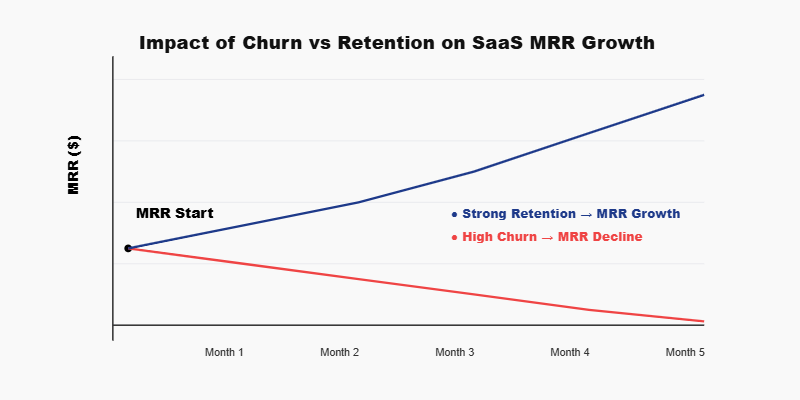
If you’re not working to reduce churn, even active marketing won’t save your monthly recurring revenue growth strategy. SaaS startups who focus on traffic and new signups can often forget about retention. As a result, the churn rate gradually increases, and MRR stops growing steadily.
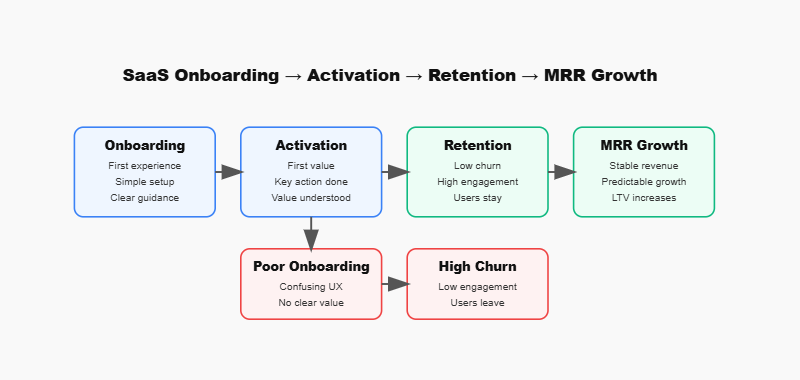
If a product has issues with onboarding, users don’t realize their primary value. If benefits aren’t clearly communicated, customers don’t understand why they should continue paying. Without user behavior analysis, you can’t identify churn signals in advance. All of this directly impacts SaaS customer retention optimization and churn reduction strategies.
The modern SaaS market is growing rapidly. AI SaaS startups and automated software tools powered by artificial intelligence are particularly active. New solutions emerge every month, competition intensifies, and users are becoming more demanding. In such an environment, it’s important not just to launch a product, but to retain and scale it.
However, the paradox is that owners of AI-based micro SaaS products are good at attracting users, but fail to reduce churn rates. They don’t analyze the reasons for subscription cancellations. They don’t use data to identify at-risk customers in subscription-based SaaS products. As a result, a company may grow in traffic but lose money due to high churn.
Increasing MRR is impossible without systematic retention management. If you don’t track engagement metrics, you don’t understand the true state of your product. Without a retention strategy, your business remains unstable. Effective churn management turns one-time sales into long-term customer relationships.
In this article, we’ll explore practical approaches to reducing churn and increasing MRR. You’ll learn how to improve onboarding processes, use data for forecasting, and implement retention strategies. Proper customer lifecycle management in SaaS businesses can significantly increase revenue stability.
If you want to build a sustainable SaaS product, it’s important to understand: growth begins with retention. Only a combination of customer acquisition, data analysis, and strategic customer engagement can deliver a realistic and predictable SaaS revenue expansion model.
1. SaaS Onboarding Optimization to Reduce Churn Rate and Increase Monthly Recurring Revenue
Onboarding is one of the most critical stages in any subscription-based SaaS business focused on long-term customer retention and predictable MRR growth. It’s in the first minutes and days of using your micro SaaS product that users decide whether to stay or leave. If the process is complex, confusing, or overwhelming, the likelihood of churn increases dramatically. As many founders discover, attracting users isn’t enough — 90% of AI SaaS startups fail, but the top 10% follow a proven growth formula.
As a micro SaaS founder, you may underestimate the impact of the initial experience on a churn rate reduction strategy for early-stage SaaS startups. You may be tempted to invest resources in advertising and traffic acquisition, but fail to optimize the user journey within the product. As a result, new customers sign up but don’t activate.
Properly designed onboarding directly impacts monthly recurring revenue growth through improved user activation and engagement metrics. The faster users understand the value of the product, the higher the chance they’ll stay and upgrade to a paid plan. This is especially important for trial or freemium models.
Furthermore, optimizing onboarding helps identify weaknesses in your product. Analyzing user behavior makes it easier to implement a data-driven SaaS growth strategy based on product usage analytics and customer behavior signals. This approach not only reduces churn but also gradually increases MRR.
In essence, high-quality onboarding is the foundation for sustainable growth in a SaaS business. Without it, even strong marketing won’t be able to offset high churn.
Designing a High-Converting SaaS Onboarding Funnel for Better User Activation
Effective onboarding should lead users to the first value as quickly as possible. A well-designed, high-converting SaaS onboarding funnel optimized for user activation and product adoption helps shorten the path from registration to completion.
It’s important to eliminate unnecessary steps and focus on the key action that demonstrates the product’s value. This could be creating the first project, integrating with a service, or completing an automated task. The simpler this path, the higher the likelihood of activation.
For bootstrapped SaaS founders building scalable subscription products, it’s especially important to track every stage of the funnel. If users get stuck on any step, it’s a signal to improve the interface or instructions. This approach increases conversion to paying customers and reduces early churn.
Reducing Time-to-Value (TTV) to Improve Early Customer Retention and Engagement
Time-to-Value is the time it takes from signup to receiving real value from a product. The shorter it is, the better retention. Optimizing a time-to-value reduction strategy for improving early-stage SaaS customer retention and engagement directly impacts churn.
If users quickly see results, they become emotionally attached to the product. This increases the likelihood of continuing to subscribe and upgrading to a more expensive plan. This is especially important for models with a free trial period.
Reducing TTV helps strengthen customer retention metrics and long-term MRR stability in subscription-based SaaS models. Therefore, many successful projects focus on quickly demonstrating value within the first minutes of use.
Tracking Activation Metrics and Product Usage Signals to Prevent Early Churn
To reduce churn, simply improving the interface is not enough – you need to analyze the data. Activation metrics show whether users are reaching the key value moment. This is part of a product analytics-driven churn prevention system for SaaS companies.
Behavior tracking helps identify low-engagement users. These signals enable proactive email campaigns or in-app notifications. This reduces the likelihood of early churn and increases retention.
Using data for decision-making is the foundation of a modern SaaS retention optimization and revenue growth framework based on user behavior analytics. When a company understands which actions drive retention, it can systematically increase MRR.
2. Data-Driven Customer Retention Strategy to Lower Churn and Improve SaaS Growth
There are still some SaaS companies where product development decisions are made based on intuition. However, the modern market demands a more systematic approach, especially when it comes to reducing user churn. This is why more and more companies are implementing a data-driven customer retention strategy for subscription-based SaaS companies trying to reduce churn rates. This approach allows decisions to be made based on real user behavior rather than guesswork.
When a team begins analyzing data, it becomes much easier to understand why users are churning. For example, it’s possible to identify which features are used most often and where users stop interacting with the product — and even before building these analytics, it’s crucial to know where to find great SaaS ideas and how to vet them so that your product addresses a real problem from the start. This is a key element of an advanced SaaS analytics framework for identifying customer churn risk and improving product engagement.
Data also helps segment users and identify different behavior patterns. Some customers actively use the product and grow with it, while others gradually lose interest. By using behavioral data analysis for SaaS products to detect early churn signals and user disengagement patterns, it’s possible to identify such groups in advance.
It has also been noted that analytics helps understand which product changes truly impact retention. This is an important part of a SaaS growth strategy focused on long-term customer lifetime value optimization and churn prevention. When a company sees real patterns in the data, it can invest resources more accurately.
As a result, a SaaS business achieves a more sustainable growth model. Instead of constantly chasing new customers, the company begins to maximize the value of its existing audience. This approach makes a monthly recurring revenue growth strategy based on retention improvements and user engagement optimization much more effective.
Using Cohort Analysis to Identify Retention Patterns and Revenue Trends
Cohort analysis is one of the most powerful tools for understanding user behavior. It allows you to analyze groups of customers who started using a product at the same time. This method helps build a cohort analysis model for tracking SaaS customer retention patterns and long-term revenue trends.
For example, you can see how users who signed up in a given month behave. Some groups may be highly active, while others churn after just a few weeks. This analysis helps identify hidden churn drivers within subscription-based SaaS platforms using cohort behavior comparison.
You’ll also notice that cohort analysis helps evaluate the effectiveness of product changes. If retention increases after an interface update, this will be visible in the data. Therefore, many companies use cohort-based retention analytics to improve SaaS product adoption and reduce early customer churn.
When a SaaS company regularly analyzes such metrics, it gains a better understanding of the user lifecycle. This allows for a more precise growth strategy and increased revenue sustainability.
Building Proactive Customer Success Workflows to Prevent At-Risk Accounts
Customer success plays a key role in user retention. Instead of reacting to issues after subscription cancellation, companies strive to act proactively. This is why proactive customer success workflows are being implemented to detect and recover at-risk SaaS customer accounts before churn.
These processes can include automated notifications, personalized recommendations, and user assistance at critical stages. For example, if a user has stopped actively using a product, the system can launch automated SaaS engagement recovery campaigns triggered by declining product usage signals.
Customer success teams also analyze customer behavior and identify potential risks. This is part of the predictive customer health scoring model used by SaaS companies to identify churn risks early. The earlier a problem is detected, the higher the chance of retaining a customer.
When such processes are implemented systematically, a SaaS company begins to reduce churn and increase customer lifetime value. This directly impacts revenue stability and MRR growth.
Implementing In-App Messaging and Lifecycle Email Campaigns for Churn Reduction
User communication plays a huge role in retention. Many customers leave not because the product is bad, but because they don’t understand its value. This is why SaaS companies actively use in-app messaging strategies to improve user engagement and reduce churn in subscription software products.
Integrated messages within the product help guide the user and suggest next steps. For example, you can show a tooltip about a feature that speeds up the user experience. This approach reinforces the contextual product guidance system designed to improve SaaS feature adoption and customer activation rates.
Email communication also remains an important tool. Lifecycle email marketing campaigns for SaaS businesses focused on user education, onboarding, and retention are particularly effective. These emails help educate users and remind them of the product’s value.
When in-app communication and email marketing work together, the company creates a more holistic user experience. This helps reduce churn and strengthen long-term customer relationships.
3. Revenue Intelligence: Predicting MRR Growth and Identifying At-Risk Customers
If you’re new to SaaS business and have just launched your own micro SaaS product, revenue growth may seem unpredictable. However, modern analytics tools allow you to understand in advance how revenue will change and which customers are at risk of churn. This is why more and more companies are implementing revenue intelligence systems to predict monthly recurring revenue growth in subscription-based SaaS companies. This approach helps not only analyze past data but also forecast future product development.
When a team begins working with revenue analytics, they can better understand MRR dynamics. For example, they can see which customers are increasing their plans and which are gradually losing interest in the product. This is an important part of the predictive SaaS revenue analytics framework for identifying churn risk and revenue expansion opportunities.
Analytics also helps you, as a founder, identify behavioral signals that appear long before subscription cancellations. If a user stops actively using key product features, this can be an early sign of risk. These signals are part of a behavior-based customer health monitoring system for the early detection of SaaS churn indicators.
When this data is combined into a single system, companies gain a more accurate picture of their business. This enables them to build a data-driven SaaS growth strategy focused on increasing customer lifetime value and stabilizing recurring revenue streams.
Revenue Intelligence also helps make strategic decisions about product development. Founders can better understand which customer segments generate the most revenue and where to focus their efforts. This approach strengthens the predictable SaaS scaling model based on retention metrics, revenue expansion, and churn forecasting analytics.
As a result, SaaS companies no longer operate blindly. They begin to manage growth based on data and accurate forecasts. This makes the subscription business model more sustainable and predictable.
Forecasting Monthly Recurring Revenue (MRR) Using Churn Rate and Expansion Data
MRR forecasting is a key element of strategic planning in SaaS. When a company understands how many customers are likely to churn and how much pricing will increase, it can more accurately plan for growth. This is achieved using a predictive monthly recurring revenue forecasting model based on churn rate, expansion revenue, and new customer acquisition trends.
Churn rate analysis helps understand how much revenue a company may lose in the future. Revenue expansion—such as pricing upgrades and additional features—is equally important. These metrics form an advanced SaaS revenue forecasting framework combining churn analysis, upsell revenue, and subscription growth metrics.
Companies also use historical data to build long-term forecasts. For example, they can identify seasonal changes in revenue growth or decline. This analysis helps create a data-driven financial planning model for SaaS businesses using recurring revenue and retention trends.
When MRR is forecasted regularly, the team gains a clearer understanding of the future business. This helps inform decisions about marketing, product development, and scaling.
Detecting Behavioral Signals That Indicate Customer Risk and Engagement Drop
In many cases, users don’t churn suddenly—certain signals appear beforehand. For example, they may access the product less frequently or stop using key features. This is why companies implement behavioral analytics systems to detect early customer disengagement signals in SaaS platforms.
These signals help identify users at risk. If a decrease in activity is detected early, efforts can be made to regain the customer’s interest. This is an important part of a predictive churn detection strategy using product usage data and customer engagement metrics.
For example, the system may detect a sharp drop in the number of actions within the product. This is often a sign that the user is not receiving sufficient value. Therefore, many SaaS companies use customer health scoring algorithms designed to identify at-risk subscription accounts before cancellation occurs.
When such signals are tracked automatically, the Customer Success team can respond more quickly. This helps reduce churn and preserve more revenue.
Combining Retention Metrics, LTV, and Revenue Analytics for SaaS Scaling Strategy
For sustainable growth in a SaaS business, analyzing churn or MRR alone isn’t enough. It’s important to combine different metrics to get the full picture. That’s why companies are creating an integrated SaaS analytics framework combining retention metrics, customer lifetime value, and recurring revenue growth indicators.
Customer Lifetime Value measures how much revenue one customer generates over the entire life of their product. When this metric grows, the business becomes more sustainable. It’s an important part of a long-term SaaS scaling strategy focused on increasing customer lifetime value while reducing churn.
User retention metrics are also important. They demonstrate how useful the product is to customers. Therefore, many teams use an advanced retention analytics system to measure SaaS product stickiness and user engagement over time.
When all this data is combined, a company can more accurately formulate a scaling strategy. This helps not only attract new users but also maximize the value of existing customers.
4. Subscription Optimization: Encouraging Annual Plans to Reduce Churn and Increase Revenue Stability
As you already know, the subscription model is the foundation of stable revenue for SaaS companies. However, choosing between monthly and annual plans can significantly impact business sustainability. This is why more and more companies are implementing a subscription pricing optimization strategy to encourage annual SaaS plans and improve revenue predictability. This approach not only increases revenue but also reduces user churn.
When users switch to an annual subscription, the company achieves a more stable cash flow. This is especially important for startups building a predictable monthly recurring revenue growth model for bootstrapped SaaS startups with subscription-based pricing. Revenue predictability helps plan product development and marketing investments.
Annual plans also directly impact user retention. Customers who pay annually in advance tend to stay with the product longer and use it more actively. Therefore, many companies are implementing an annual SaaS subscription conversion strategy designed to reduce churn and increase customer lifetime value.
I’d also like to point out that optimizing the subscription model helps increase overall customer lifetime value. The longer a user stays in the system, the more value they receive from the product. This is an important part of the long-term SaaS monetization framework focused on maximizing lifetime value and minimizing subscription churn rates.
Some online SaaS companies also use special incentives for upgrading to annual plans. These can include discounts, bonus features, or additional limits. Such methods are part of subscription upgrade funnel optimization for SaaS products aimed at increasing annual contract value and revenue stability.
When such strategies are implemented systematically, the business becomes less dependent on a constant influx of new users. The company begins to build a sustainable growth model in which customer retention plays a key role.
Designing Annual Pricing Incentives to Improve Cash Flow and Customer Lifetime Value
One of the most effective ways to encourage upgrading to annual plans is to properly design an incentive system. Many SaaS companies use an annual pricing incentive strategy designed to increase upfront revenue and improve SaaS cash flow stability. This could be a discount on an annual subscription or additional features.
When a user sees a financial benefit, the likelihood of upgrading to an annual plan increases significantly. This approach helps build a customer lifetime value optimization model through annual subscription pricing and long-term commitment incentives. As a result, the company receives more revenue upfront.
It’s also important to properly present the value of an annual subscription. For example, you can demonstrate annual savings compared to monthly payments. This method is used in high-converting SaaS pricing page designs focused on annual plan adoption and subscription upgrade conversion.
In addition to financial incentives, companies sometimes add exclusive features for annual users. This reinforces the value proposition and increases the likelihood of upgrading.
Comparing Monthly vs. Annual Subscription Models for Long-Term SaaS Profitability
The choice between a monthly and annual subscription model impacts a SaaS company’s financial strategy. Monthly plans offer users flexibility, but they also increase the likelihood of subscription cancellation. This is why many companies analyze monthly vs. annual SaaS subscription models for long-term revenue predictability and churn reduction.
The monthly model is often used to attract new users. It lowers the barrier to entry and allows users to test the product without long-term commitments. However, it increases the risk of high monthly churn rates in early-stage SaaS businesses with flexible subscription pricing models.
The annual model, on the other hand, creates a more stable financial structure. Users make long-term commitments and are less likely to cancel. This makes the annual SaaS pricing strategy for improving customer retention and stabilizing recurring revenue streams particularly popular among growing companies.
There are also many SaaS projects that use a combination of the two models. They attract customers through monthly plans and then gradually migrate them to annual plans.
Using Discount Strategies and Upgrade Paths to Drive Revenue Expansion and Reduce Churn
Discount strategies can play a significant role in increasing SaaS product revenue. Properly designed offers help motivate users to upgrade to more expensive plans. This is why companies are implementing a strategic SaaS discount framework designed to increase annual plan conversions and reduce customer churn risk.
If desired, offer users a discount when upgrading from a monthly to an annual plan. This helps increase the likelihood of upgrading and creates a subscription upgrade funnel optimized for maximizing annual contract value in SaaS products.
Special offers at subscription renewal time are also an effective tool. Users can receive a bonus or discount for renewing for a longer period. This approach is used in a customer-retention-focused SaaS pricing strategy combining renewal incentives and subscription upgrades.
When such strategies are applied systematically, a company not only increases revenue but also business stability. This allows the SaaS product to grow faster and reduce the overall churn rate.
FAQ Section
What is the average SaaS churn rate?
The average SaaS churn rate varies greatly depending on the product type, market, and pricing model. For example, churn is typically higher for B2C SaaS products than for B2B solutions. On average, many companies use the average SaaS churn rate benchmark for subscription-based software companies in different industries, which can range from 3% to 7% per month. For mature B2B SaaS companies, this rate is often lower. Early-stage startups may have higher churn, especially until they have achieved a stable product/market fit in subscription SaaS businesses. Therefore, it is important to compare your metrics not only with the market but also with your own historical data.
Is 20% churn high?
Yes, a churn of 20% is generally considered very high. This rate means that a significant portion of customers are leaving the product each month. For many companies, this is a signal that there are problems with the product’s value or user experience. High churn is often associated with poor onboarding, a lack of clear value, or a weak customer retention strategy for early-stage SaaS startups trying to reduce churn. If a company sees this level of churn, it should analyze user behavior and identify the reasons for leaving. Reducing churn becomes critical for sustainable MRR growth.
Is a 5% churn rate good?
A churn rate of around 5% per month is generally considered acceptable for many SaaS products, especially in the early stages of development. However, much depends on the segment and business model. For example, for B2B SaaS solutions with high pricing plans, companies often strive for an even lower rate. It’s important to analyze SaaS churn rate benchmarks for subscription software companies focused on long-term customer retention. If a product is actively growing and retaining customers, 5% may be a normal rate. However, in the
long term, most companies strive to reduce it to 3% or lower.
What is a bad churn rate?
A bad churn rate is usually considered a metric that significantly slows a company’s growth. Churn exceeds 10% per month, often signaling serious issues with the product or user retention strategy. This level may indicate that users don’t see sufficient value in the service. In this case, it’s important to implement a data-driven SaaS retention improvement strategy focused on identifying churn drivers and improving the customer experience. Analyzing customer behavior helps understand at what point they lose interest. Without addressing these issues, even active marketing won’t ensure stable growth.
Is a 90% retention rate good?
Retention of 90% is generally considered a good result for many SaaS companies. This means that a large portion of customers continue to use the product and renew their subscriptions. This metric often indicates a strong product and good customer service. Many companies strive for a high customer retention strategy for SaaS products focused on maximizing customer lifetime value and recurring revenue growth. However, it’s important to consider the period over which retention is measured—monthly, quarterly, or annually. The longer users stay with the product, the more sustainable the revenue model becomes.
Final Thoughts
Reducing the churn rate is one of the most important tasks for any SaaS product. Even a small churn rate can significantly slow business growth if left unchecked. That’s why successful SaaS companies place a strong emphasis on user retention and customer behavior analysis.
The first step is always improving the user experience. Well-designed onboarding helps users quickly understand the product’s value. When customers experience results early on, the likelihood of churning is significantly reduced.
Data also plays a crucial role. User behavior analytics helps identify problems before they lead to subscription cancellations. This allows SaaS companies to make more accurate decisions and build a growth strategy based on real data.
Optimizing the subscription model is equally important. Annual plans, discounts, and well-thought-out upgrade strategies help increase revenue stability. As a result, the business becomes less dependent on constantly acquiring new customers.
When a company simultaneously focuses on onboarding, analytics, and the subscription model, it creates a sustainable growth system. This approach not only helps reduce churn but also increases MRR.
In the long term, customer retention becomes the main driver of SaaS business success. The longer users stay with the product and derive value from it, the faster the company can scale and develop new capabilities.