

Building an effective SaaS marketing strategy for AI startups is very different from traditional marketing for other online products. Here, everything is built not on grandiose promises and advertising channels, but on
how quickly the user receives real value from the product.
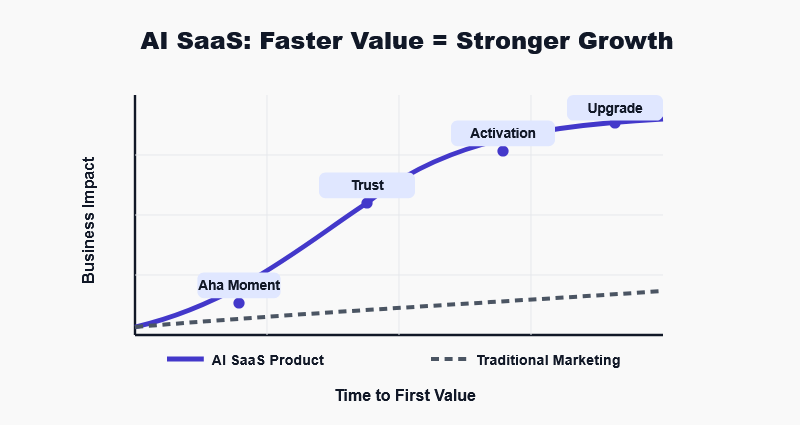
With AI-powered products, expectations are always higher and the bar for patience is lower. Users don’t need explanations; they want results. Based on this, it’s safe to say that effective marketing strategies for AI-powered SaaS start within the product, not outside it.
The faster the user achieves the most tangible result, the higher the likelihood of activation, trust, and long-term use. And with AI-powered SaaS, the product itself is the marketing funnel, not just part of it.
1. Product-Led Growth (PLG) with AI Value First
For AI startups, a product-led growth delivers results when users can sense the value of your AI SaaS product almost immediately. The product’s goal isn’t to explain how the algorithm works, but to demonstrate its purpose. This is crucial within the first few minutes of interaction with the product.
a) Design the Fastest Possible “Aha” Moment
Onboarding should lead the user directly to the result, not to settings. In AI-powered SaaS startups, this could be a generated response, an automated action, or some other action that shortens the path from the start to the first useful result. The faster the user gets this result, the higher the chance they’ll remain your customer.
b) Let the AI Do The Talking
Instead of long descriptions and feature lists, let users experience how your AI-powered product works. Demos, sandboxes, and output samples convey product value better than any marketing copy. In AI SaaS, trust is built on results, not on vague promises.
c) Use Limitations to Drive Upgrades, Not Frustration
You should have both a free and a paid product. If a user takes control of the free version of your AI-powered SaaS, they see value, even if you don’t fully disclose the product. Usage limits aren’t a problem. If the user understands they need advanced features, they’ll still pay for the premium version. Properly designed limits turn the product itself into a conversion tool.
2. Education-Driven Content Marketing
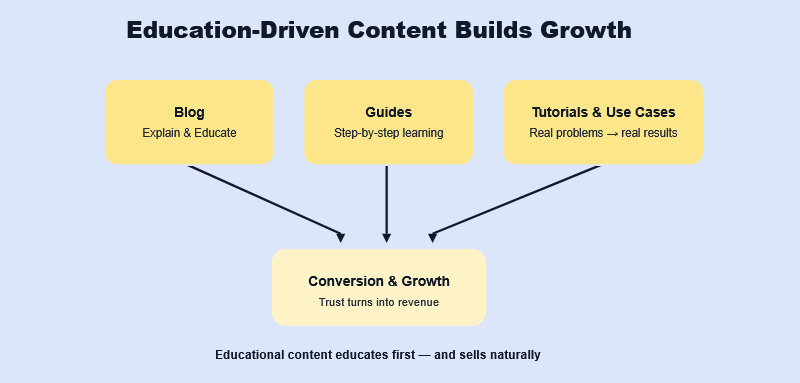
For AI-powered startups and SaaS products, effective marketing often relies on educational content. The goal here isn’t simply to sell, but to demonstrate expertise and help potential customers understand the product and see its value. Below, we’ll explore three key approaches to educational content.
a) Learning through Blog
Many newcomers and even mid-sized internet companies greatly underestimate the power of blogs. This is often a very powerful channel for presenting complex concepts in simple language. Even if your clients find AI technologies complex, regular articles help them understand how your product solves their problems. On your blog, you share insights, trends, and explain complex terms simply and clearly. Include clear explanations in your articles about why AI solutions work best on the modern internet. This builds trust and brand recognition. This approach works best when educational content is built on a clear understanding of where strong SaaS ideas come from and how to evaluate them early — before investing months into development.
b) Guides and Instructions
You can distribute guides on forums, social media, and popular niche platforms to attract attention to your AI SaaS product. Step-by-step guides help customers understand the product and its capabilities in a practical way, making training useful and interactive. An example of such a guide is “How to Integrate Our Platform into a Business Process.” You can also combine guides with visual materials such as screenshots, diagrams, and videos. Don’t forget to include them on your blog. Such useful content increases time spent on the site, which positively impacts conversion.
c) Use Cases and Tutorials
Cases and tutorials are powerful educational marketing tools. They demonstrate the real value of your AI-powered SaaS product in practice. Tutorials don’t just talk about functionality, as blog posts do. They demonstrate step-by-step how the product solves your customers’ problems. This helps users see real results and believe in the product’s power. Case studies demonstrate specific problems and how to solve them using your AI-powered micro SaaS. This increases your brand’s authority. For example, excellent case studies include: “How to Set Up Our WordPress Plugin in 10 Minutes” or “How to Automate Lead Generation with Our AI Tool.”
3. Category Positioning & Clear Messaging
When you’re a newbie trying to launch your startup, you may fail not because you have a weak product, but because you can’t communicate to the market what exactly your micro SaaS does and why.
If you formulate something like “AI-Powered Platform for Everything” there’s no value, just noise.
An effective SaaS strategy starts with a clear focus: one category, one promise, and one expected outcome. The simpler and clearer your formula, the faster you’ll be able to scale your product.
a) One Category and One Market
There’s no need to invent a new, fictitious category or cover several at once. Your client should immediately understand how they should classify your product. Maybe it’s an AI recruiting tool or a micro SaaS solution in the field of AI analytics for e-commerce. If the product can’t be categorized in any way, then the positioning is ineffective.
b) One Clear Promise Instead of “AI Powered Everything”
If your message doesn’t answer the question of what specific outcome a customer will achieve using your product, then you’re better off not even starting your AI-powered SaaS business. Many people write slogans like “We Will Improve Your Business with AI,” but they should be more like this: “Our product will reduce your lead processing time by 50%.”
c) Formula Instead of Poetry
The best message is a formula: We help (our target audience) achieve (effective result) with (one key feature). If the formula can’t be repeated word for word, it’s too vague.
d) Consistency at All Touchpoints
If you use different wording on your landing page, pitch deck, advertising, and sales scripts, it immediately undermines trust in your business. Clear repetition, on the other hand, leads to increased recognition of your
product in the market and increased conversions. Most AI SaaS teams that get this right don’t start with messaging at launch — they align positioning, product logic, and early user acquisition much earlier, at the stage where the idea is still being shaped and tested with first users.
4. True-Based Marketing (Proof Over Promises)
In AI startups, trust is the currency without which even the strongest product won’t function. You know the market is full of promises like “faster,” “better,” and “higher quality,” but without evidence, these promises won’t deliver. Your investors and clients need to be shown real value. This is why true-based marketing is a key element of an effective AI SaaS marketing strategy.
What’s the point? Simply honestly showing how the product actually works. The more complex your technology, the more transparent it should be. AI can foster skepticism, so feel free to juggle real numbers and examples. Then, marketing immediately becomes an evidence-based system.
Below we will look at the key principles of true-based marketing:
a) Real Cases Instead of Abstract Scenarios
Your AI startup should demonstrate that the product clearly solves a specific customer’s problem. No hypothetical possibilities are necessary. It’s simple and clear: (1) this is how it was initially – (2) this is how we did everything – (3) we got the result. A good case study includes context, the problem, implementation, and measurable results—improved metrics, time and money savings. Customers now see everything clearly, and their fear of complex technology disappears, as your product gradually becomes a familiar tool. The sooner you provide marketing case studies, the more your micro SaaS will be taken seriously.
b) Transparency as a Source of Trust
True-based marketing isn’t afraid to reveal a product’s limitations. You don’t need to idealize your product if it’s not even idealized. Honestly show where your AI startup excels and where you still have minor flaws. This will build trust more than if you constantly praise your product without revealing the full truth. Full transparency lowers the barrier to entry for customers. Even if you’ve already launched your product, but openly admit you’re still testing it and are still in the growth stage, it will look like the right decision. Especially in a highly competitive environment, honesty is key.
c) Evidence in Every Element of Communication
Let’s imagine you’ve created a practically perfect landing page. Customers come to you from one channel to the landing page, are delighted by the information they see, and immediately purchase your product. However, marketing should work at all levels, not just the landing page. Articles, customer reviews, and descriptions of product options are all ways to build customer trust in your product. Instead of “They Trust Us,” use quotes from real users. This approach reduces the cognitive load on the customer. They don’t have to take your word for it. They see evidence. Gradually, trust snowballs, bringing you more and more customers. It becomes a driver of conversion and growth.
5. Pre-Launch Demand Capture
You need to start winning over your future customers long before your product is publicly available. Pre-launch demand capture allows you to test the market’s interest in your AI-powered SaaS and build trust in the product before launch. This is important for AI startups, as users want to understand your new technology and who’s creating it.
Marketing shouldn’t sell here. It simply educates and engages. Focus on user problems and show them how to solve them. The faster you demonstrate everything, the faster a loyal community will grow around your product. As a result, your launch will be a logical extension of existing demand.
Now you’ll learn about key demand capture channels before launching your product.
a) AI Startup Directories and Launch Platforms
Various startup platforms are the primary entry point for pre-launch demand. Web services like Product Hunt, BetaList, Indie Hackers, and other AI-focused directories allow you to showcase your product to early adopters. While many newcomers simply post their startups and wait for approval, you’re better off highlighting the problem your AI startup solves and the value of the product itself. Even at this stage, people start clicking, subscribing, and asking questions about the product. This feedback not only increases awareness of your product but also helps you refine your positioning before scaling.
b) Niche Communities Around Pain Not Product
There are niche communities where your customers are already hanging out. They discuss their problems there, and these communities include Discord servers, Reddit, forums, and Telegram. Just be sure not to try to sell anything there. Instead, share your ideas and experiments, and you’ll understand people’s pain points. Plus, you’ll establish yourself as an expert, not a salesperson. Your goal is to engage as many people as possible in the communication process. Once the product is ready, they’ll come to you on their own, since they’ve already been involved in the process.
c) Founder-LED Platforms: Personal Brand as a Demand Channel
Platforms that highly value process and thinking, such as Hacker News, X, LinkedIn, and blogs, are particularly effective for AI startups. Here, as the founder, you become the product’s primary media outlet. You show everyone how you’re building the product, and information about your AI startup is built around this. There’s no room for abstraction here, as everything is live and open. People see this and begin following your product long before its release because they feel like they’re part of its creation.
d) Early Partnerships and Integrations as a Source of Trust
Even in the pre-launch stage, integrations and partnerships can increase trust in your product. Integration with a well-known influencer can be seen by your future customers as a powerful signal to purchase your AI-powered product. If your partner shares their experience using your product with their followers, it’s more effective than any advertising. Such successful collaborations transform early demand into trust and accelerate your product’s market launch.
6. Pricing, Access & Friction as Traffic Qualifiers
AI-powered SaaS marketing isn’t about acquiring a huge number of subscriptions, but rather about managing the quality of incoming demand. Overly easy access often attracts users who don’t understand the product’s value and aren’t ready to change their business processes.
For AI products, the critical fact is that misuse leads to low activation. Therefore, restrictions, pricing, and access control become tools for audience selection. A well-designed friction strategy will attract precisely those target audiences who are ready to start benefiting from the product immediately.
a) Limited Access as a Value Signal
Waiting lists aren’t about scarcity for the sake of scarcity, but about selecting interested users. When access is limited, people understand the need for engagement. The quality of early users increases. You also see how you can skillfully segment your audience and launch your product gradually. You engage right from the start with those who already understand the value of your SaaS and are ready to move forward with you.
b) Usage Limits Instead of Unlimited as a Training Tool
When you limit access by requests, data volume, or number of operations, you make the user understand what they’re paying for. This helps establish appropriate usage patterns and emphasizes the value of each action. Limiting usage also helps highlight where the product delivers the most value. This approach increases the likelihood that the user will actually activate it, rather than just drop in for the fun of it.
c) Price and Gated Features as Demand Qualifiers
Price isn’t just a monetization tool but also a powerful positioning signal. A price that’s too low is alarming and attracts those unwilling to invest time in the product. Gated features demonstrate value step by step, unlocking key capabilities step by step only to interested users. This helps eliminate unnecessary traffic and focus on those who see long-term value. Marketing immediately begins to improve activation and retention.
Final Thoughts
Effective marketing for AI SaaS startups begins with clarity, focus, and trust. In a saturated market, those who clearly understand their category and formulate a single, clear value proposition prevail. Proof-of-concept marketing transforms marketing from a showcase into a system of evidence, where real-world cases, transparency, and testimonials are more effective than any slogan. Prelaunch demand capture demonstrates that demand can and should be generated early – through communities, the founder’s personal brand, and early partnerships.
Remember that growth isn’t about maximizing traffic, but about carefully selecting users. Restrictions, pricing, and access control help you select the target audience that’s already willing to use your product consciously. This approach will improve activation quality, accelerate user learning, and narrow the gap between expectations and actual value. As a result, marketing ceases to be a separate function and becomes an extension of the product strategy. This combination is what drives sustainable growth for AI startups
Add a Comment