

An effective cold email strategy for SaaS startups can be a game-changer in acquiring their first B2B customers. Unlike large companies with established sales teams, marketing budgets, and strong brand recognition, smaller SaaS products need direct and creative ways to reach potential clients. That’s why more and more founders are turning to cold emails as a powerful tool to grow their customer base.
Cold email allows you to directly connect with decision-makers within the company. These could be the Head of Growth, the Director of Marketing, or the Head of Sales—specialists who are constantly searching for new tools to improve processes.
For many early-stage products, cold email outreach for SaaS startups is becoming one of the fastest ways to test market demand and start real conversations with potential clients.
But it’s important to understand that cold emails only work when properly sent and prepared. Many founders make a common mistake: they copy a single email template and send it to hundreds of companies.
In practice, this approach almost never produces results. Email providers quickly begin to consider such emails spam, and potential clients simply ignore the messages.
Successful founders spend time learning cold email deliverability best practices to ensure their emails land in the primary inbox instead of the spam folder.
Besides the technical aspects, the content of the email is crucial. Recipients should understand the value of the product within seconds.
A well-structured email combined with cold email open rate optimization can significantly increase the number of replies from potential B2B customers.
That’s why an effective cold email strategy isn’t just about text. It includes choosing the right companies, finding the right contacts, personalizing, and sequencing follow-up emails.
This is especially important for a SaaS startup, because one successful conversation can lead to a long-term customer with a subscription model.
Cold emails allow you to test different hypotheses and quickly understand which market segment responds best to your product.
With the right strategy, even a few emails a day can gradually bring in new customers.
That’s why many founders consider cold email one of the most effective channels for early B2B growth.
In this article, we’ll explore a step-by-step system that helps SaaS startups get initial responses, schedule demo calls, and convert cold leads into paying customers.
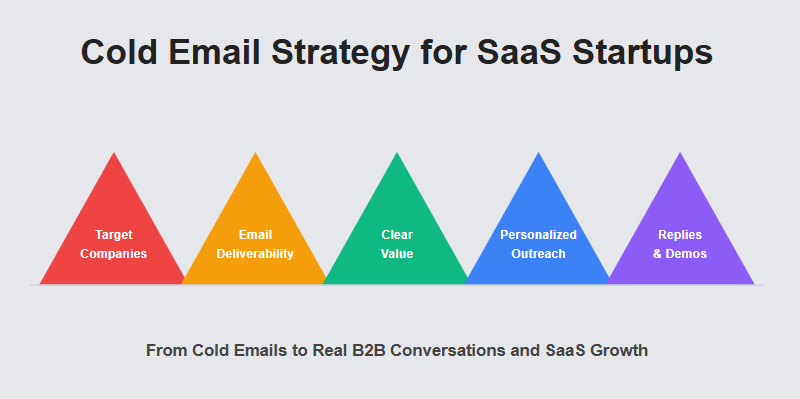
Cold email is one of the fastest ways to generate B2B leads for SaaS products. By refining outreach, testing value propositions, and following up strategically, startups can engage decision-makers and close deals. Scale your subscription-based business with data-driven email strategies
1. An Effective Cold Email Strategy for SaaS Startups to Generate B2B Leads
For many SaaS startups, finding their first customers is the most challenging stage of product development. Small teams rarely have budgets for advertising or a full-fledged sales department, so they have to look for more direct ways to enter the market, learning how to find great SaaS ideas and vet them on Day 1. One effective method is cold email, which allows them to directly connect with potential customers.
Today, more and more founders are exploring cold email strategies for B2B SaaS startups because this channel allows them to quickly test product demand and initiate initial conversations with potential customers. Unlike advertising, cold emails allow them to reach specific decision-makers within the company.
Professional tools are often used to find suitable companies and contacts. For example, many startups use apollo.io for cold email prospecting to quickly build a list of potential customers and find the right specialists within the company.
It’s important to understand that a successful email campaign isn’t just about the email itself. It also includes the right audience selection, contact list preparation, personalization, and a follow-up sequence. That’s why experienced founders build a comprehensive cold email campaign strategy for SaaS founders, where every stage impacts the final result.
If you choose the right companies, find the right people, and craft a well-written message, cold emails can become a stable source of B2B leads for your SaaS product.
Understanding Why Cold Email Still Works for SaaS Lead Generation
Despite the emergence of new marketing channels, cold email remains one of the most effective B2B sales tools. The reason is simple: you directly contact someone who is potentially interested in solving a problem. Unlike advertising, the email goes straight to the specialist’s inbox.
This is why many startups actively use cold email prospecting strategies to quickly initiate a dialogue with potential clients. This approach works especially well for SaaS products that solve specific business problems.
Discover the formula that 10% of AI SaaS startups use to succeed.
It’s important to understand that the goal of a cold email isn’t to immediately sell a product. The main goal is to start a conversation and generate interest in the solution. After the initial response, you can move on to a product demo or a short call.
Once the conversation begins, it becomes much easier to understand how to convert cold email leads into customers, because you’re already communicating with someone who is interested in solving their problem.
Choosing the Right B2B Prospects for Your SaaS Product
One of the most common mistakes in cold emailing is choosing the wrong audience. Many startups send emails to everyone, hoping someone will be interested in the product. However, this approach rarely yields good results.
In practice, it’s important to focus on companies that can actually use your product. That’s why experienced founders try to avoid common cold email mistakes startups make, including mass and non-personalized emails.
It’s much more effective to select a specific market segment and tailor the message to them. When an email appears relevant to the recipient, the likelihood of a response increases significantly.
That’s why strong teams use cold email personalization strategies for startups to demonstrate that the email is written specifically for a specific company, not for their entire contact base.
How to Build a Targeted Prospect List Using Apollo.io
A high-quality list of potential clients is the foundation of any successful cold outreach. Without the right contact base, even a good email won’t yield results. Therefore, finding companies that can truly benefit from your SaaS product is an essential step.
Apollo.io is one popular tool for this task. The platform allows you to filter companies by industry, team size, employee position, and other parameters.
Many startups use Apollo as part of their best B2B lead generation strategies for SaaS because the service helps them quickly find the right specialists within their companies.
Once the list of companies is built, you can move on to the next step: finding contacts of decision-makers. This approach allows you to understand how to generate B2B leads with cold outreach without wasting time on irrelevant contacts.
Who to Contact in B2B Companies Instead of Founders
Many aspiring founders make the same mistake: trying to contact company founders directly. However, in medium and large organizations, founders rarely search for new tools.
It’s much more effective to contact specialists responsible for business growth and the implementation of new solutions. These could be the Head of Growth, Director of Marketing, Head of Sales, Head of RevOps, or Head of Partnerships.
Therefore, understanding how to find decision makers in B2B companies who are likely to be genuinely interested in your SaaS product becomes an important skill.
When you find the right person, the likelihood of a response increases significantly. Moreover, such specialists are more likely to test new tools that can improve their workflows.
At this stage, it’s also important to follow technical guidelines for sending emails and understand how to automate cold email outreach safely to avoid being labeled as spam and to avoid damaging your domain reputation.
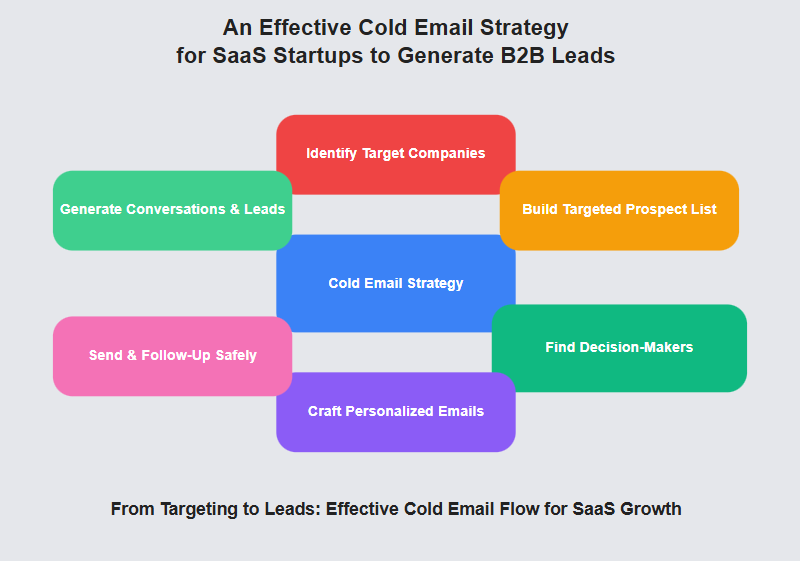
Your SaaS startup can acquire early customers without huge budgets. Use cold email campaigns to test the market and engage decision-makers. Optimize your outreach to maximize replies and demos
2. How to Build a Cold Email Outreach Strategy for SaaS Founders
For SaaS startups, cold emails can be one of the fastest ways to start a dialogue with potential B2B clients. However, sending random messages rarely produces results. Successful teams build a systematic process: from building a contact list to email structure and a sequence of follow-up messages.
In practice, cold emailing works best when each email feels personalized and relevant to the recipient. This is why many founders study cold email campaign planning for startups to plan their communication strategy with potential clients in advance.
It’s also important to understand that cold emails aren’t just marketing, but a full-fledged sales channel. Therefore, founders build a clear cold email outreach workflow for startups, where each step has its own goal: find a contact, send an email, receive a response, and schedule a demo.
The quality of the copy plays a major role. The email should be short, clear, and demonstrate the value of the product in just a few seconds. Otherwise, the recipient will simply not read the message.
It’s also important to adhere to technical limitations for sending emails. Sending too many messages from a new domain can cause email services to consider them spam.
Therefore, a sound cold email strategy always includes several key elements: limiting the number of messages, proper message structure, personalization, and consistency in follow-up emails.
When all these elements work together, cold emails begin to generate consistent responses and new B2B leads.
How Many Cold Emails You Should Send Per Day to Stay Safe
One of the most common mistakes new founders make is sending too many emails on the first day. Email providers closely monitor the activity of new accounts and can quickly limit messages sent. Therefore, when using personal email, sending about 10 emails per day is considered a safe practice.
This approach helps gradually warm up an email account and reduces the risk of emails ending up in spam. Over time, the volume can be increased, but it’s important to monitor the quality of your contact list and the personalization of your messages.
To improve efficiency, many teams analyze how to increase cold email reply rates to understand which emails truly generate interest. Furthermore, it’s important to regularly improve your message texts using cold email campaign optimization strategies.
The Perfect Cold Email Framework That Gets Replies
An effective cold email typically follows a simple and clear structure. One of the most popular approaches is the Hook → Value → CTA model. You should first grab the recipient’s attention with a short and relevant opening.
After this, it’s important to quickly explain the product’s value and demonstrate the problem it solves. For example, this could be process automation, saving the team time, or improving sales performance.
The email concludes with a short call-to-action—an invitation to discuss the product or ask a question. This approach helps the recipient quickly understand the essence of the email.
This is why many founders study the cold email framework for SaaS founders to structure their messages. It’s also important to understand how to structure cold outreach emails so that the email is logical and easy to read.
How to Write Cold Emails Under 100 Words That Convert
Short emails generally perform better than longer messages. People receive dozens of emails a day, so you only have a few seconds to engage the recipient. The optimal length for a cold email is under 100 words.
This format helps quickly convey the main idea without overloading the email with unnecessary information. It’s important to focus on the customer’s problem and explain how your SaaS product can solve it.
A well-written, short email can significantly increase the likelihood of a response. That’s why many founders learn how to write short cold emails that convert, to make their messages as effective as possible.
It’s also helpful to use cold email copywriting tips for founders to improve the structure and persuasiveness of the text.
Using ChatGPT to Generate Personalized Cold Emails Faster
Creating personalized emails for each company can be time-consuming. However, modern AI tools can significantly speed up this process. ChatGPT can be used to generate various email variations and tailor messages to a specific company.
For example, you can ask AI to generate several text options, then select the best one and make minor edits. This approach helps quickly test different communication styles.
Many SaaS founders use AI to create cold email templates for B2B SaaS startups to speed up the campaign preparation process.
Furthermore, AI helps better understand how to personalize B2B cold emails by adding details about the company or its market. This makes cold emails appear more natural and increases the likelihood of a response.
3. Cold Email Sequence Strategy to Turn Prospects Into SaaS Clients
After sending the first cold email, many SaaS founders make the same mistake: they wait for a response and do nothing else. In practice, most deals are initiated after follow-up emails. Therefore, a well-designed message sequence is an essential part of any strategy.
Experienced teams use a cold email sequence strategy for startups to gradually build a dialogue with potential clients. Instead of a single email, they send a series of short messages that remind them of the offer and add additional value.
It’s important to understand that most people simply don’t see the first email or put it off until later. This is why follow-up emails help regain the recipient’s attention. A well-designed message sequence increases the likelihood of a response several times over.
Many founders also study the best follow-up strategy for cold outreach to understand the optimal sending frequency and follow-up message structure. When the email sequence is built correctly, cold outreach begins to generate real conversations and new leads.
Furthermore, an email sequence allows you to gradually reveal the value of your product. Each follow-up message can add new information about how the SaaS tool helps companies improve processes.
As a result, cold emailing transforms from a single email into a comprehensive communication system for potential clients.
Why Follow-Up Emails Are Critical in Cold Outreach
Follow-up emails play a key role in a cold email strategy. In reality, most people don’t respond to the first email because they’re busy or simply didn’t notice it among other messages. That’s why successful teams plan a sequence of messages in advance as part of their cold email outreach workflow for startups. This approach allows them to systematically remind customers of their presence without seeming intrusive.
It’s important that follow-up emails don’t repeat the first message verbatim. Instead, they should add new information, a small case study, or additional value for the recipient. Many founders study how to structure cold outreach emails so that each follow-up email feels like a logical continuation of the conversation. When the sequence is structured correctly, the likelihood of a response increases significantly.
How Often to Send Follow-Up Emails (3-4 Days Rule)
The frequency of follow-up emails is crucial to the effectiveness of cold outreach. Sending too frequently can cause recipients to perceive the messages as spam. If you wait too long, the recipient may simply forget about the first email.
That’s why many SaaS teams use a 3-4 day rule between emails. This interval feels natural and doesn’t put pressure on the potential client. To develop the right strategy, founders learn how to build a cold email sequence and plan several follow-up messages in advance.
It’s also helpful to test different copies and analyze campaign results. Many teams regularly use cold email campaign optimization strategies to understand which emails generate the most responses.
Common Cold Email Mistakes SaaS Founders Must Avoid
Even a good cold email idea can fail due to common mistakes. One of the most common problems is overly long messages that the recipient simply doesn’t read. That’s why many founders learn how to write short cold emails that convert, making them short and clear.
Another mistake is using the same template for all campaigns. Without personalization, the email looks like a mass mailing and rarely generates interest. To avoid this, many teams are learning how to personalize cold emails for B2B and adding details about the company or its market.
It’s also important to avoid overly aggressive sales. A cold email should start a conversation, not try to sell a product right away.
How to Improve Reply Rates and Turn Conversations Into Sales
Getting a response to a cold email is only the first step. Next, it’s important to turn the conversation into a real opportunity for collaboration. One of the key factors is proper email structure and a clear product value.
Many founders are learning how to write effective B2B outreach emails to ensure they look professional and are easy to read. It’s important to quickly explain the problem your SaaS product solves and why it can be useful for the company.
The subject line is also crucial. Research shows that well-chosen best cold email subject lines for B2B can significantly increase the likelihood of email opens.
When the email structure, subject line, and product value are formulated correctly, it becomes much easier to increase cold email reply rates and turn cold contacts into real B2B conversations.
FAQ Section
Does cold email work for SaaS?
Yes, cold emails can be one of the most effective customer acquisition channels for B2B SaaS startups. They work especially well in the early stages, when a company doesn’t have a large marketing budget. The key is to use the right cold email framework for SaaS founders and clearly demonstrate the value of the product. The email should be short, relevant, and focused on solving a specific customer problem. When personalization and a well-thought-out email sequence are used, cold outreach can generate consistent B2B leads.
What is the 30/30/50 rule for cold emails?
The 30/30/50 rule helps you prioritize your efforts when working with cold emails. Approximately 30% of your time is spent researching companies and finding relevant contacts. Another 30% is spent writing and personalizing the email. The remaining 50% is devoted to follow-up messages and developing a dialogue with the potential client. This approach helps build more effective cold email campaign planning for startups and increase response rates.
Is sending 40 emails a day a lot?
For new or personal email accounts, sending 40 emails a day can be too much. Email providers closely monitor account activity, so it’s best to start with 10-15 emails per day. Gradually increasing the volume helps maintain good deliverability. Many teams use cold email automation tools for SaaS startups to scale their campaigns safely. It’s also important to monitor contact list quality and email personalization.
What is the 3 3 2 2 2 rule of SaaS?
The 3-3-2-2-2 rule is often used as a simplified prioritization model for SaaS teams. It suggests dividing attention between key areas: product growth, marketing, sales, user support, and process optimization. This approach helps avoid overloading the team and maintain a balance between product development and customer acquisition. For startups, it’s especially important to combine product development with effective acquisition channels, such as cold outreach messaging for SaaS products. This allows for faster testing of hypotheses and finding first customers.
Is the rule of 40 only for SaaS?
The Rule of 40 helps SaaS companies measure the balance between revenue growth and profitability. When a company’s growth rate plus profitability reaches 40% or more, analysts consider it financially stable. While other types of businesses can use this metric, SaaS startups rely on it most frequently. Many founders follow it as a guide when planning growth and scaling their operations.
Final Thoughts – Why Cold Email Still Matters for SaaS Startups
Cold emails remain one of the most accessible customer acquisition methods for SaaS startups, especially in the early stages, when a company doesn’t have a large advertising budget. A well-designed cold email strategy allows for direct communication with potential customers and quick testing of hypotheses.
Many founders begin with a cold email outreach workflow for startups to generate a stable flow of B2B leads. This approach not only helps find clients but also better understand the market and the audience’s real problems. When emails are structured according to the logic of how to write cold emails that get replies, the likelihood of a response increases significantly.
It’s also important to pay attention to email structure and personalization. Using the principles of writing cold emails that convert prospects helps transform simple messages into real business conversations.
Furthermore, the correct message sequence plays a key role. Many SaaS teams actively use how to build a cold email sequence to establish a systematic communication process with potential clients.
It’s equally important to continually refine your strategy. Analyzing results and optimizing cold email conversion rates allows you to gradually increase the effectiveness of your campaigns.
Ultimately, cold emails can become one of the most powerful growth channels for SaaS startups. Even a small team can attract new clients if they use the right strategy, personalization, and message sequence.