

The freemium model is a common monetization approach for micro SaaS products, where users start with free access to limited features and pay to unlock advanced functionality.
People rarely commit to paying for software they haven’t experienced. Giving users the ability to explore a product before spending money significantly reduces friction and makes adoption easier.
For SaaS businesses, the freemium model works especially well because it allows users to see real, practical value in action. Once the product proves its usefulness in day-to-day scenarios, upgrading to a paid plan becomes a natural next step rather than a forced decision.
That said, freemium is not just a pricing tactic — it’s a system. Without a clear understanding of how it should be implemented across your product, payments, and growth infrastructure, it’s almost impossible to build predictable and sustainable revenue. Poor execution often leads to large numbers of free users with little to no monetization.
This is where Freemius comes in. It’s a platform designed to help SaaS founders implement freemium and paid models correctly, without turning monetization into a technical or operational burden. In this article, we’ll look at how Freemius works and which marketing capabilities it provides to support growth.
1. Turning Free Users into Paying Customers
a) Subscriptions, Licensing, and Payments in One System
Freemius provides an all-in-one infrastructure for handling subscriptions, license management, payments, taxes, marketing automation, and analytics for digital products, including SaaS. It allows you to manage free and paid access from a single dashboard, without building complex custom solutions.
The platform takes care of subscription billing, payment processing, tax compliance, and security by default. On top of that, it offers a wide range of built-in features that simplify monetization. Instead of stitching together multiple tools, you get a unified system that lets you focus on product and growth rather than payment logic.
b) Designed for Conversion, Not Just User Acquisition
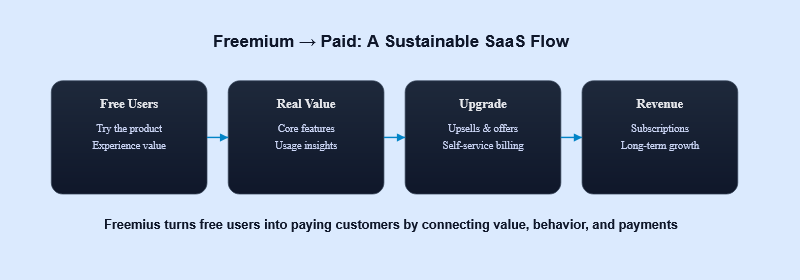
Freemius is built with one core objective in mind: converting free users into paying customers. Every marketing feature inside the platform supports this goal.
Tools such as behavioral analytics, in-product upsells, discount campaigns, and automated triggers are designed to nudge users toward upgrading at the right moment. The self-service user portal allows customers to upgrade plans, manage licenses, and update payment details on their own — reducing friction, improving retention, and lowering support overhead.
Beyond surface-level growth metrics, Freemius helps you understand how users interact with your product, identify blockers in the payment journey, and increase customer lifetime value. The focus is not on collecting free sign-ups, but on building a monetization engine that scales with your SaaS.
2. Planning Pricing Tiers and Paid Features
Pricing drives growth in every SaaS business. Founders need to decide not only how much to charge, but also which features belong in free access and which ones create real incentive to upgrade.
Users should experience value before they see a paywall. When people understand what your product does and how it helps them, moving to a paid tier feels natural. A well-designed pricing model increases the chances that free users turn into paying customers instead of staying stuck on the entry level.
a) Structuring Free and Paid Access
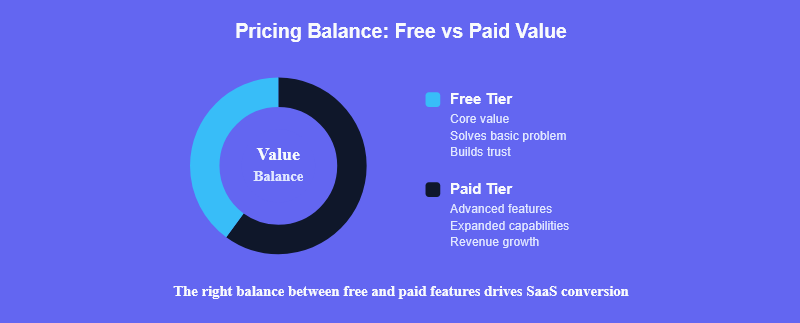
Imagine a micro-SaaS that solves one clear problem. The free plan lets users achieve a meaningful result and understand the product’s core benefit. At the same time, it clearly shows that more advanced capabilities exist in the paid version.
This balance matters. You want users to succeed with the free tier, but you don’t want to give away everything. Freemius helps manage this boundary. It allows founders to define plans and feature sets with precision, enabling or disabling functionality per tier. This approach keeps the free plan useful while protecting premium value.
b) How Pricing Structure Affects Conversion
Pricing structure directly influences upgrade behavior. When the free plan includes too many features, users see no reason to pay. When it offers too little, users fail to understand the product’s real value and leave.
The strongest conversion happens when the free tier solves a simple, narrow use case, while paid plans unlock broader capabilities and efficiency gains. Freemius supports this strategy with tools such as time-limited trials, feature-based plan configuration, and automated upgrade flows.
These mechanisms help founders observe how users interact with pricing, identify upgrade triggers, and present paid options at the right moment. Instead of forcing upgrades, the system guides users toward higher-value plans as their needs grow.
3. How Freemius Strengthens Your Marketing Funnel and Freemium Conversion
After you solve the technical side of payments, the real work begins. You need to guide users through a clear and efficient marketing funnel—from their first interaction with your product to the moment they decide to pay.
In SaaS, marketing doesn’t stop at ads or landing pages. Monetization plays a direct role in how users move through the funnel. Pricing logic, upgrade timing, and in-product messaging all influence conversion.
Monetization tools like Freemius work best when they’re part of a broader SaaS strategy — one that starts long before payments, with idea validation, positioning, onboarding, and a clear path to your first users.
If you want to see how all these elements connect into a single, structured process, this AI SaaS Roadmap: From Idea to First Users in 30 Days Without Heavy Coding walks through the full journey step by step.
Freemius helps founders shape flexible and personalized conversion paths without heavy engineering. You can test ideas, react to user behavior, and improve monetization without rebuilding your product.
a) Automated Messaging and Purchase Triggers
When a user shows exit intent, Freemius can display a targeted message instead of letting them leave silently. This small intervention often shifts hesitation into action and keeps the user engaged.
Freemius also supports discounts, upsells, and other purchase incentives that work together as part of a single system. Each message responds to user behavior, not guesswork. You create timely nudges that feel relevant instead of aggressive, which improves conversion without harming trust.
b) Marketing Integrations and Behavior Insights
Freemius connects with external marketing and analytics platforms to extend your funnel beyond the product itself. You can send data about user actions, trials, upgrades, and cancellations directly into your CRM or analytics stack through webhooks or built-in integrations.
This setup gives founders a clear view of where users slow down or drop out. You see which stages of the funnel need better value communication and which actions trigger upgrades. With data and automation working together, you build a marketing system that supports long-term growth instead of one-off campaigns.
4. Using Freemius Analytics to Drive Growth and Increase Customer Lifetime Value
Sustainable SaaS growth doesn’t happen by accident. Setting up payments alone won’t create predictable revenue. Founders need visibility into how users behave and what motivates them to stay, upgrade, or leave.
Freemius gives you direct access to these insights. The platform shows live performance metrics and lets you compare user segments so you can make informed growth decisions for your micro-SaaS. This approach matters even more when your business relies on subscriptions and ongoing engagement.
a) Metrics That Matter for Growth and LTV
Running a micro-SaaS means tracking the right numbers. Metrics like monthly recurring revenue (MRR), churn rate, average revenue per user (ARPU), and customer lifetime value (LTV) shape every strategic decision.
Freemius displays these metrics in real time inside the dashboard. You can quickly identify which plans generate the most value and which features need refinement. By exploring the data, founders understand which users stay longest, which segments drive revenue, and where additional engagement can improve retention.
b) User Segmentation and Cohort Analysis
Cohort analysis groups users by shared characteristics such as acquisition source, plan type, or signup period. Tracking these groups over time reveals patterns that individual metrics can’t show.
With Freemius, you create cohorts automatically and monitor their behavior without exporting data or building complex spreadsheets. This visibility helps founders pinpoint when churn spikes, which features push users to upgrade, and which customer groups deliver the highest long-term value.
5. User Retention and Churn Reduction with Freemius
User acquisition is only part of the success of the freemium model. It’s also important to retain paying customers, increase their lifetime value (LTV), and thus generate the core profit of your micro SaaS.
Freemius provides a complete set of tools for subscription management, user behavior analysis, and developing strategies aimed at reducing churn and increasing repeat sales.
a) Working with Subscription Renewals and Reminders
One of the reasons paid subscriptions are cancelled is unintentional cancellations of renewals. Users may forget about license renewal deadlines, misunderstand the value of upgrades, or simply hesitate over their decision. There are factors that reduce passive cancellation and make subscription renewal a natural continuation of product use. This is achieved by Freemius sending reminders about the upcoming subscription expiration. The service also notifies users of renewal benefits, such as updates, security, and support. Users can also renew their subscription without entering payment information.
b) Segmentation of Users by Behavior and Status
Not all users behave the same when interacting with the service. The service collects data on license type, frequency of updates and interactions with the product, user activity, and customer lifecycle stage. Based on this data, you can send personalized information to different segments, offer upgrades to those users who are ready to purchase, and immediately identify users at high risk of churn. This segmentation increases marketing effectiveness.
c) Win-back Strategies for Returning lost Customers
A churn isn’t always a permanent loss. Freemius provides data that helps you understand at what point a user terminated their paid subscription, which plan was a barrier, and how much time has passed since the churn. Once you have this information, you can launch win-back campaigns, such as personalized discount offers, access to new features, or temporary trial periods for paid plans. This way, you can increase your overall LTV and regain some of your lost users without spending money on acquiring new traffic.
6. Scaling Sales and Automating Monetization with Freemius
Once the freemium model has proven its effectiveness, the primary objective now becomes scaling. Freemius allows you to automate key monetization processes, reduce operating costs, and focus on product improvement rather than payment management.
a) Automation of Payments, Taxes and Licensing
Selling digital products globally can pose various financial and legal challenges. Freemius can not only process payments but also calculate and pay taxes, manage licenses and access, and issue invoices and refunds. This is especially important if your business team is small and you don’t need to build your own billing infrastructure.
b) A/B Testing of Prices and Offers
The optimal price isn’t a guess, but the result of experimentation. Freemius can test different pricing plans, monthly and annual subscriptions, bundles and upsells, and special offers for new and existing users. You can analyze conversion and revenue for each option and gradually increase ARPU (Average Revenue per User) and find the most profitable monetization models.
c) Entering the Global Market and Localizing Sales
Freemius is focused on international sales. The platform supports local payment methods, trusted checkout pages, multi-currency payments, and adaptations for different regions and markets. Developers can scale globally without having to create separate payment solutions for each country.
7. Common Mistakes When Working with Freemius and How to Avoid Them
The service provides a powerful monetization infrastructure, but developers must also know how to properly use the tools provided.
Many projects fail to realize the potential of the freemium model due to common mistakes in pricing, communication, and data management.
In practice, many of these mistakes don’t originate at the monetization stage. They usually start much earlier — when the initial SaaS idea hasn’t been clearly defined or properly validated.
If you want to begin at the very start and learn how to find and vet strong micro SaaS ideas, you can begin with Day 1 — Where to Find Great SaaS Ideas (and how to vet them).
Understanding these mistakes allows you to accelerate growth and avoid lost revenue in the initial stages of a project’s launch.
a) Generous Free Version Without Upgrade Motivation
Providing users with too much functionality in the free version of your product is a big mistake. If users perceive that they’ve received too much value, they’ll be less inclined to upgrade to a paid plan. The best approach is to ensure that the free version doesn’t address key use cases but merely demonstrates value. Paid features are a logical extension of product use. Functionality limitations shouldn’t feel like an artificial barrier. Users should see this as a natural part of their growth. Freemius allows you to track where users are stuck on the free plan and haven’t yet reached a paid plan. This is a valuable feature that will allow you to properly adjust your product growth strategy.
b) Ignoring Analytics and User Behavior
Many developers use Freemius solely as a payment tool without analyzing the data. As a result, decisions are made based on intuition rather than facts. Common problems include ignoring churn rate and LTV data, misunderstanding what influences conversion, and a lack of analysis of payment abandonment points. Regularly working with Freemius analytics, however, allows you to adjust pricing, improve onboarding, and increase overall monetization efficiency.
c) Lack of Interaction with Users After Installation
You need to constantly communicate with users so that after installing the free version of your micro SaaS, they understand the benefits of the paid version. To do this, use email notifications and in-app messages. Also, explain the value of paid features using case studies, and guide users from the first launch to the upgrade. You build all of this systemically together with the Freemius service.
Final Thoughts
The freemium model alone doesn’t guarantee success. True success lies in building the right funnel and consciously designing each stage.
If you’re a WordPress plugin developer or a micro SaaS company, Freemius becomes more than just a payment solution, but a full-fledged growth platform. This is because it allows you to convert free users into paying customers, helps you build the right marketing funnel, increases conversion, and performs a host of other essential tasks.
When you use its tools strategically, you can build a sustainable business model where product, marketing, and monetization work seamlessly.
If you plan to scale a freemium product or increase revenue without overcomplicating your infrastructure, Freemius is one of the most powerful online platforms for achieving these goals.