

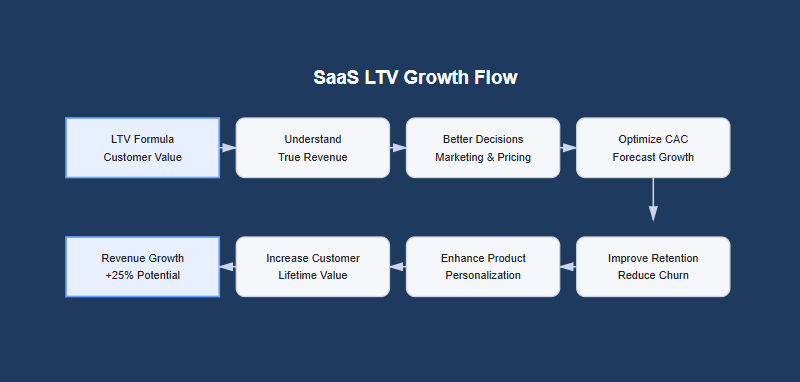
Revenue growth in SaaS is directly linked not only to new customer acquisition but also to the value each user generates over their entire interaction with the product. This is where the SaaS customer lifetime value calculation formula plays a key role, allowing you to understand the true potential of your business. Without a clear understanding of LTV, it becomes difficult to make strategic decisions and forecast revenue.
Knowing how much each customer generates makes it easier to manage marketing, pricing, and product development. This is the foundation for building a sustainable growth model and controlling acquisition costs. In today’s environment, it’s especially important to use a strategy for calculating customer lifetime value in SaaS businesses with a recurring revenue model and churn rate analysis to rely on real data rather than guesswork.
A deep understanding of LTV opens up new opportunities for scaling. You can more accurately determine which acquisition channels are truly profitable and which merely create the illusion of growth. Furthermore, it helps build long-term relationships with customers and increase their value.
Properly managing LTV also allows you to identify hidden growth opportunities. For example, improving onboarding, increasing retention, or introducing additional features can significantly increase overall revenue. In this context, data-driven strategies to increase SaaS customer lifetime value through retention optimization and personalized user experience play a crucial role, helping to identify specific growth levers.
When a SaaS company begins to systematically address this metric, its strategy becomes more accurate and predictable. This enables not just growth, but also the development of a sustainable and profitable business. In this article, we’ll explore how to calculate LTV, why it’s so important, and what practical steps can help increase it and, consequently, overall product revenue.
1. Customer Lifetime Value Explained: How to Calculate LTV in SaaS and Why It Matters for Revenue Growth
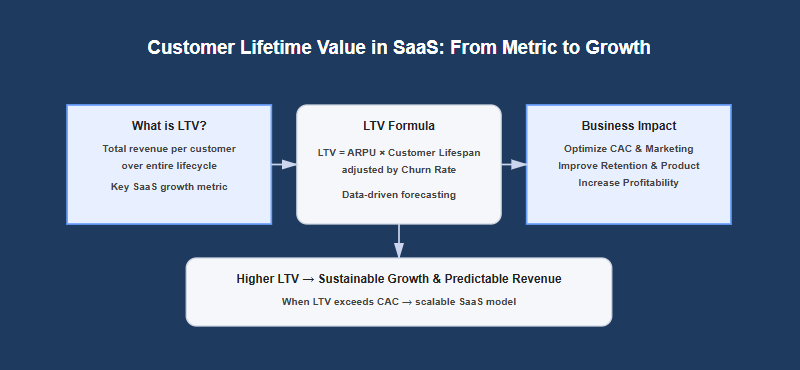
Understanding Customer Lifetime Value is fundamental for any SaaS business striving for sustainable growth. This metric reflects how much revenue one customer generates over the entire lifespan of their product. Without it, it’s difficult to evaluate marketing effectiveness and build a scaling strategy — especially if you haven’t yet validated your idea and target market, as explained in how to find and validate high-potential SaaS ideas.
Using the SaaS customer lifetime value calculation formula helps translate abstract metrics into concrete financial indicators. When LTV is calculated correctly, it becomes clear how much to invest in customer acquisition and which audience segments are the most profitable.
As you’ve likely already learned, LTV doesn’t exist in isolation from other metrics. It’s closely linked to churn rate, average order value, and customer lifetime value. Therefore, companies are increasingly using advanced SaaS LTV calculation methods using churn rate, ARPU, and customer lifespan for accurate revenue forecasting to obtain the most accurate picture.
Also, remember that the calculation itself is just the beginning. True value emerges when data is used to make decisions. This includes product optimization, improving the user experience, and adjusting the pricing strategy.
LTV also helps identify weaknesses in a business. For example, if the metric is too low, it may indicate retention issues or insufficient product value. In such cases, you should implement a SaaS revenue growth strategy based on improving customer lifetime value and reducing churn through an improved onboarding experience to increase the effectiveness of the entire model.
When a company deeply understands its LTV, it gains a powerful growth tool. This not only allows for increased revenue but also the development of a more sustainable and predictable business model.
What Customer Lifetime Value (LTV) Means in a Subscription-Based SaaS Business
Customer Lifetime Value (LTV) reflects the total revenue generated by a single customer over the entire life of their product. This is especially important in SaaS, as the business is built on a subscription model and recurring payments. The longer a user remains in the system, the greater their contribution to the company’s overall revenue. Understanding this metric will help you evaluate the effectiveness of your entire business model. Understanding customer lifetime value in a subscription-based SaaS business with recurring revenue and retention metrics allows for a more in-depth analysis of user behavior. LTV also demonstrates how valuable a product truly is to the customer. When this metric increases, it indicates that the product is successfully retaining its audience.
The Most Accurate SaaS LTV Calculation Formula for Predictable Revenue Forecasting
Accurate LTV calculations allow you to forecast future revenue and make more informed decisions. Typically, the formula takes into account metrics such as average revenue per user (ARPU), churn rate, and customer lifetime value. It is the combination of these data that provides a true understanding of the value of each user. Using the SaaS customer lifetime value calculation formula helps structure these calculations and integrate them into a growth strategy. You’ve likely noticed that some companies use the SaaS LTV calculation formula using ARPU churn rate and customer lifetime value for accurate revenue forecasting to improve forecast accuracy. When the formula is used regularly, it becomes easier to track business dynamics, allowing you to respond more quickly to changes and adjust your strategy.
Why Increasing Customer Lifetime Value Is Critical for Long-Term SaaS Profitability
Increasing LTV directly impacts a SaaS company’s profitability. The more revenue each customer generates, the less pressure there is on marketing and new user acquisition. This allows for more efficient resource allocation and increased business margins. High LTV also means that customers are satisfied with the product and continue to use it. In this context, increasing SaaS customer lifetime value plays a crucial role in improving profitability and reducing customer acquisition cost dependency. When LTV exceeds CAC, a company achieves a sustainable growth model. This balance opens up opportunities for scaling without significantly increasing costs.
2. Data-Driven Strategies to Increase SaaS LTV Through Customer Experience and Product Engagement
Increasing LTV is impossible without relying on real user behavior data. Every click, action, and scenario within the product creates a picture of how the customer receives value. These signals help identify growth opportunities and leverage the product’s strengths — a methodology also explored in the proven formula behind successful AI SaaS startups, which shows how top performers systematically turn insights into scalable growth.
Behavior analytics allows us to see which actions lead to user retention. Some features become key to activation, while others remain unused. This approach helps reallocate development resources and strengthen those elements that truly impact revenue. Gradually, a more precise user engagement strategy is developed, focused on long-term product usage.
User experience is equally important. Even minor interface difficulties can reduce engagement and lead to churn. When the user journey becomes clear and logical, interaction with the product feels natural. This directly impacts customer lifetime value.
User feedback is also important to consider. It helps you see the product through the customer’s eyes and identify weaknesses that aren’t always obvious within the team. As a result, the product becomes more user-friendly and valuable to the audience.
Systematic data management allows you to not just improve individual elements but build a holistic growth strategy. This makes it possible to increase LTV by enhancing product value, not just by raising prices.
Using Customer Behavior Analytics and Path Analysis to Identify High-Value Actions
User behavior analysis helps understand which actions within a product truly deliver value. Not all features have the same impact on retention and engagement. Some actions become key points, leading to long-term retention. Such insights can be obtained through SaaS user behavior analytics.
Path analysis allows you to see the sequence of actions users complete. This helps identify optimal product interaction scenarios. When these paths become clear, they can be strengthened and simplified. As a result, users achieve value faster.
Analytics also helps identify weaknesses in a product. If users frequently abandon a certain step, this is a sign of a problem. Addressing such bottlenecks directly impacts LTV growth. Ultimately, the product becomes more effective in terms of retention.
Collecting Customer Feedback to Improve Product Experience and Reduce Churn Drivers
User feedback remains one of the most valuable sources of information. It allows you to understand the real causes of dissatisfaction and uncover hidden problems. Even simple surveys can provide important insights into product perception. SaaS customer feedback loops are often used for this purpose.
User comments help identify which features need improvement. Sometimes small changes can significantly improve the user experience. This reduces the likelihood of churn and increases customer satisfaction, making the product more competitive.
Regular feedback builds brand trust. Users feel their opinions are taken into account and are more likely to stick with the product. This approach strengthens long-term relationships with the audience.
Removing Friction in SaaS Funnels to Improve Retention and Customer Lifetime
Any unnecessary steps or complications in a product can reduce conversion and retention. Even small obstacles in the user journey can lead to loss of interest. Therefore, it is important to constantly simplify interactions with the service. SaaS funnel optimization helps with this.
Funnel optimization includes improving onboarding, the interface, and the flow of transitions. The user should quickly understand what to do next and what value they are receiving. The simpler the path, the higher the likelihood of long-term product usage.
It’s also worth paying attention to the points where users most frequently churn. Eliminating these points of churn can significantly increase LTV. As a result, the product becomes more convenient and effective for users.
3. Product-Led Tactics to Boost Customer Lifetime Value and Drive Long-Term Engagement
Long-term growth of SaaS products is increasingly built around the product itself, rather than external marketing. When users receive value directly within the service, their engagement grows naturally. This approach creates a sustainable model where the product becomes the primary revenue driver. This is why more and more teams are focusing on product-led growth.
The focus is on the user experience. The interface, interaction logic, and access to key features should help users quickly achieve results. The faster users see value, the higher the likelihood they will stay for a long time. This directly impacts LTV growth.
Personalization also plays a key role in customer retention. When a product adapts to user behavior, interactions become more relevant. This creates a sense that the service “understands” the customer’s needs. As a result, engagement and usage frequency increase.
Don’t forget about gradually revealing the product’s value. Users aren’t always ready to explore all the features right away. Therefore, it’s important to build a process in which new features are unlocked as needed. This approach increases user engagement in SaaS and helps maintain attention.
Properly managing upgrades becomes an additional growth factor. When offers appear at the right time, they are perceived as a logical continuation of the product’s use. This allows for increased revenue without putting pressure on the user.
As a result, a product-led approach helps not only attract customers but also retain them. This creates a more stable and predictable growth model.
Building Personalized User Experiences to Increase Product Adoption and Retention
Personalization makes product interactions more precise and convenient. Users see only those features and scenarios that match their needs. This reduces interface clutter and accelerates product adoption. This approach is actively used in personalized SaaS experiences.
A dynamic interface helps adapt a product to different audience segments. Beginners are shown basic features, while more experienced users are shown advanced capabilities. This makes the user experience smoother and more logical.
When a product takes user behavior into account, it becomes more “alive.” People are more likely to return to the service because it remains relevant. This results in higher retention rates and overall customer lifetime value.
Personalization also strengthens the emotional connection with the product. Users feel that the service was created specifically for them, making abandonment less likely.
Using Interactive Onboarding and Secondary Onboarding to Deliver Continuous Value
Onboarding is the first step to keeping a user engaged with a product. If this stage is successful, the likelihood of long-term use significantly increases. Interactive prompts and product tours help users quickly understand the product’s functionality. This approach is implemented through interactive onboarding in SaaS.
However, the process doesn’t end there. Secondary onboarding helps uncover additional product features over time. The user gradually learns about new features as they become relevant.
This creates a sense of continuous product development. Users don’t get stuck on the basic level, but instead continue to delve deeper into the functionality. This results in increased engagement and usage.
This approach also reduces the likelihood of being overwhelmed at the start. The user isn’t given too much information at once, but rather masters the product step by step.
Segmenting Users to Trigger Contextual Upsells and Increase Expansion Revenue
User segmentation allows for more precise targeting. Different customer groups have different needs and engagement levels. When a product takes these differences into account, offers become more relevant. This is the foundation of SaaS user segmentation.
Contextual upgrades are much more effective than generic offers. For example, a user reaches a limit and is immediately offered an upgrade. At this point, the decision is perceived as logical and justified.
Behavioral triggers help determine the ideal moment to offer such an offer. This could be an increase in activity or the use of key features. As a result, the likelihood of an upgrade increases.
Segmentation also helps avoid hard-selling. The user receives only those offers that truly meet their current needs. This improves the user experience and increases product revenue.
4. Customer Success and Retention Systems That Maximize SaaS Customer Lifetime Value
Long-term SaaS growth is impossible without a well-established customer retention system. While user acquisition provides a quick boost, it’s retention that generates stable revenue. When a customer stays with the product longer, their value to the business increases exponentially. Therefore, the emphasis is shifting to SaaS customer retention.
Customer success is becoming a key element of this strategy. It’s not just about support, but about systematically working with users at every stage of their journey. It’s important not to wait for problems to arise, but to proactively help the customer achieve their goals. This approach builds trust and reduces the likelihood of churn.
Understanding user behavior is particularly important. By analyzing actions within the product, retention patterns can be identified. This allows you to anticipate risks and respond to them, resulting in a more accurate churn reduction strategy.
Availability of in-product help is also important. Users shouldn’t waste time searching for solutions outside the service. When answers are found quickly, the interaction becomes more comfortable.
A strong retention system is built on a combination of analytics, support, and user experience. Each element reinforces the others and creates a sustainable growth model. This not only reduces churn but also increases lifetime value.
When these processes work together seamlessly, a SaaS product becomes more predictable in terms of revenue. Users stay longer, utilize features more actively, and are more likely to upgrade to higher-priced plans.
Learning from Loyal Customers to Extend Customer Lifespan and Increase Retention
Loyal users are a valuable source of insights for product growth. Their behavior reveals which features truly deliver value. By analyzing such scenarios, patterns of successful usage can be identified. This is the foundation of SaaS power user analysis.
These customers often engage with the product more deeply and return more frequently. Their product journey can be used as a benchmark for new users, helping to accelerate adoption and increase engagement.
Furthermore, loyal users provide valuable feedback. They understand the product better and can point out areas for growth. This allows for more targeted service improvements.
Using this data helps extend the customer lifecycle. As a result, retention and overall revenue per user increase.
Offering Proactive Customer Support to Improve Satisfaction and Reduce Churn
Customer support plays a vital role in user retention. However, a proactive, rather than a reactive, approach yields the greatest impact. When help is offered proactively, the user feels cared for and cared for. This approach is implemented through proactive customer support SaaS.
Proactive support can include prompts, notifications, and personalized recommendations. This helps the user solve problems faster and avoid problems, reducing the likelihood of frustration.
Customer Success processes also play a crucial role. They help build long-term relationships with customers. The user receives not just service but comprehensive support in achieving their goals.
When support is integrated into the product and proactively delivers, satisfaction levels increase significantly. This directly impacts churn reduction.
Using In-App Resource Centers to Enhance Customer Experience and Drive Self-Service Support
Integrated help centers significantly simplify interaction with the product. Users can quickly find answers to their questions without leaving the interface. This makes the experience more convenient and reduces the burden on support. This approach is implemented through the in-app help center.
A knowledge base, guides, and in-product tips help users master features faster. Users have access to information exactly when they need it, increasing the effectiveness of training.
These resources also help reduce frustration. When solutions are found quickly, users remain engaged with the product, which positively impacts retention.
As a result, in-app support becomes an important element of the growth strategy. It improves the user experience and helps increase LTV.
FAQ Section
What is customer lifetime value in SaaS?
Customer Lifetime Value (LTV) in SaaS is a metric that reflects the total revenue generated by a single customer over the entire period of their use of the product. It takes into account the average order value, subscription duration, and retention rate. This metric helps understand how valuable each user is to the business. The higher the LTV, the more sustainable the revenue model. It is also directly related to the effectiveness of marketing and product.
How do you calculate LTV step by step?
LTV calculations typically begin with determining the average revenue per user (ARPU). Churn rate is then factored in to understand the average customer lifetime. These metrics are then combined into a formula that yields the final LTV value. In simplified form, this is ARPU / churn rate. More precise calculations may consider additional metrics and user segmentation.
What is a good LTV for a SaaS company?
A good LTV metric depends on the niche and business model of the SaaS product. However, the LTV to CAC (customer acquisition cost) ratio is often used as a guide. If LTV is at least three times higher than CAC, it’s considered a healthy model. In B2B SaaS, this ratio can be even higher. The key is that revenue from a customer significantly exceeds the cost of acquiring them.
How can I increase customer lifetime value fast?
LTV can be increased by improving user retention and increasing product value. Improving onboarding and reducing the time to first value provide immediate results. Implementing upselling and cross-selling strategies also helps. Personalization and behavioral management enhance engagement. The longer a customer stays, the greater their contribution to revenue.
What is the difference between LTV and CAC?
LTV measures how much revenue a customer generates over their lifetime, while CAC measures the cost of acquiring them. These two metrics are used together to evaluate business performance. If CAC is too high and LTV is too low, a company is losing money. When LTV significantly exceeds CAC, the model becomes profitable. Finding a balance between the two is the key to scaling SaaS.
Final Thoughts
SaaS product growth is directly linked to how deeply you understand the value of each customer. Customer Lifetime Value (CLV) becomes more than just a metric; it’s the foundation of your entire strategy. Without clear control over this metric, it’s difficult to build a sustainable business. When LTV grows, a company gains more freedom in marketing and product development.
Increasing LTV isn’t a single action, but a system. The product, user experience, and customer support are all important. Every user interaction influences their decision to stay or leave. Therefore, it’s crucial to treat the product as an ecosystem.
Analytics have a significant impact. Data helps identify real growth points and address weaknesses. This allows you to make decisions based on facts rather than assumptions. This approach accelerates product development.
Don’t underestimate the role of onboarding and engagement. The first few minutes of interaction with a product often determine the user’s subsequent behavior. The faster they perceive value, the higher the likelihood of long-term use.
Additional growth comes through expansion revenue. Upselling, cross-selling, and personalized offers increase average revenue per customer. This enables growth even without a sharp increase in traffic.
In the long term, SaaS companies that are good at retaining users win. Continuously improving the user experience, support, and product value creates a solid foundation for growth. This is how a SaaS customer lifetime value optimization strategy is formed.
When all elements work together, the business becomes predictable and scalable. This paves the way for stable growth and high MRR.