

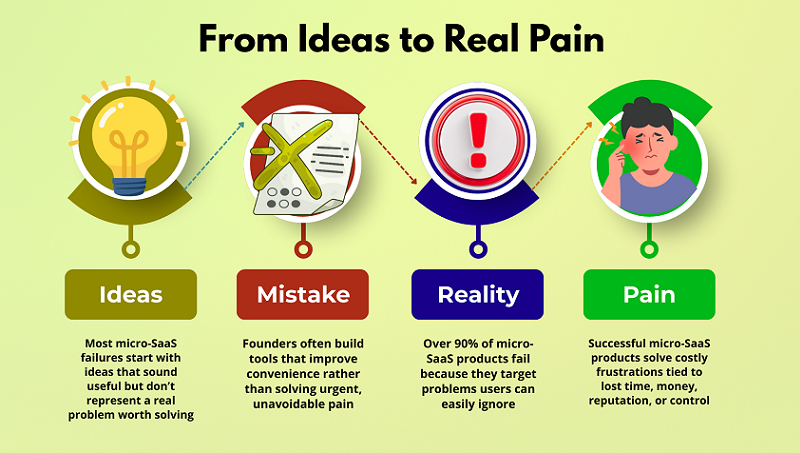
Many micro SaaS ideas fail before they ever reach the market. Almost every failed micro-SaaS story begins the same way – with a “good idea.” It may sound logical, seem useful, and even receive approval from others. But that doesn’t make it viable.
In reality, over 90% of micro-SaaS ideas die not because of competition or poor execution. They die because they didn’t address the pain. Founders often try to solve problems people can easily ignore or optimize processes users have already learned to live with.
The most dangerous trap is when a problem seems obvious but not urgent. Users may agree that “yes, it would be more convenient,” but they’ll never pull out their card to pay for it. And this is where ideas turn into dead products.
Real pain is always associated with losses: time, money, reputation, or control. It can’t be put off. You either solve it or live with it – and hate the process. Micro-SaaS is born precisely in this tension.
In this article, we’ll explore why most ideas seem reasonable but don’t work. We’ll also explore how a problem differs from a pain point in practice, not in theory. And most importantly, how to identify real pain points around which to build a micro-SaaS, not just another experiment.
If you want to stop generating ideas that don’t translate into revenue and start seeing pain where others don’t, read on.
1. Why Most Micro SaaS Ideas Are Built on False Assumptions
Most micro-SaaS projects fail not because of bad code, weak design, or a lack of features. They die much earlier—at the very idea stage. The problem is that many founders build a product on assumptions that have never been tested in reality.
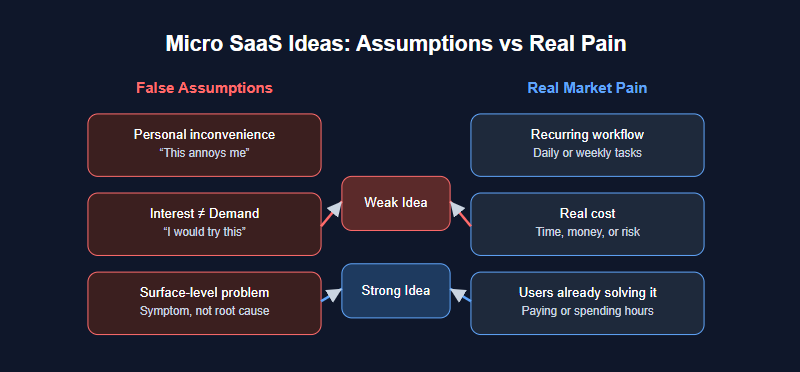
Very often, an idea begins with personal experience. The founder encounters a small, inconvenient problem and assumes that if it bothers them, it must be a problem for everyone. But personal inconvenience is not always a market pain point.
In SaaS, there’s a huge difference between what annoys users and what they’re actually willing to pay for. Most micro-SaaS ideas arise precisely in this zone of illusion.
Another common mistake is to perceive interest as proof of demand. People may say that the product sounds interesting, that the idea seems useful, or that they might try such a tool. But interest is not a demand.
True demand only emerges when users already have a problem they’re either paying money or investing significant time in solving.
Many founders also underestimate the depth of the problem. They see the surface symptom but don’t understand the user’s actual workflow.
For example, if a problem occurs once a month and takes a few minutes to resolve, it will almost never become the foundation of a sustainable SaaS product.
Strong SaaS ideas are built around repeatable processes. These are tasks people perform daily or weekly that directly impact their work, revenue, or efficiency.
When a founder builds a product without understanding these processes, they’re essentially creating a solution to a problem that doesn’t offer sufficient value.
Therefore, the key question before creating a micro-SaaS isn’t “is this idea useful?” but “how painful is the problem it solves?”
It’s the difference between assumptions and actual pain points that determines whether a product becomes a business or remains an experiment.
You can see the same pattern across the broader SaaS ecosystem as well. Many founders assume that building a product around a logical idea is enough, but in reality most startups fail long before they reach product-market fit. If you’re interested in the bigger picture, it’s worth understanding why the vast majority of AI SaaS startups fail and what the successful minority does differently.
Confusing personal inconvenience with real market pain
One of the most common pitfalls for SaaS founders is confusing personal inconvenience with real market pain. When you encounter a small problem in your work, it’s natural to want to solve it with a product.
But just because a problem exists for you doesn’t mean it’s important to the market. Very often, such problems are too specific or too rare. A user may notice an inconvenience, but it doesn’t impact their efficiency, profitability, or core tasks.
In SaaS, pain must have consequences. It must cost the user time, money, or risk.
If a problem has no real value, it almost never turns into a paid product.
It’s also important to understand that personal experience may not be representative. A founder may work in a unique environment, use specific tools, or have unusual processes.
When founders build a product based only on their own experience, it often becomes too niche or simplyunnecessary.
Strong SaaS ideas emerge when many users face the same problem regularly.
Why “I would use this” is a dangerous validation signal
The phrase “I would use this product” sounds like confirmation of an idea. But in practice, it’s one of the weakest validation signals.
People often say a tool seems useful because they want to support the idea or are simply being polite.
But there’s a huge difference between “I would try it” and “I’m willing to pay monthly.”
True validation only begins when the user makes a spending decision.
If someone is already paying for an alternative solution or spending hours on manual work, that’s a much stronger signal than any verbal confirmation.
It’s also important to observe behavior, not just listen to words.
People can claim a problem is important, but then do nothing to solve it.
In SaaS, user behavior is always more important than their opinions.
How surface-level problems mislead founders
Many SaaS ideas are born from superficial observation. The founder sees a problem at the symptom level but doesn’t understand its true cause.
For example, a user complains that reports are difficult to create manually. But the real problem may not be the reports, but rather that the data is stored in different systems.
If the founder only solves a superficial symptom, the product becomes a temporary fix rather than a full-fledged solution.
Such products often appear useful but fail to become mission-critical.
As a result, users may try the tool but see no reason to continue paying for it.
Strong SaaS products solve a fundamental part of the workflow.
They address the source of the problem, not just its manifestation.
That’s why a deep understanding of user processes is key to creating sustainable products.
The Gap Between Annoyance and Willingness to Pay
In the SaaS world, there’s a huge difference between annoyance and genuine pain.
Many problems genuinely irritate users. They can cause inconvenience, slow down work, or simply seem ineffective.
But annoyance doesn’t always translate into effective demand.
For a user to pay, a problem must have a measurable value.
For example, it could take up hours of work, create financial risks, or hinder business growth.
When a problem begins to impact money or productivity, it becomes a real pain.
And it’s precisely these pains that form the basis of successful SaaS products.
Therefore, founders should ask themselves a simple question: how much is this problem worth to the user?
If the answer is close to zero, then the market for the product is likely close to zero as well.
2. The Difference Between a Problem and a Pain Point
One of the most important distinctions in the SaaS world is the difference between a problem and a true pain. Many founders believe that if a problem exists, it can automatically become the basis for a product.
But in reality, most problems are simply ignored.
People constantly encounter inconveniences in their work. They may waste extra minutes, perform manual tasks, or use imperfect tools.
But unless these inconveniences have serious consequences, users rarely seek solutions.
True pain always has a price.
It can manifest itself in lost money, the risk of errors, wasted time, or reduced business efficiency.
When a problem begins to impact one of these factors, it becomes a priority.
And this is precisely when an opportunity for a SaaS product emerges.
Particularly powerful SaaS opportunities arise around recurring pain points.
When a problem begins to weigh heavily on a user, users begin actively seeking ways to solve it.
In such situations, SaaS becomes not just a convenient tool, but an integral part of the work infrastructure.
Understanding this difference helps founders avoid the most dangerous trap—building a product around problems that no one really cares about.
Problems People Tolerate vs. Problems They Urgently Fix
Not all problems are equally important to users.
Some problems are simply tolerated. They may be annoying, but not enough to make them change tools or pay for a solution.
For example, if a task takes an extra five minutes a week, most people will simply accept it as part of their workflow.
But there’s another type of problem—those that users try to fix as quickly as possible.
These could be data errors, lost customers, complex manual processes, or business risks.
These problems create urgency.
And it’s urgency that drives people to seek solutions and pay for them.
In SaaS, the strongest products are always found near such urgent problems.
Why pain always involves cost, risk, or lost time
Real pain almost always involves a measurable loss.
This could be lost time, when employees spend hours performing manual work.
It could be financial loss, when a business misses opportunities or loses customers.
Sometimes it’s a risk—for example, errors that could lead to customer or financial problems.
When a problem touches on one of these factors, it becomes difficult to ignore.
This is why SaaS products that save time or reduce risk often succeed.
They directly impact work efficiency.
And users quickly understand the value of such a solution.
How recurring pain creates SaaS opportunities
The most powerful SaaS ideas arise around recurring problems.
If a task occurs every day, every week, or every month, it becomes part of the workflow.
When users perform a task manually or inefficiently, an opportunity for automation arises.
And it is precisely the automation of recurring processes that underlies many SaaS companies.
The more frequently a problem occurs, the higher the value of its solution.
This creates a sustainable demand for the product.
And that’s why many successful SaaS tools are built around routine tasks.
Why optional problems don’t convert into revenue
Some problems do exist, but they are not required to be solved.
The user can improve the process, but they can also continue to work as before.
These problems are called optional.
They are the ones that most often become a trap for SaaS founders.
The product may seem useful, but users don’t feel sufficiently motivated to pay for it.
As a result, the tool receives a lot of interest but few paying customers.
For SaaS, this is one of the most dangerous scenarios.
Because interest without payment doesn’t translate into business.
3. Where Founders Usually Look for Ideas (and Why It Fails)
Most Micro-SaaS founders begin their search for ideas not from the market, but from inspiration. They read lists of startup ideas, study trends, or search for the “next big opportunity.” At first glance, this seems like a logical approach, as the internet offers countless recommendations, collections, and discussions of promising niches.
However, the problem is that such sources almost never reflect the real pain points of users. They reflect the interests of entrepreneurs, not the real business problems. As a result, many projects are built around ideas that sound interesting but don’t solve a significant problem.
When a founder starts with an idea rather than a market pain point, they’re essentially working blind. They can spend months developing a product that no one will actively use or pay for. This is one of the main reasons why most Micro-SaaS projects fail to achieve sustainable revenue.
True SaaS opportunities are rarely found on public idea lists. They’re usually hidden within people’s daily workflows, inefficient tasks, repetitive operations, and systemic issues.
If you’re unsure where to start looking for these opportunities, it helps to follow a structured approach. One practical resource walks through a step-by-step process for discovering high-quality SaaS ideas and evaluating whether they’re worth building in the first place.
Therefore, it’s important to understand where founders typically look for ideas and why these sources often lead them astray. Below, we’ll look at the most common approaches and their limitations.
Why Trend-Driven Ideas Rarely Survive
Ideas based on trends are very attractive. When a new technology or market begins to grow rapidly, it creates a sense of enormous opportunity. Many entrepreneurs try to build a product around a popular trend, hoping to ride the wave of interest.
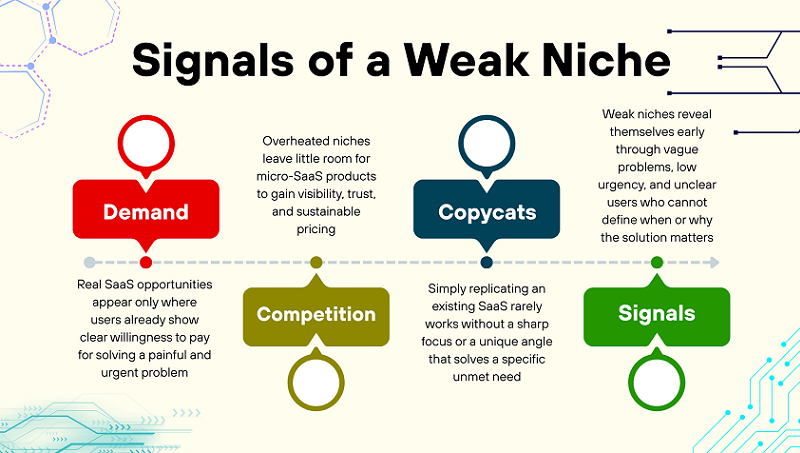
However, trends rarely guarantee sustainable demand. They often attract the attention of developers and investors faster than they attract real users. As a result, the market quickly becomes overwhelmed by dozens of similar solutions.
When supply grows faster than demand, most products simply disappear. Users choose a few strong players, and the remaining projects are left without an audience.
Furthermore, a trend in itself doesn’t necessarily indicate a significant pain point. It may be technologically interesting, but it doesn’t necessarily solve a critical business problem.
Therefore, successful Micro-SaaS projects are rarely built around trends. They are built around persistent problems that exist independently of trendy technologies.
Copying Existing SaaS Without Understanding Demand
Many aspiring founders try to copy existing SaaS products. They see a successful service and think, “If this product makes money, I can create something similar.” At first glance, this strategy seems safe.
But copying without understanding the market almost always leads to problems. Successful SaaS typically develops over years and has a deep understanding of its audience. It has a brand, distribution, and user trust.
Simply replicating a product’s features won’t create a competitive advantage. Users won’t switch to a new service without a clear reason.
Furthermore, many successful products solve complex problems within specific niches. Without understanding these nuances, it’s impossible to create a truly useful alternative.
Therefore, copying SaaS can only work when the founder understands a deep pain point for users and sees a significantly better way to solve it.
Idea lists, forums, and “startup inspiration” traps
There are countless lists of startup ideas online. They are published on blogs, forums, and in entrepreneurial communities. These collections often promise dozens of “ready-made” opportunities for creating a SaaS product.
The problem is that most of these ideas have never been tested in the market. They are theoretical assumptions, not the result of analyzing real user problems.
When a founder chooses an idea from such a list, they are essentially starting with a hypothesis without evidence. This means they still have to prove the existence of the problem.
Furthermore, popular idea lists are read by thousands of people. If an idea seems obvious, it has likely already been tried dozens of times.
Therefore, such sources can be useful for inspiration, but they rarely provide a reliable foundation for creating a profitable micro-SaaS.
Why feature gaps aren’t the same as pain gaps
Many entrepreneurs look for opportunities in missing features of existing products. They study SaaS tools and try to find “missing features.”
At first glance, this seems like a good strategy. If a product lacks something, then a solution can be created that adds it.
But in practice, most missing features aren’t real pain points. Users may mention them as wishes, but that doesn’t mean they’re willing to pay for a separate product.
Often, such features simply aren’t a priority for users. They may be convenient, but they’re not critical to their work.
A true SaaS opportunity arises not when a feature is missing, but when there’s a significant problem that prevents people from working effectively.
4. How to Identify Real Pain Points Before Building Anything
One of the most important tasks when creating a Micro-SaaS is to identify real user pain points before development begins. Many founders start coding too early, building a product in the hopes that the market will emerge later.
However, in most cases, this approach leads to a waste of time and resources. Without a clear understanding of the problem, it’s impossible to create a solution that people will pay for.
True SaaS opportunities become apparent when a founder begins to closely study user behavior. People constantly encounter tasks that take too much time, create risks, or require complex processes.
These problems are rarely described directly. Users don’t always formulate them as “an idea for a SaaS.” But they can be detected through repetitive actions, workarounds, and inefficient processes.
Therefore, instead of asking people “what product do they need,” it’s much more useful to observe how they actually do their work.
You can often uncover the most promising opportunities for Micro-SaaS by examining these details.
Observing workflows instead of asking for ideas
One of the best ways to uncover real pain is to observe people’s workflows. Many problems only become apparent when you observe how people perform tasks in practice.
For example, users may use multiple tools, copy data between systems, or perform the same operation dozens of times a day. These processes create friction and waste time.
When people regularly perform such actions, they create a potential opportunity for a SaaS solution.
It’s important to understand that users rarely identify such problems themselves. For them, it’s just part of the job.
But for a Micro-SaaS founder, these very same repetitive processes can become the basis for a new product.
Signals that indicate people are already paying to solve the problem
One of the strongest signals of real pain is when people are already paying to solve the problem. This could be through existing tools, services, or manual work by specialists.
If companies spend money to solve a problem, it means the problem has economic value.
Even if existing solutions are imperfect, the very fact of paying demonstrates that a market exists.
Sometimes users combine several tools to solve a single problem. This can also be a sign of unmet demand.
For micro-SaaS, this means the opportunity to create a simpler, more convenient, or more specialized solution.
How to spot pain through behavior, not opinions
User opinions can be useful, but they don’t always reflect reality. People often say they need something but aren’t willing to pay for it.
Therefore, analyzing behavior is much more important. What tasks do users perform most often? Where do they spend the most time?
Behavior reveals real priorities.If users repeatedly perform a task manually or rely on complex processes, it often indicates a problem.
It’s also worth paying attention to workarounds. When people create their own scripts, spreadsheets, or internal tools, this is a sign of an existing pain point.
Such observations often provide a more accurate picture than any survey.
Questions that Reveal Urgency Instead of Curiosity
When founders communicate with potential users, it’s important to ask the right questions. Many questions merely arouse curiosity but don’t reveal the true urgency of the problem.
For example, asking “Would you use this product?” rarely yields a useful answer. People tend to answer positively out of politeness or curiosity.
It’s much more useful to ask about current processes. For example, how the problem is currently being solved, how long it takes, and what problems arise.
It’s also important to find out what consequences arise if the problem isn’t solved in a timely manner.
Answers to such questions help understand how important the problem truly is to users.
5. Turning Pain Points Into Viable Micro SaaS Ideas
After understanding the real pain points of users, you can transform them into viable Micro SaaS ideas. Many entrepreneurs make a mistake at this stage, trying to create an overly complex product or solve too broad a range of problems.
However, successful Micro SaaS solutions usually start with a narrow problem. They focus on a specific audience and a specific situation.
This approach allows for faster product development, hypothesis validation, and first user acquisition.
It’s important to understand that the goal at this early stage isn’t to create a perfect product. The goal is to ensure that the problem is truly significant enough for people to start using and paying for the solution.
Once you validate the market pain point, you can gradually expand and improve the product.
Therefore, turning a pain point into a SaaS idea is a process of simplification, focus, and hypothesis validation.
Narrowing pain to a specific user and moment
A strong SaaS idea almost always targets a specific user and a specific moment in their workflow. The more precisely you define the situation, the easier it becomes to create an effective solution.
For example, instead of a general idea like “marketing tool,” you can focus on a single task within the marketing process.
When you clearly define the problem, it becomes easier to understand user needs.
This also simplifies product development and value communication.
A narrow focus is often key to a successful Micro-SaaS launch.
Validating pain without pitching a solution
During the idea validation phase, it’s important not to sell the solution too early. If you pitch a product right away, users may respond to the idea itself, not the problem.
It’s much more useful to first understand the severity of the pain itself.
The founder can ask questions about current processes, problems, and implications.
If users are actively discussing their challenges and looking for solutions, that’s a good sign.
Confirm the pain first, and only then move to discussing possible solutions.
Mapping pain to a simple, focused product
Once you confirm the problem, the next step is to identify a minimal solution.
A micro-SaaS product shouldn’t solve everything at once. Instead, it should address one specific need as effectively as possible.
A simple product is easier to develop, test, and improve.
It also reaches the market faster and begins to receive feedback.
Over time, such a product can become the basis for a larger platform.
Knowing when the pain is strong enough to build
Not every problem is worth building a SaaS product. Sometimes the pain exists, but it’s not strong enough for people to pay for a solution.
Therefore, it’s important to evaluate several factors: the frequency of the problem, its impact on work, and users’ willingness to pay.
If the problem occurs regularly and impacts business performance, the likelihood of a successful product is significantly higher.
It’s also important to consider existing solutions. If the market is already paying for similar tools, this confirms demand.
When all these signals coincide, you can confidently move on to creating a Micro-SaaS.
Final Thoughts — Micro SaaS Success Starts With Pain, Not Ideas
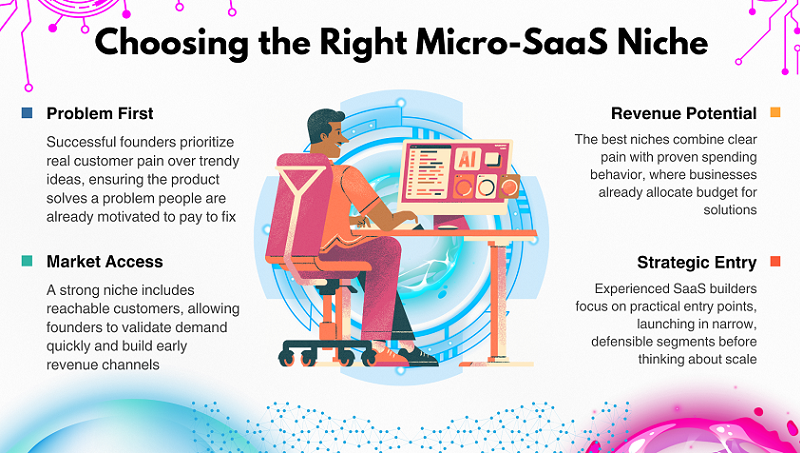
Most Micro SaaS projects fail not because the technology was bad or the product was of insufficient quality. The root cause is usually much simpler: the product solved a problem that wasn’t truly important enough for users. Many founders start with an idea, inspiration, or trend, rather than addressing a real market pain point.
However, successful Micro SaaS companies almost always emerge from a deep understanding of user problems. They don’t start with a list of features or innovative technologies. They begin with observing where people are wasting time, money, or efficiency.
True opportunities arise when a problem recurs regularly and has real business implications. In such situations, users don’t just want a solution—they actively search for a way to remove the pain. This is where the opportunity for a new SaaS product emerges.
Finding such opportunities requires a different mindset. Instead of searching for ideas, an entrepreneur needs to study people’s workflows, analyze their behavior, and identify inefficiencies. This is often where the best opportunities for creating Micro SaaS lie.
It’s also important to remember that not every problem turns into a profitable product. A strong SaaS idea typically combines several factors: a common pain point, tangible impacts, and users’ willingness to pay for the solution. When these elements align, the likelihood of a successful product increases significantly.
Therefore, the main principle of Micro SaaS can be formulated very simply: pain first, product second. By starting with a problem rather than an idea, the chances of building a useful and profitable service become significantly higher.