

Today, we will explore Profitable Micro SaaS Ideas for Solopreneurs, one of the most effective ways for developers and solo founders to launch successful SaaS products. You no longer need to build huge startups or manage large teams. The goal is to create micro SaaS startups that solve a specific problem for a niche audience.
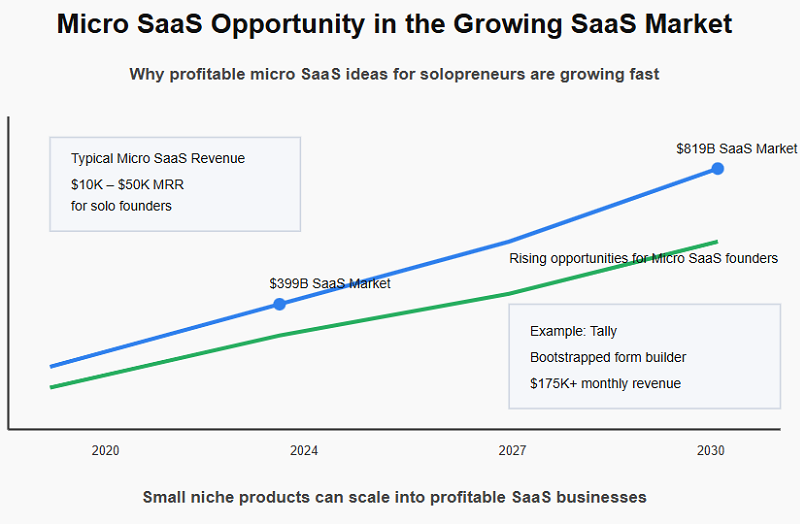
Interest in such products is growing along with the overall SaaS market. According to research, the global Software as a Service market will reach approximately $399.1 billion in 2024, and this growth is continuing. By 2030, the market could exceed $819 billion, representing a near-doubling of the industry in just a few years.
This growth opens up enormous opportunities for solo developers. Today, even a small, bootstrapped SaaS can reliably earn its owner tens of thousands of dollars in monthly revenue without investment or a large team of experts.
Most micro SaaS businesses typically earn $10,000–$50,000 MRR, which is already considered an excellent start for a solo founder. But achieving sustainable growth requires more than just launching a product — it means understanding why most AI SaaS startups fail and following the strategies that allow the successful 10% to thrive, as detailed in 90% of AI SaaS Startups Fail, but the 10% Follow This Formula. Some products, when carefully planned and executed, can grow significantly while still remaining small and independent.
A good example is Tally, a simple, no-code form builder. This product was created by a small team and completely bootstrapped, but over time it has grown to over $175K in monthly revenue (MRR) and approximately $2M in ARR, serving over 150,000 users worldwide.
The history of such products demonstrates an important point: a successful micro SaaS doesn’t necessarily have to be complex. Sometimes, solving one specific problem better than competitors is enough.
In this article, we’ll look at 7 profitable micro SaaS ideas for solopreneurs, based on real products. Many of them started as small side projects but eventually grew to $10K, $50K, and even hundreds of thousands of dollars in MRR.
1. AI Customer Support Chatbots as a Micro SaaS (Example: Setter AI)
AI chatbots for automated customer communication are becoming one of the fastest-growing areas of micro SaaS products today. Various businesses are increasingly struggling to quickly respond to incoming inquiries, messaging messages, and consultation requests. This is why solutions in the customer support automation and AI lead generation tools niche are rapidly gaining popularity.
Before diving into specific micro SaaS examples, it’s crucial to know how to identify and vet profitable ideas. A detailed guide for this process can be found here: Day 1 — Where to Find Great SaaS Ideas (and how to vet them).
One interesting example of such a micro SaaS is Setter AI. This service uses artificial intelligence to automatically process incoming leads and book appointments for clients. The product functions as an AI appointment setter, capable of responding to users and immediately scheduling calls or consultations.
The main problem this service solves is the loss of potential clients due to slow response times. Research shows that companies lose a significant portion of leads if they don’t respond within the first few minutes. This is why communication automation has become one of the most in-demand areas of AI SaaS tools.
After its launch, Setter AI was able to quickly find product-market fit. According to various SaaS reviews and startup case studies, the product achieved approximately $10,000 in monthly revenue (MRR) in the first six months after launch. This is a good example of how a niche micro-SaaS for solopreneurs can generate stable revenue without major investments.
Such products often operate on a simple subscription model. For example, companies pay a monthly fee based on the number of messages processed or the number of appointments scheduled. This allows even a small SaaS to grow steadily and scale with the number of clients.
This idea opens up numerous opportunities for launching your own project. For example, you could create a specialized AI assistant for a specific industry: real estate agencies, clinics, online schools, or marketing agencies. Narrow niches often have less competition and achieve product-market fit more quickly.
Why AI appointment setters are a fast-growing micro SaaS niche
The growth of such services is driven by businesses actively implementing AI-powered sales and customer support automation. Even small companies are eager to automatically process incoming messages to avoid losing potential clients.
Key facts about the growth of such micro SaaS products:
- ● After six months, Setter AI achieved approximately $10,000 in MRR, confirming strong demand.
- ● The product solves one key problem: automatically scheduling clients via a chatbot.
- ● Growth channels included content marketing and product demos, attracting early users.
- ● Integrations with messaging apps and CRM systems allowed the service to scale.
- ● The AI chatbot niche continues to grow thanks to SaaS solutions, lead generation automation, and sales tools.
- ● Subscription models and automated infrastructure make these products easily scalable.
If you’re considering ideas for your own micro SaaS, you can delve even deeper into this niche. For example, you could create a chatbot specifically for dental clinics, real estate agencies, or educational platforms. In these segments, companies are willing to pay for tools that help increase lead conversion and automate client booking.
The main lesson from the history of such products is simple: successful micro SaaS often solves one specific problem, but does so better and faster than existing tools.

Setter AI schedules meetings automatically, turning conversations into booked calls efficiently
2. Automated Image Generation APIs for Marketing (Example: Bannerbear)
Another interesting niche for launching a micro SaaS product is the automatic generation of marketing images via API. Modern companies constantly create visual content for websites, social media, and advertising campaigns. However, manual image creation is time-consuming and requires designers. This is why automated marketing tools and dynamic content generation solutions are becoming increasingly popular.
A good example of such a product is BannerBear. It’s a SaaS service that automatically generates images via an API based on templates. The system can input text, data, and images, creating thousands of unique visuals without designer intervention.
This approach is especially useful for companies that regularly create marketing visuals, social media images, or dynamic ads. For example, online stores can automatically generate images for new products, while media platforms can generate dynamic previews for articles.
The service quickly became popular among developers and marketing teams. Thanks to its simple API integration, it can be connected to virtually any website or SaaS product.
According to SaaS reviews and the founder, Bannerbear has achieved approximately $45K–$50K in monthly revenue (MRR) as a fully bootstrapped product.
This is a great example of how a micro SaaS for developers can grow to generate significant revenue by solving a specific marketing automation problem
Interestingly, such products often become infrastructure services. That is, they operate “behind the scenes” and are used by other applications or websites to generate content. This makes such SaaS easily scalable and capable of serving thousands of clients simultaneously.
If you’re considering ideas for launching your own project, there are many opportunities in this niche. For example, you could create a SaaS for automatically generating images for e-commerce, email marketing, or generating visuals based on CRM data. Such narrowly focused tools often quickly find their audience.
Why automated marketing assets are a profitable micro SaaS
The growth of such services is driven by companies increasingly automating the creation of content and marketing materials.
Key facts about the development of this niche:
● Bannerbear has grown to approximately $45K–$50K MRR while remaining a small, bootstrapped SaaS product, and continues to grow in revenue.
● The platform allows for automatic creation of social media images, blog images, and advertising campaigns.
● One popular use case is generating Open Graph images for articles and landing pages.
● Marketers also use the service to create dynamic ads, where images change based on data or audience.
● Integrations with popular automation tools and no-code platforms have played a major role in the product’s growth.
● The niche’s popularity is fueled by the growth of verticals like automated design tools, marketing automation SaaS, dynamic content generation, API-first SaaS, visual content automation, and developer marketing tools.
Products like these demonstrate that even a small tool can become an important part of a marketing infrastructure. Many SaaS companies and startups are willing to pay for a service that saves designers and marketers hours of work.
When considering potential ideas for a new micro SaaS, we could delve even deeper into this niche. For example, creating an image generator specifically for e-commerce product pages, an automatic creative generator for Facebook Ads, or a service that creates visuals for email newsletters.
The main idea behind such products is simple: to automate repetitive marketing tasks and enable companies to create thousands of images without manual work. It’s precisely these narrow solutions that often become successful micro SaaS products.

From social posts to ecommerce banners, Bannerbear helps you generate visuals at scale
3. Notion Form Builders for No-Code Users (Example: NoteForms)
One of the most interesting niches for launching a micro SaaS product has become integrations with popular productivity tools.
When a platform grows rapidly and attracts a large audience, an entire ecosystem of additional services begins to emerge around it. This is precisely what happened with Notion, which has become a staple workflow for startups, freelancers, and teams around the world.
One successful product in this niche is NoteForms.. This service allows you to create forms that automatically submit data directly to Notion databases. Essentially, the product solves a fairly simple problem: Notion itself has long lacked a convenient built-in tool for collecting data through forms.
Before the advent of such services, users had to rely on third-party solutions and manually transfer data into their workflow databases. NoteForms simplified this process by allowing you to create forms that instantly sync with Notion tables and databases.
This approach has proven especially useful for no-code builders and small teams. They can collect customer requests, feedback, or leads and automatically save everything in their Notion workspace.
According to interviews with the founder and SaaS reviews, NoteForms reached approximately $10,000 in MRR approximately 14 months after launch, later growing to approximately $37,000 in monthly revenue.
This example perfectly demonstrates how powerful micro SaaS integrations around popular products can be. Instead of creating a new, complex service, the founder simply leveraged the capabilities of an existing platform.
Today, an entire ecosystem of tools is developing around Notion—from analytics to automation and content generation. This creates a huge number of opportunities for launching new niche SaaS products.
Why no-code integrations are perfect for solo founders
Integrations with popular platforms are often an ideal opportunity to launch a micro SaaS project. These products already have a large user base that requires additional features.
Key facts about the growth of such services:
- NoteForms achieved approximately $10,000 in MRR approximately 14 months after launch, which is a good result for a bootstrapped project.
- Over time, the product grew to approximately $37,000 in monthly revenue while remaining a small, independent SaaS service.
- The product’s primary audience is Notion users who use the platform for project management, CRM, and databases.
- The service has proven particularly popular among no-code builders and startups who need a quick way to collect data.
- The product’s growth is supported by the development of such areas as Notion integrations, no-code SaaS tools, micro SaaS for creators, form builder software, Notion automation tools, and startup productivity tools.
- Notion’s primary growth channels have been user communities, tool catalogs, and content marketing.
Such projects are particularly attractive for solo founders. Instead of creating a complex product from scratch, they can build a narrow tool around a popular platform that already has millions of users.</p>
For example, you could launch a SaaS for Notion data analytics, task automation, report generation, or synchronization with other services. Such products often find their first customers quickly because they solve a specific problem within an existing ecosystem.
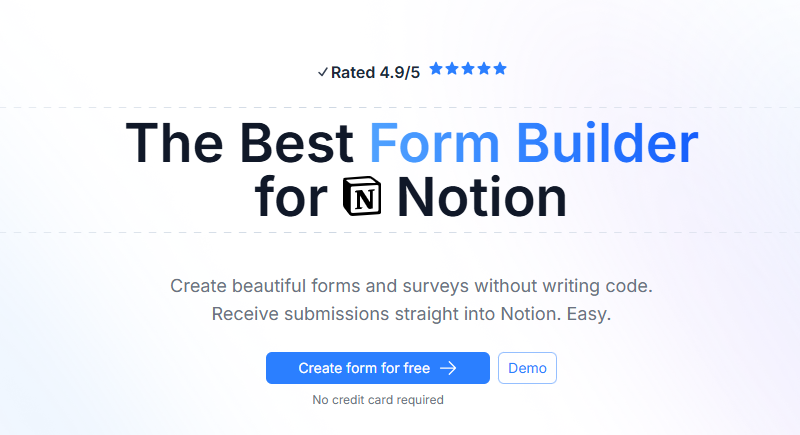
Make elegant forms and surveys without writing code. See all submissions instantly in Notion
4. Testimonial Collection Platforms for SaaS (Example: Senja)
Another interesting niche for creating a micro SaaS product is tools for collecting and displaying customer reviews. In modern online business, social proof plays a huge role: potential customers are much more likely to purchase a product if they see real reviews from other users.
Many companies collect reviews via email, social media, or contact forms, but then face the challenge of displaying them beautifully and conveniently on their website. This is where SaaS solutions for testimonial management and review automation come in.
A good example of such a product is Senja. This service helps companies easily collect customer reviews and turn them into ready-made elements for websites, landing pages, and marketing materials.
The basic idea behind the product is quite simple: to provide companies with a convenient tool that allows them to collect, manage, and publish reviews in one place. Users can send a link to a form, receive a text or video review, and then embed it on their website in just a few clicks.
Thanks to this simple concept, the product quickly found an audience among SaaS startups, online course providers, and marketing agencies.
According to interviews with founders and SaaS case studies, Senja achieved approximately $30K–$32K in monthly revenue (MRR) in its first months while remaining a fully bootstrapped product.
This case demonstrates an important feature of micro-SaaS ideas: sometimes, solving one specific marketing problem is enough to build a profitable SaaS business.
Social proof tools are especially in demand among startups and online services. The faster a company can show real customer reviews, the higher its conversion rate and user trust.
This is why such SaaS products are often becoming a standard part of the marketing stack of modern companies.
Why social proof tools are a strong micro SaaS market
Review management tools have become an important part of modern digital marketing. Companies are actively seeking ways to automatically collect and showcase real user reviews.
Key facts about the development of such micro SaaS products:
✓ In the first months after launch, Senja grew to approximately $30K–$32K MRR, while remaining a small, bootstrapped SaaS product.
✓ The platform allows for automatic collection of customer reviews via special forms and links.
✓ One of its key features is the creation of testimonial walls that can be embedded on a website or landing page.
✓ Users can also collect video testimonials, significantly increasing trust among potential customers.
✓ The service makes it easy to embed reviews on websites, landing pages, and SaaS products.
✓ The niche’s popularity is fueled by the growth of such areas as social proof software, testimonial management tools, customer review platforms, SaaS marketing automation, startup growth tools, and conversion optimization software.
For solo founders, this is one of the most attractive niches. Such a product can start with fairly simple functionality: collecting reviews, storing them in a database, and a convenient website widget.
Over time, the SaaS can be expanded with new features—for example, review analytics, automatic post-purchase review requests, or integration with CRM systems.
The main lesson from such products is quite simple: sometimes a small feature that improves a company’s marketing can turn into a profitable micro SaaS business.

Simply the best way to gather and showcase testimonials
5. Simple Form Builders That Compete With Typeform (Example: Tally)
One of the most in-demand niches for micro SaaS is simple form builders, which compete with cumbersome platforms like Typeform. Many companies and startups are looking for lightweight, fast, and intuitive solutions for data collection, surveys, registrations, and applications.
An example of such a successful product is Tally, a small, bootstrapped SaaS that offers a simple form builder with a minimal interface and the ability to create an unlimited number of forms.
Tally’s main goal is to make the product as easy to use as possible while still providing all the essential features for businesses and teams. The product is especially popular among no-code builders and solo founders who want to quickly launch surveys or forms without unnecessary configuration or complexity.
Tally also uses a Notion-like interface, making it intuitive and familiar to the millions of users already using popular productivity tools. This UX focus significantly lowers the entry barrier for new users and accelerates product adoption.
The product has become an example of how a micro SaaS with minimal functionality can be profitable if it solves a specific problem faster and more conveniently than larger platforms.
Why simple alternatives to complex tools often win
Simple and lightweight solutions often outperform complex products because users value speed, convenience, and minimalism.
Key facts about the growth of Tally and similar micro SaaS products:
✓ Tally quickly achieved its first $20K+ MRR and is now generating approximately $2-3 million ARR as a bootstrapped product.
✓ The product’s focus is on unlimited forms, allowing users to create any number of forms without restrictions.
✓ The minimal UI makes form creation quick and intuitive, reducing abandonment.
✓ The use of a Notion-like interface facilitates onboarding and accelerates user adoption.
✓ Key growth channels: no-code communities, SaaS tool catalogs, email marketing, recommendations, and productivity content.
Ideas for launching your own project in this niche include forms for online courses, event registrations, customer surveys, feedback collection, and integrations with analytics and CRM. Simple solutions quickly find their audience and are easily scalable, remaining relevant to millions of users.
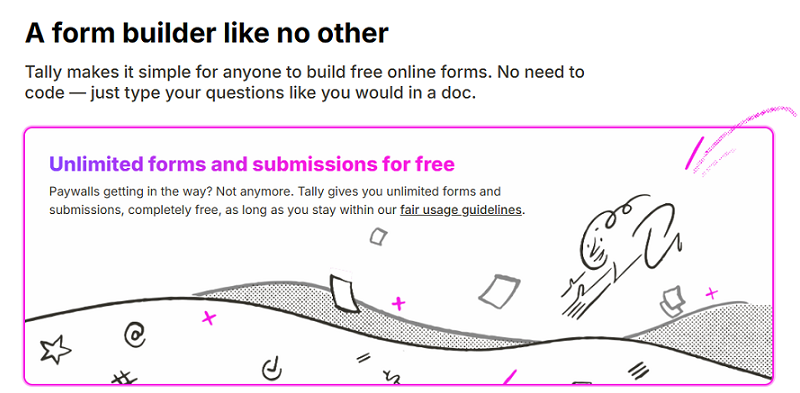
From text to form in a flash
With Tally, just write your questions and watch your online form come to life
6. Email Management Tools That Clean Your Inbox (Example: Leave Me Alone)
Another popular niche for micro SaaS products is email management and automatic unsubscribe tools. In today’s world, users receive hundreds of emails daily, making email management a real challenge. A service that helps clean out inboxes and save time quickly finds its audience.
An example of such a product is Leave Me Alone, a small SaaS that automatically unsubscribes users from unnecessary emails and helps keep their inbox organized. The service’s primary goal is email overload reduction, allowing users to focus on important emails.
The tool is aimed at users who value privacy-focused email tools and want to control which emails they receive. Its simplicity and transparency make the product especially attractive to solo founders and independent professionals.
According to interviews with the founders and SaaS reviews, Leave Me Alone grew to approximately $10,000 MRR in its first few months, remaining a fully bootstrapped project. Its growth continues smoothly, attracting new customers.
The product solves key problems: unsubscribe automation and managing overloaded email, making it popular with thousands of users worldwide.
Why privacy-focused email tools attract paying users
The market for email productivity and privacy-focused services is growing as people increasingly value their time and privacy.
Key facts and features:
- ●Leave Me Alone grew to approximately $10K MRR in its first months as a bootstrapped micro SaaS.
- ●The product’s primary function is automatic unsubscribes from unwanted emails (unsubscribe automation).
- ●Solves email overload, helping users focus on important emails.
- ●The product’s popularity is fueled by growing interest in privacy-focused software and productivity-enhancing services.
These services demonstrate that micro SaaS that solves a specific problem can generate stable revenue and be in demand, even if the team is small or the product is completely bootstrapped.

Gather all your email subscriptions in one place and unsubscribe quickly
7. Shopify Analytics and Data Tracking Tools (Example: Analyzify)
One of the most promising niches for micro SaaS is analytics and data tracking tools for Shopify apps. Online stores are constantly looking for ways to more accurately measure conversions, analyze the effectiveness of marketing campaigns, and optimize sales. These solutions help e-commerce business owners make informed, data-driven decisions and save time.
An example of a successful product in this niche is Analyzify. This SaaS tool simplifies the collection and analysis of marketing data for Shopify stores. The product provides accurate conversion tracking, integration with GA4, and comprehensive marketing campaign analytics without the need for a dedicated specialist.
Analyzify solves a key problem for most Shopify store owners: data is often scattered across platforms, and standard analytics tools can be complex to set up. GA4 integration and automated reporting make working with data as simple and straightforward as possible.
According to founder interviews and SaaS case studies, Analyzify achieved approximately $12K MRR in the first seven months after launch, while remaining a fully bootstrapped product.
The product quickly found an audience among small and medium-sized Shopify store owners looking for micro SaaS tools for marketing analytics and accurate conversion tracking.
Why niche e-commerce analytics tools are highly profitable
The niche of highly specialized e-commerce analytics tools is growing because stores are willing to pay for accurate data and convenient reports that help increase sales.
Key facts about the growth of Analyzify and similar micro SaaS products:
-
- ●Analyzify achieved approximately $12K MRR in its first seven months while remaining a small, bootstrapped SaaS product.
- ●Key features: accurate conversion tracking, GA4 integration, marketing analytics, and advertising campaign reports.
- ●The product’s popularity is growing due to the growth of e-commerce and the demand for Shopify micro SaaS and marketing analytics tools.
For solo founders and small teams, launching such a product is especially attractive – the niche is narrow, competition is manageable, and store owners are willing to pay for a high-quality and simple analytics tool.

The leading data analytics app for managing marketing integrations, optimizing your data flow, and presenting clear analytics — with professional support whenever required
FAQ About Micro SaaS and SaaS Products
What are the best SaaS ideas?
The best SaaS product ideas usually solve a specific problem for a narrow audience. Popular areas include vertical SaaS, automation tools, AI tools, analytics, and integrations. Such products often easily find their audience and can quickly become profitable, even in the micro SaaS format.
What are some examples of SaaS?
Examples of successful SaaS include CRM systems, email marketing software, analytics platforms, and project management tools. Well-known services include Slack, Shopify, Notion, and HubSpot—they demonstrate how SaaS helps companies automate processes and improve productivity.
How to get ideas for micro SaaS?
Ideas for micro SaaS are usually born from practical experience: solving minor problems in existing tools, analyzing discussions on Reddit or IndieHackers, building integrations, or automating processes for niche industries. Often, the most successful projects emerge from personal experience and understanding user pain points.
Is ChatGPT a SaaS product?
Yes, ChatGPT is considered a SaaS product because it is a cloud-based subscription service accessible over the internet. However, it is also an AI SaaS platform, as the product’s core value is artificial intelligence, which performs tasks and generates content for users.
What is the Rule of 40 / Rule of 50 in SaaS?
The Rule of 40 is a metric used to evaluate SaaS companies: growth rate + profit margin ≥ 40%. It helps understand the sustainability of a business in terms of growth and profitability. There is sometimes discussion of a Rule of 50 for high-growth companies, where the threshold is higher for companies that are actively scaling.
Final Thoughts
Most micro SaaS products are created to solve a very specific problem that is important to a specific audience. These projects often begin as side projects for one or two people, without large teams or investment. Due to their narrow focus, these products quickly find their niche and can achieve initial results.
For many solo founders, reaching $10,000 MRR becomes an important milestone, confirming product-market fit and sustainable demand for the service. This revenue level demonstrates that the product is in demand, and users are willing to pay for its functionality.
The micro SaaS niche allows for experimentation with various ideas—from automation tools to integrations with popular platforms like Notion and Shopify. These products often use the bootstrapped SaaS approach, where all costs and development are controlled by the founder, without external funding.
Many successful services began as personal projects that addressed the founder’s own pain points and subsequently found an audience among thousands of users. Focusing on a specific problem and creating a simple, intuitive interface are key factors for growth.
The advantage of micro SaaS is that such products are easy to scale, add new features, and expand their audience without losing control of the business. Narrow-focused solutions remain in demand because they address real user pain points.
For new solopreneurs, this is an excellent opportunity to create profitable solopreneur ideas that, with the right approach, can generate a stable income. It’s important to choose high-converting niches where users are willing to pay for time savings or automation of routine tasks.
Therefore, micro SaaS remains an attractive format for independent developers, allowing them to launchproducts quickly, test hypotheses, and gradually scale their business.