
Every year, several thousand AI SaaS startups are launched. The landing pages look professional, the demos are impressive, the founders confidently talk about “revolution” and “scale.” But there’s one truth that everyone is keeping quiet about: most of these projects don’t even reach their first $1K MRR. Not because the market is bad. And not because the models are weak. But because almost all of them are following the same, wrong path.
If we look at it from the outside, we might think that failure is a fluke. They were unlucky with their niche. The marketing strategy was poorly designed. The timing was off. But if we look deeper and examine dozens of projects in a row, something else becomes clear: AI SaaS fails for the same reasons. Some founders build a product without thinking about distribution. Others create tools that are so generic they struggle to stand out. And many spend months searching for “good ideas” instead of identifying real problems people are actively trying to solve. In fact, this confusion between interesting ideas and real market pain is one of the most common reasons micro-SaaS projects collapse early. A deeper breakdown of why this happens—and how experienced founders identify real pain points before building anything—is explained in Why Most Micro SaaS Ideas Fail — and How to Find Real Pain Points. On top of that, almost no one seriously considers the economics of the product until it’s already too late.
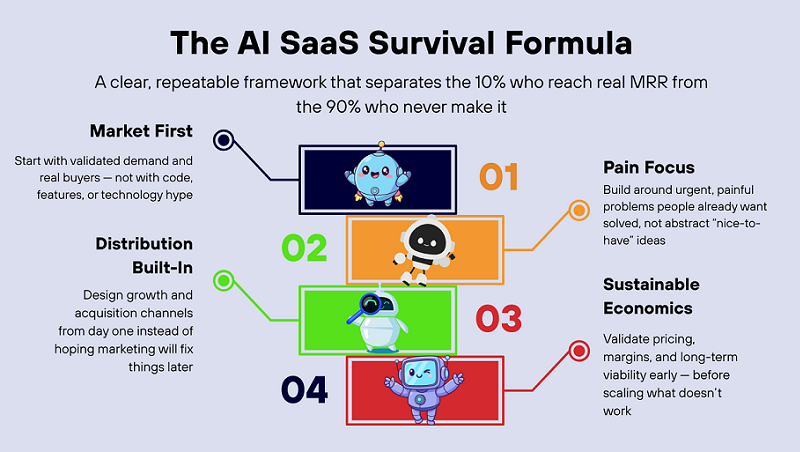
But here’s the interesting thing: there are those 10% of founders who do achieve stable MRR. Surprisingly, they aren’t geniuses and don’t use secret technologies. They simply follow a different logic. They start not with the product, but with the market. Not with features, but with pain. Not with scaling, but with sustainability. And a clear, repeatable formula is immediately apparent in their actions.
This article isn’t motivational or another “startup guide.” It’s an analysis of patterns. Why 90% of AI SaaS companies don’t even make their first profit. Where exactly do they go wrong? And what do those who do reach real users, real MRR, and real business do differently?
If you’re thinking about launching an AI SaaS—or have already launched one and feel like growth is hitting a wall—this formula can save you months of work and thousands of dollars in mistakes.
1. The Brutal Reality of AI SaaS Failure
Looking at the AI SaaS market from the outside, it might seem like the perfect time to launch. The tools are accessible, the models are powerful, no-code has removed technical barriers, and you can create a micro AI SaaS project in literally a weekend. Even launching an MVP now takes weeks, not months. But this very accessibility has created a paradox: entry has never been easier, yet survival has never been more difficult. The number of products has grown severalfold, while user attention remains limited. As a result, the market is overflowing with demos but often empty of real businesses.
For founders who want to start small and minimize risk, exploring a curated list of micro SaaS ideas under $500 can be a practical first step Micro SaaS Ideas for Small Business Owners Under $500 Budget.
Most founders consider landing the first 5–10 users a victory, yet failure often creeps in gradually. The pattern usually looks like this: first comes enthusiasm, then the initial users appear, followed by stagnation and confusion over why “everything seems to work, but there’s no revenue.” This section exposes a reality rarely discussed publicly—about recurring mistakes that become obvious when examining not one or two, but dozens of projects, and why the failure of AI SaaS is often predictable long before launch.
Why launching an AI SaaS is easier than ever — and that’s the problem
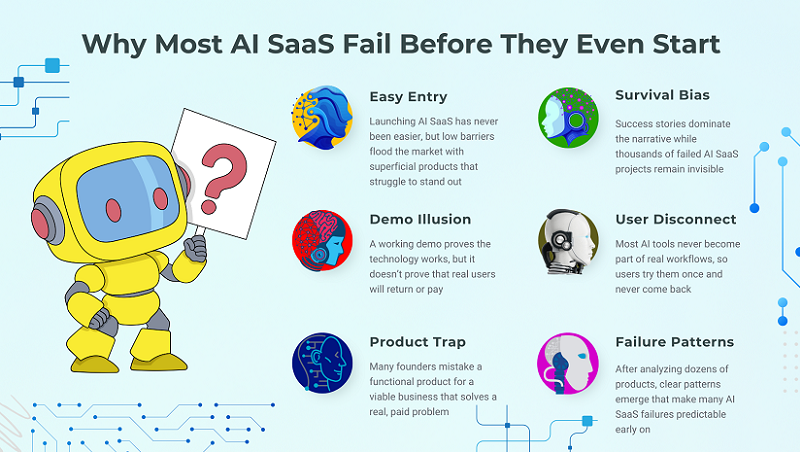
Today, almost anyone can launch an AI SaaS, even a complete beginner. Even without paid, code-free tools, you can create and launch your first micro SaaS with just ChatGPT. But when entry is too easy, the market quickly becomes overrun with superficial solutions. Most products lack a clear idea; they only have a formula.
The ease of launch creates the illusion of progress and, ultimately, success. The founder feels a sense of progress: something has been put together, something is working, something can be demonstrated. But this doesn’t create a real competitive advantage. The problem isn’t that it’s become easier to launch, but that it’s becoming more difficult to stand out and survive in the SaaS market. And many underestimate this shift.
The false signal of early demos and MVP hype
A working demo is the most misleading signal in the early stages. You might have the joyful feeling that the product is almost ready and the next step is marketing. This is especially true in AI, where even a simple scenario can seem impressive.
The problem is that a demo validates the technology but is no guarantee of attracting customers. A user might be delighted by the demo’s impact and yet never return. An MVP might work perfectly in one scenario and then fall apart in real use. The hype surrounding demos often masks a lack of systems thinking. And this is where many AI SaaS projects begin their path to failure.
Why “working product” ≠ viable business
One of the most common traps you can fall into is confusing a working product with a viable business. The AI responds, the interface works, the features are implemented—that means everything is fine. But that’s not the start of your business.
Viability is tested by how well the product solves a specific problem, one for which many are willing to pay regularly. Your task is to create a product that keeps users coming back not out of curiosity, but out of necessity. It’s about having a clear path from the first touch to revenue. Most AI SaaS stops at the “it works” level, never reaching the “it’s needed” level.
Survival bias in SaaS success stories
We see the same success stories we like: scale, millions, rapid growth, big-name founders. But almost no one shows us the thousands of projects that closed quietly and quickly. This is survival bias.
I’m sure that if you’re a founder, you also learn from the cases of winners, ignoring the statistics of losers. As a result, you’re simply copying the trappings of success, not the real reasons. Scale without context, growth without a foundation, features without demand. Understanding this is the first step to a more sober approach to launching AI SaaS.
Why most AI tools never reach real users
I’ve seen some founders’ micro SaaS products technically still exist, but they’re not actually used. They have a website, sometimes even users, but there’s no regular use. These products appear to be alive, but in reality, almost no one needs them.
The reason is simple: the product isn’t integrated into the user’s actual workflow. It’s interesting, but not essential. A user might try it once, find it interesting for a single use, and then forget about it. Without a repeatable use case, there’s no retention or MRR. And this is one of the main reasons why AI SaaS is dying a silent death.
The hidden graveyard of micro-SaaS projects
Behind every successful micro-SaaS lies a graveyard of dozens of closed projects. They’re not featured on social media, they’re not shown in case studies. But they’re the ones that make up the real market statistics.
Most micro-SaaS projects die not because of competitors, but because there’s no demand for them. Or because the founder spent too long tinkering with the product without testing it. This graveyard is the best source of learning, if you look at it honestly. Because the same mistakes are repeated there.
Why failure is usually predictable early
The most frustrating thing is that failure is rarely unexpected. Often, it’s clear early on that the product isn’t solving a pressing problem. That users aren’t returning. That the money isn’t accumulating.
But instead of stopping or changing course, founders continue to make more mistakes. They add features, change the copywriting, redesign. Yet the root cause of the problem runs deeper. Recognizing early warning signs is the key skill that distinguishes those 10%.
Patterns you start seeing after reviewing dozens of products
At first glance, one product always looks unique. After examining ten SaaS products carefully, similarities begin to appear. Reviewing fifty makes the patterns impossible to ignore.
You begin to see the same mistakes: an overly broad ICP, a lack of distribution, substituting an idea for a pain point, and believing we’ll fix problems later if they arise. These patterns repeat themselves over and over again. They highlight the importance of proven strategies for scaling SaaS that help some products survive and generate stable profits.
2. The Core Formula for the Top 10% Follow
After watching dozens of failures in a row, your belief in randomness gradually fades. You begin to understand that success in AI SaaS isn’t a stroke of luck or a “brilliant idea,” but a repeatable formula. The top 10% of projects don’t look the same on the outside, but they’re structured almost identically on the inside. Their decision-making logic, workflow, and product thinking are surprisingly similar. Technology is not the starting point, even though they work with AI. Design isn’t the first step either, despite the attention to UX. Everything begins with understanding the system: who the product is for, what pain it solves, and how it will generate revenue — a process detailed in how SaaS companies can boost revenue with smarter LTV calculations. This consistency is what distinguishes the surviving products from the beautiful but dead ones.
Why successful AI SaaS follow a repeatable structure
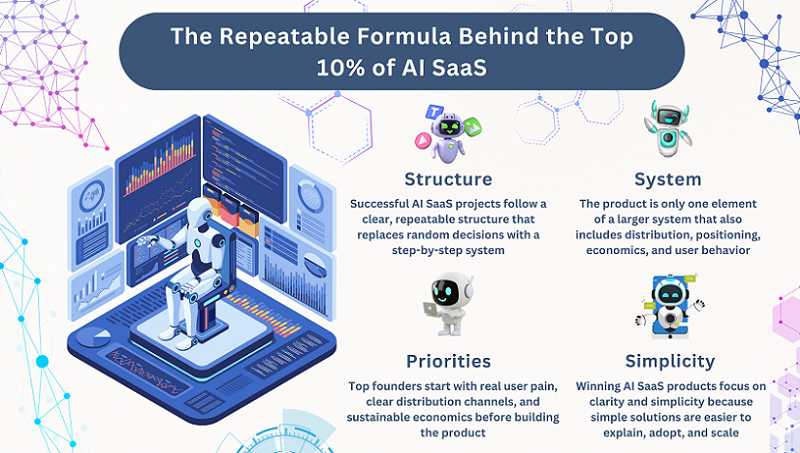
Successful AI SaaS are almost never built “on inspiration.” Their founders consciously reject chaotic decisions in favor of structure. A repeatable model reduces early errors. When you have a structure, you don’t ask yourself “what to do next”—you simply move step by step. This is especially important in AI products, where there is too much uncertainty. Structure doesn’t kill creativity; it confines it to the realm of reality. It is within this framework that sustainable growth emerges. Without structure, a product always depends on luck, not on a system.
The product is only one part of the system
One of the most painful truths for founders is that the product alone doesn’t solve anything. Even a great AI product can die if it exists in a vacuum. Successful SaaS companies view the product as part of a system, not the center of the universe. The system includes distribution, economics, positioning, and user behavior. If even one element is weak, the entire structure begins to falter. This is precisely why a “good product” so often fails to find a market. It was only good in and of itself, not as part of a working business model. The top 10% understand this very early on. And so they build systems, not features.
Distribution, pain, and economics come first
As I’ve already noticed, almost all failed projects begin with a product that would be a good idea to launch. Successful founders think differently, starting with something else: “Who is really hurting?” and “How will we reach them?” Pain is the reason for the product’s existence. Distribution is the means to survival. Economics is what allows it to continue. When you have these three elements, the formula works. This order seems boring, but it eliminates 80% of future problems. When there is pain, a clear channel, and the numbers add up, the product becomes a logical consequence, not a hope. For a concrete example of applying this approach in a micro SaaS without writing code, see From Idea to $3K MRR: Building a Micro SaaS Without Code. This is why the top 10% may seem completely simple, but they grow. They don’t romanticize the product; they earn it.
Why simplicity beats sophistication
Many AI founders believe that the more complex a product is, the more valuable it will be to the market. But the market almost always chooses simplicity. Simple products are much easier to explain, sell, and scale. Complex solutions require training, persuasion, and user patience. Successful SaaS companies consciously simplify everything, not because they can’t make it more complex, but because they understand the cost of cognitive load. Simplicity accelerates feedback and reduces friction. This is especially important in AI, because users don’t fully understand what’s going on under the hood anyway. The top 10% win not with technology, but with clarity. And it is clarity that drives growth.
How the formula stays consistent across niches
It seems that AI SaaS in different niches should operate according to different rules. In practice, the formula hardly changes. The context changes, but the logic doesn’t. Every project has a specific pain point, a specific user, and a specific method of delivering value. Successful projects don’t reinvent the process each time. They adapt the same model to different markets. This makes scaling their thinking possible. This is why experienced founders launch their second and third products faster. The formula remains, only the details change.’
What founders misunderstand about “innovation”
Most founders think innovation is something fundamentally new. In reality, the market rarely rewards novelty per se. Innovation is often a new way to solve an old problem. However, this solution requires doing things faster, cheaper, and more clearly. The top 10% don’t chase “uniqueness”; they chase utility. They understand that users care about results, not the originality of the idea. This is why many “non-innovative” products outperform “revolutionary” ones. True innovation is when a product integrates into the user’s life, not just surprises them. And this is much more difficult than it seems.
The difference between building fast and building right
Building fast is trendy, but building right is difficult. Many confuse speed with progress. You can quickly build an MVP, but not a system. The top 10% of startup founders with proven track records don’t rush where mistakes are costly. These founders accelerate only when the logic is already established. This allows them to avoid rewriting the product every three months. Building right means making less spectacular but more sustainable decisions. In the long run, this always pays off. Speed without direction is simply running in circles.
Why this formula works even without funding
The most interesting thing about this formula is that it doesn’t require investment. It requires thinking. Most of its steps aren’t about money, but about clarity. Understanding pain, the channel, and the economics is within the reach of any founder. This is why many profitable AI SaaS companies grow without venture capital. The formula protects against unnecessary expenses and focuses efforts. When you know what you’re building and why, you don’t need a large budget. Money accelerates, but it doesn’t replace the system. And the top 10% understand this perfectly well.
3. Mistake #1: Building Product Before Distribution
Most AI SaaS projects don’t die because the product is bad. They fade into oblivion because there’s simply no one to show them to. Founders constantly live in the illusion: “First, let’s make the perfect product, and then we’ll do the marketing.” In practice, it’s the other way around. When distribution comes at the very end, the product is already established, and it often doesn’t fit into any acquisition channel. As a result, the team starts pushing the product into any channel that works, and frustration sets in, as conversion is near zero. Distribution isn’t advertising or a growth hack. It’s a fundamental limitation that should be shaped by the product itself. The top 10% of founders don’t think about “what we’ll build,” but rather “how will people find out about us and why will they care?” This is where true product-market fit begins. Everything else is just fancy engineering without a market.
Why “build first, market later” fails in AI SaaS
The “product first, marketing later” approach comes from startup mythology, but in AI SaaS it almost always breaks down. The market is overheated, competition is fierce, and user attention is more valuable than development. While you’re building a product in a vacuum, others are already testing demand. Ultimately, you launch an MVP that no one needs. Or it’s needed, but too late. In AI SaaS, learning speed is more important than development speed. And learning doesn’t exist without distribution.
Distribution as a design constraint
Distribution isn’t something added after release. It’s a constraint, like a budget or a team. If your primary channel is SEO, the product must be tailored to search intent. If it’s cold outreach, it must be ultra-clear in 10 seconds. The channel dictates which features make sense and which don’t — and understanding how to quickly grow SaaS revenue and reach $50K MRR can guide which features to prioritize. The best products appear “simple” precisely because they are governed by distribution logic. All unnecessary details fall away automatically.
Channels that shape the product itself
Each channel changes the product more than it seems. Twitter/X requires opinionated and sharp tools. SEO requires structured and repeatable use cases. Enterprise sales requires predictability and control. If you don’t understand which channels need to be connected for product growth, you’re building a product blindly. The result is a generic, faceless tool. And such products don’t scale.’
Why audience > idea
Ideas are overvalued. The audience is not. When you have a clear audience, ideas appear automatically. Without an audience, even the best idea dies immediately. Top founders first gather attention, then decide what to sell — a principle well illustrated in “$10K – $500K MRR: 7 Profitable Micro SaaS Ideas for Solopreneurs”, which shows how solopreneurs validate their ideas and grow recurring revenue. Because demand is an asset. An idea is not.
Early traction vs. real demand
Early registrations and likes are a bad sign unless they’re backed by behavior. Real demand is when people come back and pay, or at least try to integrate the free version of the product into their work initially. Distribution without quality is noise. But a product without distribution is silent. Both are needed, but it’s almost always better to start with reach.
Distribution as risk reduction
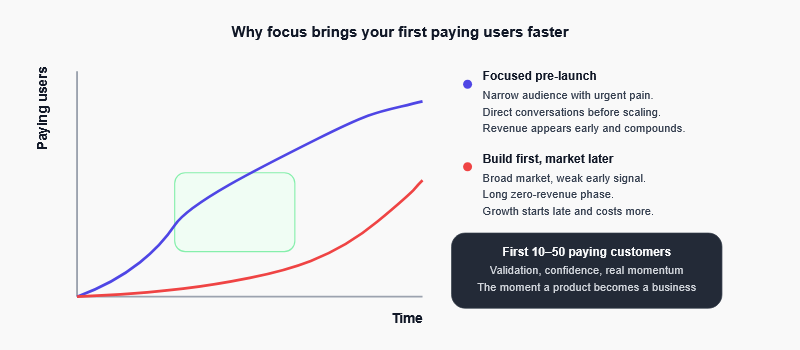
Distribution reduces risk. It allows you to test a hypothesis in weeks, not months. You quickly understand what’s not working and don’t get stuck on features. It’s not about scale—it’s about survival. Most failures could have been predicted if founders had reached the market earlier.
How the best founders pre-sell clarity
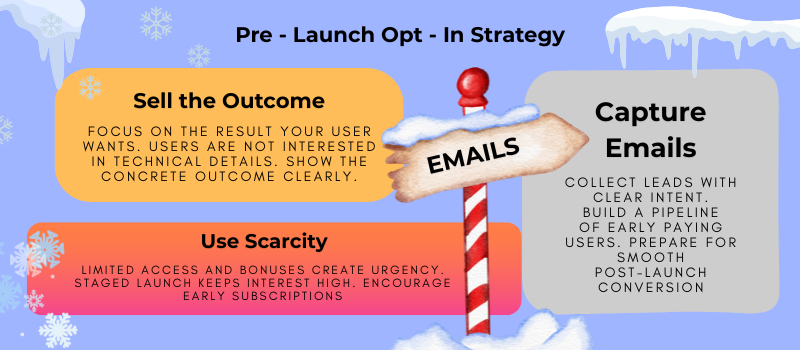
The best founders sell before they code. Through landing pages, demos, conversations, emails. They test the wording, the pain, the promise. And only then do they build. Ultimately, the product already “knows” what it is. This saves months and stress.
Product-market fit starts with reach
Product-market fit doesn’t start with features. It starts with someone actually seeing you. Without reach, there’s no data. Without data, there’s illusion. Distribution is the first step toward reality.
4. Mistake #2: Solving Generic Problems
The second common mistake is trying to solve a “very big” problem for “everyone.” On paper, this may seem logical: the market is huge and, of course, there are many users, AI can do everything. In reality, you become invisible. Generic SaaS doesn’t catch the eye, isn’t memorable, and isn’t explained from the first screen. The user doesn’t understand why you’re the one, and moves on. AI has only exacerbated this problem: now anyone can create a “universal tool.” But universality kills value. Growth begins not with scale, but with focus. The narrower the problem, the faster trust grows. And trust in SaaS is currency. Choosing the right niche is often the most underestimated step in building a sustainable SaaS. Many founders jump straight into product development without understanding whether the niche itself is viable. A deeper breakdown of how experienced founders approach this decision is explained in how SaaS startup founders choose the right micro-SaaS niche.
Why Generic SaaS is Invisible SaaS
If your product is “for everyone,” it’s for no one. It’s important for the user to recognize themselves in the description. If this isn’t the case, there’s no trigger, no emotion, no reason to stay. Generic products don’t generate resistance—and that’s bad. Because growth always begins with a strong reaction.
AI makes broad tools easier—and worse
AI has lowered the barrier to entry. Now anyone can build a “smart micro SaaS” in literally a weekend. As a result, the market is flooded with identical solutions, and that’s not a good sign. Broad AI tools are quickly becoming a commodity. And commodities don’t sell without huge budgets.
Niche clarity as a growth lever
A clear niche is a growth lever. It simplifies everything: marketing, product, support, sales. You’re communicating with a specific person, not an abstract market. Conversion grows not because of miraculous things, but because of recognition.
Why specificity compounds trust
When a product solves a specific pain point for a specific role, trust grows faster. The user feels, “They understand my situation.” Specificity is a signal of expertise. Genericity is a signal of inexperience.
Horizontal vs. vertical AI products
Horizontal AI sounds big, but vertical AI makes money. Vertical products are embedded deeper into processes. They’re harder to copy and easier to protect. That’s why most sustainable AI SaaS are niche.
The hidden cost of “for everyone”
“For everyone” is more expensive than it seems. Sales cycles are longer, onboarding is more difficult, and churn is higher. You’re constantly explaining what you’re doing. This exhausts the team and slows growth.
Why narrow markets grow faster
A narrow market provides quick feedback. You find a fit faster, improve the product faster, and reach MRR faster. Scale comes later. But without focus, it doesn’t happen at all.
How focus simplifies everything else
Focus is not a constraint, but an accelerator. It reduces decisions, eliminates noise, and makes growth manageable. Most successful SaaS companies became large after being very small and very precise. For founders looking to accelerate their revenue growth, see “$10K MRR in 6 Months: Small SaaS Startup Growth Strategies” for actionable tactics to move from early traction to sustainable monthly recurring revenue.
5. Mistake #3: Searching for Ideas Instead of Pain
One of the most insidious mistakes founders make is the desire to find an idea that will produce the desired result. The idea sounds beautiful, inspiring, and looks good in Notion and pitch decks. But the problem is that ideas are worthless until they’re backed by real pain. Most AI SaaS projects fail not because the idea is bad, but because the pain was imaginary. Founders confuse interest with necessity. The user expresses interest, and the founder assumes the user is ready to pay: “I’ll pay.” In reality, these are two different worlds. Real pain isn’t an inconvenience or “wouldn’t it be cool?” It’s a situation where the user is already wasting time, money, or stress. And while you’re searching for ideas, someone else is simply observing problems and building a business around them. It’s pain that shapes the product, the market, and the price. Everything else is noise. For founders at the early stage, the challenge is often not building the product but identifying the right idea and validating it properly. If you’re still exploring potential directions, the free lesson Day 1 — Where to Find Great SaaS Ideas (and how to vet them) explains practical ways to discover promising SaaS ideas and test them before committing to development.
Why ideas are cheap and pain is rare
There are always more ideas than products. More ideas than markets. But true, real pain is rare. Because it requires constant searching, not inventing. And more often than not, it looks boring and not exactly “revolutionary.” But it pays. That’s why an idea without pain almost always leads nowhere.
Pain as urgency, not inconvenience
Pain is urgent. If a problem can be postponed until later, it’s not a pain. Real pain requires a solution here and now. The user doesn’t think “maybe,” they think “must.” AI SaaS built around urgent pain is much easier to sell. Because it relieves pressure, rather than simply adding functionality.
How AI founders misread user feedback
One typical mistake is believing words over actions. Users can praise your product, give ideas, write lengthy reviews, and still not pay for your AI SaaS product. Founders mistake this for validation. But real validation is behavior: usage, repeat sessions, attempts to integrate the product into their work. Everything else is just politeness.
The difference between interest and need
Interest is “cool.” Need is “hard to live without.” A user can be interested in dozens of AI tools and not pay for any of them. People pay only for those that solve a real problem. If your product arouses curiosity but doesn’t solve a pain point, it’s doomed to churn.
Observable pain vs. hypothetical problems
Hypothetical problems live in the heads of founders. Observable pain lives in reality. This is when people are already using workarounds: Excel, Notion, scripts, manual labor. If the user is already solving the problem, it exists. If not, you most likely invented it.
Where real SaaS pain lives
Real pain rarely lives on the surface. It hides in routine, repetitive actions, errors, and wasted time. In operational processes, not in “ideas.” Good SaaS are born not from inspiration, but from observation. From questions like “Why is it so inconvenient?” and “Why is this still being done manually?”
Why users pay to remove friction, not curiosity
Users pay not for the magic of AI, but for removing friction. To save time. For reducing stress. For predictability. Curiosity doesn’t open the wallet. Friction does. And the more tangible it is, the higher the willingness to pay.
How pain defines pricing power
Price always follows pain. If the pain is mild, the price is low or zero. If the pain is severe, the market itself will dictate how much to charge. Founders who identify the pain first and then think about price almost always win. Everyone else starts with the pricing page and ends up disappointed.
6. Mistake #4: Choosing B2C by Default
Many AI founders default to B2C. Why? Because it seems simpler. Users are more understandable, onboarding is easier, decisions don’t have to be made. But this is a dangerous trap. B2C AI SaaS only seems easy at the start. Then the problems begin: low willingness to pay, high churn, and endless support. People use AI tools, but that doesn’t mean they’re willing to pay for them. Especially regularly. In B2C, you’re competing not only with other products but also with user habits. In B2B, it’s different: businesses pay for time, clarity, and results. That’s why most sustainable SaaS are B2B, even if they started out as B2C. The mistake isn’t in B2C per se, but in choosing it “by default,” without proper calculation.
Why B2C feels easier but scales harder
Launching a B2C business is easier: fewer decisions, faster feedback, less explanation. But scaling is excruciatingly difficult. You need a huge number of users to make the economics work. Marketing is expensive, loyalty is low. Any mistake hurts retention. As a result, growth becomes a never-ending race.
AI usage ≠ willingness to pay
People love to play with AI. They try it, test it, watch demos. But usage doesn’t equal payment. Especially if the product isn’t integrated into their workflow. Most B2C AI tools become “play it and forget it.” This is fatal for SaaS. The reality often shows up after launch, when early traction fades and monetization stalls — one of the mistakes explored in $1M Micro SaaS Launch: 5 Common Startup Mistakes to Avoid.
The psychology of B2B SaaS buying
In B2B, it’s not emotion that pays, but logic. Businesses buy solutions that save time, reduce risks, or increase profits. There’s less “wow” factor, but more stability. If you solve a clear problem, you get paid regularly. This is what makes B2B attractive.
Why businesses pay for clarity and time
Businesses pay for clarity. For removing uncertainty. For employees to do fewer unnecessary things. AI in B2B is not a feature, but an optimization tool. And people are willing to pay for it if the results are measurable.
Support, Churn, and Expectations
In B2C, users are demanding and churn quickly. In B2B, expectations are higher, but relationships are also longer. Support becomes part of the product, not a pain. Churn is lower if the product is truly integrated into the process. This changes the entire economy.
B2C vs. B2B Unit Economics
In B2C, you live off volume. In B2B, you live off value. B2B allows you to reach meaningful MRR with micro SaaS faster with a smaller number of customers. For micro SaaS, this is critical because resources are always fewer than desired.
When B2C actually makes sense
B2C makes sense if you have either a massive audience, unique behavior, or a freemium product with a clear upsell. Or if the product is part of an ecosystem. But these are rare cases. Most AI SaaS that think they’re B2C simply haven’t fully understood their market.
How many AI tools misclassify their market
A huge number of AI products call themselves B2C, although they sell professional value. They treat users like ordinary people, while businesses have to pay. This leads to poor positioning and weak sales. Correctly classifying the market often solves half the growth problems.
7. The Silent Killers of AI SaaS: Economics, Focus, and Feature Chaos
At this stage, most AI SaaS may already look quite acceptable. There are users, there’s growth, there are metrics on the dashboard. And this is where the most dangerous zone begins. The product seems to work, people are using it, the founders feel progress, but the business is already heading in the wrong direction. The cause is almost always systemic: the economics don’t align, the audience is fuzzy, and the product is turning into a collection of features without a center of gravity.
These problems rarely explode immediately. They accumulate slowly, almost imperceptibly. Each new user seems delightful, each new feature seems like a step forward. But in reality, growth begins to amplify weaknesses rather than compensate for them. Money doesn’t scale with usage, marketing becomes increasingly expensive, and the product becomes increasingly complex.
Founders often try to treat the symptoms: changing pricing, adding features, expanding the ICP. But the root of the problem is deeper. AI SaaS companies are dying here not because of a bad model or competitors, but because the system was built incorrectly. Economics, focus, and product must reinforce each other. If they don’t, growth becomes the enemy. It’s this layer that kills most “promising” AI SaaS projects.
Why revenue without margins is a trap
If you see your first revenue, know immediately that it’s the most deceptive signal of early success. It gives you dopamine, screenshots, and a sense of momentum. But if there’s no margin behind revenue, you’re simply accelerating the path to problems. Many AI SaaS businesses grow in usage but lose money on each user. This isn’t growth—it’s leakage. And the faster you run, the faster you run out of oxygen.
AI costs change everything
AI is completely upending the SaaS economy. Inference, tokens, external APIs—all these are variable costs that grow with usage. Old SaaS models with “near-zero costs” no longer work. If you don’t understand the value of one useful result for the user, you’re playing blind. And more often than not, you lose.
LTV illusions in early-stage SaaS
In the early stages, LTV is a fantasy. Founders extrapolate the behavior of early users to the future and paint pretty figures. But reality is almost always harsher. Early adopters aren’t a market. They’re more patient, cheaper, and more motivated. When regular customers arrive, LTV changes dramatically. And usually not for the better.
Nobody calculates CAC (until it’s too late)
CAC is often “put off until later.” While traffic is relatively free, everything seems under control. But as soon as scaling begins, it turns out that acquisition costs more than the user brings in. And then frantic attempts to “fix marketing” begin. Even though the problem was in the system from the very beginning.
Why wide ICP quietly destroys economics
A wide ICP looks like a large market. But in practice, it destroys the economics. Messages become blurred, conversion rates fall, onboarding becomes more complicated. You pay more for acquisition and receive less value in return. As a result, CAC rises, LTV falls—and all this looks like “strange market behavior,” although in reality it’s a problem of focus.
Feature factories vs. solution engines
When there’s no clear ICP and clear economics, a product begins to grow through features. Adding features seems like development. In reality, it’s compensation for the lack of a clear solution. Feature factories produce noise, not value. The user is drowning in features but doesn’t get results. And they stop coming back.
Output ≠ Outcome
AI SaaS easily confuses output with outcome. Generation, reports, options, buttons—all of this is output. The user wants a result: a solution, time savings, pain relief. When a product focuses on output, it seems smart. When it focuses on the outcome, it becomes valuable. This is where the line between “interesting” and “paid” is drawn.
How strong SaaS removes choices, not adds them
Strong SaaS doesn’t give the user control—it takes it away. It reduces choice, removes decisions, and simplifies the path. This is especially important in AI. The more options you show, the less responsibility the product takes. The best SaaS AI thinks for the user and guides them to results. This is what increases retention, reduces churn, and makes the business sustainable.
8. The Distribution-First AI SaaS Model
After examining all the mistakes discussed, it becomes clear: successful AI SaaS are built not “product-first,” but channel-first. This is an inconvenient truth for most founders, because they first create what they believe to be a great AI SaaS product and then try to find users. The distribution-first model reverses this approach. Here, the product is an extension of the audience, not the other way around.
In this model, the channel becomes not just a source of traffic, but an integral part of the product system. It sets the format, constraints, expectations, and even the UX. You understand in advance who your user is, what context they live in, and why they would even consider your product. This dramatically reduces risk.
This is especially critical for AI SaaS. Generation and automation have become cheap, but attention has not. The distribution-first model eliminates months of guesswork. It transforms marketing from “promotion” into a validation tool. This is precisely why micro-SaaS built this way launches faster, is cheaper, and lasts longer.
Designing Products Around Channels
When a channel is chosen in advance, the product ceases to be abstract. You’re not “inventing features”; you’re responding to a specific use case. The SEO, community, or workflow channel immediately defines the solution’s format. This eliminates unnecessary hypotheses. The product becomes more precise, which means it reaches paying users faster.
SEO-first, community-first, workflow-first SaaS
Different channels give birth to different products. SEO-first SaaS solves specific search problems. Community first SaaS grows around a group’s pain points. Workflow-first SaaS are integrated into daily work. This isn’t a marketing choice—it’s an architectural one. The mistake many founders make is choosing a channel after the product. Strong ones do the opposite.
Why Distribution Shapes UX
UX isn’t just about screen design. It’s about user expectations. A search user expects speed and clarity. A community user expects context and dialogue. If UX doesn’t align with the channel, the product feels “wrong,” even if it’s functional. Distribution-first SaaS feels natural to its audience.
Feedback loops from audience to roadmap
When the audience is there before the product, feedback becomes constant. You don’t wonder what to build next—you hear it directly. The roadmap ceases to be a founder’s fantasy. It becomes a reflection of real needs. This accelerates development and reduces the number of useless features.
When marketing informs product decisions
In this model, marketing isn’t a package, but a source of knowledge. What words are clicked, what pain points are discussed, what examples are resonating—all of this directly influences product decisions. The line between marketing and product blurs. And this is where competitive advantage emerges.
Distribution as validation
The very fact that a channel works is already valid. If the audience responds, the problem exists. If people return, the solution is right. It’s cheaper, faster, and more honest than any fake MVP. Distribution-first allows for validation before large-scale investments in time and development.
How this model reduces risk
Risk in SaaS is the unknown. Distribution-first eliminates it step by step. You know in advance who you’re selling to, how to reach them, and what they’re willing to pay for. This doesn’t guarantee success, but it dramatically reduces the number of fatal mistakes, especially at the start.
Why it works especially well for micro-SaaS
Micro-SaaS businesses can’t afford long experimentation cycles. They have limited resources, teams, and time. Distribution-first fits this reality perfectly. It allows you to launch quickly, scale consciously, and remain profitable without external pressure.
9. Micro-SaaS vs. Traditional Startups
Micro-SaaS and traditional startups are often confused, but they are fundamentally different games. They have different goals, different constraints, and different decision-making logic. The problem is that many micro-SaaS are built according to startup rules—and that’s precisely why they fail.
A traditional startup optimizes for growth. Micro-SaaS optimizes for sustainability. A startup lives for the next round. Micro-SaaS thrives on profit and freedom. When these models are mixed, the product begins to make decisions that contradict its reality.
AI amplifies this conflict. It makes launching easier, but scaling up is more expensive. And here, micro-SaaS often win because they aren’t forced to play the game of endless growth.
Different goals, different constraints
A startup needs to grow quickly. Micro-SaaS needs to survive and make money. This changes everything: from niche selection to product architecture. When the goal is profit, decisions become simpler and more honest. When the goal is growth at any cost, trade-offs arise that destroy the business.
Growth vs. Profitability Mindset
Growth looks good, but it’s rarely free. Micro-SaaS think in terms of margins, startups think in terms of metrics. These are different priorities. In AI SaaS, this is especially noticeable due to variable costs. Profitability thinking often proves more far-sighted.
Why Micro-SaaS Win in AI
AI doesn’t provide a huge moat by default. Models are accessible to everyone. The winner isn’t the one with the biggest scale, but the one with the most precision. Micro-SaaS win through focus, speed, and understanding of the individual user. This is their natural environment.
Speed vs. Scale Tradeoffs
Startups optimize for scale, even if it never happens. Micro-SaaS are optimized for decision-making speed. They launch faster, change faster, and reach revenue faster. In a climate of uncertainty, this is a huge advantage.
Team size and complexity
Large teams create complex processes. Micro-SaaS relies on minimal complexity. This reduces costs, speeds up communication, and simplifies the product. AI amplifies this effect—one person can do what previously required a team. Why independence changes decisions When there are no investors, decisions are made differently. The founder thinks of the product as an asset, not a presentation. This affects pricing, support, and the roadmap. Independence allows you to build a business, not a pitch story.
When VC logic breaks products
VC logic requires growth, even if it destroys the economy. Many AI SaaS companies die here. The product is forced to grow faster than it is ready. Micro-SaaS that avoid this trap live longer and more peacefully.
Sustainable SaaS as an Asset
Ultimately, micro-SaaS isn’t a “small startup.” It’s an independent asset. It can grow slowly but steadily, generating revenue for years. And this approach is increasingly winning in the AI era, where technologies change faster than markets.
10. From Validation to Scale: Where AI SaaS Becomes Real Businesses
At this stage, most AI SaaS projects don’t die — they simply don’t become businesses.
This is where the real dividing line is drawn between an “interesting project” and a functioning system. Validation, initial funding, and growth are often perceived as separate stages, but in practice, it’s one continuous chain of decisions.
The mistake founders make is trying to navigate this process formally: survey, launch, implement analytics, and then wait for magic. In reality, the market doesn’t validate an idea or a product. It tests your thinking. It tests whether you can distinguish signal from noise, money from interest, growth from the illusion of growth. For those who want to systematically reduce churn and grow MRR in their SaaS, integrating early analytics and retention strategies — as described in this guide on reducing churn and increasing recurring revenue
— can make the difference between a project and a real business.
The first paying users shatter almost all beautiful theories. And the first attempts at scaling reveal architectural cracks that were previously invisible. This stage is unpleasant because it requires honesty. Registration numbers no longer provide a place to hide. “Potential” stops being a convincing justification. Blaming marketing or the AI model for problems also becomes impossible.
This is where AI SaaS either becomes a system or remains a set of functions forever. And the sooner a founder understands this, the fewer resources they waste.
Why validation is usually fake
Most “validations” don’t actually validate anything. Surveys provide comfortable answers, but rarely tell the truth. People readily say they’re “interested” because it doesn’t require anything of them. Founders mistake attention for need—and this is a fatal mistake. True validation always involves user discomfort. If a person isn’t risking money, time, or reputation, it’s not a signal. AI SaaS is especially vulnerable here because the “wow” factor is easily confused with value. The market doesn’t vote with likes—it votes with payments. Everything else is noise.
Why pre-sales beat surveys every time
Pre-sales are the most honest conversation with the market. They immediately answer the key question: is anyone willing to pay for it now? Not after refinements, not after scaling, not “when it’s perfect.” Founders fear pre-sales because they fear rejection. But rejection is cheap information. It saves months of development. AI SaaS that pre-sales early almost always formulate the product more accurately. The price ceases to be abstract. And the idea ceases to be a fantasy.
Signal vs. noise in early traction
The first numbers are almost always deceiving. Registrations grow, but users don’t return. Demos are used, but not integrated into production. AI SaaS suffers particularly from this, because it’s easy to try, but hard to stick with. Signal is repeatable behavior. Noise is a one-time interest. If a user doesn’t change their process, the product hasn’t become valuable. It’s important to look not at “how many came,” but at who stayed and why. This is where real analytics begins.
Why the first $1K MRR changes everything
The first $1K MRR isn’t about the money. It’s about entering a new reality. Before that, you have a project. After that, you have a business. Your attitude toward decisions begins to shift. Discipline gradually becomes stronger. Even the level of honesty with yourself increases.AI SaaS without $1K MRR can be explained away by anything. With $1K, the excuses run out.
Selling before automating
One of the most costly mistakes is automating something that isn’t selling yet. Founders hide behind code because sales require dialogue. But it’s conversations with early customers that shape the product. Founder led sales isn’t a crutch, but an accelerator. This is where the language of the market becomes clear. Real objections start to surface. It also becomes obvious what people are willing to pay for—and what they ignore. AI SaaS that start with sales build simpler and more powerful systems. Automation comes later—and it fits perfectly.
Why early churn is your best teacher
Churning at the start isn’t a problem. It’s a free product audit. Every lost user reveals where the system failed. It’s important not to be afraid to look at the root causes. AI SaaS often lose users not because of the quality of generation, but because of a lack of clear results. People don’t like to “figure it out.” They want the product to think for them. Churn isn’t about retention. It’s about not getting the job done.
When growth starts breaking the system
Growth doesn’t break products. It reveals what’s already broken. AI costs start to rise. Logic begins to fail. Support becomes untenable. If the system isn’t ready, scale becomes a threat. Founders often confuse user growth with value growth. But you need to scale logic, not traffic. Otherwise, every new user degrades the business.
Sustainable scale vs. vanity growth
Vanity growth looks good in reports. Sustainable scale looks boring—but it lasts a long time. Control over unit economics becomes the foundation. Stable retention is what determines sustainability. Clear decision-making logic inside the product ties everything together. AI SaaS that survive grow slowly and deliberately. They don’t chase numbers. They build a system that can handle growth. And these are the products that ultimately win.
11. The 10% Formula: How Winning AI SaaS Are Actually Built
If we strip away all the noise, tools, trends, and marketing promises, successful AI SaaS companies have one thing in common: they’re built as systems, not experiments.
We’re not talking about products that “got lucky.” They didn’t guess the market by accident. They didn’t succeed because of a model or a particular moment. Founders in the top 10% think differently from the start. Instead of chasing ideas, they build structure. Growth isn’t pursued blindly—chaos is reduced first. Complexity is avoided in favor of clarity.
The most inconvenient thing about this formula is that there’s no magic in it. There are no hidden tricks. No “secret AI prompts.” There’s a sequence of decisions that repeats itself over and over—across different niches, teams, and scenarios.
This formula is boring for Twitter/X and very effective for business. It doesn’t promise quick millions. But it dramatically increases the likelihood of a product surviving at all. And that’s precisely why it’s talked about less often than “breakthrough ideas.”
What follows isn’t motivation or theory. It’s a condensed pattern of thinking that you begin to see when reviewing dozens of successful and failed AI SaaS.
They design systems, not demos
The top 10% don’t fall in love with demos. They fall in love with the system’s behavior. A demo may look impressive, but the system must work reliably. These founders immediately think about what will happen with the 100th user, the 1,000th, or with a non-standard request. They design logic, not responses. For them, UX is predictability, not animation. AI is a component, not the core of the product. That’s why their SaaS doesn’t fall apart after the first real users. From the start, they build not a show, but a mechanism.
They start with distribution, not ideas
Instead of “what to build?” they ask “who and through what channel?” For them, distribution isn’t marketing, but a design constraint. The channel dictates the product’s format. The audience dictates the language. Context dictates functionality. An idea without a channel is a hypothesis without verification. The top 10% first understand where they’ll get attention and only then decide what to sell. That’s why their products hit the ground running. And they get the feedback others spend months paying for faster.
One practical way to apply this distribution-first thinking is through targeted outreach. By understanding your audience and channel, you can craft highly relevant messages that reach the right people. For SaaS founders, strategies like Effective Cold Email Strategy for SaaS Startups: Step-by-Step Guide to Generate B2B Leads turn this principle into actionable steps, helping convert attention into paying customers efficiently.
They optimize for clarity, not features
Strong SaaS AI doesn’t try to be smart. They try to be understandable. Every screen answers the question “what’s happening here and why.” Every decision reduces the user’s workload. Features are added only if they reduce the number of decisions. If a feature requires explanation, it’s questionable. The top 10% know: complexity kills adoption faster than bugs. Therefore, they win not by quantity, but by clarity. And this is felt within the first few minutes of use.
They narrow before expanding
Instead of “for everyone,” they focus on “specific.” Instead of a broad ICP, they focus on one user type, one task, one scenario. This seems limiting, but in reality, it’s an accelerator. A narrow focus simplifies messaging, sales, onboarding, and product decisions. The top 10% initially dominate a small segment. And they expand only when the system can handle the load. This makes their growth feel organic, not forced. And users feel like the product was “made for them.”
They price for profit, not hope
Successful founders don’t put off economics until later. Before scaling, they calculate unit economics. The true cost of AI is clearly understood from the beginning. Margins are built into the model instead of relying on optimistic assumptions. For them, price is a filter, not a compromise. If a user isn’t willing to pay, that’s also a signal. The top 10% aren’t afraid to be more expensive. Because they sell results, not access. And that’s what makes a business sustainable.
They remove decisions from users
Users don’t want to choose. They want the product to decide for them. Strong SaaS AI removes choices where they’re unnecessary. They don’t offer 10 options—they offer one that works. They don’t ask for customization—they offer a ready-made solution. The top 10% understand: control ≠ value. Value lies in removing the burden. That’s why their products feel like a service, not a tool. And it’s these kinds of services that people return to.
They ship with intent, not speed
Fast doesn’t mean right. The top 10% release fewer, but more meaningfully. Each release solves a specific problem. Each change fits into the system. They don’t create features for the sake of features. They move the product in a single direction. This creates a sense of cohesion. The user feels the product is evolving, not stumbling. And this directly impacts trust.
They think in second-order effects
The main difference between experts is thinking one step ahead. Not “what will this give now?” but “what will this break later?” How will it affect support? Cost? UX? User expectations? The top 10% see the consequences before they become problems. That’s why their SaaS looks simple on the outside and well-thought-out on the inside. And that’s what makes the formula repeatable.
Final Thoughts
90% of AI SaaS startups fail not because their technology is bad. Nor because their model is “not smart enough.” Most failures occur much earlier—at the founder’s level of thinking.
Founders build a product without understanding the market. They add features without distribution. They optimize UX without a rationale. And they scale what wasn’t sustainable from the start.
The top 10% act differently. Instead of chasing ideas, they design systems. The starting point isn’t what to build, but who to build it for and through which channel. Pain is understood before code, and economics before growth.
For them, a product isn’t an interface or a set of features. A product is a chain of decisions that reliably leads the user to a result. AI in this chain is an amplifier, not a lifeline.
This formula doesn’t sound inspiring in presentations. It doesn’t create a sense of “breakthrough.” It doesn’t have wow demos or grandiose promises. But it does remove the randomness. It reduces risk. And it turns SaaS launching from a lottery into a manageable process.
If you’re building AI SaaS today, the main question isn’t what your model can do. The main question is what problem you’re solving, who needs it, and what people are willing to pay you for again.
Successful AI SaaS don’t grow the fastest. They just crash less often. And that’s why they survive until they reach profitability, not until the next pivot.
This article isn’t motivation or a one-size-fits-all solution. It’s a map of typical mistakes and repeatable solutions that, time and again, distinguish the survivors from the vanished.
If you recognize your project in these mistakes, that’s good news. It means there’s still time to rebuild the system, not just patch up the symptoms. Because in AI SaaS, it’s not the smartest products that win. It’s the most clearly designed ones.