
why-most-ai-products-fail

Why Most AI Products Fail Before Reaching Real Users

Today, creating an AI product is technically easier than ever. Models are readily available, no-code tools lower the barrier to entry, and examples of successful launches are constantly appearing in the news feed. But the paradox is that most AI products never reach real users. They don’t fail because of bad code or a weak model—they fail much earlier.

Most often, the problem lies in the founder’s mindset and how they understand the word “product.” Many launch a demo, wrap it in a beautiful interface, and call it a service. The first tests go well, friends say “wow,” but then something goes wrong. Users don’t return, the scenarios break, and any improvements turn into chaotic prompt edits. It feels like “the AI is acting weird,” when in fact, it’s the system itself that’s acting weird.

In this article, we’ll explore why AI products don’t reach the point of real use, where exactly they break down, and what mistakes are repeated over and over again. Without technical jargon, we’ll use product logic.

This article isn’t about models or tools. It’s about why good ideas don’t become products, and how to distinguish a temporary demo from a trustworthy system.

If you’re building an AI service, micro-SaaS, or a no-code product, you’ll almost certainly recognize yourself here. And that’s good: it means the problem can still be fixed.
1. Mistaking a Demo for a Product

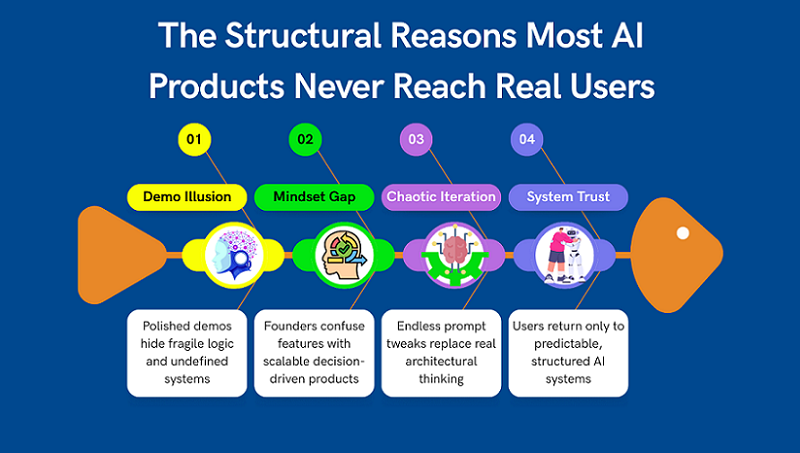
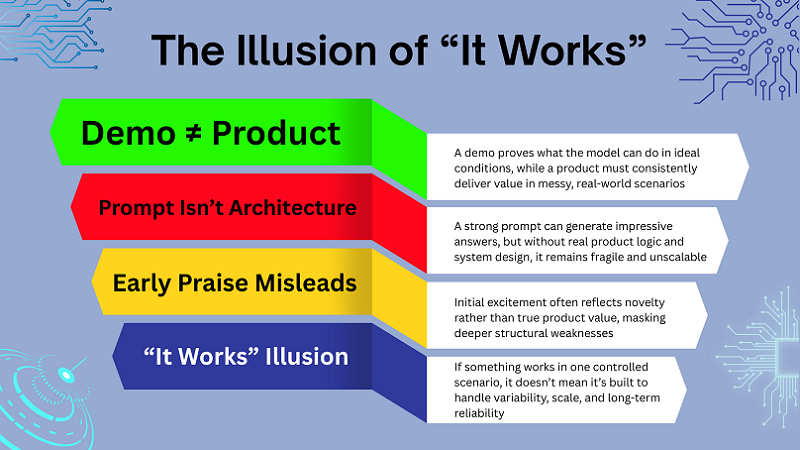
Most AI projects fail not at the scaling stage, but much earlier—when a demo is mistaken for a product. A demo demonstrates what the model can do, but the product is responsible for delivering consistent user experiences. These are fundamentally different things, yet they are often confused.

In a demo, everything works under ideal conditions: one scenario, one type of request, minimal context. In reality, users act chaotically, ask questions incorrectly, and expect predictable results.

When there’s no system in place, any deviation from the “ideal case” begins to break the product. And instead of scaling, the founder begins endlessly fixing prompts.

The problem is compounded by the fact that a demo is easy to sell to oneself. It looks smart, provides attractive answers, and creates the illusion of readiness. But it’s precisely this illusion that most often kills a product.

In this section, we’ll explore the line between a demo and a product and why it’s so important to recognize it as early as possible.

A Prompt Is Not a Product

One of the most common mistakes is thinking that a good prompt is already a product. Yes, a well-thought-out prompt can provide impressive answers, especially at the start. But at its core, it’s just an instruction for a model, not product logic.

A prompt doesn’t make decisions, doesn’t manage context, and doesn’t understand the user’s goal. It simply reacts to input. As soon as the scenario becomes more complex, the prompt begins to crumble.

A real product knows what it does, why it does it, and what state the user is in. If everything rests on one big prompt, the system becomes fragile and unpredictable. This is why products built solely on prompts don’t scale well and require constant manual intervention. This isn’t architecture—it’s a temporary construct.

Why Early Praise Is Misleading

Almost every AI founder has encountered this: early users say the product is “really cool.” It’s nice, but dangerous. Early feedback often evaluates the quality of responses rather than the product’s value.

People are impressed that the AI understands anything at all and responds coherently. But that doesn’t mean they’re ready to use the product regularly or pay for it.

This kind of feedback rarely reveals where the system breaks down in real-world use. It doesn’t identify problems with logic, context, or repeatability.

As a result, the founder begins to optimize what they already like and ignores structural weaknesses. These only surface later, when fixing them becomes expensive.

When “It Works” Actually Means “It Breaks Later”

In AI products, the phrase “everything works for me” almost always means “it works in one scenario.” This is the most dangerous point, as it creates a false sense of readiness.

As soon as new user types, different goals, or non-standard requests appear, the system begins to behave unpredictably. Responses contradict each other, logic is lost, and trust declines.

The problem isn’t with the model or the API. The problem is that the product wasn’t designed to handle variability.

Scaling in this case doesn’t break the product—it simply reveals the errors inherent in the very beginning. And that’s why it’s so important to distinguish between “it works now” and “it could work stably.”
2. Solving Abstract Ideas Instead of Concrete Problems

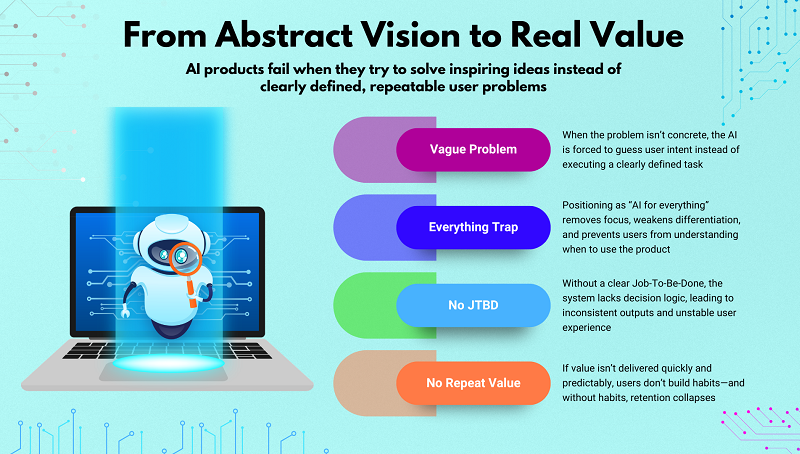
One of the key reasons AI products fail to reach real users is the attempt to solve an abstract idea instead of a concrete task. Founders often start with an inspiring description but not a clear problem statement. Under these conditions, the AI is forced to “guess” what is expected of it rather than perform a specific task.

At the start, this may seem normal, especially if the initial model responses are impressive. But as usage increases, inconsistencies, contradictions, and instability begin to emerge. The user perceives this as a “raw” product, even if they can’t explain why.

Abstract formulations don’t provide the system with a basis for decision-making. As a result, the product doesn’t scale and doesn’t become part of the user’s daily workflow. This is where many AI projects lose their chance to move from experimentation to production.

“AI That Helps With Everything” Trap

The promise of “AI that helps with everything” almost always works against the product. The user doesn’t understand the specific scenario in which the service will be useful. Without a clear focus, the product doesn’t set expectations and doesn’t reinforce behavior.

Such solutions often turn into a one-size-fits-all chat that “can do everything” but doesn’t solve anything well enough.

The user tries it a couple of times and never returns because they don’t see any specific value.

Broad positioning also complicates product development: each new improvement pulls it in a different direction. As a result, the team loses focus, and the system loses stability.

No Clear Job-To-Be-Done

When it’s unclear what work AI performs for the user, the product begins to break down internally. The system doesn’t understand which decisions are a priority and which are secondary. This leads to inconsistent results and unstable behavior.

A clear Job-To-Be-Done defines the framework for logic, context, and UX. Without it, each request becomes a separate experiment. The user is forced to constantly clarify, correct, and monitor the result.

Under such conditions, AI doesn’t reduce the workload; on the contrary, it creates additional work. This quickly destroys trust in the product.

Why Users Don’t Return

Users only return to products where value is felt quickly and repeatably. If the result is different every time, trust doesn’t develop. Even good responses don’t compensate for the lack of consistency.

An abstract task doesn’t allow for a predictable experience. Users can’t integrate the product into their workflow. As a result, the service remains “interesting,” but not essential. When value isn’t cemented into habit, the product loses users even before it reaches the growth stage. The problem here isn’t marketing, but the initial problem.

If you’re at the very beginning and still defining what problem your AI product should solve, start here:
Day 1 — Where to Find Great SaaS Ideas (and How to Vet Them) It walks through how to identify concrete, monetizable problems instead of abstract ideas — and how to validate them before building anything.
3. Building Screens Before Systems

The second common mistake is starting with the interface, not the system. Many AI products look beautiful, but lack clear logic underneath. This is especially common in no-code environments, where screens are assembled faster than product decisions are made.

Focusing on the UI creates the illusion of progress. The product seems almost ready because it has buttons, forms, and scenarios. But beneath the surface, a lack of structure lurks.

When the user begins using the product in real-world conditions, the system can’t handle the load. Errors appear suddenly and are difficult to fix without reworking the entire logic. As a result, a beautiful interface becomes a mask for a fragile product.

UI-First Thinking in No-Code Tools

No-code tools simplify interface creation, but they increase the focus on screens. Founders begin to think in terms of “page,” “form,” and “button” rather than “decision” and “logic.”

This leads to the product being designed as a set of screens rather than as a decision-making system. In this approach, AI is simply inserted into the UI, without understanding its role.

As a result, the system becomes dependent on the interface, not vice versa. Any change to the flow requires manual edits and complicates product development.

When UX Hides Broken Logic

Good design can temporarily hide problems in logic. The user feels the product is “beautiful,” but over time, they begin to notice strange behavior. Responses contradict each other, the system forgets the context, and decisions appear random.

In the early stages, this is often attributed to “AI quirks.” But the real problem is the lack of a clear structure. UX can’t compensate for a weak system.

When logic breaks down, no interface can save the user’s trust. They simply stop using the product.

Why Systems Scale, Screens Don’t

Interfaces don’t scale on their own. Only the logic behind them scales. If the system understands what to do and why, the interface can be changed painlessly.

When logic is hardwired into screens, every change becomes a risk. The product becomes fragile and poorly adapts to growth.

This is why sustainable AI products are built as systems, with the interface merely as a way to interact with them. This is the fundamental difference between a demo and a real product.

If you’re trying to understand what it actually means to build AI as a system — not just a set of prompts behind a UI — this is explored in depth in How to Build Scalable AI Products Without Code (Using ChatGPT as the Core Layer).

It breaks down how to structure decision logic, context layers, and product architecture so the system stays stable even as usage grows.

4. Ignoring Context as a Core Product Layer

One of the most underestimated reasons for the failure of AI products is ignoring context as a fully-fledged product layer. Many founders consider context to be secondary: “we’ll add memory later,” “this can be solved with a prompt.” In practice, it is context that determines whether a product feels intelligent or useless.

When AI starts from scratch every time, the product loses consistency, predictability, and trust. The user is forced to repeat the same things, clarify goals, and correct answers. This may be unnoticeable in early demos, but in real use, the problem immediately becomes apparent.

Context is not a technical detail, but product logic: what the system knows about the user, the process, and the current state of the task. Without it, AI remains a response generator, not part of the service. This is precisely why products without context rarely reach regular use. They may impress, but they don’t retain users.

Treating Every Request as Isolated

When each request is treated as a separate event, the AI loses the sense of continuity. The product doesn’t “understand” what came before and doesn’t know where to lead the user next. As a result, responses may be formally correct, but contextually useless.

The user feels like they’re interacting not with the system, but with disjointed responses. This undermines the sense of intelligence and reduces the product’s value after just a few sessions. This approach may work in tests, but quickly breaks down in a real-world scenario.

Isolated requests are a quick path to frustration because the product doesn’t evolve with the user. It simply reacts, but doesn’t support it.

What Users Expect the Product to Remember

Users don’t think in terms of “memory” or “state.” They simply expect the product to remember their goal, previous steps, and constraints. This is a basic expectation shaped by other digital services.

When AI forgets what the user has already explained or selected, a sense of chaos ensues. People have to waste time repeating themselves instead of moving forward. In SaaS products, this is perceived as poor UX, not an “AI feature.”

Context allows a product to be consistent, not just clever in its own words. This is why memory is not a feature, but a foundation.

Context Loss as a Trust Killer

Trust in an AI product is built on the feeling that the system understands the user. When context is lost, this trust vanishes instantly. Even one glitch can call the entire product into question.

The user begins to double-check answers, doubt recommendations, and spend more time than it saves. At this point, the product ceases to be a helper.

The most dangerous thing is that such glitches are perceived not as bugs, but as the product’s “stupidity.” And regaining trust after this is extremely difficult.

5. Confusing Generation With Real Value

Many AI products get stuck at the content generation level, mistaking it for the ultimate value. Texts, lists, and answers look impressive, but they don’t necessarily solve the user’s problem. This is the key mistake that prevents products from moving from interest to utility.

The user isn’t interested in the generation itself, but in the result: the decision, the choice, the next step. When a product simply “writes,” it shifts the bulk of the work onto humans. As a result, AI increases the volume of information without reducing the workload.

Real value arises when a product takes on some of the thinking. Without this, AI remains a tool, not a service. This is why generation without logic rarely leads to user retention.

Content ≠ Outcome

A well-written text doesn’t equal a solved problem. The user may receive the perfect answer but still be confused about what to do next. This creates the illusion of help without any real results.

AI founders often confuse the quality of generation with the value of a product. But in real life, it’s not the text that’s valued, but the action or decision it leads to.

If a product doesn’t lead the user to a result, it remains informational noise, albeit a beautiful one.

No Decision-Making Inside the Product

When AI doesn’t make decisions, it doesn’t take responsibility. It merely suggests options, leaving the entire cognitive load to the user. This approach quickly becomes tiring.

Product value emerges when the system itself selects, filters, and recommends. This isn’t about control, but about assistance.

Without integrated decision-making, AI remains an assistant, not a service. And assistants rarely become products worth paying for.

Why Users Feel Overloaded Instead of Helped

Paradoxically, many AI products actually make users more tired. Instead of saving time, they add new layers of choice and analysis.

When a product presents too many options without clear logic, it shifts the thinking onto humans. The user feels like they’re working in the system’s stead.

True help is simplification. If AI doesn’t do this, the product loses its meaning, even if it generates excellent solutions.

6. Avoiding Real Users for Too Long

One of the most common, yet rarely acknowledged, reasons for AI product failure is avoiding real users. Many teams spend years tinkering with a product, believing it’s not ready for release. As a result, the product exists only in the founder’s mind and in closed demos.

The problem is that without contact with reality, an AI system doesn’t receive the feedback it needs to grow. Errors go unnoticed, hypotheses go untested, and confidence in the product is built on assumptions.

This is especially dangerous for AI products, where system behavior only manifests itself in a variety of real-world scenarios. The longer the product is isolated from users, the more painful the launch moment is. And the higher the chance that users simply won’t see the value.

The “Not Ready Yet” Syndrome

The “not ready yet” syndrome seems rational, but in practice, it’s destructive. The founder convinces themselves that the logic, interface, or AI responses need some more refinement. In reality, this is often a fear of receiving negative feedback.

AI products don’t become “ready” in a vacuum. They only become sustainable through use. Every delayed release is a lost opportunity to uncover real problems.

As a result, the product either never launches or launches too late, when energy and focus have already been lost.

Building in Isolation

When a product is created without users, it develops in a closed system. All decisions are made based on assumptions, not behavior. This is especially dangerous for AI services, where the nuances of use are everything.

A founder may be confident that the product is logical and useful, but users think differently. Without real use cases, the system is optimized for an imaginary user.

As a result, upon first contact with the market, it turns out that the product solves the wrong problem or does so in an inconvenient way.

Why No-Code Doesn’t Remove This Fear

No-code lowers the technical barrier, but it doesn’t remove the psychological one. The ability to quickly build a product doesn’t mean you’re ready to share it with the world.

Many founders continue to endlessly “improve” the product, even when technical limitations are removed. The fear of evaluation remains the same.

Therefore, no-code is a tool for acceleration, but not a substitute for determination. Real progress begins only with the first users, not with the next update.

7. Scaling Before the Product Is Ready

Attempts to scale an AI product before it’s stable almost always end in failure. Growth amplifies everything: both strengths and weaknesses. If the system is unstable, scaling only accelerates decay.

Many founders begin thinking about metrics, automation, and growth without ensuring the product behaves predictably. As a result, problems that could have been fixed early on turn into systemic failures.

AI products are especially sensitive to this because their behavior depends on context, logic, and decisions. If these layers aren’t in place, growth becomes dangerous.

Premature Automation

Automating weak logic doesn’t make a product stronger—it makes problems happen faster. AI starts making mistakes more frequently, but on a larger scale.

Founders often automate processes that haven’t yet proven their resilience. As a result, the product loses flexibility and becomes more difficult to fix.

The right approach is to first ensure that the logic works in manual or semi-automated mode and only then scale.

Metrics Without Product Stability

Metrics can create the illusion of control. Increased traffic, requests, or sessions don’t mean the product is working properly.

If system behavior is unstable, the numbers only hide the real problems. Users may come, but they won’t stay.

Without robust product logic, analytics becomes noise, not a decision-making tool.

When Growth Exposes Structural Flaws

Growth doesn’t break a product—it reveals what’s already broken. Errors in logic, context, or decision-making become apparent precisely when the load increases.

What worked for ten users can completely fall apart for a hundred. And that’s okay—if you’re prepared.

The problem arises when growth starts too early, and the team doesn’t understand what exactly needs to be fixed.

Final Thoughts — AI Products Fail Because of Thinking, Not Technology

Most AI products fail to reach real users not because of models, APIs, or a lack of code. They fail much earlier — at the thinking level.

Founders confuse demos with products, generation with value, and interfaces with systems. They avoid users, fear the release, and try to scale before the product is sustainable.

AI products require a different approach: systemic, consistent, and solution-oriented, not answer-oriented.

The context, logic, and responsibility of the system are more important than any prompts or UI effects.

A real product begins when AI takes over some of the thinking, not just writing text.

This is what distinguishes a service that is used from a tool that is quickly forgotten.

Understanding these mistakes is the first step to creating a sustainable AI product.

The solutions to these mistakes are discussed in detail in the pillar article on scalable, no-code AI products.
designing-and-building-ai-products

Designing and Building AI Products and Services — From UX to System Architecture

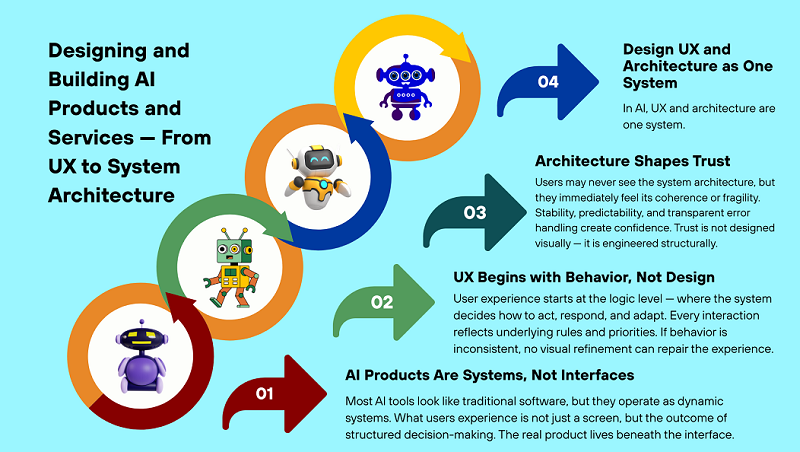
Designing and Building AI Products and Services is not about adding a model to a clean interface. It’s about creating systems that behave predictably, make decisions consistently, and deliver value beyond a single response. Many AI products look polished on the surface — they generate text, answer questions, or analyze data — but they fail to give users the feeling of interacting with a coherent system. The reason is simple: they’re designed as interfaces, not as behaviors.

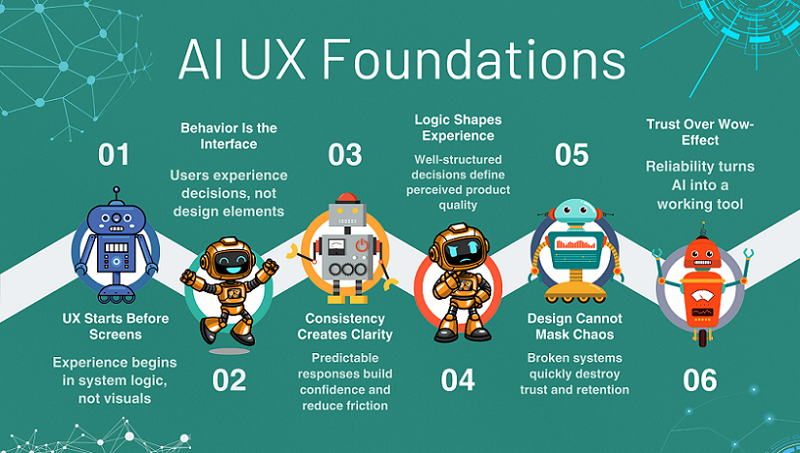
In AI products, UX begins long before the first screen or button. It’s shaped by how the system makes decisions, how it handles errors, and how it behaves in unusual scenarios. Users may never see the architecture, but they always feel its presence. This is why beautiful screens rarely save a product built on unstable logic.

In this article, we’ll explore how Designing and Building AI Products and Services requires treating UX and system architecture as a unified discipline — not at the code level, but at the level of structure, decision flows, and product behavior.

This perspective is especially critical in no-code and low-code environments, where architectural weaknesses surface quickly. We’ll examine where UX truly begins, why design alone can’t fix a broken system, and how to build AI experiences that inspire long-term trust.

1. Designing and Building AI Products and Services: Why UX Starts Before the Interface

In AI products, the user experience doesn’t begin with a login screen or dashboard. Designing and Building AI Products and Services always starts with how the system thinks, reasons, and acts before the interface ever exists. It begins with how the system thinks and acts. The user may not understand how the AI works internally, but they immediately sense chaos or structure. If the system’s behavior is unpredictable, no design will save the situation.

UX in AI is primarily about consistency, logic, and explainability. That’s why the interface is only the final layer, not the starting point. Trying to “finish the UX” after the logic has already been broken is a mistake.

In this section, we’ll explore why UX in AI is product architecture, not visual style. And why UX development should begin long before prototypes and mockups.

UX in AI Products Is System Behavior, Not Visual Design

In classic products, UX is often associated with visuals, but this thinking doesn’t apply to AI systems. Users interact not with screens, but with the system’s behavior. They experience UX in how the AI responds to input, how it interprets context, and what decisions it makes. If a system responds one way today and another tomorrow without explanation, the UX is considered poor. Even with perfect design. Good UX in AI is predictability without a sense of rigidity. It’s when the user understands what to expect from the product. Therefore, UX in AI is the result of well-designed logic, not a well-designed UI. Design merely visualizes an already-adopted system decision. If decisions are chaotic, the UX will be the same.

Why Good UX Can’t Fix a Broken AI System

A beautiful interface is often used as a mask for weak logic. This may work for the first few users, but only briefly. When the AI starts making mistakes, getting confused, or giving inconsistent answers, the UX collapses instantly. The user loses trust in the product, even if they like the design. This is because UX can’t compensate for the lack of a decision-making system. If the product doesn’t understand the user’s goal, the interface won’t save it. In AI products, UX is a consequence of the architecture, not the other way around. This is why many projects look “good” but fail to retain users. This is one of the key reasons why AI products fail to reach real users and die early on.

Designing UX for Trust, Not Wow-Effect

In AI products, the main currency isn’t the wow factor, but trust. Users may be surprised once, but they’ll only use what they trust. Wow-effect responses often look impressive, but they’re unstable. And instability ruins UX faster than anything else. Good UX in AI is when the system explains its behavior through actions, not lengthy prompts. Users should feel like the product understands their task. UX should reduce cognitive load, not add to it. This is achieved not by animations, but by the structure of solutions. When users see logic, even errors are more easily accepted. This is how UX transforms from a show into a working tool.

2. From User Actions to Product Logic

In AI products, there’s always a layer of interpretation between a user’s action and the result. This layer is often underestimated, even though Designing and Building AI Products and Services depends on how well intent is separated from interface actions.

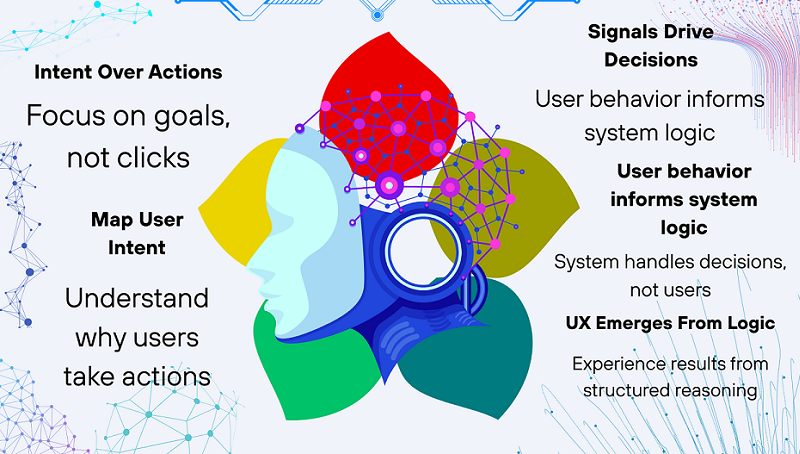
The user clicks a button, enters text, or loads data, but the product doesn’t care about that. It’s important to understand why they’re doing it. This is where most products start to break down, because they continue to think in terms of screens and scenarios. This is acceptable in classic UX, but not in AI. An AI product must work with intent, not clicks. When logic is built around actions, the system becomes fragile and doesn’t scale well. When logic is built around meaning, the product begins to behave like a system.

This section shows how to move from superficial UX thinking to product logic. Without delving into architecture, but with a clear understanding of the system’s responsibilities. This is the foundation for predictable AI behavior. And this is where UX becomes a product.

Mapping User Intent When Designing AI Products and Services

In traditional products, user flows describe the user’s journey through screens. In AI products, this approach quickly becomes unworkable. Users can reach the same goal in different ways, and the system must understand this. Therefore, instead of click flows, it’s important to model intent. Intent is not an action, but the goal behind it. When a product understands intent, it can adapt behavior without changing the interface. This makes the system flexible and resilient. In this approach, UX becomes a consequence of logic, not its source. The user feels that the product “understands” them, even if they act unconventionally. It is intent-based thinking that allows AI products to appear smarter than they actually are. And this is a direct bridge to systems thinking.

Translating UX Signals Into System Decisions

Every user action is a signal, not a command. Entering text, repeating a request, or correcting a result carries context. The task of an AI system is to correctly interpret this context. The mistake many products make is that they react to the interface rather than the meaning of what’s happening. AI shouldn’t “see a button”; it should understand the situation. When UX signals are transformed into system decisions, the product becomes alive. It begins to adjust behavior, not simply follow instructions. This reduces errors and repeated requests. The user experiences it as a smooth and logical experience. This approach prepares the product for growth without complicating the UX. And this is where architectural thinking begins, without technical overload.

Where UX Ends and System Responsibility Begins

One of the most common mistakes is shifting logic to the user. When a product requires “formulating a request correctly,” the UX is already broken. The interface should collect signals, not make decisions. Decisions are the responsibility of the system. When the boundary is blurred, the product becomes tedious and unpredictable. The user begins to adapt to the AI, not the other way around. A good AI product internalizes complexity and externalizes simplicity. UX ends where decision making begins. Everything related to interpretation, context, and action selection must be internal to the system. This is directly related to the idea that a product is a chain of decisions, not a set of functions. And this is what distinguishes a product from a tool.

3. From UX Thinking to AI Product Logic

In AI products, the user journey can’t be viewed as a series of clicks. Designing and Building AI Products and Services requires shifting from interface-driven flows to intent-driven logic. Actions are simply external signals, always based on intent. When a product responds solely to the interface, it quickly hits the limit of its logic. This is why many AI services appear smart in demos but break down in real-world use.

For a product to be robust, it must understand what the user is trying to solve, not just what they clicked. This is where UX begins to seamlessly transition into product logic. This is the point where design ceases to be visual and becomes semantic. An AI product begins to behave like a system, not a form with buttons. This approach simplifies product development without rewriting the entire UX. And this is where the foundation for codeless architectural thinking is laid.

Intent-Based Design in AI Products and Services

Traditional user flows describe the user’s journey through screens. In AI products, this approach quickly breaks down because users act nonlinearly. The same intent can be expressed in different ways. If the system doesn’t understand this, the product begins to feel “dumb.” An intent-based approach shifts the focus from the path to the goal. AI begins to address the user’s task, not their behavior in the interface. This makes the product more flexible and resilient to non-standard scenarios. The user feels understood by the system, even if their request is not perfectly formulated. This approach directly leads to systems thinking.

Translating UX Signals Into System Decisions

Every user action is a signal, not an instruction. Repeating a request, correcting a result, or pausing between actions carries meaning. The task of an AI product is to transform these signals into decisions. When a system responds only to UI events, it loses context. In strong products, AI responds to the situation, not the button. This reduces errors and increases the product’s perceived intelligence. The user doesn’t have to think about logic—they simply see that the product is behaving appropriately. This approach prepares the product for growth without complicating the interface.

Where UX Ends and System Responsibility Begins

One of the key mistakes is forcing the user to compensate for a weak system. When UX requires “asking the right question,” this is a signal of a problem. The interface should collect input, not make decisions. All complex interpretations should occur within the system. If the boundary is blurred, the product becomes tedious. The user begins to adapt to the AI, not the other way around. A good AI product hides complexity rather than exposes it. This is where the idea that a product is a chain of decisions, not a set of screens, comes into play.

4. Designing and Building AI Product Architecture Without Code

AI product architecture is often perceived as something technical and intimidating. In reality, Designing and Building AI Products and Services in a no-code context is primarily about logic, decisions, and structure — not technology. In fact, in a no-code context, architecture is about logic, not technology. It’s a way to organize thinking about the product.

A good architecture answers the question “what’s going on underneath the hood,” even without code. It defines how the product makes decisions and responds to the user. Without architecture, an AI product turns into a set of disconnected prompts. With architecture, it becomes a system that can evolve. It’s important to understand this before choosing tools. Then, no-code becomes an accelerator, not a constraint. This block helps alleviate the fear of the word “architecture” and prepares for a deeper dive into the pillars.

What “Architecture” Means in No-Code AI Products

In no-code AI products, architecture isn’t diagrams and servers. It’s a decision-making structure. Architecture is responsible for when, why, and how the system acts. It resides in logic, not in tools. Even the simplest AI product already has an architecture—the only question is whether it’s conscious or not. When the architecture is well-thought-out, the product is easier to improve. Without it, any change breaks its behavior. This approach allows for systemic thinking without technical overload.

Input, Context, Processing, Output as a Core Model

Any AI product can be broken down into four parts: input, context, processing, and output. Input isn’t just text, but everything the system receives. Context is what helps interpret this input. Processing is the decision-making logic within the product. Output isn’t text, but a useful result for the user. This model is simple yet universal. It’s suitable for any no-code AI product. Understanding this framework immediately simplifies thinking about the product.

Why Tools Don’t Define Architecture

Choosing a platform is the most overrated step in no-code AI. Tools don’t define the architecture, they merely implement it. Without clear logic, even the best service won’t save the product. Architecture lives in solutions, not in settings. When the logic is clear, tools are easy to change. When there’s no logic, changing platforms is useless. This section helps the reader avoid getting stuck in comparing services and focus on what truly impacts the quality of the product. This approach is what distinguishes a product founder from a “tool hoarder.”

5. Designing Context as a Core Layer of AI Products and Service

In most AI products, context is perceived as an auxiliary detail rather than a separate product layer. Because of this, the system appears intelligent only within the context of a single request. As soon as the user steps outside the context, the logic falls apart.

Context is what connects past actions, the current goal, and the expected outcome. Without it, AI responds formally rather than meaningfully. This is why UX can be cluttered, but the experience can be frustrating. When context is designed correctly, the product begins to behave consistently. The user feels that the system is “in the know,” rather than starting over every time. This layer is rarely visible, but it directly impacts trust. Context is not memory for memory’s sake, but a decision-making tool. And in mature AI products, it becomes a fully-fledged part of the architecture.

Context Is the Missing Layer Between UX and AI

Context is the bridge between what the user does and how the system responds. UX collects signals, AI processes data, but without context, a gap arises. As a result, the product behaves inconsistently. The user expects logic, but receives random responses. Context allows AI to understand the situation, not just a single request. This is where UX thinking and systems logic merge. This approach fits well with step-by-step product development, where meaning emerges first, and automation follows. Without this layer, even the most careful no-code product quickly hits a ceiling.

What the System Must Remember to Feel Intelligent

For a product to feel intelligent, it must remember the right things, not just everything. First and foremost, the user’s goal. Then, the constraints within which this goal must be achieved. The current state is also important: what has already been done and what is expected next. All this creates a sense of continuity. The user doesn’t have to verbalize it, but they immediately feel the difference. When the system “remembers” the context, interaction becomes smooth. AI ceases to be seen as a tool and begins to be perceived as a service. This directly increases trust and reduces frustration.

How Poor Context Design Breaks UX

The most common mistake is treating every request as the first. This leads to contradictory responses. The user is forced to repeat the same thing in different words. The product’s logic falls apart, even if the model is strong. On the surface, this looks like “stupid AI.” In reality, the problem isn’t with intelligence, but with structure. Poor context breaks UX faster than a bad interface. Users leave not because of the design, but because of the feeling of chaos. And this is fixed not by prompts, but by architectural solutions.

6. Decision-Making as the Core of AI Services

The true value of an AI service is not in text generation, but in decision making. This is a central principle when Designing and Building AI Products and Services that aim to behave like real services rather than smart tools. When a product decides for the user, it saves time and reduces workload. If AI only generates options, the user is left alone with the problem. That’s why decision-making is only the basic level.

Decisions shape the product logic. They determine what to show, what to hide, and how to respond to errors. Both the UX and the architecture depend on decisions. When decisions are unclear, the product appears chaotic. When they are clear, the system scales without complicating the interface. This is the core of AI services.

AI as a Decision Engine, Not a Generator

Generation is a means, not an end. The user cares about the result, not the answer itself. When AI makes decisions, it relieves the user of some responsibility. This creates the feeling of a service, not a tool. Decisions can be simple, but they must be consistent. They shape the product’s behavior. This approach directly supports scalability. The less the user thinks about “how,” the higher the product’s value. And the closer the AI service is to a real product.

What Decisions Should Be Automated First

Not all decisions should be immediately delegated to AI. Repetitive and predictable choices are automated first—those where error isn’t critical, but the time savings are significant. Complex and risky decisions are best left under user control. This approach reduces stress and builds trust. The product doesn’t try to be smarter than necessary. It helps where it’s truly useful. This is a product strategy, not a technical limitation. And it’s precisely this that protects the system from overload.

How Decisions Shape Both UX and Architecture

Every decision made by AI impacts two layers at once. UX – through what the user sees and feels. Architecture – through processing logic and context. If decisions are well-thought-out, the interface becomes simpler. If not, UX begins to compensate for a weak system. Architecture always follows decision logic, not the other way around. Therefore, design without understanding decisions is doomed. In strong AI products, decisions are defined first, and screens are created second. This is what distinguishes a service from a set of features.

7. Connecting UX, Architecture, and Scale

At this stage, it’s important to bring everything we’ve discussed so far together into a single picture. UX, architecture, and scale are not different stages of a product’s lifespan, but interconnected layers of a single system. In AI products, they are especially closely intertwined because the system’s behavior is directly experienced by the user.

Problems arise when these layers develop out of sync: UX is improved without changing the logic; architecture is complicated without considering the user experience. While this may be subtle at first, as users grow, such gaps quickly devolve into systemic chaos.

A well-designed AI product considers scale at the design level, not at the infrastructure level. It’s not about load or servers, but whether the product’s logic can withstand changing scenarios, behaviors, and user expectations. In this section, we’ll explore why the UX + architecture pairing is key to sustainability, how to design a system with room for change, and when it’s time to stop “designing” and start testing the product with real people.

Why Products Break When UX and Architecture Drift Apart

One of the most common reasons for AI product failure is when the UX takes on a life of its own, while the system does its own. The interface is improved, simplified, and new scenarios are added, but the underlying logic remains the same.

As a result, the user perceives the product as having become “smarter,” but the system is unprepared to support this behavior. The AI begins to respond inconsistently, becomes confused, and loses context.

Such problems are rarely noticeable in the early stages because users are few and scenarios are predictable. But as the product grows, any discrepancy between the UX promise and the system’s reality becomes critical.

The product becomes unreliable, and the team begins patching holes instead of developing. This is why UX and architecture should be designed as a unified whole, not as independent layers.

Designing for Change Without Rebuilding Everything

Change is an inevitable part of any AI product’s life. Users evolve, scenarios become more complex, and quality requirements increase. The problem isn’t the changes themselves, but how the system prepares for them.

If the architecture is tied to specific screens, prompts, or tools, any change turns into a rewrite of the entire product. This is expensive, slow, and demotivating.

A flexible system is designed around decisions, context, and logic, not implementation. Then you can change the UX, add new scenarios, or improve AI behavior without breaking the foundation.

This approach allows the product to evolve gradually, rather than through painful “relaunches.” It’s a direct bridge to scalability.

When to Stop Designing and Start Testing with Users

There comes a point when further design stops being useful. The logic is established, the system is clear, the UX is well thought out — and then comes the realm of hypotheses.

Many founders get stuck here, endlessly refining the design instead of testing it with real users. But AI products cannot be perfected in theory.

Only real-world use reveals where the system behaves unexpectedly, which decisions are unnecessary, and which are missing. This is where weaknesses in context, logic, and UX are identified.

But testing is not only about interface or behavior — it’s about validating the core idea behind the product. If the initial problem is weak, no amount of architectural clarity will save it.

If you’re still shaping your product direction, start with the fundamentals. Our free lesson — Day 1 — Where to Find Great SaaS Ideas (and How to Vet Them) — walks through how to systematically discover SaaS opportunities, evaluate real demand, and avoid building technically impressive systems that nobody actually needs.

Early testing doesn’t mean scaling. It’s a way to ensure that the system can, in principle, withstand life beyond your imagination. And it’s this step that separates a product from a concept.

Final Thoughts

AI products don’t break suddenly. They break gradually — due to decisions made too early or too superficially. In most cases, the failure has little to do with models or tools, and everything to do with how Designing and Building AI Products and Services was approached from the start.

UX without logic creates the illusion of convenience. Architecture without user insight creates the illusion of reliability. AI without solutions creates the illusion of intelligence. And all these illusions work only until the first serious use.

Good AI products feel simple on the outside and thoughtful on the inside. The user doesn’t see the architecture, but they feel it through stability, predictability, and trust. This is true UX in AI services.

It’s important to understand: no-code doesn’t free you from thinking. It only removes technical noise, leaving you alone with the product logic. And this is where many projects stumble.

If you’ve read this far, it means you’re already thinking about the product more deeply than most. The next step is to understand how all of this can be turned into a scalable system that can grow without constant rework.

If you want to go deeper into how to turn this architectural thinking into a practical, scalable no-code system, explore our complete guide on how to build scalable AI products without code. There we break down the exact structural principles, system layers, and product decisions that allow AI services to grow without collapsing under complexity.