

Selecting a domain name is one of the earliest decisions you’ll make when starting an AI SaaS project, and it has a direct impact on everything that follows.
A domain name shapes how users perceive your product, influences their level of trust, and can also affect how your website performs in search results.
Picking a domain shouldn’t be a random decision — it plays a key role in establishing credibility, defining your SaaS positioning, and supporting long-term brand growth.
Below, we’ll break down how to select the right domain and highlight the key factors worth considering.
1. Short and Memorable Domain for AI SaaS Project
Instead of relying heavily on domain name generators, take time to clearly define what your brand stands for. A strong domain grows from a solid understanding of your product, values, and audience. This approach helps create a business that’s not only recognizable, but also sustainable. Ultimately, the best domain choice comes from your own strategic thinking.
Start by writing down around 30 potential domain names that could fit your project. Then, remove any options that don’t clearly match your product’s concept or tone. This filtering process should leave you with a short list of 5–7 domains that feel credible and professional to your future customers.
Another effective approach is to research existing websites that operate in a similar niche to your future AI SaaS project by using Google search.
Let’s say you’re creating an SEO-related platform, and the domain surferseo.com is already taken, so you create a variant based on it.
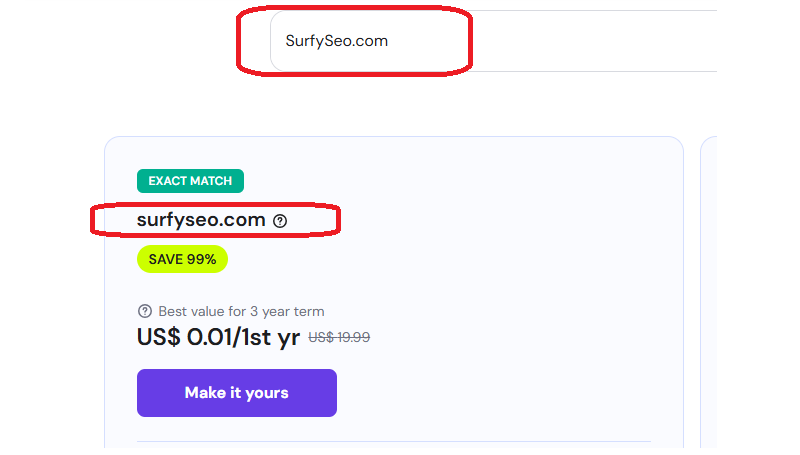
In other words, rather than copying domain names already in use by other companies, focus on crafting original domains that stand out and leave a lasting impression on your clients.
In practice, domain choices rarely work in isolation. They are a continuation of much earlier decisions—how the product idea was formed, what problem it solves, and who it’s built for. If that foundation is still taking shape, it makes sense to start from the very beginning of the SaaS journey in Day 1 — Where to Find Great SaaS Ideas (and how to vet them).
2. The Psychology Behind AI-Powered SaaS Brands
If you’re starting your own online store, you should choose a domain name based on creative logic. However, if you’re choosing a name for an AI or SaaS project, you’ll be guided by the clarity of the domain name and your reputation as an online entrepreneur.
In other words, you need a domain that enhances the value of the product you’re bringing to the market. A domain name for an AI or SaaS project should sound convincing to investors. Once you’ve answered these questions, your domain is strong.
Think about the words that best reflect your brand’s essence. Terms like “Agent,” “Suite,” “Brain,” “Vision,” or “Score” can instantly evoke ideas related to intelligence, analytics, and AI functionality. By thoughtfully merging two meaningful words, you can create a domain that feels both memorable and authoritative. Names like “BrainFlow” or “LogicAI” already convey strength and perfectly suit the AI SaaS niche.
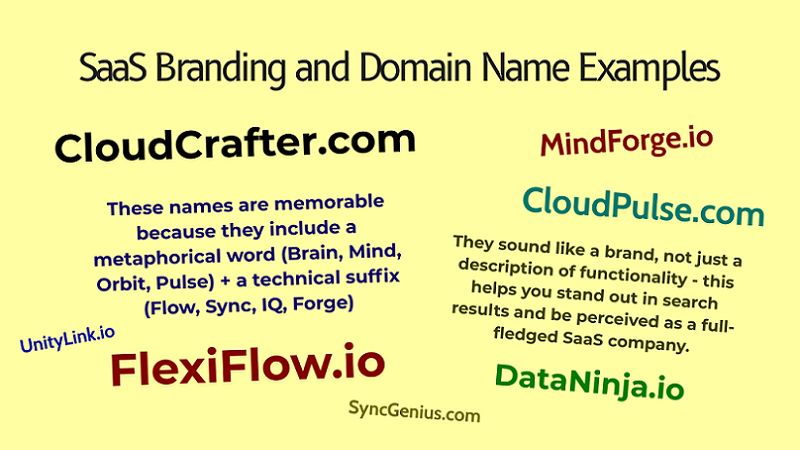
Once you have a clear picture of your customers’ mindset and a solid understanding of your AI SaaS product, picking the right domain becomes much simpler. You’ll naturally envision the ideal brand identity, making it easier to create a domain that is unique, memorable, and perfectly aligned with your product.
3. What Makes an AI SaaS Domain Valuable?
Choosing the right domain for your AI SaaS project is more than just a creative exercise. Many founders get caught up in trying to make their domain short, catchy, or easy to read, while losing sight of the bigger picture: branding and long-term positioning. This can lead to confusion and missed opportunities.
The true impact of your domain lies in three critical areas:
a) Communicate Your Product’s Core Function Clearly
A domain is most effective when it immediately tells users what your AI-powered SaaS does. Whether your software automates workflows, performs risk analysis, processes data, or supports decision-making, a clear domain helps your audience understand your product at a glance. When the domain aligns with your software’s core functions, adoption becomes easier, and your brand gains credibility faster.
b) Convey Competence, Not Emotion
Avoid letting personal feelings or abstract ideas dictate your domain choice. Instead, focus on projecting professionalism and trust. Strong SaaS domains communicate logic, reliability, and expertise—qualities that inspire confidence in prospective users and investors alike. Abstract or overly playful names may be memorable, but they risk undermining your authority in a competitive AI SaaS market.
c) Ensure Scalability and Long-Term Fit
Your domain should grow with your product. Consider whether it can accommodate future features, expansions, or changes in your AI SaaS offering. A scalable, versatile domain appeals to a broader audience and supports long-term branding. Conversely, a domain that is too narrow or limiting can restrict your product’s potential and make future growth more challenging.
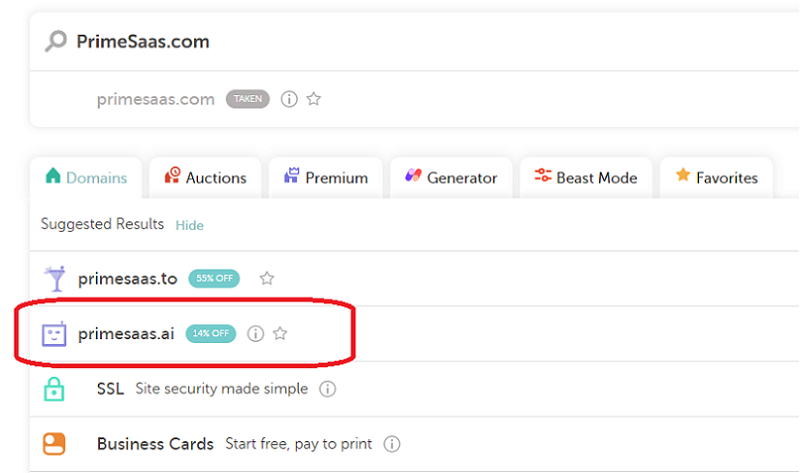
For example, if we take the domain names PrimeSaas.ai and InvoiceSoft.ai, the former will have very high scalability, and to an investor, it will look like a universal, large brand. If we take the InvoiceSoft.ai domain, it has medium-low scalability and a narrow, financially constrained niche.
4. Categories of Domains Determining Demand for AI and Saas
When choosing a domain for your AI SaaS project, it’s important to consider the product’s functionality rather than just keywords. Domains that clearly reflect the AI service type tend to be more memorable, scalable, and attractive to both customers and investors. Below is a structured overview of key domain categories in the AI SaaS space.
a) Autonomous Agent Domains
These domains represent AI that acts as a self-sufficient agent performing user tasks, such as automated content creation, email and communication management, task planning, and workflow automation. Examples include TaskAI.io, AgentSaaS.ai, and AutoBot.ai. High demand exists here, as autonomous agents are a fast growing trend, offering strong scalability potential and investor appeal.
b) Process Automation Domains
Automation domains focus on optimizing workflows without necessarily acting as autonomous agents. Key applications include reporting, data processing, marketing, CRM, and billing. Examples: SmartWorkFlow.ai, SaaSify.ai. Ideal for niche B2B products, these domains can be expanded across related processes, enhancing long-term value.
c) Analytics and Insights Domains
Domains in this category highlight AI SaaS that analyzes data, generates forecasts, and provides actionable insights rather than automated execution. Examples include InsightAI.io, DataMind.ai, and AnalyticsSaaS.ai. These are particularly attractive to corporate clients and large enterprises, where data-driven decision-making is critical.
d) Verification and Compliance Domains
SaaS AI in this sphere ensures authenticity, security, and regulatory compliance, including document verification, fraud prevention, and identity checks. Domain examples: VerifyAI.io, TrustLayer.ai. These domains have medium-to-high scalability and are especially valuable to banks, financial institutions, and other regulated industries.
e) Data Infrastructure Domains
Domains that reflect AI SaaS focused on data storage, integration, and processing. Applications include data pipelines, lakes, and quality monitoring. Examples: DataOps.ai, CloudAI.io, SmartDB.ai. These domains attract large SaaS enterprises and strategic buyers due to their cross-industry applicability, from finance to marketing and HR.
f) Productivity and Workflow Domains
These domains represent AI that enhances team efficiency and internal workflows, such as smart assistants, document automation, team chatbots, and workflow optimization. Examples: WorkAI.io, FlowSaaS.ai, TaskMind.ai. High scalability and broad industry application make these domains appealing to investors.
g) Developer and API Platform Domains
Focused on SaaS AI that provides SDKs, APIs, or developer tools, enabling integration of AI into web projects. Examples: DevAI.io, APIHab.io, CodeSaaS.ai. This segment is highly expandable into analytics, fintech, gaming, and marketing, attracting startups and investors building AI ecosystems.
h) Customer Experience Domains
Domains for SaaS AI improving customer interactions through chatbots, personalized recommendations, and automated support. Examples: SupportBot.ai, CustomerFlow.ai, AssistAI.io. Demand is high across e-commerce, fintech, education, and SaaS, with ROI easily measurable, making these domains attractive to investors.
i) Retail and E-Commerce Domains
These domains optimize sales, recommendations, pricing, and marketing for online and physical stores. Examples: RetailAI.io, ShopSaaS.ai, SmartStore.ai. They can scale across marketplaces, SaaS trading platforms, and warehouse management, offering high demand potential from online sellers.
j) Professional Corporate Domains
Short, technologically advanced domains that convey reliability and professionalism. Ideal for B2B SaaS and large AI platforms. Examples: PrimeSaaS.ai, DataBridge.ai, FlowSaaS.ai. High demand and scalability make them attractive to corporate clients and investors.
k) Hybrid Functional Domains
Domains combining a product keyword with AI/SaaS/Bot or an industry term with a tech term. These names are clear, moderately formal, and SEO-friendly. Examples: MarketingAI.io, AutoWorkFlow.ai. They balance brand identity with product functionality, offering medium-to-high scalability.
l) Human-Like AI Domains
Domains that sound personal or human, creating an emotional connection with users. Best suited for AI assistants, chatbots, and B2C products. Examples: EvaAI.io, AlexBot.ai. These domains are niche, moderately scalable, and excel in branding, though less impactful for SEO.
5. The Future of AI & SaaS Domains
The future of domains for SaaS projects and AI platforms is being shaped not by hype, but by how quickly the way products are being built is changing. Today, you can launch any startup in literally a week, sometimes a weekend, and a domain is increasingly becoming the first strategic decision, not a formality. In the AI niche, a domain name is increasingly perceived less as just a website address and more as part of the product and brand. This is especially noticeable in micro-SaaS projects, where a domain can immediately provide a top-notch trust framework.
The market is gradually moving away from complex, difficult-to-read names toward short, clear, and easily scalable domains. AI projects no longer need to explain their name—you simply glance at it and read it intuitively. At the same time, the value of domains that aren’t tied to a single function or model is growing. Name flexibility is now more important than specificity.
We are also seeing a trend toward domains that can be used globally, without any linguistic or cultural barriers. AI-SaaS is increasingly being built for a single country or market. This means that domain versatility will likely only increase in value. In the future, a domain for an AI project will become an asset that can be scaled, repositioned, and even sold separately from the product. This is why understanding future trends is crucial even at the naming stage.
6. The Smart Investor’s Guide to High-Potential AI & SaaS Domains
In today’s fast-moving world of AI and SaaS, a domain name isn’t just a web address—it’s a strategic asset. The right domain can increase a startup’s perceived value, attract investors, and support long-term growth. But finding such a domain requires more than speed or luck; it demands understanding the market niche, branding, and emerging trends.
Below, we outline five key principles that savvy investors use to identify domains with genuine potential and lasting value.
a) Secure a Strong Category Before Making a Purchase
Never buy a domain without first evaluating the strength of the niche behind it. A domain that belongs to a growing market automatically benefits from demand momentum, making it more valuable over time. Even outside your own product, such a domain can retain value on the secondary market because it is supported by real industry growth.
b) Use the A.I.R. Framework: Attract, Identify, Retain
A well-chosen domain should work for your brand from the very beginning. The A.I.R. framework helps with this. An effective name attracts attention instantly, is easy to recognize and remember, and clearly reflects what the product does. Most importantly, it creates trust, turning a simple domain into a long-term brand asset rather than just a web address.
c) Choose Domains That Strengthen Brand Identity
Your domain is often the first interaction users and investors have with your startup. Strong domains communicate clarity, confidence, and authority. When a name clearly reflects who you are and what you offer, it becomes easier to build credibility and position your product in a competitive AI SaaS market from day one.
d) Learn from Proven Startups and Market Leaders
Analyzing successful startups provides valuable insight into naming patterns, keyword usage, and branding strategies that actually work. This research helps you understand how your target audience perceives certain terms and allows you to select a domain that feels modern, professional, and aligned with current market expectations.
e) Avoid Short-Term Trends and Gimmicks
Trendy or overly creative domains may look appealing at first, but they rarely age well. Many of them lose relevance as markets evolve. Instead, focus on domain names that are timeless, trustworthy, and flexible enough to grow with your AI SaaS business. Domains built on solid logic and clarity are far more likely to hold long-term value.
By relying on market analysis, brand alignment, and real industry signals—rather than buzzwords or fleeting trends—you increase your chances of choosing a domain that supports sustainable growth and long-term success.
7. How Investors Assess the Real Value of AI & SaaS Domains
The pricing of AI and SaaS domains follows very different rules compared to standard domain names. Value is influenced not only by how short or catchy a name is, but also by the market it serves, the strength of the niche, and its branding potential. A well-positioned domain in a fast-growing category can be worth many times more than a similar name in a less competitive space.
a) Base Value: Clarity, Length, and Ease of Use
Domains that are short, easy to pronounce, and simple to remember form the foundation of any valuation. For SaaS projects, a clean two-word .com domain often starts around the $5,000 range. Strong branding combinations can push this value toward $50,000 or more, especially when investors see clear upside.
b) Category Premium: Demand Drives Price
Market demand plays a major role in pricing. Domains tied to rapidly expanding sectors—such as AI copywriting tools, generative media, automation, fintech, or cybersecurity—often command significantly higher prices. In some cases, niche momentum alone can increase a domain’s value by 150–200% compared to generic alternatives.
c) Brand Strength: Ready for a Startup from Day One
A valuable domain must work as a brand, not just a label. Startup-friendly names that clearly communicate purpose and identity allow companies to launch faster and with more confidence. Premium, highly brandable AI SaaS domains commonly trade in the $30,000 range, and in high-growth scenarios, valuations can exceed $100,000.
d) Comparable Sales and Market Reality
To understand true market value, investors analyze real transactions on platforms such as Sedo and Flippa. Recent sales show that two- or three-word SaaS domains in strong categories typically sell between $5,000 and $50,000. Short, single-word premium domains operate in a different tier, often reaching $50,000 to $200,000 or more.
e) Liquidity and Exit Potential
Domains that can be easily reused, resold, or positioned as a credible startup brand have high liquidity. This perception alone can add 30–50% to the base valuation. Domains lacking resale appeal, even if they sound attractive, tend to remain illiquid and offer little long-term investment value.
f) Investor Shortcut: A Practical Valuation Model
Many investors rely on a simple multiplier-based approach. The base price is adjusted by niche strength, brand quality, and liquidity. Example: Base value: $5,000 / Strong AI category multiplier: 1.5 → $7,500 / Branding strength multiplier: 2 → $15,000 / High liquidity multiplier: 1.3 → $19,500
This framework provides a fast, realistic snapshot of a domain’s investment potential.
8. The Mistakes that Kill AI & SaaS Domain Potential
Many people believe that domain problems arise from short-term thinking. A common mistake you can make is choosing a domain “for a current feature” rather than for a future product. Today it’s an AI chat, tomorrow a platform, but the domain is already limiting growth. You can’t fix such decisions without rebranding.
If you’re overcomplicating things, that’s your second mistake. Adding unnecessary words, hyphens, or non-standard endings reduces memorability and trust. A user may forget your domain name within minutes of their first visit. This isn’t ideal for your micro SaaS project.
Also, many underestimate the negative value of a domain. If a name looks cheap or lacking confidence, it automatically diminishes the overall product’s perception. Even powerful technology can’t compensate for a bad first impression.
Another mistake is trying to copy trends without understanding the context. Not every AI term will be relevant in a year. Domains tied to temporary hype often quickly lose value. As a result, the project starts with a limitation that is not immediately apparent, but which can become a problem in the future, especially as it gradually becomes a problem as you grow.
9. Selling AI & SaaS Domains: The Proven Conversion Method
Selling domains in the AI and SaaS niches doesn’t work by listing a domain and then expecting it to be bought. The value of your domain should be immediately apparent. Buyers aren’t paying for symbols—they’re paying for potential. That’s why it’s crucial to know how to properly present a domain to a buyer.
If you can demonstrate the actual use case for a domain, it will sell well. When a potential buyer immediately sees what a product under that name could be, conversion rates soar. This is especially noticeable in the AI niche, where the domain often becomes part of the positioning.
It’s also important to understand the type of buyer you’re dealing with. A founder, a marketer, and an investor will always view a domain differently. This should also be taken into account.
Another key point is the right entry point. AI domains sell best where there’s an entrepreneurial mindset, not just hunters for rare names. As a result, the domain ceases to be some abstract asset and becomes a logical part of the business strategy. This approach leads to stable transactions, not random sales.
Final Thoughts
In practice, there are two clear paths forward. You can either select a domain and grow it together with your AI-powered SaaS product, or deliberately build a strong, market-ready domain and treat it as a standalone digital asset. In both cases, the focus should be on concise two-word names that clearly express what your SaaS business stands for and show real potential from both a branding and market standpoint.
Domain decisions make the most sense when viewed as part of a larger sequence—from shaping the initial idea to validating it, building the product, and reaching the first real users. This broader perspective is outlined in AI SaaS Roadmap: From Idea to First Users in 30 Days Without Heavy Coding, where domain strategy fits naturally into the overall launch process.
This mindset allows you to create domains that become the backbone of a successful AI SaaS product—or assets that retain long-term value on their own. A thoughtfully chosen domain does more than label a project; it helps establish credibility and confidence from the very first interaction.
Remember, a domain is not just a technical detail or a URL. It is a core component of your brand and a signal of seriousness to users, partners, and investors. Apply the principles outlined in this guide to ensure that every decision you make contributes to sustainable growth and lasting business value.