

YOU DON’T NEED TO BE A DEVELOPER to launch your own Micro SaaS.
Many people think that launching a SaaS project requires learning programming, hiring developers, and spending thousands of dollars on development. But the reality today is completely different.
- ✔️ You don’t need to learn Python
- ✔️ You don’t need to hire developers
- ✔️ You don’t need a big startup budget
- ✔️ You can build a Micro SaaS in 30–60 days
Today, thousands of people around the world are creating small SaaS products using AI and no-code tools. These projects are called micro SaaS, and many of them start as simple ideas that solve a single problem.
The most interesting thing is that many founders start by looking for simple micro SaaS ideas for beginners (see Day 1: Where to Find Great SaaS Ideas) and then turn them into real products in just a few weeks.
Some of these projects launch in 30-60 days and begin generating stable revenue thanks to a subscription model.
Some of them make:
- ✔ $1,000/month side income
- ✔ $5,000/month solo SaaS business
- ✔ $10,000+/month recurring revenue
And all this thanks to a simple strategy on how to build a micro SaaS without code, used by thousands of independent developers and entrepreneurs today.
Instead of complex development, you can use AI tools and no-code platforms that help launch a profitable micro SaaS product faster — a strategy followed by the 10% of AI SaaS startups that succeed. See the full guide on why 90% fail. This means you can focus not on code, but on identifying the problem and creating a solution that people really need.
This is exactly how the micro SaaS business model works for solo founders – a small product, a narrow niche, and a stable monthly subscription.
If you can find the right idea and validate demand, you can start a profitable micro SaaS from scratch, even if you’ve never launched a SaaS project before.
In this article, we’ll walk you through the step-by-step path from idea to $3K MRR, and show you how to build a micro SaaS business without code, using simple tools and a quick-start strategy.
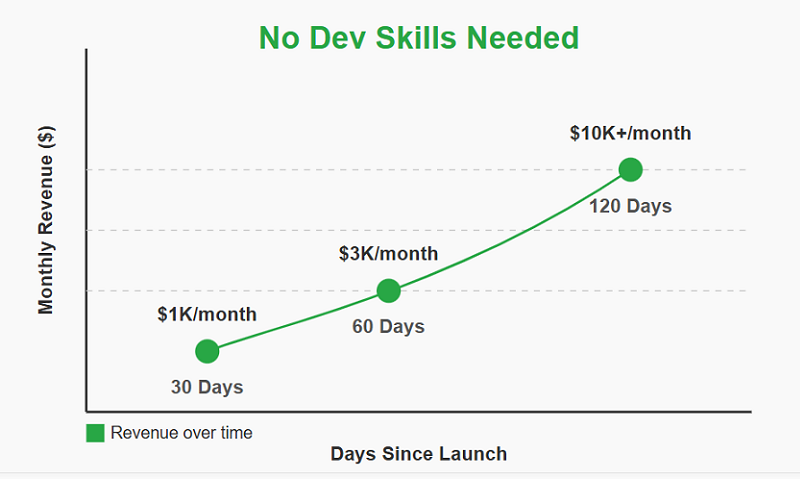
This chart illustrates the growth potential of a micro SaaS: starting at $1K/month in 30 days, climbing to $3K/month in 60 days, and reaching $10K+/month in 120 days
1. The Biggest Lie About Building a Micro SaaS
Launching a micro SaaS doesn’t require tens of thousands of dollars or in-depth programming knowledge. In fact, many beginners make these 5 mistakes, thinking they can’t succeed without experience:
- ✔ Trying to write complex code from scratch
- ✔ Ignoring simple no-code solutions
- ✔ Spending too much time perfecting design instead of MVP
- ✔ Setting prices too low at the start
- ✔ Ignoring feedback from early users
In fact, you can create a profitable micro SaaS in 30-60 days and earn your first $1K-$3K per month using simple tools.
Modern entrepreneurs use strategies such as:
- ● Validating a micro SaaS idea with real users
- ● Automating repetitive tasks using AI tools
- ● Launching a subscription-based solo SaaS business
This approach bypasses traditional obstacles, saves time and money, and, most importantly, shows a realistic path to $10K+/month in revenue for solo founders.
You Don’t Need to Be a Developer to Start a SaaS
Many people think that launching a SaaS requires extensive programming experience. This is a myth. You can create a profitable micro SaaS without knowing Python or JavaScript, using no coding needed for building a micro SaaS. Modern no-code platforms and AI tools allow you to automate most tasks. You can start with a simple idea that solves one specific problem. It’s important to test the product with early users and collect feedback. This minimizes risks and saves money on development. This approach helps solo founders quickly reach their first $1K–$3K in revenue.
Why Most SaaS Products Take Years (And Why Yours Shouldn’t)
Most SaaS products take years to develop due to excessive planning and overbuilding. Many startups try to create the perfect product before launching, instead of acting quickly. In micro SaaS, you can use the strategy “how to launch a micro SaaS quickly without coding” to speed up the launch. Create a minimum viable version (MVP) in 30–60 days and get initial feedback immediately. This saves time and money, accelerates growth, and increases your chances of success. Using no-code solutions allows you to launch your product almost instantly. This approach helps avoid common mistakes and start generating revenue faster.
How a Micro SaaS Can Be Built in 30 Days
Even a beginner can create a micro SaaS in just a month. The key is to choose a narrow niche and a simple problem to solve. Use ready-made platforms and AI tools for prototyping, following a step-by-step guide to micro SaaS creation. Start with basic functionality and test the product with users right away. The feedback you receive will help you adjust the product early on. Within 30 days, you can launch an MVP and start receiving your first subscriptions. This method saves time and reduces startup risks, making micro SaaS accessible to everyone, even without development experience.
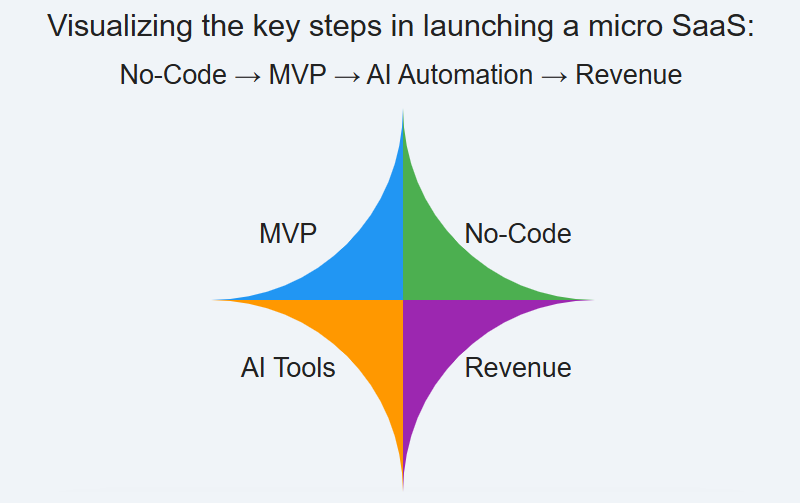
Build no-code MVP fast, test with users, automate with AI, refine quickly, launch subscriptions, generate revenue, scale smartly, repeat success
2. The Simple Math Behind a $3K–$10K Micro SaaS
Building a micro SaaS doesn’t require hundreds of customers or large budgets. In fact, simple math shows that 50–200 users can generate stable revenue.
- ✔️ $30/month SaaS × 100 customers = $3,000/month
- ✔️ $50/month SaaS × 200 customers = $10,000/month
- ✔️ Fewer customers but more value per user
You don’t need complex programming: use how to calculate micro SaaS revenue potential to understand how many users you need to achieve your goals.
Many entrepreneurs get their first customers even before their product is complete, thanks to waitlists and early adopters. Building a micro SaaS with a small audience allows you to test ideas and gather feedback early on.
You can launch a product with minimal functionality, and revenue growth will depend on the pricing and subscription strategy for micro SaaS. Even simple automation using AI and no-code tools allows you to create a full-fledged SaaS in a matter of weeks.
This model is suitable for solo founders: a small niche, a narrow audience, and a stable subscription. It’s important to focus on the problem the product actually solves. A step-by-step micro SaaS growth strategy helps you gradually increase revenue to $10K+ per month without spending years on development.
Why You Only Need 50–100 Customers
Even a small number of customers can generate a stable income. For example, 50–100 users paying $30–$50 per month easily generates $3,000–$5,000 in revenue. This allows you to focus on a quality product and customer support. There’s no need to immediately acquire hundreds of users—it’s important that your first customers are interested. You can use early access, beta tests, and waitlists to find these people. This approach saves time and helps improve your product early on. Even a small, loyal user base can serve as a foundation for growth. This is the key principle of micro SaaS growth with a minimal audience.
Getting Your First Customers Before the Product Is Finished
Many successful micro SaaS startups acquire their first customers even before the full product launch. Creating a waitlist and attracting early adopters allows you to test ideas and receive feedback. You can provide access to an MVP or prototype and adjust functionality to meet real needs. This minimizes risks and saves money on development. It’s important for early users to feel the value of the product. This approach accelerates growth and increases the chances of stable revenue. Even a minimal MVP can attract the first 20-50 customers. This is a proven strategy for validating a micro SaaS idea with users.
Using AI and No-Code Tools to Build Faster
Now you can create a micro SaaS without programming knowledge, using AI and no-code platforms. These tools speed up the prototyping process and automate routine tasks. You can focus on solving real user problems, not coding. An MVP can be launched in 30-60 days, validating ideas with early customers. This approach reduces costs and accelerates revenue growth. Even a solo founder can create a full-fledged SaaS product. The right combination of AI and no-code tools allows you to scale a micro SaaS faster than traditional development. This is the key to a fast micro SaaS launch strategy.
3. Five Profitable Micro SaaS Ideas You Can Start Today
Micro SaaS projects allow you to quickly launch a product and start making money without large investments. Even without programming experience, you can create a working MVP in 30-60 days.
✅ Today’s ideas allow you to earn your first $1K-$3K per month and scale further.
Here are five profitable areas:
- Vertical-Specific Form Builders – platforms for creating forms tailored to specific industries, such as real estate, coaches, or clinics.
- AI Content Repurposing Tools – turn blog posts into Twitter threads or YouTube videos into blog articles for maximum reach.
- Niche Analytics Dashboards – specialized dashboards for Shopify analytics, YouTube analytics, and other niche data insights.
- Simple Automation Tools for Small Businesses – automate routine tasks like auto invoice reminders or lead follow-ups.
- Industry-Specific CRM Tools – CRMs for coaches, freelancers, or other specialized industries.
These ideas allow you to
- Quickly test the market without spending a lot of money
- Get early feedback from real users
- Use AI and no-code platforms to speed up development
- Start generating revenue in the first month
Vertical-Specific Form Builders
These tools allow you to create forms for narrow niches, such as forms for real estate, coaches, or clinics. You can quickly launch an MVP for a specific segment, minimizing development time. Using custom form builder platforms for small businesses allows you to immediately test your product with real customers. Forms can be adapted for registration, applications, or surveys. Adding analytics increases the product’s value. Even simple forms can be monetized through subscriptions. Industry-specific form software for niche markets helps you stand out in the market and quickly gain your first subscribers.
AI Content Repurposing Tools
AI tools help transform a blog into a Twitter thread or a YouTube video into a blog. This saves dozens of hours of manual work and allows you to maintain a constant stream of content. Using automated content repurposing tools for marketers accelerates audience growth. These SaaS solutions can include a post scheduler and social media integration. Even simple MVPs allow you to test demand. AI content conversion tools help entrepreneurs scale quickly. Content automation software for small businesses is ideal for solo founders looking to increase their reach without overspending.
Niche Analytics Dashboards
Specialized dashboards help track key metrics for a specific niche: Shopify analytics, YouTube analytics, and others. Users receive ready-made insights without setting up a complex BI system. Using niche data dashboard SaaS tools speeds up the decision-making process. Dashboards can include visualizations, notifications, and integration with other platforms. Even simple MVPs provide tangible value to customers. Custom analytics dashboards for e-commerce help identify trends and optimize sales strategies.
Simple Automation Tools for Small Businesses
Simple automations help with routine tasks: automatic invoice reminders, lead follow-up, and more. This SaaS saves time and reduces errors. Using automation tools for small business workflows speeds up MVP launches. Systems can integrate with CRM, email, and other services. Even minimal functionality is immediately in demand by users. SaaS workflow automation for solo founders allows you to quickly test ideas and collect revenue.
Industry-Specific CRM Tools
CRM systems for specific industries, such as CRM for coaches or CRM for freelancers, allow you to manage clients and tasks without unnecessary complexity. This SaaS solution helps focus on sales and customer service. Industry-specific CRM SaaS platforms speed up product launches. CRMs can be customized for reminders, tasks, and reports. Simple MVPs help entrepreneurs systematize work. Custom CRM tools for niche markets enable rapid growth and initial subscriptions.
4. Common Micro SaaS Mistakes That Kill Startups
Many aspiring micro SaaS founders make mistakes that slow down their launch and undermine growth. Often, startups try to create an overly complex product with numerous features, neglecting the MVP. This leads to delays and unnecessary costs. Others ignore feedback from early users, believing they know better. Underestimating the product’s price often prevents them from generating sufficient revenue from early customers. Some founders try to do everything alone for too long, without delegating or using no-code or AI tools.
These mistakes are common, but they can be avoided by following a strategic launch plan. Validate ideas with real users and gather early feedback. Launch the MVP quickly to test the market. Focus on key features and minimize risks. Use automation to save time. Monitor metrics and adjust your strategy as you grow. Even a small micro SaaS can bring in the first $1K–$3K per month with the right approach.
Building Too Many Features Before Launch
Many startups suffer from overbuilding—building too many features before launch. They waste time and money creating a product that no one has yet tested. Using micro SaaS MVP strategies for beginners helps limit functionality and focus on the essentials. Focusing on core features allows for a faster product launch. Even simple MVPs with minimal features collect feedback. Lean SaaS development practices for solo founders minimize risks and accelerate revenue.
Ignoring Customer Feedback in Early Stages
Ignoring feedback from early users is one of the most common mistakes. Even small pieces of feedback can help improve the product and increase retention. Using early SaaS user feedback collection tools speeds up iterations and testing of ideas. Apply user feedback to improve UX and functionality. SaaS MVP testing with real users helps understand which features are truly in demand.
Underpricing Your SaaS Product
A low product price often prevents a startup from generating sufficient revenue in the early stages. Underestimating the value of a service is demotivating and complicates scaling. Use pricing strategies for micro SaaS products to calculate optimal pricing. The right price helps cover expenses and invest in growth. SaaS revenue optimization techniques for small businesses increase profits from the first customers.
Trying to Build Everything Alone for Too Long
Trying to do everything alone for too long is a classic mistake. It slows down the launch and increases the risk of burnout. Use solo founder SaaS productivity tools for automation and delegation. Use AI and no-code platforms to speed up development. Efficient micro SaaS launch strategies help you get to market faster and gain early subscribers. Even a minimal MVP with tool support allows you to collect feedback and grow.
FAQ Section
What is a Micro SaaS?
Micro SaaS is a small online service that solves a specific problem for a niche audience. It’s typically run by one or two people, with minimal overhead. A small niche SaaS business for beginners is an ideal example.
Can you build a SaaS without coding?
Yes, modern no-code platforms and AI tools allow you to create a fully functional MVP without programming. Launching a no-code micro SaaS quickly is a common strategy for solo founders.
How much money can a Micro SaaS make?
With the right approach, a micro SaaS can generate $1K–$3K in the first few months, and then scale to $10K+ per month. Profitable micro SaaS revenue examples show that this is achievable.
How long does it take to build one?
Most MVPs can be launched in 30–60 days. The key is to focus on core features and quickly gather feedback. Build a micro SaaS MVP in 30 days—a working scenario for beginners.
What tools can help build a micro SaaS?
No-code platforms, AI automation tools, analytics dashboards, and CRM systems for niche markets. They speed up launches and help solo founders manage their products. “Best no-code SaaS tools for beginners” is a popular request among startup founders.
Final Thoughts
Micro SaaS is one of the fastest and most effective ways to build an online business with recurring revenue.
You don’t need large capital, a team of developers, or years of programming training. One problem, a simple solution, and 50–100 initial customers are enough. Launching a micro SaaS with a minimal budget works well for beginners.
Use an MVP to test ideas and collect early user feedback. Gradually improve the product based on real insights. AI tools and no-code platforms accelerate development and process automation. Micro SaaS product testing with real users reduces risks and saves time. Focusing on a narrow niche helps gain traction and initial subscriptions quickly. Minimal functionality can deliver immediate value. Correct pricing allows you to earn from the first few months. Optimizing micro SaaS pricing can lead to $1K–$3K per month.
Repeat this process and add new features as you grow. Avoid overcomplicating the product. Stay in touch with users and listen to feedback. Automation with AI and workflow tools allows scaling without expanding your team.
Solo founders can build a $10K/month micro SaaS by following these principles. Acting quickly, minimizing overbuilding, and pricing products correctly are key. Niche analytics dashboards help analyze user behavior and optimize products. Data-driven micro SaaS growth strategies support informed decisions.
Start small, learn from early feedback, use AI and no-code tools, test ideas, and scale. Micro SaaS provides a way to make money and an opportunity to create a sustainable online business with recurring revenue.