

How to Build an AI Product is one of the most important questions in today’s rapidly evolving digital economy. The product market is changing faster than ever before, and traditional development approaches are no longer the only path to success.
Launching a valuable digital product no longer requires deep programming expertise, a full development team, or months of complex coding. Today, competitive advantage belongs to those who clearly understand the problem, move quickly, and know how to turn artificial intelligence into a practical, working solution.
This shift is especially visible in the AI-powered micro-SaaS space. A new generation of product creators is emerging — experts, marketers, analysts, and founders without technical backgrounds — who are building scalable AI products without writing code. The market increasingly rewards systems thinking, speed of execution, and clarity of vision over “deep” engineering complexity.
At the same time, most people still fear, “Without code, I can’t create a real AI product.” Or, at the other extreme, when an AI product is understood as a simple chat with a few tips, it’s a simple process. As a result, dozens of projects are emerging that look like tools but never become products.
In this article, we’ll walk you through the step-by-step process of creating a fully-fledged AI product without code, not just an interface on top of a model. You’ll understand the logical building blocks of such a product, how it makes decisions, how it works with context, and why this makes it scalable. We’ll speak in simple language, without technical noise, but with a depth often lacking in guides.
This article is about the mindset of a product founder in the AI era.
If you want to create micro-SaaS products that actually find users, rather than die at the idea stage, you’ve come to the right place.
1. What Do We Call an AI product (and where everyone gets confused)
The term “AI product” is overused these days. Some use it to describe a chat with prompts, others to describe API-based automation, and still others to describe any interface with a “Generate” button. This creates the illusion that many are already building a product, when in fact, they only have a tool or a wrapper around a model.
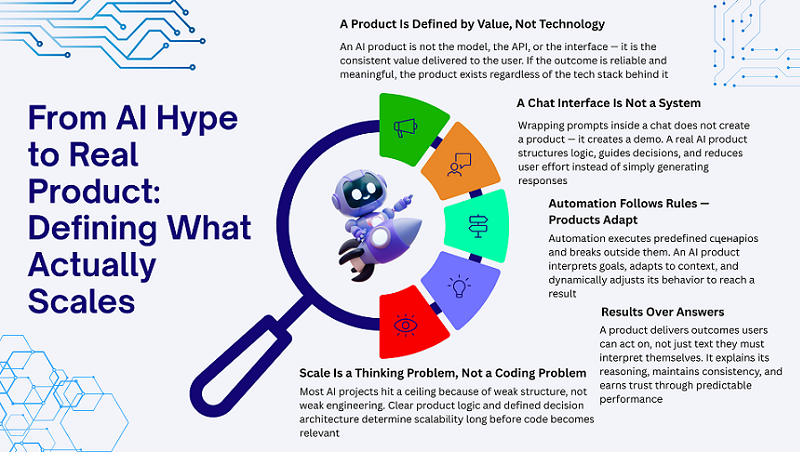
In this section, it’s important to clarify the concepts, because without it, everything will be built on a shaky foundation. An AI product isn’t about the technology, the model, or the service you use. It’s about the value the system consistently delivers to the user.
If you don’t separate these things from the very beginning, the product is almost guaranteed to hit a ceiling with the first few users. Therefore, let’s first understand what makes a product a product, not just a set of features. Only then does it make sense to talk about steps, scaling, and growth.
An AI product ≠ a Chat with Prompts
Most so-called AI products are actually just a regular chat with a pre-written prompt. The user enters something, the model responds, and that’s it. This may look impressive at first, especially if the answers are good.
The problem is that this approach doesn’t create a system. It doesn’t make decisions, doesn’t consider context, and doesn’t guide the user to a result. It’s simply an interface on top of the model.
An AI product begins when the system takes over some of the thinking, rather than simply generating text. If you remove the user from the process of making every step, that’s when the product emerges. Everything else is just a demo.
How a Product Differs from Automation
Automation solves a specific problem according to a predetermined scenario. If the conditions are met, it works; if not, it breaks. An AI product takes a different approach: it adapts to the situation rather than simply following instructions.
The product considers the user’s goal, their context, and possible scenarios. It doesn’t simply “do an action,” but helps them make a decision or reach a result.
This is where the line between automation and a product is drawn. If a system can’t choose and adapt, it’s a set of scripts, even if it’s powered by AI. And such projects almost always come down to scale.
How to Know You’re Creating a Product
There’s a simple way to check this without using complicated terms. First, the product can explain why it performs a particular step. Second, it delivers a result, not just an answer. And third, it works consistently and reliably for different users, not just for the “ideal scenario.”
If a system requires manual edits, clarifications, and monitoring every time, it’s not a product. A true AI product reduces the user’s cognitive load, rather than shifting it onto them.
If you see that the user trusts the system and follows its logic, that’s a good sign. This means you’re no longer creating a tool, but a product.
Why code isn’t even important here
A common mistake is to think that scale and quality are limited by code. In practice, it’s the opposite. Most AI products fail not because of technical limitations, but because of a lack of structure and logic.
You can write perfect code, but if the product doesn’t understand what it does and why, it won’t scale. Conversely, a well-designed system can evolve for a long time without any programming at all.
Code is just a way of implementing it. Growth is limited by thinking: how you define the problem, solutions, and product behavior. That’s where you need to start.
2. Clearly Define the Task, Not the Idea
Almost all AI product problems begin with the phrase “I have an idea.” The idea sounds inspiring, but it’s too vague to build a system on. AI doesn’t handle abstractions well, but it’s great at concrete work.
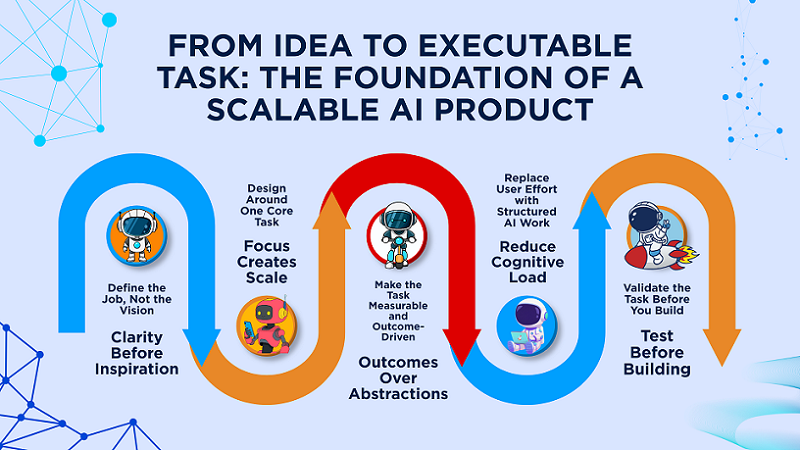
Therefore, the first and most important step is to stop thinking in terms of ideas and start thinking in terms of tasks. Not “what we want to do,” but what job the product performs for the user.
If this step is skipped or done pro forma, everything will fall apart: the UX, the logic, and scaling. But if the task is clearly defined, half the product is already built. In this section, we’ll look at how to do this as simply as possible.
This is exactly where most AI products quietly fail — long before prompts, tools, or automation even matter.
Founders often jump straight into defining tasks without validating whether the underlying idea is worth turning into a system at all. As a result, the task may be well-defined technically, but irrelevant from a market perspective.
A scalable AI product always starts one level earlier: with a strong, narrow SaaS idea grounded in a real problem. If the problem is weak, no amount of task clarity will save the product later. You’ll end up optimizing logic for something users don’t truly need.
Before defining what the AI should do, it’s essential to understand *which problems are actually worth solving* and how to quickly filter out ideas that sound good but fail in reality.
If you want a practical, no-fluff breakdown of how to find strong SaaS ideas and validate them before building anything, this free lesson walks through the exact process: Day 1 — Where to Find Great SaaS Ideas (and how to vet them)
This step ensures that every task you define later is anchored in real demand, not assumptions.
Not “what to do,” but “what job does AI perform”
The phrase “AI helps write texts” means nothing. But “AI turns a rough brief into a finished draft for a specific purpose” is a task. The AI Job To Be Done approach helps eliminate unnecessary distractions and focus on results.
It’s not the technologies used that matter, but what work the user no longer wants to do themselves. If AI takes over this work, the product will be in demand.
A clearly defined task immediately suggests the logic, context, and solutions the system needs. Everything else is built around this.
One Task is Better than Ten Features
Many people believe that more features = more value. In AI products, this is almost always a mistake. Each new feature increases system complexity and reduces stability.
One well-solved task scales much better than ten superficial ones. Users value predictability and a clear outcome, not a set of features.
Focus simplifies not only the product but also marketing, onboarding, and growth. This is why most successful micro-SaaS start with a single task.
Examples of Good and Bad AI Tasks
A bad task is: “AI helps entrepreneurs.” A good one is: “AI analyzes incoming leads and suggests the next step.” In the first case, it’s unclear what the product does; in the second, everything is clear.
A good task is always measurable, limited, and tied to a specific outcome. A bad one is abstract and requires constant clarification from the user.
If the task is difficult to explain in a single sentence without “and,” “or,” and “plus,” it’s likely poorly formulated.
How to Test a Task Before Building a Product
There’s a simple sanity check. Imagine an AI performing a task perfectly. Is the user willing to pay for it or use the product regularly? If not, the task is weak.
The second test is whether the process can be described in words, without an interface or code. If the logic falls apart at this stage, the product will also fall apart later.
This type of check saves months of work and helps immediately weed out ideas that sound good but don’t work in practice.
3. Break the Product Into a System, Not Screens
Most no-code AI products start from screens: dashboard, chat window, settings, buttons. This feels logical, especially for founders with a design background. But screens are just the surface — they hide how the product actually works.
When you think in screens, you optimize UI, not decisions. And AI products fail not because of bad UI, but because of broken logic underneath.
A scalable AI product should be designed as a system first, and only then wrapped into interfaces.
System thinking forces you to define inputs, transformations, and outputs explicitly.
This makes the product easier to debug, extend, and automate later. More importantly, it prevents the “it works in demo but breaks in ” problem.
In this section, we’ll reframe how to think about AI products before touching any no-code tools.
Why Screens Kill Product Thinking
Screens push you to focus on how things look, not how decisions are made. Most no-code projects fail because founders design flows instead of logic. A beautiful interface can hide a fundamentally weak system underneath.
When something breaks, you don’t know where or why. AI products especially suffer from this, because errors are often invisible at first. System-first thinking forces clarity before complexity appears.
What “a System” Means in an AI Product
A system is a sequence of steps that turns raw input into user value. It doesn’t require architectural diagrams or technical jargon.
At its core, it answers four questions: what comes in, what happens inside, and what comes out. AI is just one component inside this flow, not the whole product.
When you define the system clearly, tools become replaceable. That’s how no-code products avoid being fragile.
Input: What the AI Actually Receives
Most founders think the input is “the prompt”. That’s only the visible layer. In reality, input includes user intent, prior actions, constraints, and product state.
If you don’t define this explicitly, the AI is forced to guess. Guessing works with early users, but fails at scale. Clear inputs reduce hallucinations and increase consistency. Good AI products don’t rely on luck — they rely on structure.
Output: What Counts as a Result
The output of an AI product is not text. It’s value. Sometimes that value is a decision, sometimes a summary, sometimes a next action.
If you measure success by “good answers”, you’ll miss the real problem. Users care about outcomes, not eloquence.
A strong system defines what success looks like before generating anything. That’s how AI becomes useful, not just impressive.
A strong system defines what success looks like before generating anything.
That’s how AI becomes useful, not just impressive.
4. Design Context, Not Prompts
Most beginners obsess over prompts. They tweak wording, add instructions, and hope for better results.
This works temporarily, but it doesn’t scale. Prompts are fragile because they lack memory, structure, and awareness of the product state.
Context is what makes AI behave consistently across sessions and users.
It defines why the request exists, not just what is being asked.
When context is designed properly, prompts become short and stable.
This is one of the biggest mindset shifts in building no-code AI products.
Why AI Breaks Without Context
Without context, AI treats every request as isolated. This leads to contradictions, repeated questions, and shallow outputs.
The problem often isn’t visible with the first users. It appears only when usage patterns diversify. At that point, prompt tweaks stop working. Context is what prevents the system from falling apart under real usage.
Core Types of Context in AI Products
There are four main types of context: history, goal, constraints, and state. History explains what already happened. Goals define what the user is trying to achieve. Constraints limit what is allowed. State reflects where the process currently stands. Together, they give AI situational awareness.
How to Store and Update Context Without Code
Context management is about logic, not tools. You decide what must persist and what can expire.
Some context lives across sessions, some only within a single flow. The key is to update context after meaningful actions, not every message.
This keeps the system lightweight and predictable. No-code tools can store data, but you design the rules.
The “Every Request From Scratch” Anti-Pattern
Treating each request as new is the fastest way to kill product intelligence. It forces the AI to re-learn the same things repeatedly. This increases costs and decreases quality. More importantly, it breaks the user’s mental model. Users expect the product to “remember”. Persistent context is what makes AI feel like a system, not a toy.
5. Turning an AI Idea Into a Working Product System
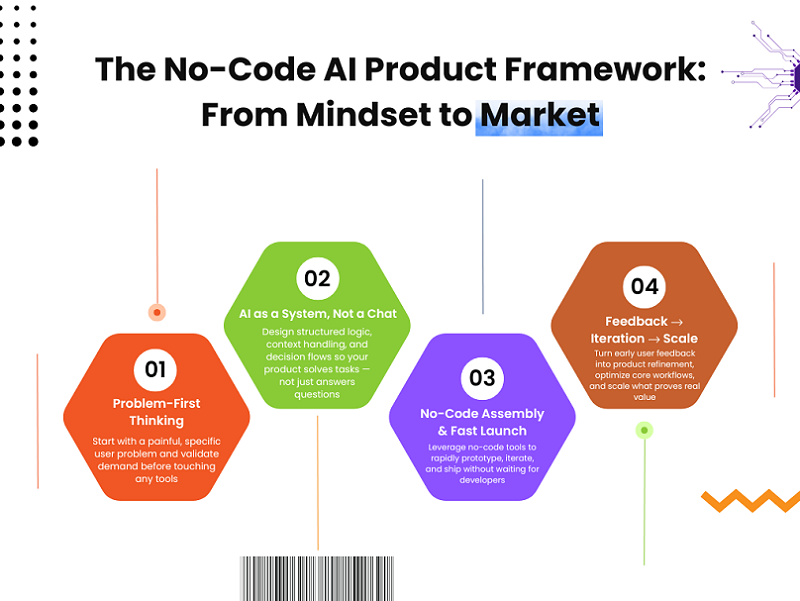
At this stage, it’s crucial to make a key shift in thinking: stop perceiving an AI product as a set of screens or functions and start seeing it as a system. This is where most no-code projects either start to grow or get stuck forever.
The problem isn’t the tools or the lack of code, but rather the product’s lack of understanding of how it should work in different situations. A system is what connects inputs, context, logic, and output into a coherent whole. Without this, the product only works in demo mode.
In this section, we won’t delve into architecture. The goal here is simpler: to demonstrate how to think systemically, even when building a product without code. This is the foundation without which scalability and stability are impossible.
Product ≠ Screens: Why Interfaces Don’t Define AI Products
Most no-code products start with screens: chat, dashboard, settings, buttons. This creates a sense of progress, but in reality, it distracts from the essence. The interface is a shell, not a product. When thinking gets stuck on the UI, the decisions within the system remain unformulated.
This is where the first mistakes appear: the product “looks” finished, but behaves unpredictably. The system begins to break down under non-standard requests. Ultimately, the design becomes a crutch that hides a lack of logic. Therefore, in AI products, the system is always more important than the interface—the interface can be replaced, but the system cannot.
Context Over Prompts: What Makes AI Behave Predictably
Many people think that the quality of an AI product depends on a perfect prompt. This may work at the start, but not at scale. A prompt is just one signal, not the whole picture.
Context is an understanding of why the user is making a request, what state they’re in, and what’s happened before. Without this, the AI starts from scratch every time. The product loses consistency, and the user loses trust. It’s the context that makes AI behavior stable and predictable, and this is immediately noticeable, even if a human can’t explain why.
Decisions, Not Generation: Where Real Product Value Lives
Text generation alone doesn’t create a product. It can be useful, but value only emerges when the system starts making decisions. An AI product’s value isn’t in the way it answers beautifully, but in the way it guides the user to a result.
Real products decide what to do next, which option is better, where the user is making mistakes. If AI simply generates, it’s a tool. If it chooses, guides, and limits, it’s a product.
This is where the line between a tool and a system is drawn. We explore this distinction in depth in How to Build Scalable AI Products Without Code (Using ChatGPT as the Core Layer) — where we break down the architectural principles behind decision-driven AI systems. Here we’ll only hint at it: scalable AI products are built around decisions, not text.
6. From Prototype to First Users (Without Breaking the System)
The transition from prototype to first users is the most fragile stage in the life of an AI product. This is where most projects fail, even if the idea itself is strong. The problem is rarely related to the model, tools, or lack of code. More often than not, the system is simply not prepared for real-world human behavior.
At the prototype stage, everything seems logical and manageable, but first users wreak havoc. They use the product differently than expected, ask the “wrong” questions, and break the flowcharts. The goal of this stage is not growth, but testing the viability of the system. You need to reach users without the product falling apart under the first pressure. That’s what this section is about: how to carefully transition into reality without destroying logic and trust.
Why Most AI Products Never Reach Real Users
Most AI products get stuck before their first users, and the reason is almost never technical. People endlessly refine, rewrite, and improve something that no one uses yet. This is often driven by fear: the fear that the product is “not good enough.”
No-code isn’t a solution here, because it speeds up the build process but doesn’t eliminate uncertainty. Ultimately, the product exists only in the creator’s mind. The longer the release is delayed, the harder it becomes to take the first step. And without real users, the system remains a hypothesis.
What “Minimum Viable” Means for AI Products
For AI products, an MVP isn’t a “bare bones” or “unfinished” product. It’s a system that reliably does one thing. The user doesn’t care how many features it contains, as long as the outcome is predictable.
At launch, the core should work: input → logic → output. Everything else can be deliberately simplified or eliminated. The most dangerous thing is to launch a product that behaves inconsistently. This is what destroys trust the fastest. A good MVP in AI has fewer features, but more confidence in the system’s behavior.
Getting First Users Without Marketing or Budget
First users aren’t about growth or scale. They’re a learning tool. Their purpose is to show where the system breaks down in real life. Therefore, advertising is unnecessary and even harmful.
The right first users are people you can communicate with directly. Manual onboarding at this stage isn’t a crutch, but a strategy. It allows you to see the product through the user’s eyes.
When an AI product is truly useful, it automatically suggests what needs to be fixed next. And this knowledge is more important than any metrics at the start.
Conclusion
AI products don’t die due to lack of code or poor tooling. They die due to a lack of structure and clear thinking. A prototype is just the beginning, and real users quickly reveal where the system was weak.
In the early stages, you shouldn’t think about scaling, automation, and growth. You need to think about product behavior and trust. If the system can handle the first few users, it will handle more.
We explore everything related to upgrades, scale, and long-term sustainability of an AI product in our pillar article. This is where the next level of product founder thinking begins.