
why-ai-saas-startups-fail-formula

90% of AI SaaS Startups Fail, but the 10% Follow This Formula

Every year, several thousand AI SaaS startups are launched. The landing pages look professional, the demos are impressive, the founders confidently talk about “revolution” and “scale.” But there’s one truth that everyone is keeping quiet about: most of these projects don’t even reach their first $1K MRR. Not because the market is bad. And not because the models are weak. But because almost all of them are following the same, wrong path.

If we look at it from the outside, we might think that failure is a fluke. They were unlucky with their niche. The marketing strategy was poorly designed. The timing was off. But if we look deeper and examine dozens of projects in a row, something else becomes clear: AI SaaS fails for the same reasons. Some founders build a product without thinking about distribution. Others create tools that are so generic they struggle to stand out. And many spend months searching for “good ideas” instead of identifying real problems people are actively trying to solve. In fact, this confusion between interesting ideas and real market pain is one of the most common reasons micro-SaaS projects collapse early. A deeper breakdown of why this happens—and how experienced founders identify real pain points before building anything—is explained in Why Most Micro SaaS Ideas Fail — and How to Find Real Pain Points. On top of that, almost no one seriously considers the economics of the product until it’s already too late.

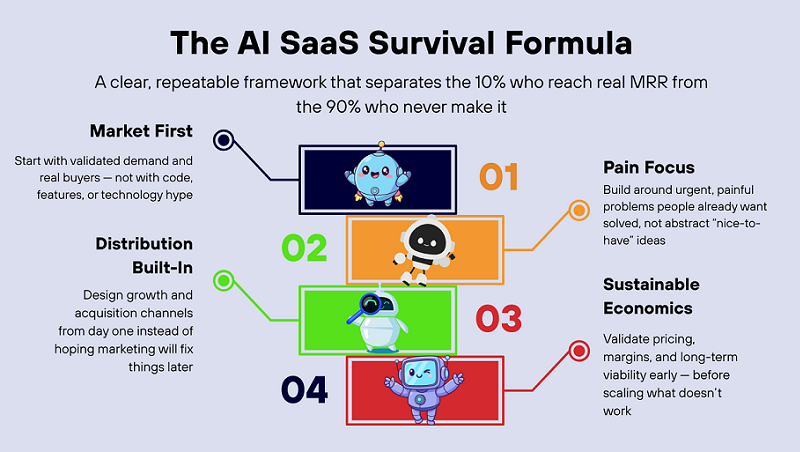
But here’s the interesting thing: there are those 10% of founders who do achieve stable MRR. Surprisingly, they aren’t geniuses and don’t use secret technologies. They simply follow a different logic. They start not with the product, but with the market. Not with features, but with pain. Not with scaling, but with sustainability. And a clear, repeatable formula is immediately apparent in their actions.

This article isn’t motivational or another “startup guide.” It’s an analysis of patterns. Why 90% of AI SaaS companies don’t even make their first profit. Where exactly do they go wrong? And what do those who do reach real users, real MRR, and real business do differently?

If you’re thinking about launching an AI SaaS—or have already launched one and feel like growth is hitting a wall—this formula can save you months of work and thousands of dollars in mistakes.
1. The Brutal Reality of AI SaaS Failure

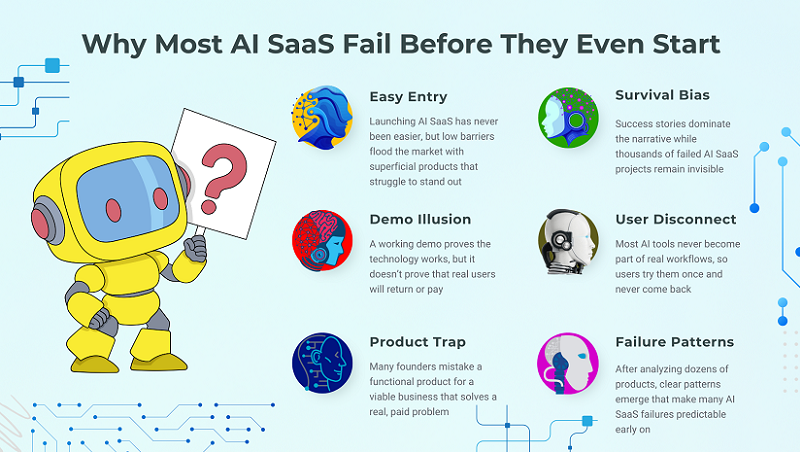
Looking at the AI SaaS market from the outside, it might seem like the perfect time to launch. The tools are accessible, the models are powerful, no-code has removed technical barriers, and you can create a micro AI SaaS project in literally a weekend. Even launching an MVP now takes weeks, not months. But this very accessibility has created a paradox: entry has never been easier, yet survival has never been more difficult. The number of products has grown severalfold, while user attention remains limited. As a result, the market is overflowing with demos but often empty of real businesses.

For founders who want to start small and minimize risk, exploring a curated list of micro SaaS ideas under $500 can be a practical first step Micro SaaS Ideas for Small Business Owners Under $500 Budget.

Most founders consider landing the first 5–10 users a victory, yet failure often creeps in gradually. The pattern usually looks like this: first comes enthusiasm, then the initial users appear, followed by stagnation and confusion over why “everything seems to work, but there’s no revenue.” This section exposes a reality rarely discussed publicly—about recurring mistakes that become obvious when examining not one or two, but dozens of projects, and why the failure of AI SaaS is often predictable long before launch.

Why launching an AI SaaS is easier than ever — and that’s the problem

Today, almost anyone can launch an AI SaaS, even a complete beginner. Even without paid, code-free tools, you can create and launch your first micro SaaS with just ChatGPT. But when entry is too easy, the market quickly becomes overrun with superficial solutions. Most products lack a clear idea; they only have a formula.

The ease of launch creates the illusion of progress and, ultimately, success. The founder feels a sense of progress: something has been put together, something is working, something can be demonstrated. But this doesn’t create a real competitive advantage. The problem isn’t that it’s become easier to launch, but that it’s becoming more difficult to stand out and survive in the SaaS market. And many underestimate this shift.

The false signal of early demos and MVP hype

A working demo is the most misleading signal in the early stages. You might have the joyful feeling that the product is almost ready and the next step is marketing. This is especially true in AI, where even a simple scenario can seem impressive.

The problem is that a demo validates the technology but is no guarantee of attracting customers. A user might be delighted by the demo’s impact and yet never return. An MVP might work perfectly in one scenario and then fall apart in real use. The hype surrounding demos often masks a lack of systems thinking. And this is where many AI SaaS projects begin their path to failure.

Why “working product” ≠ viable business

One of the most common traps you can fall into is confusing a working product with a viable business. The AI responds, the interface works, the features are implemented—that means everything is fine. But that’s not the start of your business.

Viability is tested by how well the product solves a specific problem, one for which many are willing to pay regularly. Your task is to create a product that keeps users coming back not out of curiosity, but out of necessity. It’s about having a clear path from the first touch to revenue. Most AI SaaS stops at the “it works” level, never reaching the “it’s needed” level.

Survival bias in SaaS success stories

We see the same success stories we like: scale, millions, rapid growth, big-name founders. But almost no one shows us the thousands of projects that closed quietly and quickly. This is survival bias.

I’m sure that if you’re a founder, you also learn from the cases of winners, ignoring the statistics of losers. As a result, you’re simply copying the trappings of success, not the real reasons. Scale without context, growth without a foundation, features without demand. Understanding this is the first step to a more sober approach to launching AI SaaS.

Why most AI tools never reach real users

I’ve seen some founders’ micro SaaS products technically still exist, but they’re not actually used. They have a website, sometimes even users, but there’s no regular use. These products appear to be alive, but in reality, almost no one needs them.

The reason is simple: the product isn’t integrated into the user’s actual workflow. It’s interesting, but not essential. A user might try it once, find it interesting for a single use, and then forget about it. Without a repeatable use case, there’s no retention or MRR. And this is one of the main reasons why AI SaaS is dying a silent death.

The hidden graveyard of micro-SaaS projects

Behind every successful micro-SaaS lies a graveyard of dozens of closed projects. They’re not featured on social media, they’re not shown in case studies. But they’re the ones that make up the real market statistics.

Most micro-SaaS projects die not because of competitors, but because there’s no demand for them. Or because the founder spent too long tinkering with the product without testing it. This graveyard is the best source of learning, if you look at it honestly. Because the same mistakes are repeated there.

Why failure is usually predictable early

The most frustrating thing is that failure is rarely unexpected. Often, it’s clear early on that the product isn’t solving a pressing problem. That users aren’t returning. That the money isn’t accumulating.

But instead of stopping or changing course, founders continue to make more mistakes. They add features, change the copywriting, redesign. Yet the root cause of the problem runs deeper. Recognizing early warning signs is the key skill that distinguishes those 10%.

Patterns you start seeing after reviewing dozens of products

At first glance, one product always looks unique. After examining ten SaaS products carefully, similarities begin to appear. Reviewing fifty makes the patterns impossible to ignore.

You begin to see the same mistakes: an overly broad ICP, a lack of distribution, substituting an idea for a pain point, and believing we’ll fix problems later if they arise. These patterns repeat themselves over and over again. They highlight the importance of proven strategies for scaling SaaS that help some products survive and generate stable profits.
2. The Core Formula for the Top 10% Follow

After watching dozens of failures in a row, your belief in randomness gradually fades. You begin to understand that success in AI SaaS isn’t a stroke of luck or a “brilliant idea,” but a repeatable formula. The top 10% of projects don’t look the same on the outside, but they’re structured almost identically on the inside. Their decision-making logic, workflow, and product thinking are surprisingly similar. Technology is not the starting point, even though they work with AI. Design isn’t the first step either, despite the attention to UX. Everything begins with understanding the system: who the product is for, what pain it solves, and how it will generate revenue — a process detailed in how SaaS companies can boost revenue with smarter LTV calculations. This consistency is what distinguishes the surviving products from the beautiful but dead ones.

Why successful AI SaaS follow a repeatable structure

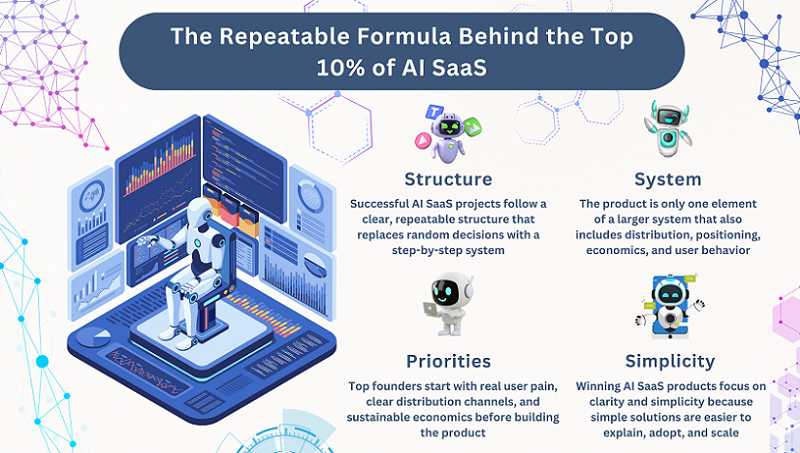
Successful AI SaaS are almost never built “on inspiration.” Their founders consciously reject chaotic decisions in favor of structure. A repeatable model reduces early errors. When you have a structure, you don’t ask yourself “what to do next”—you simply move step by step. This is especially important in AI products, where there is too much uncertainty. Structure doesn’t kill creativity; it confines it to the realm of reality. It is within this framework that sustainable growth emerges. Without structure, a product always depends on luck, not on a system.

The product is only one part of the system

One of the most painful truths for founders is that the product alone doesn’t solve anything. Even a great AI product can die if it exists in a vacuum. Successful SaaS companies view the product as part of a system, not the center of the universe. The system includes distribution, economics, positioning, and user behavior. If even one element is weak, the entire structure begins to falter. This is precisely why a “good product” so often fails to find a market. It was only good in and of itself, not as part of a working business model. The top 10% understand this very early on. And so they build systems, not features.

Distribution, pain, and economics come first

As I’ve already noticed, almost all failed projects begin with a product that would be a good idea to launch. Successful founders think differently, starting with something else: “Who is really hurting?” and “How will we reach them?” Pain is the reason for the product’s existence. Distribution is the means to survival. Economics is what allows it to continue. When you have these three elements, the formula works. This order seems boring, but it eliminates 80% of future problems. When there is pain, a clear channel, and the numbers add up, the product becomes a logical consequence, not a hope. For a concrete example of applying this approach in a micro SaaS without writing code, see From Idea to $3K MRR: Building a Micro SaaS Without Code. This is why the top 10% may seem completely simple, but they grow. They don’t romanticize the product; they earn it.

Why simplicity beats sophistication

Many AI founders believe that the more complex a product is, the more valuable it will be to the market. But the market almost always chooses simplicity. Simple products are much easier to explain, sell, and scale. Complex solutions require training, persuasion, and user patience. Successful SaaS companies consciously simplify everything, not because they can’t make it more complex, but because they understand the cost of cognitive load. Simplicity accelerates feedback and reduces friction. This is especially important in AI, because users don’t fully understand what’s going on under the hood anyway. The top 10% win not with technology, but with clarity. And it is clarity that drives growth.

How the formula stays consistent across niches

It seems that AI SaaS in different niches should operate according to different rules. In practice, the formula hardly changes. The context changes, but the logic doesn’t. Every project has a specific pain point, a specific user, and a specific method of delivering value. Successful projects don’t reinvent the process each time. They adapt the same model to different markets. This makes scaling their thinking possible. This is why experienced founders launch their second and third products faster. The formula remains, only the details change.’

What founders misunderstand about “innovation”

Most founders think innovation is something fundamentally new. In reality, the market rarely rewards novelty per se. Innovation is often a new way to solve an old problem. However, this solution requires doing things faster, cheaper, and more clearly. The top 10% don’t chase “uniqueness”; they chase utility. They understand that users care about results, not the originality of the idea. This is why many “non-innovative” products outperform “revolutionary” ones. True innovation is when a product integrates into the user’s life, not just surprises them. And this is much more difficult than it seems.

The difference between building fast and building right

Building fast is trendy, but building right is difficult. Many confuse speed with progress. You can quickly build an MVP, but not a system. The top 10% of startup founders with proven track records don’t rush where mistakes are costly. These founders accelerate only when the logic is already established. This allows them to avoid rewriting the product every three months. Building right means making less spectacular but more sustainable decisions. In the long run, this always pays off. Speed without direction is simply running in circles.

Why this formula works even without funding

The most interesting thing about this formula is that it doesn’t require investment. It requires thinking. Most of its steps aren’t about money, but about clarity. Understanding pain, the channel, and the economics is within the reach of any founder. This is why many profitable AI SaaS companies grow without venture capital. The formula protects against unnecessary expenses and focuses efforts. When you know what you’re building and why, you don’t need a large budget. Money accelerates, but it doesn’t replace the system. And the top 10% understand this perfectly well.
3. Mistake #1: Building Product Before Distribution

Most AI SaaS projects don’t die because the product is bad. They fade into oblivion because there’s simply no one to show them to. Founders constantly live in the illusion: “First, let’s make the perfect product, and then we’ll do the marketing.” In practice, it’s the other way around. When distribution comes at the very end, the product is already established, and it often doesn’t fit into any acquisition channel. As a result, the team starts pushing the product into any channel that works, and frustration sets in, as conversion is near zero. Distribution isn’t advertising or a growth hack. It’s a fundamental limitation that should be shaped by the product itself. The top 10% of founders don’t think about “what we’ll build,” but rather “how will people find out about us and why will they care?” This is where true product-market fit begins. Everything else is just fancy engineering without a market.

Why “build first, market later” fails in AI SaaS

The “product first, marketing later” approach comes from startup mythology, but in AI SaaS it almost always breaks down. The market is overheated, competition is fierce, and user attention is more valuable than development. While you’re building a product in a vacuum, others are already testing demand. Ultimately, you launch an MVP that no one needs. Or it’s needed, but too late. In AI SaaS, learning speed is more important than development speed. And learning doesn’t exist without distribution.

Distribution as a design constraint

Distribution isn’t something added after release. It’s a constraint, like a budget or a team. If your primary channel is SEO, the product must be tailored to search intent. If it’s cold outreach, it must be ultra-clear in 10 seconds. The channel dictates which features make sense and which don’t — and understanding how to quickly grow SaaS revenue and reach $50K MRR can guide which features to prioritize. The best products appear “simple” precisely because they are governed by distribution logic. All unnecessary details fall away automatically.

Channels that shape the product itself

Each channel changes the product more than it seems. Twitter/X requires opinionated and sharp tools. SEO requires structured and repeatable use cases. Enterprise sales requires predictability and control. If you don’t understand which channels need to be connected for product growth, you’re building a product blindly. The result is a generic, faceless tool. And such products don’t scale.’

Why audience > idea

Ideas are overvalued. The audience is not. When you have a clear audience, ideas appear automatically. Without an audience, even the best idea dies immediately. Top founders first gather attention, then decide what to sell — a principle well illustrated in “$10K – $500K MRR: 7 Profitable Micro SaaS Ideas for Solopreneurs”, which shows how solopreneurs validate their ideas and grow recurring revenue. Because demand is an asset. An idea is not.

Early traction vs. real demand

Early registrations and likes are a bad sign unless they’re backed by behavior. Real demand is when people come back and pay, or at least try to integrate the free version of the product into their work initially. Distribution without quality is noise. But a product without distribution is silent. Both are needed, but it’s almost always better to start with reach.

Distribution as risk reduction

Distribution reduces risk. It allows you to test a hypothesis in weeks, not months. You quickly understand what’s not working and don’t get stuck on features. It’s not about scale—it’s about survival. Most failures could have been predicted if founders had reached the market earlier.

How the best founders pre-sell clarity

The best founders sell before they code. Through landing pages, demos, conversations, emails. They test the wording, the pain, the promise. And only then do they build. Ultimately, the product already “knows” what it is. This saves months and stress.

Product-market fit starts with reach

Product-market fit doesn’t start with features. It starts with someone actually seeing you. Without reach, there’s no data. Without data, there’s illusion. Distribution is the first step toward reality.

4. Mistake #2: Solving Generic Problems

The second common mistake is trying to solve a “very big” problem for “everyone.” On paper, this may seem logical: the market is huge and, of course, there are many users, AI can do everything. In reality, you become invisible. Generic SaaS doesn’t catch the eye, isn’t memorable, and isn’t explained from the first screen. The user doesn’t understand why you’re the one, and moves on. AI has only exacerbated this problem: now anyone can create a “universal tool.” But universality kills value. Growth begins not with scale, but with focus. The narrower the problem, the faster trust grows. And trust in SaaS is currency. Choosing the right niche is often the most underestimated step in building a sustainable SaaS. Many founders jump straight into product development without understanding whether the niche itself is viable. A deeper breakdown of how experienced founders approach this decision is explained in how SaaS startup founders choose the right micro-SaaS niche.

Why Generic SaaS is Invisible SaaS

If your product is “for everyone,” it’s for no one. It’s important for the user to recognize themselves in the description. If this isn’t the case, there’s no trigger, no emotion, no reason to stay. Generic products don’t generate resistance—and that’s bad. Because growth always begins with a strong reaction.

AI makes broad tools easier—and worse

AI has lowered the barrier to entry. Now anyone can build a “smart micro SaaS” in literally a weekend. As a result, the market is flooded with identical solutions, and that’s not a good sign. Broad AI tools are quickly becoming a commodity. And commodities don’t sell without huge budgets.

Niche clarity as a growth lever

A clear niche is a growth lever. It simplifies everything: marketing, product, support, sales. You’re communicating with a specific person, not an abstract market. Conversion grows not because of miraculous things, but because of recognition.

Why specificity compounds trust

When a product solves a specific pain point for a specific role, trust grows faster. The user feels, “They understand my situation.” Specificity is a signal of expertise. Genericity is a signal of inexperience.

Horizontal vs. vertical AI products

Horizontal AI sounds big, but vertical AI makes money. Vertical products are embedded deeper into processes. They’re harder to copy and easier to protect. That’s why most sustainable AI SaaS are niche.

The hidden cost of “for everyone”

“For everyone” is more expensive than it seems. Sales cycles are longer, onboarding is more difficult, and churn is higher. You’re constantly explaining what you’re doing. This exhausts the team and slows growth.

Why narrow markets grow faster

A narrow market provides quick feedback. You find a fit faster, improve the product faster, and reach MRR faster. Scale comes later. But without focus, it doesn’t happen at all.

How focus simplifies everything else

Focus is not a constraint, but an accelerator. It reduces decisions, eliminates noise, and makes growth manageable. Most successful SaaS companies became large after being very small and very precise. For founders looking to accelerate their revenue growth, see “$10K MRR in 6 Months: Small SaaS Startup Growth Strategies” for actionable tactics to move from early traction to sustainable monthly recurring revenue.

5. Mistake #3: Searching for Ideas Instead of Pain

One of the most insidious mistakes founders make is the desire to find an idea that will produce the desired result. The idea sounds beautiful, inspiring, and looks good in Notion and pitch decks. But the problem is that ideas are worthless until they’re backed by real pain. Most AI SaaS projects fail not because the idea is bad, but because the pain was imaginary. Founders confuse interest with necessity. The user expresses interest, and the founder assumes the user is ready to pay: “I’ll pay.” In reality, these are two different worlds. Real pain isn’t an inconvenience or “wouldn’t it be cool?” It’s a situation where the user is already wasting time, money, or stress. And while you’re searching for ideas, someone else is simply observing problems and building a business around them. It’s pain that shapes the product, the market, and the price. Everything else is noise. For founders at the early stage, the challenge is often not building the product but identifying the right idea and validating it properly. If you’re still exploring potential directions, the free lesson Day 1 — Where to Find Great SaaS Ideas (and how to vet them) explains practical ways to discover promising SaaS ideas and test them before committing to development.

Why ideas are cheap and pain is rare

There are always more ideas than products. More ideas than markets. But true, real pain is rare. Because it requires constant searching, not inventing. And more often than not, it looks boring and not exactly “revolutionary.” But it pays. That’s why an idea without pain almost always leads nowhere.

Pain as urgency, not inconvenience

Pain is urgent. If a problem can be postponed until later, it’s not a pain. Real pain requires a solution here and now. The user doesn’t think “maybe,” they think “must.” AI SaaS built around urgent pain is much easier to sell. Because it relieves pressure, rather than simply adding functionality.

How AI founders misread user feedback

One typical mistake is believing words over actions. Users can praise your product, give ideas, write lengthy reviews, and still not pay for your AI SaaS product. Founders mistake this for validation. But real validation is behavior: usage, repeat sessions, attempts to integrate the product into their work. Everything else is just politeness.

The difference between interest and need

Interest is “cool.” Need is “hard to live without.” A user can be interested in dozens of AI tools and not pay for any of them. People pay only for those that solve a real problem. If your product arouses curiosity but doesn’t solve a pain point, it’s doomed to churn.

Observable pain vs. hypothetical problems

Hypothetical problems live in the heads of founders. Observable pain lives in reality. This is when people are already using workarounds: Excel, Notion, scripts, manual labor. If the user is already solving the problem, it exists. If not, you most likely invented it.

Where real SaaS pain lives

Real pain rarely lives on the surface. It hides in routine, repetitive actions, errors, and wasted time. In operational processes, not in “ideas.” Good SaaS are born not from inspiration, but from observation. From questions like “Why is it so inconvenient?” and “Why is this still being done manually?”

Why users pay to remove friction, not curiosity

Users pay not for the magic of AI, but for removing friction. To save time. For reducing stress. For predictability. Curiosity doesn’t open the wallet. Friction does. And the more tangible it is, the higher the willingness to pay.

How pain defines pricing power

Price always follows pain. If the pain is mild, the price is low or zero. If the pain is severe, the market itself will dictate how much to charge. Founders who identify the pain first and then think about price almost always win. Everyone else starts with the pricing page and ends up disappointed.

6. Mistake #4: Choosing B2C by Default

Many AI founders default to B2C. Why? Because it seems simpler. Users are more understandable, onboarding is easier, decisions don’t have to be made. But this is a dangerous trap. B2C AI SaaS only seems easy at the start. Then the problems begin: low willingness to pay, high churn, and endless support. People use AI tools, but that doesn’t mean they’re willing to pay for them. Especially regularly. In B2C, you’re competing not only with other products but also with user habits. In B2B, it’s different: businesses pay for time, clarity, and results. That’s why most sustainable SaaS are B2B, even if they started out as B2C. The mistake isn’t in B2C per se, but in choosing it “by default,” without proper calculation.

Why B2C feels easier but scales harder

Launching a B2C business is easier: fewer decisions, faster feedback, less explanation. But scaling is excruciatingly difficult. You need a huge number of users to make the economics work. Marketing is expensive, loyalty is low. Any mistake hurts retention. As a result, growth becomes a never-ending race.

AI usage ≠ willingness to pay

People love to play with AI. They try it, test it, watch demos. But usage doesn’t equal payment. Especially if the product isn’t integrated into their workflow. Most B2C AI tools become “play it and forget it.” This is fatal for SaaS. The reality often shows up after launch, when early traction fades and monetization stalls — one of the mistakes explored in $1M Micro SaaS Launch: 5 Common Startup Mistakes to Avoid.

The psychology of B2B SaaS buying

In B2B, it’s not emotion that pays, but logic. Businesses buy solutions that save time, reduce risks, or increase profits. There’s less “wow” factor, but more stability. If you solve a clear problem, you get paid regularly. This is what makes B2B attractive.

Why businesses pay for clarity and time

Businesses pay for clarity. For removing uncertainty. For employees to do fewer unnecessary things. AI in B2B is not a feature, but an optimization tool. And people are willing to pay for it if the results are measurable.

Support, Churn, and Expectations

In B2C, users are demanding and churn quickly. In B2B, expectations are higher, but relationships are also longer. Support becomes part of the product, not a pain. Churn is lower if the product is truly integrated into the process. This changes the entire economy.

B2C vs. B2B Unit Economics

In B2C, you live off volume. In B2B, you live off value. B2B allows you to reach meaningful MRR with micro SaaS faster with a smaller number of customers. For micro SaaS, this is critical because resources are always fewer than desired.

When B2C actually makes sense

B2C makes sense if you have either a massive audience, unique behavior, or a freemium product with a clear upsell. Or if the product is part of an ecosystem. But these are rare cases. Most AI SaaS that think they’re B2C simply haven’t fully understood their market.

How many AI tools misclassify their market

A huge number of AI products call themselves B2C, although they sell professional value. They treat users like ordinary people, while businesses have to pay. This leads to poor positioning and weak sales. Correctly classifying the market often solves half the growth problems.

7. The Silent Killers of AI SaaS: Economics, Focus, and Feature Chaos

At this stage, most AI SaaS may already look quite acceptable. There are users, there’s growth, there are metrics on the dashboard. And this is where the most dangerous zone begins. The product seems to work, people are using it, the founders feel progress, but the business is already heading in the wrong direction. The cause is almost always systemic: the economics don’t align, the audience is fuzzy, and the product is turning into a collection of features without a center of gravity.

These problems rarely explode immediately. They accumulate slowly, almost imperceptibly. Each new user seems delightful, each new feature seems like a step forward. But in reality, growth begins to amplify weaknesses rather than compensate for them. Money doesn’t scale with usage, marketing becomes increasingly expensive, and the product becomes increasingly complex.

Founders often try to treat the symptoms: changing pricing, adding features, expanding the ICP. But the root of the problem is deeper. AI SaaS companies are dying here not because of a bad model or competitors, but because the system was built incorrectly. Economics, focus, and product must reinforce each other. If they don’t, growth becomes the enemy. It’s this layer that kills most “promising” AI SaaS projects.

Why revenue without margins is a trap

If you see your first revenue, know immediately that it’s the most deceptive signal of early success. It gives you dopamine, screenshots, and a sense of momentum. But if there’s no margin behind revenue, you’re simply accelerating the path to problems. Many AI SaaS businesses grow in usage but lose money on each user. This isn’t growth—it’s leakage. And the faster you run, the faster you run out of oxygen.

AI costs change everything

AI is completely upending the SaaS economy. Inference, tokens, external APIs—all these are variable costs that grow with usage. Old SaaS models with “near-zero costs” no longer work. If you don’t understand the value of one useful result for the user, you’re playing blind. And more often than not, you lose.

LTV illusions in early-stage SaaS

In the early stages, LTV is a fantasy. Founders extrapolate the behavior of early users to the future and paint pretty figures. But reality is almost always harsher. Early adopters aren’t a market. They’re more patient, cheaper, and more motivated. When regular customers arrive, LTV changes dramatically. And usually not for the better.

Nobody calculates CAC (until it’s too late)

CAC is often “put off until later.” While traffic is relatively free, everything seems under control. But as soon as scaling begins, it turns out that acquisition costs more than the user brings in. And then frantic attempts to “fix marketing” begin. Even though the problem was in the system from the very beginning.

Why wide ICP quietly destroys economics

A wide ICP looks like a large market. But in practice, it destroys the economics. Messages become blurred, conversion rates fall, onboarding becomes more complicated. You pay more for acquisition and receive less value in return. As a result, CAC rises, LTV falls—and all this looks like “strange market behavior,” although in reality it’s a problem of focus.

Feature factories vs. solution engines

When there’s no clear ICP and clear economics, a product begins to grow through features. Adding features seems like development. In reality, it’s compensation for the lack of a clear solution. Feature factories produce noise, not value. The user is drowning in features but doesn’t get results. And they stop coming back.

Output ≠ Outcome

AI SaaS easily confuses output with outcome. Generation, reports, options, buttons—all of this is output. The user wants a result: a solution, time savings, pain relief. When a product focuses on output, it seems smart. When it focuses on the outcome, it becomes valuable. This is where the line between “interesting” and “paid” is drawn.

How strong SaaS removes choices, not adds them

Strong SaaS doesn’t give the user control—it takes it away. It reduces choice, removes decisions, and simplifies the path. This is especially important in AI. The more options you show, the less responsibility the product takes. The best SaaS AI thinks for the user and guides them to results. This is what increases retention, reduces churn, and makes the business sustainable.

8. The Distribution-First AI SaaS Model

After examining all the mistakes discussed, it becomes clear: successful AI SaaS are built not “product-first,” but channel-first. This is an inconvenient truth for most founders, because they first create what they believe to be a great AI SaaS product and then try to find users. The distribution-first model reverses this approach. Here, the product is an extension of the audience, not the other way around.

In this model, the channel becomes not just a source of traffic, but an integral part of the product system. It sets the format, constraints, expectations, and even the UX. You understand in advance who your user is, what context they live in, and why they would even consider your product. This dramatically reduces risk.

This is especially critical for AI SaaS. Generation and automation have become cheap, but attention has not. The distribution-first model eliminates months of guesswork. It transforms marketing from “promotion” into a validation tool. This is precisely why micro-SaaS built this way launches faster, is cheaper, and lasts longer.

Designing Products Around Channels

When a channel is chosen in advance, the product ceases to be abstract. You’re not “inventing features”; you’re responding to a specific use case. The SEO, community, or workflow channel immediately defines the solution’s format. This eliminates unnecessary hypotheses. The product becomes more precise, which means it reaches paying users faster.

SEO-first, community-first, workflow-first SaaS

Different channels give birth to different products. SEO-first SaaS solves specific search problems. Community first SaaS grows around a group’s pain points. Workflow-first SaaS are integrated into daily work. This isn’t a marketing choice—it’s an architectural one. The mistake many founders make is choosing a channel after the product. Strong ones do the opposite.

Why Distribution Shapes UX

UX isn’t just about screen design. It’s about user expectations. A search user expects speed and clarity. A community user expects context and dialogue. If UX doesn’t align with the channel, the product feels “wrong,” even if it’s functional. Distribution-first SaaS feels natural to its audience.

Feedback loops from audience to roadmap

When the audience is there before the product, feedback becomes constant. You don’t wonder what to build next—you hear it directly. The roadmap ceases to be a founder’s fantasy. It becomes a reflection of real needs. This accelerates development and reduces the number of useless features.

When marketing informs product decisions

In this model, marketing isn’t a package, but a source of knowledge. What words are clicked, what pain points are discussed, what examples are resonating—all of this directly influences product decisions. The line between marketing and product blurs. And this is where competitive advantage emerges.

Distribution as validation

The very fact that a channel works is already valid. If the audience responds, the problem exists. If people return, the solution is right. It’s cheaper, faster, and more honest than any fake MVP. Distribution-first allows for validation before large-scale investments in time and development.

How this model reduces risk

Risk in SaaS is the unknown. Distribution-first eliminates it step by step. You know in advance who you’re selling to, how to reach them, and what they’re willing to pay for. This doesn’t guarantee success, but it dramatically reduces the number of fatal mistakes, especially at the start.

Why it works especially well for micro-SaaS

Micro-SaaS businesses can’t afford long experimentation cycles. They have limited resources, teams, and time. Distribution-first fits this reality perfectly. It allows you to launch quickly, scale consciously, and remain profitable without external pressure.

9. Micro-SaaS vs. Traditional Startups

Micro-SaaS and traditional startups are often confused, but they are fundamentally different games. They have different goals, different constraints, and different decision-making logic. The problem is that many micro-SaaS are built according to startup rules—and that’s precisely why they fail.

A traditional startup optimizes for growth. Micro-SaaS optimizes for sustainability. A startup lives for the next round. Micro-SaaS thrives on profit and freedom. When these models are mixed, the product begins to make decisions that contradict its reality.

AI amplifies this conflict. It makes launching easier, but scaling up is more expensive. And here, micro-SaaS often win because they aren’t forced to play the game of endless growth.

Different goals, different constraints

A startup needs to grow quickly. Micro-SaaS needs to survive and make money. This changes everything: from niche selection to product architecture. When the goal is profit, decisions become simpler and more honest. When the goal is growth at any cost, trade-offs arise that destroy the business.

Growth vs. Profitability Mindset

Growth looks good, but it’s rarely free. Micro-SaaS think in terms of margins, startups think in terms of metrics. These are different priorities. In AI SaaS, this is especially noticeable due to variable costs. Profitability thinking often proves more far-sighted.

Why Micro-SaaS Win in AI

AI doesn’t provide a huge moat by default. Models are accessible to everyone. The winner isn’t the one with the biggest scale, but the one with the most precision. Micro-SaaS win through focus, speed, and understanding of the individual user. This is their natural environment.

Speed vs. Scale Tradeoffs

Startups optimize for scale, even if it never happens. Micro-SaaS are optimized for decision-making speed. They launch faster, change faster, and reach revenue faster. In a climate of uncertainty, this is a huge advantage.

Team size and complexity

Large teams create complex processes. Micro-SaaS relies on minimal complexity. This reduces costs, speeds up communication, and simplifies the product. AI amplifies this effect—one person can do what previously required a team. Why independence changes decisions When there are no investors, decisions are made differently. The founder thinks of the product as an asset, not a presentation. This affects pricing, support, and the roadmap. Independence allows you to build a business, not a pitch story.

When VC logic breaks products

VC logic requires growth, even if it destroys the economy. Many AI SaaS companies die here. The product is forced to grow faster than it is ready. Micro-SaaS that avoid this trap live longer and more peacefully.

Sustainable SaaS as an Asset

Ultimately, micro-SaaS isn’t a “small startup.” It’s an independent asset. It can grow slowly but steadily, generating revenue for years. And this approach is increasingly winning in the AI era, where technologies change faster than markets.

10. From Validation to Scale: Where AI SaaS Becomes Real Businesses

At this stage, most AI SaaS projects don’t die — they simply don’t become businesses.

This is where the real dividing line is drawn between an “interesting project” and a functioning system. Validation, initial funding, and growth are often perceived as separate stages, but in practice, it’s one continuous chain of decisions.

The mistake founders make is trying to navigate this process formally: survey, launch, implement analytics, and then wait for magic. In reality, the market doesn’t validate an idea or a product. It tests your thinking. It tests whether you can distinguish signal from noise, money from interest, growth from the illusion of growth. For those who want to systematically reduce churn and grow MRR in their SaaS, integrating early analytics and retention strategies — as described in this guide on reducing churn and increasing recurring revenue
— can make the difference between a project and a real business.

The first paying users shatter almost all beautiful theories. And the first attempts at scaling reveal architectural cracks that were previously invisible. This stage is unpleasant because it requires honesty. Registration numbers no longer provide a place to hide. “Potential” stops being a convincing justification. Blaming marketing or the AI model for problems also becomes impossible.

This is where AI SaaS either becomes a system or remains a set of functions forever. And the sooner a founder understands this, the fewer resources they waste.

Why validation is usually fake

Most “validations” don’t actually validate anything. Surveys provide comfortable answers, but rarely tell the truth. People readily say they’re “interested” because it doesn’t require anything of them. Founders mistake attention for need—and this is a fatal mistake. True validation always involves user discomfort. If a person isn’t risking money, time, or reputation, it’s not a signal. AI SaaS is especially vulnerable here because the “wow” factor is easily confused with value. The market doesn’t vote with likes—it votes with payments. Everything else is noise.

Why pre-sales beat surveys every time

Pre-sales are the most honest conversation with the market. They immediately answer the key question: is anyone willing to pay for it now? Not after refinements, not after scaling, not “when it’s perfect.” Founders fear pre-sales because they fear rejection. But rejection is cheap information. It saves months of development. AI SaaS that pre-sales early almost always formulate the product more accurately. The price ceases to be abstract. And the idea ceases to be a fantasy.

Signal vs. noise in early traction

The first numbers are almost always deceiving. Registrations grow, but users don’t return. Demos are used, but not integrated into production. AI SaaS suffers particularly from this, because it’s easy to try, but hard to stick with. Signal is repeatable behavior. Noise is a one-time interest. If a user doesn’t change their process, the product hasn’t become valuable. It’s important to look not at “how many came,” but at who stayed and why. This is where real analytics begins.

Why the first $1K MRR changes everything

The first $1K MRR isn’t about the money. It’s about entering a new reality. Before that, you have a project. After that, you have a business. Your attitude toward decisions begins to shift. Discipline gradually becomes stronger. Even the level of honesty with yourself increases.AI SaaS without $1K MRR can be explained away by anything. With $1K, the excuses run out.

Selling before automating

One of the most costly mistakes is automating something that isn’t selling yet. Founders hide behind code because sales require dialogue. But it’s conversations with early customers that shape the product. Founder led sales isn’t a crutch, but an accelerator. This is where the language of the market becomes clear. Real objections start to surface. It also becomes obvious what people are willing to pay for—and what they ignore. AI SaaS that start with sales build simpler and more powerful systems. Automation comes later—and it fits perfectly.

Why early churn is your best teacher

Churning at the start isn’t a problem. It’s a free product audit. Every lost user reveals where the system failed. It’s important not to be afraid to look at the root causes. AI SaaS often lose users not because of the quality of generation, but because of a lack of clear results. People don’t like to “figure it out.” They want the product to think for them. Churn isn’t about retention. It’s about not getting the job done.

When growth starts breaking the system

Growth doesn’t break products. It reveals what’s already broken. AI costs start to rise. Logic begins to fail. Support becomes untenable. If the system isn’t ready, scale becomes a threat. Founders often confuse user growth with value growth. But you need to scale logic, not traffic. Otherwise, every new user degrades the business.

Sustainable scale vs. vanity growth

Vanity growth looks good in reports. Sustainable scale looks boring—but it lasts a long time. Control over unit economics becomes the foundation. Stable retention is what determines sustainability. Clear decision-making logic inside the product ties everything together. AI SaaS that survive grow slowly and deliberately. They don’t chase numbers. They build a system that can handle growth. And these are the products that ultimately win.

11. The 10% Formula: How Winning AI SaaS Are Actually Built

If we strip away all the noise, tools, trends, and marketing promises, successful AI SaaS companies have one thing in common: they’re built as systems, not experiments.

We’re not talking about products that “got lucky.” They didn’t guess the market by accident. They didn’t succeed because of a model or a particular moment. Founders in the top 10% think differently from the start. Instead of chasing ideas, they build structure. Growth isn’t pursued blindly—chaos is reduced first. Complexity is avoided in favor of clarity.

The most inconvenient thing about this formula is that there’s no magic in it. There are no hidden tricks. No “secret AI prompts.” There’s a sequence of decisions that repeats itself over and over—across different niches, teams, and scenarios.

This formula is boring for Twitter/X and very effective for business. It doesn’t promise quick millions. But it dramatically increases the likelihood of a product surviving at all. And that’s precisely why it’s talked about less often than “breakthrough ideas.”

What follows isn’t motivation or theory. It’s a condensed pattern of thinking that you begin to see when reviewing dozens of successful and failed AI SaaS.

They design systems, not demos

The top 10% don’t fall in love with demos. They fall in love with the system’s behavior. A demo may look impressive, but the system must work reliably. These founders immediately think about what will happen with the 100th user, the 1,000th, or with a non-standard request. They design logic, not responses. For them, UX is predictability, not animation. AI is a component, not the core of the product. That’s why their SaaS doesn’t fall apart after the first real users. From the start, they build not a show, but a mechanism.

They start with distribution, not ideas

Instead of “what to build?” they ask “who and through what channel?” For them, distribution isn’t marketing, but a design constraint. The channel dictates the product’s format. The audience dictates the language. Context dictates functionality. An idea without a channel is a hypothesis without verification. The top 10% first understand where they’ll get attention and only then decide what to sell. That’s why their products hit the ground running. And they get the feedback others spend months paying for faster.

One practical way to apply this distribution-first thinking is through targeted outreach. By understanding your audience and channel, you can craft highly relevant messages that reach the right people. For SaaS founders, strategies like Effective Cold Email Strategy for SaaS Startups: Step-by-Step Guide to Generate B2B Leads turn this principle into actionable steps, helping convert attention into paying customers efficiently.

They optimize for clarity, not features

Strong SaaS AI doesn’t try to be smart. They try to be understandable. Every screen answers the question “what’s happening here and why.” Every decision reduces the user’s workload. Features are added only if they reduce the number of decisions. If a feature requires explanation, it’s questionable. The top 10% know: complexity kills adoption faster than bugs. Therefore, they win not by quantity, but by clarity. And this is felt within the first few minutes of use.

They narrow before expanding

Instead of “for everyone,” they focus on “specific.” Instead of a broad ICP, they focus on one user type, one task, one scenario. This seems limiting, but in reality, it’s an accelerator. A narrow focus simplifies messaging, sales, onboarding, and product decisions. The top 10% initially dominate a small segment. And they expand only when the system can handle the load. This makes their growth feel organic, not forced. And users feel like the product was “made for them.”

They price for profit, not hope

Successful founders don’t put off economics until later. Before scaling, they calculate unit economics. The true cost of AI is clearly understood from the beginning. Margins are built into the model instead of relying on optimistic assumptions. For them, price is a filter, not a compromise. If a user isn’t willing to pay, that’s also a signal. The top 10% aren’t afraid to be more expensive. Because they sell results, not access. And that’s what makes a business sustainable.

They remove decisions from users

Users don’t want to choose. They want the product to decide for them. Strong SaaS AI removes choices where they’re unnecessary. They don’t offer 10 options—they offer one that works. They don’t ask for customization—they offer a ready-made solution. The top 10% understand: control ≠ value. Value lies in removing the burden. That’s why their products feel like a service, not a tool. And it’s these kinds of services that people return to.

They ship with intent, not speed

Fast doesn’t mean right. The top 10% release fewer, but more meaningfully. Each release solves a specific problem. Each change fits into the system. They don’t create features for the sake of features. They move the product in a single direction. This creates a sense of cohesion. The user feels the product is evolving, not stumbling. And this directly impacts trust.

They think in second-order effects

The main difference between experts is thinking one step ahead. Not “what will this give now?” but “what will this break later?” How will it affect support? Cost? UX? User expectations? The top 10% see the consequences before they become problems. That’s why their SaaS looks simple on the outside and well-thought-out on the inside. And that’s what makes the formula repeatable.

Final Thoughts

90% of AI SaaS startups fail not because their technology is bad. Nor because their model is “not smart enough.” Most failures occur much earlier—at the founder’s level of thinking.

Founders build a product without understanding the market. They add features without distribution. They optimize UX without a rationale. And they scale what wasn’t sustainable from the start.

The top 10% act differently. Instead of chasing ideas, they design systems. The starting point isn’t what to build, but who to build it for and through which channel. Pain is understood before code, and economics before growth.

For them, a product isn’t an interface or a set of features. A product is a chain of decisions that reliably leads the user to a result. AI in this chain is an amplifier, not a lifeline.

This formula doesn’t sound inspiring in presentations. It doesn’t create a sense of “breakthrough.” It doesn’t have wow demos or grandiose promises. But it does remove the randomness. It reduces risk. And it turns SaaS launching from a lottery into a manageable process.

If you’re building AI SaaS today, the main question isn’t what your model can do. The main question is what problem you’re solving, who needs it, and what people are willing to pay you for again.

Successful AI SaaS don’t grow the fastest. They just crash less often. And that’s why they survive until they reach profitability, not until the next pivot.

This article isn’t motivation or a one-size-fits-all solution. It’s a map of typical mistakes and repeatable solutions that, time and again, distinguish the survivors from the vanished.

If you recognize your project in these mistakes, that’s good news. It means there’s still time to rebuild the system, not just patch up the symptoms. Because in AI SaaS, it’s not the smartest products that win. It’s the most clearly designed ones.
how-to-build-an-ai-product-step-by-step

How to Build an AI Product Step by Step — From Idea to First Users (No Code)

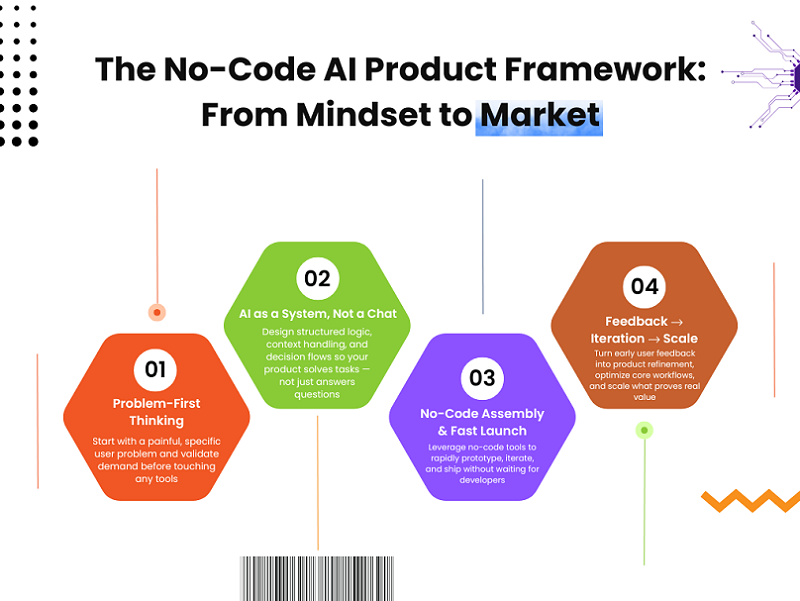
How to Build an AI Product is one of the most important questions in today’s rapidly evolving digital economy. The product market is changing faster than ever before, and traditional development approaches are no longer the only path to success.

Launching a valuable digital product no longer requires deep programming expertise, a full development team, or months of complex coding. Today, competitive advantage belongs to those who clearly understand the problem, move quickly, and know how to turn artificial intelligence into a practical, working solution.

This shift is especially visible in the AI-powered micro-SaaS space. A new generation of product creators is emerging — experts, marketers, analysts, and founders without technical backgrounds — who are building scalable AI products without writing code. The market increasingly rewards systems thinking, speed of execution, and clarity of vision over “deep” engineering complexity.

At the same time, most people still fear, “Without code, I can’t create a real AI product.” Or, at the other extreme, when an AI product is understood as a simple chat with a few tips, it’s a simple process. As a result, dozens of projects are emerging that look like tools but never become products.

In this article, we’ll walk you through the step-by-step process of creating a fully-fledged AI product without code, not just an interface on top of a model. You’ll understand the logical building blocks of such a product, how it makes decisions, how it works with context, and why this makes it scalable. We’ll speak in simple language, without technical noise, but with a depth often lacking in guides.

This article is about the mindset of a product founder in the AI era.

If you want to create micro-SaaS products that actually find users, rather than die at the idea stage, you’ve come to the right place.

1. What Do We Call an AI product (and where everyone gets confused)

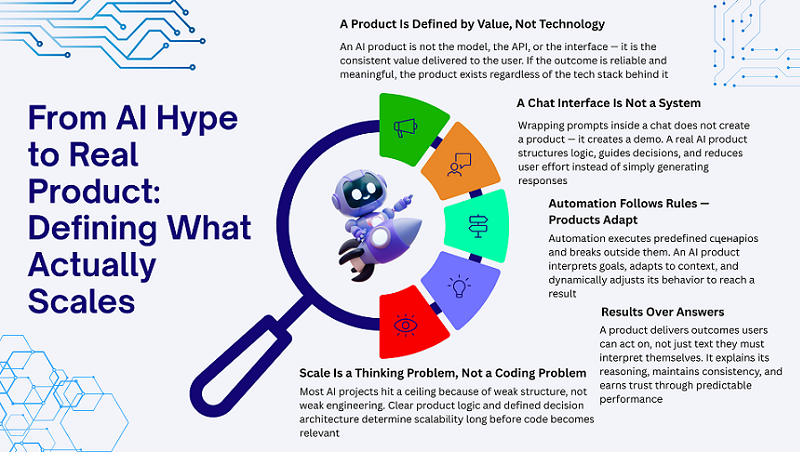
The term “AI product” is overused these days. Some use it to describe a chat with prompts, others to describe API-based automation, and still others to describe any interface with a “Generate” button. This creates the illusion that many are already building a product, when in fact, they only have a tool or a wrapper around a model.

In this section, it’s important to clarify the concepts, because without it, everything will be built on a shaky foundation. An AI product isn’t about the technology, the model, or the service you use. It’s about the value the system consistently delivers to the user.

If you don’t separate these things from the very beginning, the product is almost guaranteed to hit a ceiling with the first few users. Therefore, let’s first understand what makes a product a product, not just a set of features. Only then does it make sense to talk about steps, scaling, and growth.

An AI product ≠ a Chat with Prompts

Most so-called AI products are actually just a regular chat with a pre-written prompt. The user enters something, the model responds, and that’s it. This may look impressive at first, especially if the answers are good.

The problem is that this approach doesn’t create a system. It doesn’t make decisions, doesn’t consider context, and doesn’t guide the user to a result. It’s simply an interface on top of the model.

An AI product begins when the system takes over some of the thinking, rather than simply generating text. If you remove the user from the process of making every step, that’s when the product emerges. Everything else is just a demo.

How a Product Differs from Automation

Automation solves a specific problem according to a predetermined scenario. If the conditions are met, it works; if not, it breaks. An AI product takes a different approach: it adapts to the situation rather than simply following instructions.

The product considers the user’s goal, their context, and possible scenarios. It doesn’t simply “do an action,” but helps them make a decision or reach a result.

This is where the line between automation and a product is drawn. If a system can’t choose and adapt, it’s a set of scripts, even if it’s powered by AI. And such projects almost always come down to scale.

How to Know You’re Creating a Product

There’s a simple way to check this without using complicated terms. First, the product can explain why it performs a particular step. Second, it delivers a result, not just an answer. And third, it works consistently and reliably for different users, not just for the “ideal scenario.”

If a system requires manual edits, clarifications, and monitoring every time, it’s not a product. A true AI product reduces the user’s cognitive load, rather than shifting it onto them.

If you see that the user trusts the system and follows its logic, that’s a good sign. This means you’re no longer creating a tool, but a product.

Why code isn’t even important here

A common mistake is to think that scale and quality are limited by code. In practice, it’s the opposite. Most AI products fail not because of technical limitations, but because of a lack of structure and logic.

You can write perfect code, but if the product doesn’t understand what it does and why, it won’t scale. Conversely, a well-designed system can evolve for a long time without any programming at all.

Code is just a way of implementing it. Growth is limited by thinking: how you define the problem, solutions, and product behavior. That’s where you need to start.

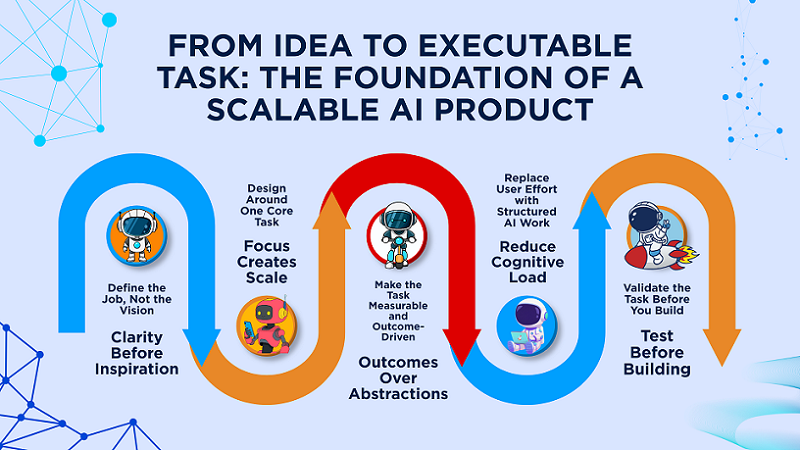
2. Clearly Define the Task, Not the Idea

Almost all AI product problems begin with the phrase “I have an idea.” The idea sounds inspiring, but it’s too vague to build a system on. AI doesn’t handle abstractions well, but it’s great at concrete work.

Therefore, the first and most important step is to stop thinking in terms of ideas and start thinking in terms of tasks. Not “what we want to do,” but what job the product performs for the user.

If this step is skipped or done pro forma, everything will fall apart: the UX, the logic, and scaling. But if the task is clearly defined, half the product is already built. In this section, we’ll look at how to do this as simply as possible.

This is exactly where most AI products quietly fail — long before prompts, tools, or automation even matter.

Founders often jump straight into defining tasks without validating whether the underlying idea is worth turning into a system at all. As a result, the task may be well-defined technically, but irrelevant from a market perspective.

A scalable AI product always starts one level earlier: with a strong, narrow SaaS idea grounded in a real problem. If the problem is weak, no amount of task clarity will save the product later. You’ll end up optimizing logic for something users don’t truly need.

Before defining what the AI should do, it’s essential to understand *which problems are actually worth solving* and how to quickly filter out ideas that sound good but fail in reality.

If you want a practical, no-fluff breakdown of how to find strong SaaS ideas and validate them before building anything, this free lesson walks through the exact process: Day 1 — Where to Find Great SaaS Ideas (and how to vet them)

This step ensures that every task you define later is anchored in real demand, not assumptions.

Not “what to do,” but “what job does AI perform”

The phrase “AI helps write texts” means nothing. But “AI turns a rough brief into a finished draft for a specific purpose” is a task. The AI Job To Be Done approach helps eliminate unnecessary distractions and focus on results.

It’s not the technologies used that matter, but what work the user no longer wants to do themselves. If AI takes over this work, the product will be in demand.

A clearly defined task immediately suggests the logic, context, and solutions the system needs. Everything else is built around this.

One Task is Better than Ten Features

Many people believe that more features = more value. In AI products, this is almost always a mistake. Each new feature increases system complexity and reduces stability.

One well-solved task scales much better than ten superficial ones. Users value predictability and a clear outcome, not a set of features.

Focus simplifies not only the product but also marketing, onboarding, and growth. This is why most successful micro-SaaS start with a single task.

Examples of Good and Bad AI Tasks

A bad task is: “AI helps entrepreneurs.” A good one is: “AI analyzes incoming leads and suggests the next step.” In the first case, it’s unclear what the product does; in the second, everything is clear.

A good task is always measurable, limited, and tied to a specific outcome. A bad one is abstract and requires constant clarification from the user.

If the task is difficult to explain in a single sentence without “and,” “or,” and “plus,” it’s likely poorly formulated.

How to Test a Task Before Building a Product

There’s a simple sanity check. Imagine an AI performing a task perfectly. Is the user willing to pay for it or use the product regularly? If not, the task is weak.

The second test is whether the process can be described in words, without an interface or code. If the logic falls apart at this stage, the product will also fall apart later.

This type of check saves months of work and helps immediately weed out ideas that sound good but don’t work in practice.

3. Break the Product Into a System, Not Screens

Most no-code AI products start from screens: dashboard, chat window, settings, buttons. This feels logical, especially for founders with a design background. But screens are just the surface — they hide how the product actually works.

When you think in screens, you optimize UI, not decisions. And AI products fail not because of bad UI, but because of broken logic underneath.

A scalable AI product should be designed as a system first, and only then wrapped into interfaces.

System thinking forces you to define inputs, transformations, and outputs explicitly.

This makes the product easier to debug, extend, and automate later. More importantly, it prevents the “it works in demo but breaks in ” problem.

In this section, we’ll reframe how to think about AI products before touching any no-code tools.

Why Screens Kill Product Thinking

Screens push you to focus on how things look, not how decisions are made. Most no-code projects fail because founders design flows instead of logic. A beautiful interface can hide a fundamentally weak system underneath.

When something breaks, you don’t know where or why. AI products especially suffer from this, because errors are often invisible at first. System-first thinking forces clarity before complexity appears.

What “a System” Means in an AI Product

A system is a sequence of steps that turns raw input into user value. It doesn’t require architectural diagrams or technical jargon.

At its core, it answers four questions: what comes in, what happens inside, and what comes out. AI is just one component inside this flow, not the whole product.

When you define the system clearly, tools become replaceable. That’s how no-code products avoid being fragile.

Input: What the AI Actually Receives

Most founders think the input is “the prompt”. That’s only the visible layer. In reality, input includes user intent, prior actions, constraints, and product state.

If you don’t define this explicitly, the AI is forced to guess. Guessing works with early users, but fails at scale. Clear inputs reduce hallucinations and increase consistency. Good AI products don’t rely on luck — they rely on structure.

Output: What Counts as a Result

The output of an AI product is not text. It’s value. Sometimes that value is a decision, sometimes a summary, sometimes a next action.

If you measure success by “good answers”, you’ll miss the real problem. Users care about outcomes, not eloquence.

A strong system defines what success looks like before generating anything. That’s how AI becomes useful, not just impressive.

A strong system defines what success looks like before generating anything.

That’s how AI becomes useful, not just impressive.

4. Design Context, Not Prompts

Most beginners obsess over prompts. They tweak wording, add instructions, and hope for better results.

This works temporarily, but it doesn’t scale. Prompts are fragile because they lack memory, structure, and awareness of the product state.

Context is what makes AI behave consistently across sessions and users.

It defines why the request exists, not just what is being asked.

When context is designed properly, prompts become short and stable.

This is one of the biggest mindset shifts in building no-code AI products.

Why AI Breaks Without Context

Without context, AI treats every request as isolated. This leads to contradictions, repeated questions, and shallow outputs.

The problem often isn’t visible with the first users. It appears only when usage patterns diversify. At that point, prompt tweaks stop working. Context is what prevents the system from falling apart under real usage.

Core Types of Context in AI Products

There are four main types of context: history, goal, constraints, and state. History explains what already happened. Goals define what the user is trying to achieve. Constraints limit what is allowed. State reflects where the process currently stands. Together, they give AI situational awareness.

How to Store and Update Context Without Code

Context management is about logic, not tools. You decide what must persist and what can expire.

Some context lives across sessions, some only within a single flow. The key is to update context after meaningful actions, not every message.

This keeps the system lightweight and predictable. No-code tools can store data, but you design the rules.

The “Every Request From Scratch” Anti-Pattern

Treating each request as new is the fastest way to kill product intelligence. It forces the AI to re-learn the same things repeatedly. This increases costs and decreases quality. More importantly, it breaks the user’s mental model. Users expect the product to “remember”. Persistent context is what makes AI feel like a system, not a toy.

5. Turning an AI Idea Into a Working Product System

At this stage, it’s crucial to make a key shift in thinking: stop perceiving an AI product as a set of screens or functions and start seeing it as a system. This is where most no-code projects either start to grow or get stuck forever.

The problem isn’t the tools or the lack of code, but rather the product’s lack of understanding of how it should work in different situations. A system is what connects inputs, context, logic, and output into a coherent whole. Without this, the product only works in demo mode.

In this section, we won’t delve into architecture. The goal here is simpler: to demonstrate how to think systemically, even when building a product without code. This is the foundation without which scalability and stability are impossible.

Product ≠ Screens: Why Interfaces Don’t Define AI Products

Most no-code products start with screens: chat, dashboard, settings, buttons. This creates a sense of progress, but in reality, it distracts from the essence. The interface is a shell, not a product. When thinking gets stuck on the UI, the decisions within the system remain unformulated.

This is where the first mistakes appear: the product “looks” finished, but behaves unpredictably. The system begins to break down under non-standard requests. Ultimately, the design becomes a crutch that hides a lack of logic. Therefore, in AI products, the system is always more important than the interface—the interface can be replaced, but the system cannot.

Context Over Prompts: What Makes AI Behave Predictably

Many people think that the quality of an AI product depends on a perfect prompt. This may work at the start, but not at scale. A prompt is just one signal, not the whole picture.

Context is an understanding of why the user is making a request, what state they’re in, and what’s happened before. Without this, the AI starts from scratch every time. The product loses consistency, and the user loses trust. It’s the context that makes AI behavior stable and predictable, and this is immediately noticeable, even if a human can’t explain why.

Decisions, Not Generation: Where Real Product Value Lives

Text generation alone doesn’t create a product. It can be useful, but value only emerges when the system starts making decisions. An AI product’s value isn’t in the way it answers beautifully, but in the way it guides the user to a result.

Real products decide what to do next, which option is better, where the user is making mistakes. If AI simply generates, it’s a tool. If it chooses, guides, and limits, it’s a product.

This is where the line between a tool and a system is drawn. We explore this distinction in depth in How to Build Scalable AI Products Without Code (Using ChatGPT as the Core Layer) — where we break down the architectural principles behind decision-driven AI systems. Here we’ll only hint at it: scalable AI products are built around decisions, not text.

6. From Prototype to First Users (Without Breaking the System)

The transition from prototype to first users is the most fragile stage in the life of an AI product. This is where most projects fail, even if the idea itself is strong. The problem is rarely related to the model, tools, or lack of code. More often than not, the system is simply not prepared for real-world human behavior.

At the prototype stage, everything seems logical and manageable, but first users wreak havoc. They use the product differently than expected, ask the “wrong” questions, and break the flowcharts. The goal of this stage is not growth, but testing the viability of the system. You need to reach users without the product falling apart under the first pressure. That’s what this section is about: how to carefully transition into reality without destroying logic and trust.

Why Most AI Products Never Reach Real Users

Most AI products get stuck before their first users, and the reason is almost never technical. People endlessly refine, rewrite, and improve something that no one uses yet. This is often driven by fear: the fear that the product is “not good enough.”

No-code isn’t a solution here, because it speeds up the build process but doesn’t eliminate uncertainty. Ultimately, the product exists only in the creator’s mind. The longer the release is delayed, the harder it becomes to take the first step. And without real users, the system remains a hypothesis.

What “Minimum Viable” Means for AI Products

For AI products, an MVP isn’t a “bare bones” or “unfinished” product. It’s a system that reliably does one thing. The user doesn’t care how many features it contains, as long as the outcome is predictable.

At launch, the core should work: input → logic → output. Everything else can be deliberately simplified or eliminated. The most dangerous thing is to launch a product that behaves inconsistently. This is what destroys trust the fastest. A good MVP in AI has fewer features, but more confidence in the system’s behavior.

Getting First Users Without Marketing or Budget

First users aren’t about growth or scale. They’re a learning tool. Their purpose is to show where the system breaks down in real life. Therefore, advertising is unnecessary and even harmful.

The right first users are people you can communicate with directly. Manual onboarding at this stage isn’t a crutch, but a strategy. It allows you to see the product through the user’s eyes.

When an AI product is truly useful, it automatically suggests what needs to be fixed next. And this knowledge is more important than any metrics at the start.

Conclusion

AI products don’t die due to lack of code or poor tooling. They die due to a lack of structure and clear thinking. A prototype is just the beginning, and real users quickly reveal where the system was weak.

In the early stages, you shouldn’t think about scaling, automation, and growth. You need to think about product behavior and trust. If the system can handle the first few users, it will handle more.

We explore everything related to upgrades, scale, and long-term sustainability of an AI product in our pillar article. This is where the next level of product founder thinking begins.

How to Set Up Freemius Payments

How to Set Up Freemius Payments for Your AI Micro-Saas Project

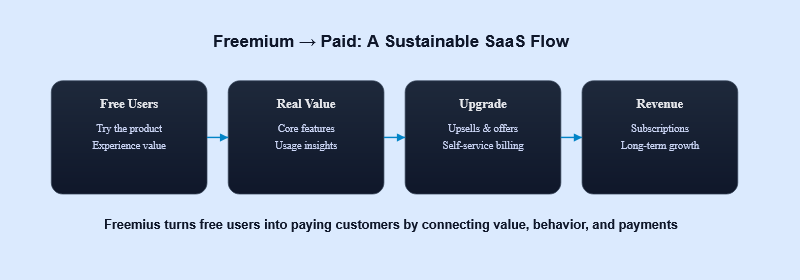
The freemium model is a common monetization approach for micro SaaS products, where users start with free access to limited features and pay to unlock advanced functionality.

People rarely commit to paying for software they haven’t experienced. Giving users the ability to explore a product before spending money significantly reduces friction and makes adoption easier.

For SaaS businesses, the freemium model works especially well because it allows users to see real, practical value in action. Once the product proves its usefulness in day-to-day scenarios, upgrading to a paid plan becomes a natural next step rather than a forced decision.

That said, freemium is not just a pricing tactic — it’s a system. Without a clear understanding of how it should be implemented across your product, payments, and growth infrastructure, it’s almost impossible to build predictable and sustainable revenue. Poor execution often leads to large numbers of free users with little to no monetization.

This is where Freemius comes in. It’s a platform designed to help SaaS founders implement freemium and paid models correctly, without turning monetization into a technical or operational burden. In this article, we’ll look at how Freemius works and which marketing capabilities it provides to support growth.

1. Turning Free Users into Paying Customers

a) Subscriptions, Licensing, and Payments in One System

Freemius provides an all-in-one infrastructure for handling subscriptions, license management, payments, taxes, marketing automation, and analytics for digital products, including SaaS. It allows you to manage free and paid access from a single dashboard, without building complex custom solutions.

The platform takes care of subscription billing, payment processing, tax compliance, and security by default. On top of that, it offers a wide range of built-in features that simplify monetization. Instead of stitching together multiple tools, you get a unified system that lets you focus on product and growth rather than payment logic.

b) Designed for Conversion, Not Just User Acquisition

Freemius is built with one core objective in mind: converting free users into paying customers. Every marketing feature inside the platform supports this goal.

Tools such as behavioral analytics, in-product upsells, discount campaigns, and automated triggers are designed to nudge users toward upgrading at the right moment. The self-service user portal allows customers to upgrade plans, manage licenses, and update payment details on their own — reducing friction, improving retention, and lowering support overhead.

Beyond surface-level growth metrics, Freemius helps you understand how users interact with your product, identify blockers in the payment journey, and increase customer lifetime value. The focus is not on collecting free sign-ups, but on building a monetization engine that scales with your SaaS.

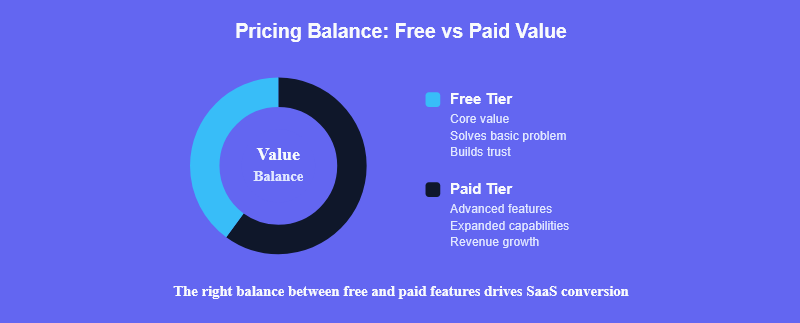
2. Planning Pricing Tiers and Paid Features

Pricing drives growth in every SaaS business. Founders need to decide not only how much to charge, but also which features belong in free access and which ones create real incentive to upgrade.

Users should experience value before they see a paywall. When people understand what your product does and how it helps them, moving to a paid tier feels natural. A well-designed pricing model increases the chances that free users turn into paying customers instead of staying stuck on the entry level.

a) Structuring Free and Paid Access

Imagine a micro-SaaS that solves one clear problem. The free plan lets users achieve a meaningful result and understand the product’s core benefit. At the same time, it clearly shows that more advanced capabilities exist in the paid version.

This balance matters. You want users to succeed with the free tier, but you don’t want to give away everything. Freemius helps manage this boundary. It allows founders to define plans and feature sets with precision, enabling or disabling functionality per tier. This approach keeps the free plan useful while protecting premium value.

b) How Pricing Structure Affects Conversion

Pricing structure directly influences upgrade behavior. When the free plan includes too many features, users see no reason to pay. When it offers too little, users fail to understand the product’s real value and leave.

The strongest conversion happens when the free tier solves a simple, narrow use case, while paid plans unlock broader capabilities and efficiency gains. Freemius supports this strategy with tools such as time-limited trials, feature-based plan configuration, and automated upgrade flows.

These mechanisms help founders observe how users interact with pricing, identify upgrade triggers, and present paid options at the right moment. Instead of forcing upgrades, the system guides users toward higher-value plans as their needs grow.

3. How Freemius Strengthens Your Marketing Funnel and Freemium Conversion

After you solve the technical side of payments, the real work begins. You need to guide users through a clear and efficient marketing funnel—from their first interaction with your product to the moment they decide to pay.

In SaaS, marketing doesn’t stop at ads or landing pages. Monetization plays a direct role in how users move through the funnel. Pricing logic, upgrade timing, and in-product messaging all influence conversion.

Monetization tools like Freemius work best when they’re part of a broader SaaS strategy — one that starts long before payments, with idea validation, positioning, onboarding, and a clear path to your first users.

If you want to see how all these elements connect into a single, structured process, this AI SaaS Roadmap: From Idea to First Users in 30 Days Without Heavy Coding walks through the full journey step by step.

Freemius helps founders shape flexible and personalized conversion paths without heavy engineering. You can test ideas, react to user behavior, and improve monetization without rebuilding your product.

a) Automated Messaging and Purchase Triggers

When a user shows exit intent, Freemius can display a targeted message instead of letting them leave silently. This small intervention often shifts hesitation into action and keeps the user engaged.

Freemius also supports discounts, upsells, and other purchase incentives that work together as part of a single system. Each message responds to user behavior, not guesswork. You create timely nudges that feel relevant instead of aggressive, which improves conversion without harming trust.

b) Marketing Integrations and Behavior Insights

Freemius connects with external marketing and analytics platforms to extend your funnel beyond the product itself. You can send data about user actions, trials, upgrades, and cancellations directly into your CRM or analytics stack through webhooks or built-in integrations.

This setup gives founders a clear view of where users slow down or drop out. You see which stages of the funnel need better value communication and which actions trigger upgrades. With data and automation working together, you build a marketing system that supports long-term growth instead of one-off campaigns.

4. Using Freemius Analytics to Drive Growth and Increase Customer Lifetime Value

Sustainable SaaS growth doesn’t happen by accident. Setting up payments alone won’t create predictable revenue. Founders need visibility into how users behave and what motivates them to stay, upgrade, or leave.

Freemius gives you direct access to these insights. The platform shows live performance metrics and lets you compare user segments so you can make informed growth decisions for your micro-SaaS. This approach matters even more when your business relies on subscriptions and ongoing engagement.

a) Metrics That Matter for Growth and LTV

Running a micro-SaaS means tracking the right numbers. Metrics like monthly recurring revenue (MRR), churn rate, average revenue per user (ARPU), and customer lifetime value (LTV) shape every strategic decision.

Freemius displays these metrics in real time inside the dashboard. You can quickly identify which plans generate the most value and which features need refinement. By exploring the data, founders understand which users stay longest, which segments drive revenue, and where additional engagement can improve retention.

b) User Segmentation and Cohort Analysis

Cohort analysis groups users by shared characteristics such as acquisition source, plan type, or signup period. Tracking these groups over time reveals patterns that individual metrics can’t show.

With Freemius, you create cohorts automatically and monitor their behavior without exporting data or building complex spreadsheets. This visibility helps founders pinpoint when churn spikes, which features push users to upgrade, and which customer groups deliver the highest long-term value.

5. User Retention and Churn Reduction with Freemius

User acquisition is only part of the success of the freemium model. It’s also important to retain paying customers, increase their lifetime value (LTV), and thus generate the core profit of your micro SaaS.

Freemius provides a complete set of tools for subscription management, user behavior analysis, and developing strategies aimed at reducing churn and increasing repeat sales.

a) Working with Subscription Renewals and Reminders

One of the reasons paid subscriptions are cancelled is unintentional cancellations of renewals. Users may forget about license renewal deadlines, misunderstand the value of upgrades, or simply hesitate over their decision. There are factors that reduce passive cancellation and make subscription renewal a natural continuation of product use. This is achieved by Freemius sending reminders about the upcoming subscription expiration. The service also notifies users of renewal benefits, such as updates, security, and support. Users can also renew their subscription without entering payment information.

b) Segmentation of Users by Behavior and Status

Not all users behave the same when interacting with the service. The service collects data on license type, frequency of updates and interactions with the product, user activity, and customer lifecycle stage. Based on this data, you can send personalized information to different segments, offer upgrades to those users who are ready to purchase, and immediately identify users at high risk of churn. This segmentation increases marketing effectiveness.

c) Win-back Strategies for Returning lost Customers

A churn isn’t always a permanent loss. Freemius provides data that helps you understand at what point a user terminated their paid subscription, which plan was a barrier, and how much time has passed since the churn. Once you have this information, you can launch win-back campaigns, such as personalized discount offers, access to new features, or temporary trial periods for paid plans. This way, you can increase your overall LTV and regain some of your lost users without spending money on acquiring new traffic.

6. Scaling Sales and Automating Monetization with Freemius

Once the freemium model has proven its effectiveness, the primary objective now becomes scaling. Freemius allows you to automate key monetization processes, reduce operating costs, and focus on product improvement rather than payment management.

a) Automation of Payments, Taxes and Licensing

Selling digital products globally can pose various financial and legal challenges. Freemius can not only process payments but also calculate and pay taxes, manage licenses and access, and issue invoices and refunds. This is especially important if your business team is small and you don’t need to build your own billing infrastructure.

b) A/B Testing of Prices and Offers

The optimal price isn’t a guess, but the result of experimentation. Freemius can test different pricing plans, monthly and annual subscriptions, bundles and upsells, and special offers for new and existing users. You can analyze conversion and revenue for each option and gradually increase ARPU (Average Revenue per User) and find the most profitable monetization models.

c) Entering the Global Market and Localizing Sales

Freemius is focused on international sales. The platform supports local payment methods, trusted checkout pages, multi-currency payments, and adaptations for different regions and markets. Developers can scale globally without having to create separate payment solutions for each country.

7. Common Mistakes When Working with Freemius and How to Avoid Them

The service provides a powerful monetization infrastructure, but developers must also know how to properly use the tools provided.

Many projects fail to realize the potential of the freemium model due to common mistakes in pricing, communication, and data management.

In practice, many of these mistakes don’t originate at the monetization stage. They usually start much earlier — when the initial SaaS idea hasn’t been clearly defined or properly validated.

If you want to begin at the very start and learn how to find and vet strong micro SaaS ideas, you can begin with Day 1 — Where to Find Great SaaS Ideas (and how to vet them).

Understanding these mistakes allows you to accelerate growth and avoid lost revenue in the initial stages of a project’s launch.

a) Generous Free Version Without Upgrade Motivation

Providing users with too much functionality in the free version of your product is a big mistake. If users perceive that they’ve received too much value, they’ll be less inclined to upgrade to a paid plan. The best approach is to ensure that the free version doesn’t address key use cases but merely demonstrates value. Paid features are a logical extension of product use. Functionality limitations shouldn’t feel like an artificial barrier. Users should see this as a natural part of their growth. Freemius allows you to track where users are stuck on the free plan and haven’t yet reached a paid plan. This is a valuable feature that will allow you to properly adjust your product growth strategy.

b) Ignoring Analytics and User Behavior

Many developers use Freemius solely as a payment tool without analyzing the data. As a result, decisions are made based on intuition rather than facts. Common problems include ignoring churn rate and LTV data, misunderstanding what influences conversion, and a lack of analysis of payment abandonment points. Regularly working with Freemius analytics, however, allows you to adjust pricing, improve onboarding, and increase overall monetization efficiency.

c) Lack of Interaction with Users After Installation

You need to constantly communicate with users so that after installing the free version of your micro SaaS, they understand the benefits of the paid version. To do this, use email notifications and in-app messages. Also, explain the value of paid features using case studies, and guide users from the first launch to the upgrade. You build all of this systemically together with the Freemius service.

Final Thoughts

The freemium model alone doesn’t guarantee success. True success lies in building the right funnel and consciously designing each stage.

If you’re a WordPress plugin developer or a micro SaaS company, Freemius becomes more than just a payment solution, but a full-fledged growth platform. This is because it allows you to convert free users into paying customers, helps you build the right marketing funnel, increases conversion, and performs a host of other essential tasks.

When you use its tools strategically, you can build a sustainable business model where product, marketing, and monetization work seamlessly.

If you plan to scale a freemium product or increase revenue without overcomplicating your infrastructure, Freemius is one of the most powerful online platforms for achieving these goals.

How to Choose the Best Domain Name for Your AI SaaS Project

Selecting a domain name is one of the earliest decisions you’ll make when starting an AI SaaS project, and it has a direct impact on everything that follows.

A domain name shapes how users perceive your product, influences their level of trust, and can also affect how your website performs in search results.

Picking a domain shouldn’t be a random decision — it plays a key role in establishing credibility, defining your SaaS positioning, and supporting long-term brand growth.

Below, we’ll break down how to select the right domain and highlight the key factors worth considering.

1. Short and Memorable Domain for AI SaaS Project

Instead of relying heavily on domain name generators, take time to clearly define what your brand stands for. A strong domain grows from a solid understanding of your product, values, and audience. This approach helps create a business that’s not only recognizable, but also sustainable. Ultimately, the best domain choice comes from your own strategic thinking.

Start by writing down around 30 potential domain names that could fit your project. Then, remove any options that don’t clearly match your product’s concept or tone. This filtering process should leave you with a short list of 5–7 domains that feel credible and professional to your future customers.

Another effective approach is to research existing websites that operate in a similar niche to your future AI SaaS project by using Google search.

Let’s say you’re creating an SEO-related platform, and the domain surferseo.com is already taken, so you create a variant based on it.

In other words, rather than copying domain names already in use by other companies, focus on crafting original domains that stand out and leave a lasting impression on your clients.

In practice, domain choices rarely work in isolation. They are a continuation of much earlier decisions—how the product idea was formed, what problem it solves, and who it’s built for. If that foundation is still taking shape, it makes sense to start from the very beginning of the SaaS journey in Day 1 — Where to Find Great SaaS Ideas (and how to vet them).

2. The Psychology Behind AI-Powered SaaS Brands

If you’re starting your own online store, you should choose a domain name based on creative logic. However, if you’re choosing a name for an AI or SaaS project, you’ll be guided by the clarity of the domain name and your reputation as an online entrepreneur.

In other words, you need a domain that enhances the value of the product you’re bringing to the market. A domain name for an AI or SaaS project should sound convincing to investors. Once you’ve answered these questions, your domain is strong.

Think about the words that best reflect your brand’s essence. Terms like “Agent,” “Suite,” “Brain,” “Vision,” or “Score” can instantly evoke ideas related to intelligence, analytics, and AI functionality. By thoughtfully merging two meaningful words, you can create a domain that feels both memorable and authoritative. Names like “BrainFlow” or “LogicAI” already convey strength and perfectly suit the AI SaaS niche.

Once you have a clear picture of your customers’ mindset and a solid understanding of your AI SaaS product, picking the right domain becomes much simpler. You’ll naturally envision the ideal brand identity, making it easier to create a domain that is unique, memorable, and perfectly aligned with your product.

3. What Makes an AI SaaS Domain Valuable?

Choosing the right domain for your AI SaaS project is more than just a creative exercise. Many founders get caught up in trying to make their domain short, catchy, or easy to read, while losing sight of the bigger picture: branding and long-term positioning. This can lead to confusion and missed opportunities.

The true impact of your domain lies in three critical areas:

a) Communicate Your Product’s Core Function Clearly

A domain is most effective when it immediately tells users what your AI-powered SaaS does. Whether your software automates workflows, performs risk analysis, processes data, or supports decision-making, a clear domain helps your audience understand your product at a glance. When the domain aligns with your software’s core functions, adoption becomes easier, and your brand gains credibility faster.

b) Convey Competence, Not Emotion

Avoid letting personal feelings or abstract ideas dictate your domain choice. Instead, focus on projecting professionalism and trust. Strong SaaS domains communicate logic, reliability, and expertise—qualities that inspire confidence in prospective users and investors alike. Abstract or overly playful names may be memorable, but they risk undermining your authority in a competitive AI SaaS market.

c) Ensure Scalability and Long-Term Fit

Your domain should grow with your product. Consider whether it can accommodate future features, expansions, or changes in your AI SaaS offering. A scalable, versatile domain appeals to a broader audience and supports long-term branding. Conversely, a domain that is too narrow or limiting can restrict your product’s potential and make future growth more challenging.

For example, if we take the domain names PrimeSaas.ai and InvoiceSoft.ai, the former will have very high scalability, and to an investor, it will look like a universal, large brand. If we take the InvoiceSoft.ai domain, it has medium-low scalability and a narrow, financially constrained niche.

4. Categories of Domains Determining Demand for AI and Saas

When choosing a domain for your AI SaaS project, it’s important to consider the product’s functionality rather than just keywords. Domains that clearly reflect the AI service type tend to be more memorable, scalable, and attractive to both customers and investors. Below is a structured overview of key domain categories in the AI SaaS space.

a) Autonomous Agent Domains

These domains represent AI that acts as a self-sufficient agent performing user tasks, such as automated content creation, email and communication management, task planning, and workflow automation. Examples include TaskAI.io, AgentSaaS.ai, and AutoBot.ai. High demand exists here, as autonomous agents are a fast growing trend, offering strong scalability potential and investor appeal.

b) Process Automation Domains

Automation domains focus on optimizing workflows without necessarily acting as autonomous agents. Key applications include reporting, data processing, marketing, CRM, and billing. Examples: SmartWorkFlow.ai, SaaSify.ai. Ideal for niche B2B products, these domains can be expanded across related processes, enhancing long-term value.

c) Analytics and Insights Domains

Domains in this category highlight AI SaaS that analyzes data, generates forecasts, and provides actionable insights rather than automated execution. Examples include InsightAI.io, DataMind.ai, and AnalyticsSaaS.ai. These are particularly attractive to corporate clients and large enterprises, where data-driven decision-making is critical.

d) Verification and Compliance Domains

SaaS AI in this sphere ensures authenticity, security, and regulatory compliance, including document verification, fraud prevention, and identity checks. Domain examples: VerifyAI.io, TrustLayer.ai. These domains have medium-to-high scalability and are especially valuable to banks, financial institutions, and other regulated industries.

e) Data Infrastructure Domains

Domains that reflect AI SaaS focused on data storage, integration, and processing. Applications include data pipelines, lakes, and quality monitoring. Examples: DataOps.ai, CloudAI.io, SmartDB.ai. These domains attract large SaaS enterprises and strategic buyers due to their cross-industry applicability, from finance to marketing and HR.

f) Productivity and Workflow Domains

These domains represent AI that enhances team efficiency and internal workflows, such as smart assistants, document automation, team chatbots, and workflow optimization. Examples: WorkAI.io, FlowSaaS.ai, TaskMind.ai. High scalability and broad industry application make these domains appealing to investors.

g) Developer and API Platform Domains

Focused on SaaS AI that provides SDKs, APIs, or developer tools, enabling integration of AI into web projects. Examples: DevAI.io, APIHab.io, CodeSaaS.ai. This segment is highly expandable into analytics, fintech, gaming, and marketing, attracting startups and investors building AI ecosystems.

h) Customer Experience Domains

Domains for SaaS AI improving customer interactions through chatbots, personalized recommendations, and automated support. Examples: SupportBot.ai, CustomerFlow.ai, AssistAI.io. Demand is high across e-commerce, fintech, education, and SaaS, with ROI easily measurable, making these domains attractive to investors.

i) Retail and E-Commerce Domains

These domains optimize sales, recommendations, pricing, and marketing for online and physical stores. Examples: RetailAI.io, ShopSaaS.ai, SmartStore.ai. They can scale across marketplaces, SaaS trading platforms, and warehouse management, offering high demand potential from online sellers.

j) Professional Corporate Domains

Short, technologically advanced domains that convey reliability and professionalism. Ideal for B2B SaaS and large AI platforms. Examples: PrimeSaaS.ai, DataBridge.ai, FlowSaaS.ai. High demand and scalability make them attractive to corporate clients and investors.

k) Hybrid Functional Domains

Domains combining a product keyword with AI/SaaS/Bot or an industry term with a tech term. These names are clear, moderately formal, and SEO-friendly. Examples: MarketingAI.io, AutoWorkFlow.ai. They balance brand identity with product functionality, offering medium-to-high scalability.

l) Human-Like AI Domains

Domains that sound personal or human, creating an emotional connection with users. Best suited for AI assistants, chatbots, and B2C products. Examples: EvaAI.io, AlexBot.ai. These domains are niche, moderately scalable, and excel in branding, though less impactful for SEO.

5. The Future of AI & SaaS Domains

The future of domains for SaaS projects and AI platforms is being shaped not by hype, but by how quickly the way products are being built is changing. Today, you can launch any startup in literally a week, sometimes a weekend, and a domain is increasingly becoming the first strategic decision, not a formality. In the AI ​​niche, a domain name is increasingly perceived less as just a website address and more as part of the product and brand. This is especially noticeable in micro-SaaS projects, where a domain can immediately provide a top-notch trust framework.

The market is gradually moving away from complex, difficult-to-read names toward short, clear, and easily scalable domains. AI projects no longer need to explain their name—you simply glance at it and read it intuitively. At the same time, the value of domains that aren’t tied to a single function or model is growing. Name flexibility is now more important than specificity.

We are also seeing a trend toward domains that can be used globally, without any linguistic or cultural barriers. AI-SaaS is increasingly being built for a single country or market. This means that domain versatility will likely only increase in value. In the future, a domain for an AI project will become an asset that can be scaled, repositioned, and even sold separately from the product. This is why understanding future trends is crucial even at the naming stage.

6. The Smart Investor’s Guide to High-Potential AI & SaaS Domains

In today’s fast-moving world of AI and SaaS, a domain name isn’t just a web address—it’s a strategic asset. The right domain can increase a startup’s perceived value, attract investors, and support long-term growth. But finding such a domain requires more than speed or luck; it demands understanding the market niche, branding, and emerging trends.

Below, we outline five key principles that savvy investors use to identify domains with genuine potential and lasting value.

a) Secure a Strong Category Before Making a Purchase

Never buy a domain without first evaluating the strength of the niche behind it. A domain that belongs to a growing market automatically benefits from demand momentum, making it more valuable over time. Even outside your own product, such a domain can retain value on the secondary market because it is supported by real industry growth.

b) Use the A.I.R. Framework: Attract, Identify, Retain

A well-chosen domain should work for your brand from the very beginning. The A.I.R. framework helps with this. An effective name attracts attention instantly, is easy to recognize and remember, and clearly reflects what the product does. Most importantly, it creates trust, turning a simple domain into a long-term brand asset rather than just a web address.

c) Choose Domains That Strengthen Brand Identity

Your domain is often the first interaction users and investors have with your startup. Strong domains communicate clarity, confidence, and authority. When a name clearly reflects who you are and what you offer, it becomes easier to build credibility and position your product in a competitive AI SaaS market from day one.

d) Learn from Proven Startups and Market Leaders

Analyzing successful startups provides valuable insight into naming patterns, keyword usage, and branding strategies that actually work. This research helps you understand how your target audience perceives certain terms and allows you to select a domain that feels modern, professional, and aligned with current market expectations.

e) Avoid Short-Term Trends and Gimmicks

Trendy or overly creative domains may look appealing at first, but they rarely age well. Many of them lose relevance as markets evolve. Instead, focus on domain names that are timeless, trustworthy, and flexible enough to grow with your AI SaaS business. Domains built on solid logic and clarity are far more likely to hold long-term value.

By relying on market analysis, brand alignment, and real industry signals—rather than buzzwords or fleeting trends—you increase your chances of choosing a domain that supports sustainable growth and long-term success.

7. How Investors Assess the Real Value of AI & SaaS Domains

The pricing of AI and SaaS domains follows very different rules compared to standard domain names. Value is influenced not only by how short or catchy a name is, but also by the market it serves, the strength of the niche, and its branding potential. A well-positioned domain in a fast-growing category can be worth many  times more than a similar name in a less competitive space.

a) Base Value: Clarity, Length, and Ease of Use

Domains that are short, easy to pronounce, and simple to remember form the foundation of any valuation. For SaaS projects, a clean two-word .com domain often starts around the $5,000 range. Strong branding combinations can push this value toward $50,000 or more, especially when investors see clear upside.

b) Category Premium: Demand Drives Price

Market demand plays a major role in pricing. Domains tied to rapidly expanding sectors—such as AI copywriting tools, generative media, automation, fintech, or cybersecurity—often command significantly higher prices. In some cases, niche momentum alone can increase a domain’s value by 150–200% compared to generic alternatives.

c) Brand Strength: Ready for a Startup from Day One

A valuable domain must work as a brand, not just a label. Startup-friendly names that clearly communicate purpose and identity allow companies to launch faster and with more confidence. Premium, highly brandable AI SaaS domains commonly trade in the $30,000 range, and in high-growth scenarios, valuations can exceed $100,000.

d) Comparable Sales and Market Reality

To understand true market value, investors analyze real transactions on platforms such as Sedo and Flippa. Recent sales show that two- or three-word SaaS domains in strong categories typically sell between $5,000 and $50,000. Short, single-word premium domains operate in a different tier, often reaching $50,000 to $200,000 or more.

e) Liquidity and Exit Potential

Domains that can be easily reused, resold, or positioned as a credible startup brand have high liquidity. This perception alone can add 30–50% to the base valuation. Domains lacking resale appeal, even if they sound attractive, tend to remain illiquid and offer little long-term investment value.

f) Investor Shortcut: A Practical Valuation Model

Many investors rely on a simple multiplier-based approach. The base price is adjusted by niche strength, brand quality, and liquidity. Example: Base value: $5,000 / Strong AI category multiplier: 1.5 → $7,500 / Branding strength multiplier: 2 → $15,000 / High liquidity multiplier: 1.3 → $19,500

This framework provides a fast, realistic snapshot of a domain’s investment potential.

8. The Mistakes that Kill AI & SaaS Domain Potential

Many people believe that domain problems arise from short-term thinking. A common mistake you can make is choosing a domain “for a current feature” rather than for a future product. Today it’s an AI chat, tomorrow a platform, but the domain is already limiting growth. You can’t fix such decisions without rebranding.

If you’re overcomplicating things, that’s your second mistake. Adding unnecessary words, hyphens, or non-standard endings reduces memorability and trust. A user may forget your domain name within minutes of their first visit. This isn’t ideal for your micro SaaS project.

Also, many underestimate the negative value of a domain. If a name looks cheap or lacking confidence, it automatically diminishes the overall product’s perception. Even powerful technology can’t compensate for a bad first impression.

Another mistake is trying to copy trends without understanding the context. Not every AI term will be relevant in a year. Domains tied to temporary hype often quickly lose value. As a result, the project starts with a limitation that is not immediately apparent, but which can become a problem in the future, especially as it gradually becomes a problem as you grow.

9. Selling AI & SaaS Domains: The Proven Conversion Method

Selling domains in the AI ​​and SaaS niches doesn’t work by listing a domain and then expecting it to be bought. The value of your domain should be immediately apparent. Buyers aren’t paying for symbols—they’re paying for potential. That’s why it’s crucial to know how to properly present a domain to a buyer.

If you can demonstrate the actual use case for a domain, it will sell well. When a potential buyer immediately sees what a product under that name could be, conversion rates soar. This is especially noticeable in the AI ​​niche, where the domain often becomes part of the positioning.

It’s also important to understand the type of buyer you’re dealing with. A founder, a marketer, and an investor will always view a domain differently. This should also be taken into account.

Another key point is the right entry point. AI domains sell best where there’s an entrepreneurial mindset, not just hunters for rare names. As a result, the domain ceases to be some abstract asset and becomes a logical part of the business strategy. This approach leads to stable transactions, not random sales.

Final Thoughts

In practice, there are two clear paths forward. You can either select a domain and grow it together with your AI-powered SaaS product, or deliberately build a strong, market-ready domain and treat it as a standalone digital asset. In both cases, the focus should be on concise two-word names that clearly express what your SaaS business stands for and show real potential from both a branding and market standpoint.

Domain decisions make the most sense when viewed as part of a larger sequence—from shaping the initial idea to validating it, building the product, and reaching the first real users. This broader perspective is outlined in AI SaaS Roadmap: From Idea to First Users in 30 Days Without Heavy Coding, where domain strategy fits naturally into the overall launch process.

This mindset allows you to create domains that become the backbone of a successful AI SaaS product—or assets that retain long-term value on their own. A thoughtfully chosen domain does more than label a project; it helps establish credibility and confidence from the very first interaction.

Remember, a domain is not just a technical detail or a URL. It is a core component of your brand and a signal of seriousness to users, partners, and investors. Apply the principles outlined in this guide to ensure that every decision you make contributes to sustainable growth and lasting business value.

ai-saas-roadmap

AI SaaS Roadmap: From Idea to First Users in 30 Days Without Heavy Coding

Building an AI SaaS solution no longer requires a large team of developers and months of development. You also don’t need to spend a huge budget on developing a micro SaaS solution. You can do it all yourself.

Of course, there are still many nuances to consider when building and launching your project, but today, everything has become hundreds of times simpler than it was before the advent of AI.

This guide will help you navigate a practical roadmap to turning your idea into a working and powerful AI SaaS product, test its value for your future clients, and get your first paying users within 30 days of starting development. All this without complex coding or a complicated infrastructure.

Day 1 – 3: Finding and Validating Your AI SaaS Idea

Our modern internet is full of routine tasks, and company employees, as well as anyone who does business online, want to automate them. This allows them to speed up many work processes, and of course, they’re willing to pay you to solve these routine tasks using AI-powered SaaS tools.

You can also already use some micro SaaS in your work and pay monthly fees for its use. This allows you to move faster in solving problems in your online business with AI-based SaaS solutions.

Now consider why you or someone else uses a specific AI SaaS solution that generates excellent profits for the owner of that AI SaaS business. Try to explain its value to users and why they are willing to pay monthly for its use.

This will help you understand what the market actually wants, and this will be your starting point for understanding how to create and launch similar AI SaaS apps and programs in today’s market.

At this stage, it’s also important to clearly understand what type of product you’re planning to build. The strategic difference between a full-scale AI SaaS platform and a focused micro-SaaS directly affects validation speed, monetization, and growth potential. If you’re unsure which model fits your idea best, this detailed breakdown explains the key differences and trade-offs between them: AI SaaS Platform vs Micro-SaaS: How to Build, Scale and Monetize Your Product Successfully

Below you can see a specific graph showing how the SaaS market shares are distributed at the moment.

However, the chart can’t accurately predict which micro AI SaaS project will work best for you. To find out, you simply need to look at existing AI SaaS products already on the market and consider them first.

a) How Quickly SaaS Became Successful

The first thing you should pay attention to is how long it took the AI SaaS project to become popular. If it’s already reached $20,000 in MRR in 6–12 months, that’s rapid growth, and you need to pay attention to why.

b) Understanding Promotion Methods

So, your second step is to determine why this rapid growth occurred. That is, you need to figure out what promotion methods the owner used to enable their AI SaaS product to grow so quickly and become profitable.

c) Why Users Chose This AI SaaS Solution

The third step is to look at the useful features of the AI-powered SaaS software, which is already used by hundreds, maybe even thousands, of users. Sometimes you can test several free AI SaaS tools yourself to understand why they’ve become popular. This is very helpful in understanding which MVP to build for your future target audience.

Now you should have a clear picture of how to build your micro AI SaaS project to ensure its success.

Day 4 – 6: Selecting a Domain, Hosting, and Creating a Website for an AI SaaS Project

For some, choosing a domain may seem easy, and for others, difficult, but in fact, you need to understand several nuances, namely:

a) The Domain Name Should Be Short and Memorable

Choose your domain name carefully because it reflects the essence of your AI SaaS business. If it’s long and confusing, it will confuse users. Try not to limit your imagination to just .com or .net extensions, but make sure they resonate with you and your users.

b) Use Niche Keywords in your Domain Name

A unique domain name allows you to differentiate your AI SaaS product from your competitors. Furthermore, the right niche keywords in your domain will help your target audience find your AI-powered SaaS solution faster. Essentially, you’ll attract only the right clients for your business. If you want a deeper breakdown with practical examples, check out our detailed guide on how to choose the best domain name for your AI SaaS project.

c) Avoid Trendy Names that may Become Outdated

Trendy names are often based on current fads, popular slang, or viral phrases. While they may feel excited at the moment, trends can change quickly over time. A domain that relies on a trend might seem outdated or irrelevant in a few years. Choosing a timeless name ensures your AI SaaS brand remains professional and recognizable long-term.

When choosing hosting for your AI SaaS project, you’re initially choosing a less expensive but reliable hosting solution. Let’s look at what we mean by “reliable.”

The speed of your pages loading and security—where your data and that of your clients are protected—are crucial here. It’s also crucial to have ongoing technical support available, so if you have any questions about your hosting, you can contact them via live chat and get answers.

In fact, when developing a simple micro SaaS website, the cheapest standard hosting will be sufficient. I recommend choosing Hostinger

The price is practically a gift, because $1.99 + 2 extra months is a very small price and it will suit you.

What are the benefits and what exactly do you get?

a) You can create up to 3 websites simultaneously.
b) You get 20 GB of space for your files on your SSD drive.
c) 2 Mailboxes for your website
d) Free domain for 1 year of hosting
e) And much more that you can find out about on the Hostinger service itself.

Our service also chose Hostinger because it offers a number of advantages over other hosting providers, including WordPress optimization, stable uptime, Cloudflare integration, daily backups, and automatic SSL and HTTPS. However, even if you’re a beginner starting your own micro SaaS project, simply setting up a website and creating a dedicated email address is enough to kickstart your web project. This is all done virtually automatically with Hostinger. That’s its main goal—to make things as easy as possible for everyone.

Once you’ve purchased hosting space, the next step is installing WordPress. This is done automatically when you purchase web hosting for your AI SaaS project.

WordPress is popular worldwide because it’s easy to use, flexible, and suitable for any type of website. Plus, it has many useful plugins.

It allows developers and beginners alike to build, scale, and manage projects efficiently with a huge ecosystem of themes and plugins.

Hostinger is optimized specifically for WordPress, offering fast performance and high stability for WordPress themes.

An essential step in website creation is creating a showcase where you’ll tell your future customers about your product and what they’ll get when they purchase it. To achieve this, you need to fill your site with the right content.

You choose any free WordPress theme, like Phlox, and then select a child theme to match it and install it on top. Everything starts working.

Phlox has a ton of different templates, and you can choose one of the free ones for your AI SaaS project.

Phlox has a ton of different templates, and you can choose one of the free ones for your AI SaaS project.

Let’s go over how it all works step by step:

a) WordPress – is the engine on which everything works, that is, you install your WordPress themes and plugins on it.

b) Phlox is a Premium WordPress theme, or, in simpler terms, it’s a design plus functionality on top of WordPress.

c) Child Theme is a child WordPress theme that is installed on top of a Premium Theme.

Next, it’s very easy to start adding sections to your website using Elementor.

You’d definitely want to know what Elementor is. It’s a visual web page builder for WordPress that lets you create websites with a drag-and-drop interface. It all works in real time, without any coding knowledge. It’s used worldwide because it’s flexible, fast, and beginner-friendly.

The next step is to create 4-5 simple but essential sections on the website. You’ve created your first SaaS solution, and now you’ll create a clear hero section that explains in one sentence what your product is about. The next section explains what your SaaS solution does and how it solves user problems. Social proof and testimonials build trust. Next, the pricing section is crucial, where website visitors decide whether to subscribe to your product. Also, don’t forget the footer, where you also place the main links to important supporting pages on your website.

Day 7: Creating Privacy Policy and TOS Pages

Every AI SaaS project works with algorithms and user data that make decisions or make recommendations. Terms of Use and Privacy Policy pages formally explain how the project operates, what data it may collect, and what it may use. This explanation protects both the user and the company from legal risks.

At first glance, it may seem that these pages are unnecessary for your micro SaaS business, but it’s best to create them from the start and thoroughly describe everything in them. As your business grows, you’ll need at least this level of protection.

a) Terms of Use are important for your project

This page contains information describing the terms of service use, the responsibilities of the parties, content restrictions and rights, payment and subscription terms. This is, of course, important for any SaaS project, as AI can produce results that aren’t always perfect. The user can understand that the service is provided as is. The company is protected from claims that may be unfounded or far-fetched.

b) The Privacy Policy page is also important

A privacy policy explains what data is collected (e.g., in-app behavior, analytics), what data is protected and where it is stored, with whom the data may be shared (e.g., integration with other services), and how the user can manage the data. This is critical for an AI SaaS project because the AI works with sensitive or personal data. Without a transparent privacy policy, the project risks violating laws (e.g., the GDPR or the CCPA). Transparent information on this page increases user trust.

c) Legal protection and investor confidence

Having these pages reduces the risk of lawsuits and demonstrates that the company takes its responsibility to its users seriously. This increases the trust of investors and partners. As your AI SaaS project grows, you’ll see how this can help it gain greater trust from international partners.

d) What else is important when creating a TOS and Privacy Policy?

There’s no need to write in complex language, but if you need to explain something using complex legal terms, don’t be afraid to do so. Update information as your project grows if you feel it’s necessary. Make pages easily accessible on the website.

Day 8: Creating a Sign Up Page to Collect Subscribers

Many newbies start by creating their own micro SaaS project and launch it right away. This approach can also be used to sell directly, but it’s better to create awareness of your AI SaaS project before you launch.

To do this, create a subscription page and a free product. This could be a basic version of your product or simply a PDF file in the form of an e-book where you explain the various features of your product. This way, you build an initial audience, which will make it easier to sell subscriptions at the start.

All this creates anticipation and gradually forms the basis for further marketing.

a) Preparing an email newsletter

Your task is to prepare a subscription page, and you can simply create a separate page on your website with all the information about what materials subscribers will receive after subscribing.

These people have already shown interest in your product, and you can communicate with them via email. This way, you’ll warm up your audience, converting those already interested in your free product or PDF file into users who will be ready to purchase your paid product right away.

b) Building trust and expertise

A subscription page and automatic emails sent every 2-3 days to your subscribers are a chance to demonstrate the value of your product and your team’s expertise even before the launch of your AI SaaS project.

You can send videos demonstrating the benefits of your AI SaaS service, and this way you begin to build trust with your target audience. Users begin to trust your expertise, and some will even purchase a subscription to your paid product at launch.

c) Preparing for a successful launch

Before launching your paid product, you no longer need to worry about how to attract paying subscribers. You already have a potential customer base.

You simply notify your subscribers about the release of your AI SaaS project and begin collecting initial feedback, activating paid subscriptions.

This increases conversion and accelerates subsequent project growth immediately after launch.

Day 9 -11: End-to-End Website Creation for an AI SaaS with Required Plugins

You’ve already chosen a specific WordPress theme and a child theme to create your website. You’ve also decided on the specific sections you want to create, and now it’s time to install the necessary plugins, which are literally essential for working with AI-powered SaaS projects.

a) WPS Hide Login

There’s a plugin that allows you to replace the default admin login /wp-login.php with any other login. This means anyone who knows the default admin login will no longer be able to access it. This plugin is enough for you to launch your micro SaaS project and protect yourself for now. It’s also important to save the login address you set in the plugin settings. Otherwise, you won’t be able to access the admin panel if you forget it. If you do forget it, you can deactivate the plugin at any time through your file manager. Then everything will be restored.

b) Yoast SEO

This plugin offers a variety of useful features. It helps you set up a sitemap and optimize your website for search engines. It makes SEO more understandable and accessible, even if you’re not an SEO expert. When starting your micro SaaS business, the free version of this plugin will be sufficient. It also helps analyze your articles and has a number of options that automate many SEO processes. It also easily integrates with other tools such as Google Search Console, Elementor, and WooCommerce. While this plugin doesn’t guarantee rapid traffic growth, it is truly indispensable when working with your website and editing content.

c) Royal Addons for Elementor

This is a plugin that extends the standard functionality of Elementor pages in WordPress. This means you no longer need to create pages for your site yourself; instead, you can use ready-made pages and sections from this package, embed them in your site, and customize the design as desired. This plugin requires no coding knowledge and is useful for both beginners and developers.

We’ve already discussed what a website’s homepage should look like, but let’s also consider what else needs to be done.

To start your project, you only need three pages: a Homepage, which will be your key webpage; a How It Works page; and a Blog, which you’ll need to share your expertise about.

Also, create an inbox and an AI chat on your website that will automatically answer your clients’ questions.

Design your website in a style that makes it more customer-focused. Many people create websites to tell more about their company. You need to make sure your customers understand that you’re showing them your product in a way that will be valuable to them. So, always strive to be customer-focused in your design and copy.

Day 12 – 14: Capturing Early Users for an AI SaaS Through a Signup Page

You’ve likely already read various recommendations on how to attract people through social media, or how to launch paid advertising and spend money on it. Again, you may be unsure whether the advertising will be effective. Moreover, some of you don’t even know how online advertising works or how to set it up.

However, there is a way that allows you to easily and inexpensively gain your first subscribers before launching your product.

It’s best to start gathering loyal users 2-3 months before the launch of your paid product. This way, they can test your free version, read about your product in a PDF file, or watch a video where you explain what the initial version of your paid product will look like. In any case, you need your first subscribers, and we’ll learn how to get them right now.

a) X

Surprisingly, it’s very easy to attract subscribers for AI-focused SaaS projects through X.com (formerly Twitter). You don’t need a huge audience to do this. Even 50–100 followers are more than enough to get started. To begin, publish 30–70 tweets and add one new post every day about how you’re building your SaaS, along with a few stories from your daily routine. So, you don’t need to try to accumulate tens of thousands of followers. The key is to follow 50-70 similarly popular niche profiles and see what other people are commenting on. Then, simply send them a DM to try to solve their problem, usually related to SaaS, and gradually, through conversation, invite them to subscribe to your newsletter. Usually, everyone readily agrees since it’s free. This way, you gain 30-40 subscribers per day.

b) LinkedIn

Start writing about your SaaS on LinkedIn. Present it so users can see how it works and the value your SaaS will bring early on. Divide it into posts with insights and case studies, followed by long-form articles where you talk about the product itself. Also, include visual content in the third article format, as it gets more reach. If you already have connections, such as B2B, you can use direct messages, but the key is to provide value rather than spam. Also, find groups related to your product and leave helpful comments, gently including a subscription link.

c) Free Version for Large Online Corporations

As crazy as it may sound, you can try distributing a version of your SaaS product to owners of large corporations at the start. They’ll be happy to test your product and likely talk about it on their blogs. This will be very profitable for you, and it won’t hurt that you’re giving them access for free. If 10-15 large online corporations write about you, it’ll be a huge success. You can find the contact information for these corporations publicly. The key is to understand who to contact, as your SaaS product may be targeted at a narrow audience, for example, and you need to understand what exactly to tell them. But in any case, this approach will work if you do it wisely.

Even if you manage to gain two or three hundred subscribers through your subscription page before launching your product, that’s already excellent news. That’s roughly 10-50 paid users at the start, and the conversion rate depends on how you present your product to them.

Typically, the average conversion rate is around 7%, meaning about 15-17 people will become paid subscribers, which is an excellent result. You can confidently say you’ve done a great job. If you have, say, about a thousand subscribers, then you’ve already got about 70 paid users, which is also an excellent result.

Don’t despair if your conversion rate is lower than you expected. This can be influenced by many different factors, such as the type of emails you send to your subscribers, how valuable your SaaS is to them, the price of your product, and so on. Therefore, if your conversion rate was low, you can ask your audience what’s wrong, and they’ll tell you. Then, you can gradually improve various metrics, and you’ll see that after these improvements, everything should fall into place.

Day 15 – 16: Choosing an Idea for Your Micro AI SaaS

When you want to start building a specific AI-based micro SaaS solution, it’s important to first understand what problems other people or businesses are facing.

A good idea almost always stems from a pain point that’s clear and something that people are willing to pay to solve. Here, you don’t need to search for a brilliant concept; it’s much more important to find a specific, focused problem and solve it better and more simply than other AI SaaS businesses.

Let’s look at the main things to pay attention to:

a) Problem and target audience

Many beginners make the mistake of starting with an idea instead of a problem. If you’re building an AI-based SaaS solution, you need a narrow pain point that’s common to a clearly defined group of people. You’re not creating a product for all businesses, but rather, say, “Owners of Online Stores Using WordPress.” It’s also important to understand that your potential client encounters the problem regularly, not just once a year, and that the problem has a significant impact on growth and time. Your client is already looking for a solution to this problem.

b) Willingness to Pay

Micro SaaS relies on a subscription model, so it’s important not only that your SaaS solves your customers’ problems, but that they are willing to pay regularly for it. You can simply check if there are similar services online. Of course, there are, because competition is always normal. Then determine whether your target audience is already paying for similar tools. Does the user directly benefit from them: more leads, time savings, lower costs? If someone says they could use it if it were free, they’re not your target audience. However, if they understand that they’re willing to try a free, stripped-down version of your AI-powered SaaS and are then willing to pay for expanded functionality, then you can engage with them.

c) Simplicity & MVP Speed

Your goal is to quickly create a micro-product that can be launched in just a few weeks. You don’t need complex infrastructure or lengthy development. The best idea for an AI-powered micro SaaS product is one that solves a single core problem rather than multiple tasks. It’s best when it can be implemented as a script or plugin and uses AI as an accelerator.

To conclude, a strong micro SaaS idea lies at the intersection of a specific target audience’s pain point, willingness to pay for a solution, and the ability to quickly create a simple product. If any of these aspects are weak, the idea will always falter. This is where the first free lesson comes in: it explains how to spot SaaS ideas with a narrow scope that can be validated and shipped quickly.

Day 17 – 20: Evaluating Free Solutions for a Micro AI SaaS Project

If you’d like to test your micro SaaS project first, as a founder, you can use free solutions that allow you to do so.

Local development environments such as Localhost and XAMPP are often used early on to develop small business projects and reduce even initial financial costs.

Don’t be intimidated by unfamiliar terms and tools. You can set them up in just a few minutes and understand their practical benefits.

a) Localhost Setup for Early Micro SaaS Development

This is where the magic begins: local hosting allows you to develop AI-powered SaaS entirely on your own computer. You don’t need to buy a domain, connect hosting, or install WordPress on the hosting. All the logic, interface, and functionality will be created locally. This is very convenient during the concept and development phase of the MVP. You don’t spend any money here. You are completely focused on the product and immersed in the process.

b) XAMPP as Simple All-in-One Free Stack

If you’re a beginner, don’t be intimidated by seemingly complex terms. Once you start breaking it down step by step, you’ll realize it’s much simpler than you imagined. XAMPP is a free package that includes a web server, a database, and, crucially, support for server-side programming languages. It lowers the technical barrier to entry and simplifies launching the server side of a micro SaaS project, especially for solo founders.

c) VS Code as the Primary Development Tool

Your entire project is edited in Visual Studio Code. It’s a free code editor. It is used for both the frontend and backend of your AI-powered SaaS project. Suitable for both beginners and experienced developers, it makes development more accessible. It makes editing code more convenient in one place, and it highlights errors. This significantly speeds up development and reduces errors, which is especially important for the rapid development of your SaaS project.

Consider these tools, as they’re free and allow you to launch a micro SaaS project quickly and affordably. They’re incredibly reliable tools to have on hand. This allows you to focus on the idea itself and test it faster. Once your idea is successful, switching to cloud services will ensure the scalability and stability of your AI powered SaaS business.

Day 21 – 25: Creating a Micro AI SaaS with ChatGPT: A No-Code Approach

Building your own AI-powered SaaS with ChatGPT has become easier than ever. You don’t need advanced programming skills to create a working product that solves specific user problems. What matters more than coding experience is your ability to ask precise questions, structure tasks correctly, and guide the AI step by step.

ChatGPT can generate production-ready code, suggest architecture decisions, and even help shape your MVP feature set. For early-stage founders, this removes one of the biggest barriers — technical complexity.

However, while this roadmap focuses on speed and fast validation, building something that scales requires a slightly deeper understanding of how AI components are structured behind the scenes. If you want a detailed breakdown of how to design scalable AI systems and use ChatGPT as the core intelligence layer, read our full guide on how to build scalable AI products without code.

Now, let’s move from theory to practice.

Imagine you want to create a simple WordPress plugin. Here’s how to approach it correctly with ChatGPT.

a) How to Properly Manage a ChatGPT Conversation

To ensure AI gives you the “right” answers, you need to be specific in your questions. Instead of writing, “Create a WordPress Plugin,” you should be more specific, specifically, “Create a WordPress Plugin That Automatically Generates a Table of Popular Posts and Displays It on the Home Page.” Of course, you need to start by understanding which programming languages you’ll use, who the plugin will be useful for, what your project structure will be, and what coding style you’ll use. These clear instructions will save you a lot of time and reduce the number of edits.

b) Planning Your Micro SaaS Project

Before you begin, it’s best to outline all the details you plan to include in the project. Decide exactly what features will be in the MVP. You can confidently collaborate with ChatGPT to create a feature list, architecture, and even marketing copy. But again, provide them with clear instructions, and then everything will go smoothly.

c) Creating WordPress Plugins Without Code

ChatGPT allows you to create small AI-powered SaaS projects in just a few days. While this might have previously taken you 1-2 months, now you can do it in just a weekend. Numerous plugins have already been created using AI, and they’ve become incredibly popular immediately after being published on the WordPress Marketplace. As you can see, what was once a difficult barrier to overcome is now a barrier you can easily leap over.

d) Rapid Growth of Your MVP

A quick launch allows you to test different ideas and quickly acquire your first users. Now you can analyze dozens of popular plugins and apps online and, based on them, create ones with undeniable potential to become equally popular. ChatGPT will help you create a quick MVP in a couple of days, accelerating your product’s growth.

e) What programming languages to use

If you want to create a micro SaaS project like a WordPress plugin, PHP is usually the preferred choice as the foundation for WordPress plugins. Then comes JavaScript, which is used for interactive elements and the frontend. HTML/CSS are needed for structure and design. When you create everything with No-Code using ChatGPT, you can quickly create entire chunks of code that you use when building your micro SaaS project. All this without extensive knowledge of languages.

f) Speeding Up the Communication Process with ChatGPT

Break down daily tasks into small steps. For example, first, you work on the frontend with AI, then the functionality. Then, you test what’s already working. This way, you move forward slowly but surely. If something isn’t clear, you can come back and ask ChatGPT what’s wrong and how to fix it. It’ll fix it in a jiffy. This allows you to launch and test everything quickly, without any coding knowledge.

ChatGPT allows you to quickly transform ideas into working micro SaaS products without programming knowledge. Asking the right questions and using no-code tools accelerates MVP creation and hypothesis testing.

This approach reduces costs and significantly shortens time to market, helping you focus on results and revenue.

Day 26 – 28: From Free to Paid: Freemius Payment Setup for a Micro AI SaaS

Now your micro SaaS is ready to be presented to the online community in its final form. It’s now ready to drive conversion and revenue growth.

The next logical step is to integrate Freemius, which has a built-in structure for converting free users into loyal paying customers.

Here, you can build a proper, live sales funnel using the many useful features Freemius provides. If you want to understand the practical side of this process — from connecting the SDK to configuring plans and licenses — this step-by-step guide explains how to set up Freemius payments for an AI micro-SaaS project.

At this stage, you don’t need to worry about money; it’s important to create the right path for users that will smoothly lead them to payment.

Freemius allows you to test different approaches to premium features, turning payment into a clearly thought-out marketing solution, not just a technical challenge.

a) Here’s Why Freemius Is Ideal for Micro SaaS

Its integration doesn’t require extensive resources, as it was created with micro-online projects in mind. You don’t need to figure out how to connect banking APIs, manage licenses, or track user subscriptions. The platform handles all of this automatically. If you need to know which features your users value, the Freemius platform will collect purchase and activation analytics for you. The documentation is always detailed for a quick launch. Even if you don’t understand the code, you can still quickly connect this payment system.

b) Connecting Freemius in One Day

Integration is very simple and divided into stages. You add your product or SDK to the project, then configure plans, including subscriptions, trial periods, and one-time payments. Before going live, test how payments work and ensure licenses are issued correctly. Then enable real-time payment acceptance. Ultimately, you’ll have a ready-made monetization solution with minimal effort.

c) We define Paid Features and Limitations of the Free Mode

You should always clearly distinguish between the free and paid versions of your product. The free version should always encourage upgrading to the paid version. This means either limiting product functionality or adding a trial period for premium features. However, it’s important for users to see the value of paid options through tooltips in the free product. If a user sees that upgrading to the paid version is better because it solves their problem, they’ll do so.

d) The Path to Conversion of Free Users to Paid Users

The main goal is to motivate free users to take the decisive step toward a paid subscription. Push notifications, emails, and communication with users via the free version of the product are all ways to encourage users to ultimately make their first payment. Special discounts at certain times increase the appeal of paid micro SaaS. You can use timers to create a sense of urgency.

e) Testing and Analytics of Paid Plans

Analyzing user payment data allows you to see which features of your SaaS system are needed and which are not. It’s also important to test different product and subscription prices to determine which is optimal. It’s also crucial to stay in close contact with users to quickly respond to their messages and fix any product issues. This  will help you maintain the trust of users and customers. Continuous analytics helps you develop a product growth strategy and increase revenue.

f) Customer Support and Paid User Retention

You’ll reach a point where you start seeing your first sales, followed by a steady stream of sales from your micro SaaS. This is where it’s crucial to provide prompt technical support to customers and work to retain them. You can create a knowledge base or FAQ to help customers quickly find the answers they need. It’s also important to occasionally upgrade your product and add new features to demonstrate the value of their subscription. Retaining paid users is often more effective than finding new ones who may not even have heard of your SaaS.

By properly integrating Freemius, you’ll start accepting payments and create a growth and conversion engine that will work automatically for you.

It’s important to think strategically about your users, demonstrate value, and gently nudge them toward payment. Ultimately, the Freemius platform becomes a scaling tool for your micro-SaaS. This is where the journey to your first paying users and stable revenue begins.

Day 29 – 30: Scaling an AI SaaS to 10–50 Paying Users per Month

You already have an AI-powered SaaS product and a configured payment system. The next step is to notify the users you’ve been collecting via email subscriptions while building your product about the launch.

These people have already shown interest in your product, and they will be the 10-50 paying users in the initial phase of your launch.

This is the moment when you’re not starting from scratch, but rather your product transforms from a project into a business with predictable revenue.

However, attracting your first 10–50 paying users requires a structured approach, not random promotion attempts. If you want a detailed breakdown of the exact tactics, outreach methods, and validation steps that help early-stage founders move from zero to consistent revenue, read our full guide: How to Scale a SaaS Business: Step-by-Step Guide to 10 – 50 Paid Users.

Below, we’ll briefly cover the core channels. The complete scaling framework is explained there in depth.

a) Social Networks for Attracting First Clients

When you’re first faced with attracting paid users, you’re not always choosing the quick and easy route. Some people think they can attract users from Reddit, while others turn to LinkedIn. These are both viable options, but they require following certain rules and understanding how to properly attract your first paid users. However, even social media platforms like Instagram, with a quick profile setup and daily posting, can generate paid users within 1-3 months.

b) Your Blog Is A Traffic Generator

In our modern world, writing articles quickly is no longer a myth, but a reality. AI can create lengthy guides useful to your users for you. All you need to do is choose the right keywords and optimize your website for search queries. Your users will find you through Google, and realizing that your article describing the actions of your micro SaaS was useful, they will ultimately buy your product. This approach works especially well for AI products, where marketing is built around real product value, fast activation, and trust — not traditional advertising mechanics. Thus, by publishing short articles month after month, you attract more and more new users to your website, and your profits grow.

c) Direct Tactics for Contacting Potential Clients

If your product solves a specific business problem, direct contact with the target audience works better than any other channel. Let’s imagine you’ve created a micro SaaS that writes articles and optimizes them for SEO. You contact editors and content managers at large corporations directly with an offer to test your SaaS. Within a month of active operation in this mode, you could potentially attract 30-60 paying users. It all works without running paid advertising on your part. It’s important to personalize your messages, mention the problem, and demonstrate how your product solves it. This approach takes time, but the results are worth the effort – you gain high-value clients.

Gradually, you transform your micro SaaS from a prototype into a live business. SEO attracts organic traffic, and email subscriptions become the basis for your first paying customers. Manual contact with your audience also plays a significant role. Ultimately, you’ll have an effective sales funnel that ensures growth and stable revenue.

Final Thoughts

Building a SaaS product from scratch in 30 days without heavy coding isn’t just theory. It’s a realistic, achievable action plan.

You already know how to turn an idea into a prototype. Test the value of your SaaS product, and attract your first users. Now you can confidently move forward.

Every day gives you a mini-result, bringing you closer to launching your SaaS product. Don’t wait for the perfect moment; improve your product on the fly and take action as you go.

An AI SaaS product doesn’t require millions of dollars in investment at the start. All you need is the desire to win. So start today, and in 30 days you’ll have your first paying users, confirming that your idea is valuable and needed by customers.

Remember that ideas without action are just dreams. Take the first step, and the journey will be yours.