

How to scale a SaaS business from zero to 10–50 paying users isn’t about growth hacks or complex automation. What matters most is putting your product in front of the right audience early, so they clearly understand its value and functionality.
It’s been noted that many new micro SaaS projects fail not because they’re ineffective, but because their launch was initially poorly coordinated. Founders build the product and then think they’ll find paying users, wasting time without feedback or initial profit.
The fastest path to first sales begins even before development is complete. A smart pre-launch strategy allows you to capture demand, test willingness to pay, and build momentum before release.
This guide describes steps to quickly get your first 10-50 paying customers. Each approach is designed for working with limited resources and minimal automation.
You’ll learn how to attract users with high purchase intent, convert them at the start, and turn early demand into scalable growth. The goal here isn’t growth at any cost, but rather building a business with rapid momentum from the very beginning.
1. Start with a Narrow Audience with High Purchase Intent
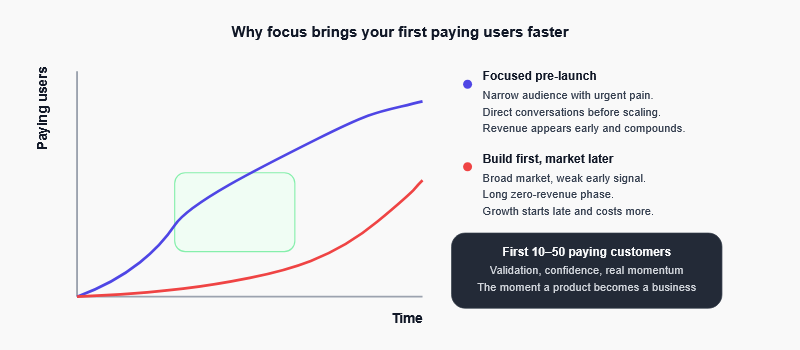
The biggest mistake founders make is trying to please everyone at the start. Don’t focus on a mass audience, as it requires large budgets, a long decision-making cycle, and complex marketing.
Always focus on a narrow target group that already has a pain point and needs a solution right now. That’s how you’ll get your first 10-50 paying users.
a) Formulate an Urgent Problem
When you go to the pharmacy and buy a medicine, you’re actually paying not for the product but for the opportunity to relieve pain. It’s exactly the same in the world of SaaS products. The user wants to eliminate their pain. You need to identify the user’s problem—one that they regularly face, one that’s already being solved with spreadsheets, hacks, or manual labor, and one that impacts their money, time, and reputation. The urgency of the user’s problem is key to driving quick sales. If you’re unsure how to consistently find urgent, high-value problems like this, start with Day 1 — Where to Find Great SaaS Ideas (and how to vet them). It walks through a practical framework for spotting real SaaS opportunities and validating them before building anything.
b) Choose a Niche that You can Reach Manually
When launching your micro SaaS, it’s important to select an audience you can reach in person, via email, private message, or through niche communities like Reddit, LinkedIn, and Discord. This immediate, direct contact will allow you to quickly understand needs, refine your product, and close your first sales without complex marketing.
c) Confirm Demand Through Conversations
Personal contact with users is the best way to understand their problem and provide them with a solution. If they have a product but aren’t satisfied with it, find out what you can do to make them happy. Gently offer early access to your SaaS product. If people are willing to discuss pricing and ask probing questions about your product, you’re on the right track. This is how you build a pipeline of early paying users.
2. Create a High-Converting Opt-In Page Before Launch
Your core SaaS product may be unfinished, but that’s no reason to wait with marketing. Creating a well-designed pre-launch opt-in page allows you to gather your first subscribers and customers, test demand, and prepare your audience for payment immediately after launch.
This isn’t just a web page; it’s a tool for early marketing and testing your product’s value.
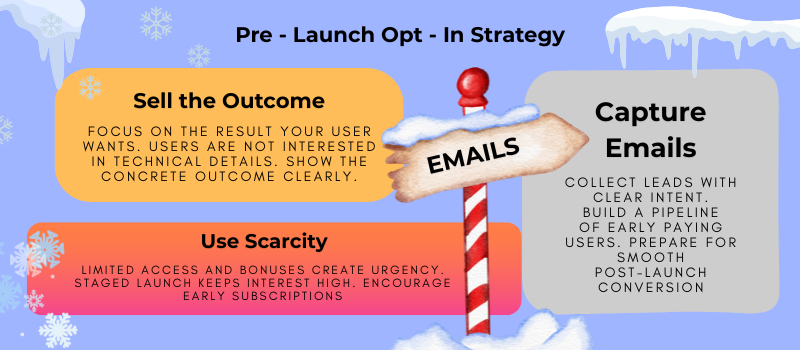
a) Sell the Outcome, not the Product
Users aren’t interested in how your product looks, and they don’t want to delve into technical details. They want a concrete result that solves their problem. To achieve this, describe the end value on your opt-in page, using language your audience can understand without complex technical jargon, and avoid long, dense descriptions that are difficult to understand. Your goal is for the website visitor to immediately understand that the product solves their problem.
b) Use Scarcity and Positioning
You need to understand the unique features of your micro SaaS and showcase them to future customers. You also need to create a sense of scarcity. This can be achieved through limited access, such as limited access to 50 seats at a certain price, with a discount for early adopters. Early adopters can also receive certain bonuses. You can also break the launch into stages, introducing new features to users. This also generates interest in the product. All this creates a sense of value and accelerates the decision to subscribe.
c) Capture Emails with Clear Intent
Don’t assume that quickly creating a pre-launch page will generate subscriptions. The key is to capture the user’s intent to pay. For example, you can inform the user that they will receive early access for $X. You can also collect not only the user’s name and email address, but if this is important to your business, you can also collect information about the user’s company size, their role in the business, and so on. These leads will form the basis of your pre-launch email funnel, with high conversion rates and initial payments expected at the start.
3. Build a Pre-Launch Email Funnel That Warms Users Up
If your product is still in development, that’s not a problem. It’s important to create a pre-launch email funnel now that builds trust, demonstrates the product’s value, and generates user interest.
Set up a consistent email sequence, and you’ll be able to not only talk about the problem and its solution but also highlight progress, feedback, and insights. This will ensure that your first paid users get started immediately after launch, already understanding the functionality of your micro SaaS.
a) Educate Users about the Problem
At this stage, your goal is to convey to your audience the importance of the problem you’re solving. You need to show examples of the difficulties other users are experiencing without your product and why this is critical for their business. If you have case studies, use them to clearly define the scale of the problem. This will create an emotional connection with the user, and such users are more likely to purchase micro SaaS products when they understand the consequences of ignoring the problem.
b) Show Progress and Social Proof
Share stories from early testers, beta results, and feedback. When users see you regularly displaying such content, it means your micro SaaS is gradually moving toward launch. Audiences feel like they’re participating in something exclusive when they see social proof. People enjoy the feeling of being part of the process at the same time. It’s almost a sign of willingness to pay for the product upon launch.
c) Pre-Sell Before the Product is Finished
You don’t need to wait until your product is fully ready to start monetizing. Offer early access, exclusive terms, and a discount to subscribers of your pre-launch marketing funnel as soon as possible. This way, you’ll quickly build a core of paying users, receive your first revenue, and validate real demand before investing more time into development. If you’re still shaping your idea, positioning, and first-user strategy, follow the AI SaaS Roadmap: From Idea to First Users in 30 Days Without Heavy Coding. It outlines a practical path from validation to your first paying customers without heavy technical complexity. The value and limited nature of your early offer are exactly what you need to emphasize. When people see clear benefits and defined limits, they’re far more likely to act immediately instead of postponing the decision.
4. Launch with a Clear Offer, Not Just a Product
When you launch a SaaS product, as we’ve already learned, people are buying a solution to their problem. Therefore, it’s important to formulate a clear offer. Users should understand what they’re getting, why it’s better than other options, and why it’s worth starting now.
Especially during the initial stage of recruiting the first 10-50 paying users, it’s important to give them a sense of exclusivity and a simple path to success.
a) Limited-Time Pricing for Early Adopters
Don’t be afraid to offer something mega-exclusive. For example, the first 50 users receive a 50% discount for the entire year. People see the obvious benefit and are afraid they might miss out on such a great chance to get your SaaS with such a discount. Always clearly state the expiration date or user limit. This helps convert interest into quick action.
b) Remove Friction from Onboarding and Payment
Make the launch process as simple and transparent as possible. Minimize the number of steps, such as enabling popular payment methods like PayPal or Stripe, and allowing users to use the product without complicated registration or verification. These are all important factors, as any obstacle of this kind reduces conversion. Even a minor complication can reduce customer acquisition by half. To do this, ask your colleagues and friends if they encounter any barriers on the site, and you’ll get excellent feedback on what needs to be eliminated to ensure everything runs smoothly.
c) Personally Onboard Your First Users
There are some SaaS projects where every user is truly cared for. You can do this at the initial stage, for example, by holding a demo session of your product or configuring it together with the user. This way, you’ll get even more user feedback, which will allow you to implement improvements. This works wonders, as your first customers are the ones who provide reviews of your product on other websites, which is crucial for your business. Also, ask them for reviews and post them on your website.
5. Use Direct Outreach to Get Your First 50 Paid Users
At the launch stage of your product, there’s no point in waiting for users to accidentally discover it. Directly reaching your target audience is the fastest way to attract paying customers.
Your goal here is not just to talk about your product, but to demonstrate how it solves a specific problem right now.
If you have a micro SaaS that would be useful to online companies, then even if you reach 500 online companies and only 10% become paying users, you’ll already have 50 consistently paying users every month.
Therefore, don’t delay this method of attracting paying users. This will allow you to quickly receive your first payments and validate your product. You’ll also establish personal contact with users and collect valuable feedback to improve your product.
a) Cold Emails with a Problem – First Approach
Cold emails should never be about product promotion. First, highlight a problem your prospect has likely already encountered and demonstrate how your micro SaaS solution can help them solve it. This works because each of us responds to a real, personal pain point, not to yet another out-of-the-box service. To be even more convincing, use specific figures or examples from your experience. This also plays a role whenengaging with the user.
b) Leverage Your Waitlist and Early Signups
Create a sense of urgency in your waitlist for your users. This will increase conversion and attract more paying users. They’re already interested, but they need a little nudge to make a quick decision—that is, to pay. Offering some kind of exclusive access or bonus will further strengthen your offer.
c) Turn Conversations into Paid Trials
Once you’ve successfully established a dialogue with your user, it’s important to offer value through a paid trial. Here, you need to demonstrate the product in action and motivate users to pay without leaving any room for doubt. You can offer a short paid trial instead of a free period. Many perceive this as an indicator of the product’s credibility. For example, an offer that allows users to try all product features for 7 days for $1. The key here is not to engage in dialogue for the sake of dialogue, but to clearly lead users to a paid trial by demonstrating the product’s value and alleviating any doubts.
6. Turn Early Users Into Proof and Growth Assets
Don’t ignore the growth phase at the initial stage of launching your micro SaaS project. Your asset is when 10-50 paying users are already solving a real problem, and it’s important to capture this evidence now.
Don’t try to generate huge amounts of traffic right away. It should be highly targeted to gain a special degree of trust from users and social proof of the need for your product.
Try to focus on extracting maximum value from existing users. Even a few successful case studies can significantly increase conversion rates on your landing page and in sales. Your task is to quickly transform the initial results into clear and compelling stories.
a) Collect Testimonials and Quick Wins
If you already have 10-50 paid users, some of them will quickly experience positive results when interacting with your product. It’s important to capture this moment. Reach out to your users after a while and ask them to leave a review. Even a 3-4 sentence format works better than a long text in the early stages. Use real customer feedback, screenshots, and real numbers. Typically, the more positive case studies you have, the faster new users will start subscribing to your product. In any case, it’s minimal effort with maximum impact.
b) Create Simple Case Studies Fast
Case studies don’t have to be complex or detailed. A simple structure is sufficient: problem → solution → result. Even one specific use case can demonstrate the product’s value better than any marketing text. Publish such case studies on your website, for example, as articles on your blog, in your newsletter, or use them in personal messages. The sooner you start collecting them, the easier it will be to scale. At this stage, quantity and relevance are more important than perfect presentation.
c) Use Referrals and Founder Credibility
f you connect with a couple of founders of SaaS brands or even mid-sized companies whose names are household names, people will be more likely to buy your product. This is a recommendation from the brand’s founder, not just some guy from the streets.
7. Systemize What Works to Reach 50 Paid Users
Once you understand where your first paying customers are coming from, it’s time to systematize. Scaling isn’t about adding new channels, but rather strengthening what’s already producing results.
Many SaaS projects make the mistake of spreading their efforts too thin. Instead, it’s important to solidify your workflows and eliminate any unnecessary clutter.
The goal of this stage is to create a repeatable system for attracting and activating users. This is what will allow you to consistently reach the 50 paying customer mark.
a) Double Down on the Best Acquisition Channel
Don’t spread your attention too thin across a ton of different traffic sources. Simply find one channel that brings you more targeted traffic than the rest. This could be social media or cold emails, for example. Focus on improving it while simultaneously searching for new traffic sources. In the early stages, focus is more important than scale. Then, gradually increase traffic volume and improve conversion.
b) Automate Onboarding and Email Sequences
Manual onboarding works well at the start, but then you need to automate key stages. Welcome emails, prompts, and follow-ups save time and increase activation. It’s important for users to quickly understand the value of your product without your intervention. A simple email series can significantly increase retention. We’re not talking about complex funnels here, but rather a basic structure and sequence of actions. The less friction, the higher the chance of payment.
c) Avoid Premature Scaling Mistakes
One of the most common mistakes is launching ads or scaling a team too early. If the product isn’t yet stable and the funnel isn’t polished, scaling will only exacerbate the problems. Before you reach 50 paying users, it’s crucial to remain flexible and close to the user. Repeatable results come first, then growth. A solid foundation is always more important than quick numbers. Patience at this stage pays off many times over.
Final Thoughts
Reaching 10–50 paying users isn’t a matter of luck, but the result of the right sequence of actions. At this stage, the most technologically advanced products win, but rather those that best understand their users. Focus, speed, and consistency are key. Use early results as an asset, strengthen existing channels, and take your time scaling. This approach lays the foundation for further growth in a SaaS business.
Add a Comment